History of SSA 1993 - 2000
ducating the public on Social Security issues has always been an important part of the Agency’s mission. From 1993 thru 2000, the Social Security Administration (SSA) continued its commitment to providing information to the public. This responsibility spanned from providing basic information to beneficiaries to entering the public policy arena by promoting an interest and knowledge of issues such as Social Security’s long-range fiscal health. The significance of public understanding is reflected not only in the Agency’s strategic plans, but also in the major change that has occurred within the Agency itself, namely that of Independent Agency. Independence in 1995 provided an atmosphere that significantly changed the manner in which, and hence the effectiveness, of the Agency’s efforts to reach the American public. Increased external visibility to Social Security’s stakeholders [1] and internal reorganization necessitated by independence required the Agency to change its focus, vision, and emphasis. The Agency embarked on a number of initiatives to educate the American public, and to give its own employees the tools to become individual representatives for Social Security. For 65 years, the Agency has delivered service to the American public in a manner that has fostered confidence and trust in the quality of its programs and employees. But this confidence and trust are premised upon both outstanding service and a public understanding of what Social Security is and means to the American public. Millions of Americans are directly benefited by the Agency and take a more active and personal interest in Social Security. Many more millions, however, are not directly affected by the Agency, and they often do not understand how Social Security works, how it will benefit them in the future, and how best to protect its integrity. Without this broader public understanding, the Agency cannot build the trust and confidence of the American public in the importance of Social Security. Also, the Agency would not be able to fulfill its mandate to serve the public in an effective and compassionate manner. SSA has the responsibility to communicate in an authoritative, credible, accurate, and accessible manner with the 200 million Americans, as of calendar year 1999, who are affected by and/or benefit from its many programs. These include the 48 million individuals who are receiving Social Security benefits, and the 153 million workers who pay the taxes that finance the program. [2] The Agency has a special obligation to inform these workers about the benefit protections, the financing of benefits, and the operations of the Trust Fund. Public confidence in the Agency is directly linked to public understanding of the programs, and the American public has a vital need and interest in information about Social Security, a program that has become a part of the fabric of our society.
Independent Agency
1993-1995: Pre-Independent Agency
he Agency in 1993 was relatively passive and reactive in educating the public. Protected by the Department of Health and Human Services (HHS) from public scrutiny, and more importantly, Congressional attention, the Agency’s self prescribed mandate did not extend beyond the straightforward: to provide basic, programmatic information to those who inquire about it. However, the idea was born that the Agency should do more to promote a broader understanding of the public policy issues surrounding Social Security, and increase efforts to educate the broader American public about Social Security. This idea expanded with new leadership, and was acknowledged as part of the fundamental mission of the Agency.
Historical Background
In 1936, when the Social Security Board began operation, an Office of Information was created with direct access to the agency’s top administrator. The need for and value of public information were clear. First, there was a nationwide effort to explain the difference between the new concept of “social insurance” and to create a distinction between this government program and the widely accepted though stigmatized notion of “public relief.” On a practical level, wide publicity was needed to register people with Social Security numbers and to respond to privacy concerns about that number. During 1937, 50 million leaflets explaining the use of the Social Security number were printed and distributed to workers at factory gates and offices throughout the country. These workers also needed to be informed about their rights and responsibilities under the Social Security program, such as tax contribution rates, benefit formulas and eligibility criteria. In 1936, for example, the Board said “if the public is fully informed about eligibility requirements, the agency is saved much trouble and expense since few ineligibles apply.” By the post World War II years, the program was maturing and quickly becoming part of the fabric of American life. Public information responsibilities of the Agency, while important, now played a subordinate role. Public education and public information efforts increasingly focused on program eligibility requirements, with comparatively lesser attention given to basic program philosophy and financing structure. This lack of priority was reflected in the institutional placement of the Office of Communications (OCOMM) within the Agency. Until 1996, OCOMM (and its predecessors) functioned as a staff component headed by an Associate Commissioner. For example, in 1990, the Office of Public Affairs was a subcomponent of the Office of the Deputy Commissioner for Policy and External Affairs. The Associate Commissioner for Public Affairs was one of five associate commissioners reporting to a Deputy Commissioner, and one of 35 associate commissioners within the agency. Access to the Commissioner and the Executive Staff was limited. Professional advice about communications issues and vital communications concerns on policy issues was filtered through other components, as were questions from the Executive Staff about appropriate communications policies. Broad issues about national public affairs policy were often deferred to the Agency’s then parent agency, HHS, much like most other issues within the Agency at the time. More significantly, this arrangement kept the Agency from the glare of public scrutiny and Congressional attention, and there was little direct pressure for the Agency to go beyond the basic responsibility of providing programmatic information to the public. Throughout most of the past 25 years, and until it became an independent agency in 1995, the Agency’s communications activities were often scattered, unfocused, and uncoordinated. For example: · The Press Office was part of the Office of the Commissioner; · Employee communications were located within the Office of Human Resources; · Speechwriting was first a function of the Office of Policy, and then switched to the Office of the Commissioner; · Regional communications efforts were directed by the Office of Operations; and, · Internet public information responsibilities were primarily under the Office of Systems, but a number of other components also had control over other aspects of it, leading to an unfocused and inefficient use of resources. The result of a non-centralized communications policy was an inability to define or effectively present core Social Security public information messages. Communications efforts were often duplicative and wasteful of limited agency resources. In short, the Agency’s emphasis on public education and public information efforts was comparatively less than in the early years, and OCOMM often did not have a “seat at the table” when important communications policy decisions about SSA and its programs were being made. Moreover, other collateral issues had an impact upon how the Agency carried out its mandate to educate the American public. For instance, one of the legacies of downsizing in the 1980s was a decreasing workforce with increasing workload. This never ending “trimming of the fat” led to less and less time and energy devoted by the Agency to educate its own workforce on program philosophy and financial structure, and an increase in focus on workload management, resulting in many field office Managers unable or unwilling to grant much time for the long term investment of workforce development at the expense of short term workload product. The unfortunate and unforeseen result of this shortsighted course of action has been that the Agency’s own employees, arguably its greatest public education tool, have become less effective as representatives of their own employer, the Social Security Administration, to the American public. These institutional and collateral forces made Agency efforts to educate the public less than effective. Because of the insularity afforded by HHS, SSA could not achieve the full scope of its mission, causing the appearance of a lack of initiative in the Agency’s education efforts. The lack of cohesion and focus in communications efforts ensured that any initiatives undertaken by the OCOMM were going to be less than successful. And with its actions usually below the radar of the Executive Staff (not to mention the leadership of HHS), there was often a lack of interest and support from the leadership. However, new leadership under Commissioner Chater sought to change some of these systemic problems. Whereas the strategic goals set in 1991 did not directly address the issue of public understanding, [4] one of the three strategic goals articulated by Commissioner Chater in 1994 specifically addressed communication issues – Rebuild Public Confidence in Social Security. [5] Rebuilding and revitalizing the communications function of the Agency was one of her highest priorities. To do so, Commissioner Chater brought in outside expertise to help develop this function within the newly independent Agency. Commissioner Chater understood that public confidence was predicated upon a public that understands the issues surrounding Social Security. More significantly, she understood that while not directly related to the actual work of Social Security, the confidence of the American public was critical to maintaining public backing, public involvement, and thus Congressional support for Social Security. She recognized that her standing with the White House was crucial to these efforts, and that proper handling of the media was critical. Her farsightedness would serve the Agency well through the changes to come, and the theme of public confidence was soon to be echoed by Congress in the most significant change to SSA during the Clinton Administration – its independence.
1995: SSA Becomes an Independent Agency
n August 1994, the Congress passed and the President signed into law legislation that established the Social Security Administration as an independent agency within the Executive Branch of government. The reasons given by the Congress for establishing the SSA as an independent agency were to strengthen the public’s confidence in Social Security by giving it more visibility and accountability, by promoting administrative efficiency, and by streamlining the operations of the Agency so that it could better serve the American public. Independence changed the Agency in far more significant ways both externally and internally than the simple word would suggest. Externally, the Congressional goal to strengthen public confidence by promoting visibility and accountability was quickly achieved by the Agency’s elevation to the center stage for both the public and the Congress. Internally, the advent of independence resulted in major organizational changes necessitated by the Agency separating from HHS; components and departments of SSA formerly underdeveloped or underutilized because of the protective shadow of HHS were forced to mature. External visibility and internal reorganization began to reverse many of the roadblocks in the way of an effective Agency communications plan. Without the cover of HHS, the Agency was forced to deal directly with the American public, the Congress, the White House, and the media. Internal reorganization resulted in a much more consolidated communications team, leading to more cohesion and focus. And the elevation of OCOMM to the Deputy Commissioner level brought communication issues to the attention of the Executive Staff. OCOMM now had direct access to and full support of the entire leadership of the Agency.
External Pressure: Increased Visibility
External visibility increased significantly with independence. The Agency would henceforth deal directly with its main external stakeholders – the American public, the Congress, the White House, and the media. Heightened attention given to Social Security public policy issues during this time period, especially around the issue of solvency after President Clinton’s 1998 State of the Union Address, guaranteed that the Agency’s voice would be heard. Moreover, the Agency would have to respond to public inquiries on its own. After legislation making SSA independent became effective in March 1995, the Agency quickly gained a more prominent profile. For example: · Media contacts became more frequent; · The Agency set up a physical presence in Washington DC; · The Commissioner made more public appearances and testified more often before Congress; [7] and · Agency employees began to participate more frequently in local discussions regarding Social Security. These actions were a direct result of the increased visibility of the Agency to the American public. Then, through his 1998 State of the Union Address, President Clinton further thrust the Agency into the public spotlight when he acknowledged the long-term financing problems that were facing the Social Security program. To “Save Social Security First,” the President stated that educating the American public so that they understand the issues facing Social Security programs was crucial. Thus began a full year of dialogue with the American public. The Agency was committed to talking with and listening to the American public. The Agency also placed a new emphasis upon liaison with, and outreach efforts to national advocacy groups and major civic organizations. Periodic “brown-bag lunches” with stakeholders and others interested in Social Security issues were begun. These efforts promoted an informal discussion of issues and Agency initiatives, and efforts were also made to ensure that the Agency had a presence at every major convention across the country. The Social Security Advisory Board noted at the time that SSA should take the lead in educating workers and their families about retirement planning. This will be especially important in the coming decades. There are as of 2000 roughly 80 million members of the “baby boom” generation in middle age, and in 2008 the first of these individuals will begin to retire. Many are just now starting to prepare financial plans for their retirement years.
Internal Pressure: Organizational Change
Internal organizational change was required by independence because certain components were underutilized while the Agency was a component of HHS. For example, the pre-independence OCOMM was less than proactive because institutionally it was not given the responsibility beyond narrowly defined goals of providing specific program information. Typically, public and (especially) Congressional inquires were dealt with by HHS; the Agency did not develop the structures necessary to respond to such requests. Independence changed all of this. The elevation of OCOMM to a Deputy Commissioner level component resulted in bringing communication issues to the forefront of the Agency’s leadership and in allowing it to focus and consolidate formerly disjointed communication efforts. OCOMM began to slowly consolidate the formerly scattered communication efforts of the Agency, providing a foundation for developing a comprehensive, focused, and cohesive communications plan. The Press Office, internal communication efforts, speechwriting, and eventually the running of the Agency’s Internet website would come under its purview. Communication initiatives that were once unfocused and unrealized were given the focus and support that was previously missing. While both Commissioner Chater and Commissioner Apfel have championed the cause of SSA being a force for public education in Social Security issues, they both realized that real change could only occur with institutional change. Without an institutional component advocating the communication perspective, the Agency could not provide the focused and cohesive leadership in education that was envisioned by the Commissioners and demanded by the President and the American public. But this change was not always easy or necessarily smooth. Communications is not an explicit business process of the Social Security Administration, and the Agency’s leadership sometimes had to work hard to convince others to understand the need for and value of communications. The linkage between effective communications, public and hence Congressional support, and the future stability of the Social Security program was not always clear. Moreover, the concept that public confidence is directly tied to an informed and educated public was sometimes lost to those who saw the Agency as just a technical program service provider rather than an integral part of Americans’ lives. However, leadership directly from the Commissioners spearheaded both the elevation of communications within the institutional structure of the Agency, and also as a strategic goal. One of the first challenges of the newly established OCOMM was finding its place within the strategic plans for the newly independent SSA. Under both new strategic plans, [8] public understanding was recognized as one of five Agency-wide strategic goals; both plans defined the goal as: “[T]o strengthen public understanding of the social security programs.” [9] The inclusion of public understanding as a strategic goal of the Agency was not a forgone conclusion, but required the strong sponsorship of Commissioner Apfel. Only through his personal advocacy did the full Executive Staff become convinced of the need for communications as one of five strategic goals for the Agency. In addition to OCOMM, the Office of Legislation and Congressional Affairs (OLCA) also went through significant changes as a result of independence. OLCA was forced to establish a physical presence in Washington DC, [10] increase its staff substantially to take on all the responsibilities of a “full fledged” agency, and develop the institutional and human resource skills to become effective communicators with one of the Agency’s most important external stakeholders – the Congress. The appointment of the Agency’s first confirmed Deputy Commissioner in November 1999 was a key component of improved Congressional relations. As the Chief Operating Officer and working closely with the Commissioner, the Deputy Commissioner made a number of visits to members of Congress. These visits emphasized Social Security’s appropriations and budgetary needs, the Agency’s efforts to enhance service to the public through electronic service delivery initiatives, the impact of the repeal of the Retirement Earnings Test, and issues affecting Social Security’s future. The higher visibility of the Agency on the Hill helped facilitate such things as securing $35 million in supplemental funding for the Agency in June 2000. In addition, Congressional awareness of the challenges facing Social Security increased, and the Agency’s working relationship with Congress and numerous subcommittees was strengthened. The Deputy Commissioner’s Office also spearheaded the creation of an Agency task force to inform Congressional Members and their staffs about Social Security’s Fiscal Year 2001 resource needs and to develop support for a proposal to take Social Security’s administrative expenses out of the discretionary spending caps. As a result of this effort, on October 11, 2000, Congressman Clay Shaw and Congressman Ben Cardin introduced The Social Security Administration Preparedness Act of 2000. This legislation would exempt Social Security’s administrative expenses from current budget caps and classifies these expenses under a new separate cap only for Social Security’s administrative costs. [11] If enacted, Social Security will no longer compete with health research, education, and other important programs for resources to administer the nation’s social insurance programs, placing the Agency in a much better position to deal with the substantial workload increases anticipated as the baby boom generation moves toward their disability prone years and retirement. These two forces, the pressure of public scrutiny and internal reorganization, provided the impetus for the Agency to grow and mature quickly. These changes coupled with dynamic new leadership helped forge new initiatives and pushed the Agency to go further in educating the public. The leadership came from the Commissioner and his Executive Staff. Assistance also came from the Social Security Advisory Board, who noted that the Agency should go beyond providing basic information about Social Security and should take the lead in educating workers and their families about retirement planning. [12] During the national dialogue associated with solvency, the newly developed skills in communicating with the American public and the Congress would serve the Agency well.
Major Initiatives
n assessing communications needs soon after becoming independent, the Agency concluded that new initiatives were needed in three separate but related areas: 1) reliably measuring communications performance; 2) creating new public information products to address topical Social Security issues; and 3) training SSA executives and employees to communicate effectively with the public in a new communications environment. Additional emphasis by Vice President Gore, in the National Partnership for Reinventing Government, was given when he noted that the Federal government has a special responsibility to communicate concisely and understandably. SSA committed itself to an aggressive, proactive public education outreach campaign. The campaign included the following: 1) public events and media campaigns; 2) the development of new brochures and printed materials; 3) the Social Security Statement; and 4) making maximum use of new technology, including the Internet. From 1998 thru 2000, Agency employees participated in more than 10,000 public events and media opportunities on Social Security and issues affecting its future. These events included, for example, community events co-sponsored by such organizations as the Junior Chamber of Commerce and Americans Discuss Social Security, community forums held in conjunction with U.S. Congressional representatives, newspaper editorial board interviews, and Internet forums.
Measuring Communications Performance
he Government Performance and Results Act (GPRA) of 1993 redefined how government is evaluated, making every Federal program responsible for producing measurable results. In 1997, SSA established a Strategic Plan with five key strategic goals, with one of the goals being “to strengthen public understanding of the Social Security programs.” In response to the GPRA’s mandate to demonstrate tangible results, quantitative objectives were established for each of the five goals. For the public understanding goal, the Agency’s objective was to have 90 percent of the American public knowledgeable about the Social Security program in five critical areas by 2005. Those areas are: (1) Basic program facts; (2) Financial value of the program to individuals; (3) Economic and social impact of the program; (4) Social Security’s current financing; and (5) Financing issues. As noted in the Agency’s Strategic Plan, “the achievement of this goal [of strengthened public understanding] supports every other goal of the organization. It helps people knowledgeably debate the issues facing Social Security; it supports SSA’s ability to provide world-class customer service; it helps customers understand their responsibilities under law, leading to payment accuracy and reduction of fraud; and it raises the level of public respect for SSA employees.” When the goal was established in 1997, available measures of public knowledge about Social Security were unsatisfactory, and the Agency was unable to determine if progress was being made toward achieving the objectives. It needed to identify the effectiveness of implemented programs among different segments of the national audience and program information areas that needed more emphasis. At the time, the best data available on public knowledge regarding Social Security were survey data on the degree to which individuals personally claimed to have knowledge about Social Security. These data were inadequate to answer the specific questions the Agency identified, and better measurement tools had to be devised. In late 1997, SSA, with the help of the Gallup Organization, developed the Public Understanding Measurement System (PUMS) as a process to measure the public’s baseline level of knowledge of Social Security programs. A series of 19 questions related to Social Security was created, and in 1998 a nationwide survey of 4,000 adults was conducted. The Agency determined that individuals who had 13 correct answers would be considered “knowledgeable.” [14] The 1998 results indicated that 55 percent of the public was knowledgeable about Social Security programs, and had an understanding of the basic programs and concepts. The results also indicated that the public was not as knowledgeable about the more technical features of Social Security, such as the average benefit amount. A statistical analysis showed that knowledge variance was chiefly due to demographic factors such as age, education, and income, with older, more educated, and high-income individuals showing the highest degree of knowledge. A second survey was completed in January 2000, and it showed a slightly higher overall knowledge level. In addition, the results showed an increase in the public’s knowledge about several questions related to an individual’s own retirement planning. For example, knowledge that an individual can receive some retirement benefits before full retirement age rose from 62 percent to 65 percent, while knowledge that there will be an increase in the age for receipt of full retirement benefits rose from 65 percent to 72 percent. One pivotal factor in increasing the overall level of public knowledge about Social Security was receipt of the Social Security Statement. [15] The PUMS survey was designed to answer both questions initially identified by SSA as important to further the strategic goal of educating the public on Social Security. It provides a valuable guide for identifying basic Social Security information not generally known by the public, and identifying subsets of the population in which an understanding of Social Security was lower than the general population. This knowledge will help facilitate focused communication efforts to target under informed segments of society. The Agency has set performance targets for FY 2000 and FY 2001. Data and other analysis from the PUMS will be the primary method used to measure progress in achieving the strategic education objective. A national survey of 4,000 people will be conducted each October through the year 2005, and a series of quarterly surveys in several regions will help determine the effectiveness of specific public education initiatives.
The Social Security Statement
n October 1, 1999, the Social Security Administration launched the largest customized mailing ever undertaken by a Federal agency when it began to send an annual Social Security Statement (a redesigned Personal Earnings and Benefit Estimate Statement) to125 million workers. Designed to increase the overall level of public knowledge about Social Security, the Social Security Statement potentially represents one of the Agency’s most valuable public information and education tools. The 4-page statement helps workers with financial planning by providing estimates of their retirement, disability, and survivors’ benefits. The statement also provides workers an easy way to determine whether their earnings are accurately posted on their Social Security records. The annual Social Security Statement was the result of efforts by Senator Daniel Patrick Moynihan to establish in law the requirement that all Americans receive an annual statement of potential Social Security benefits. By law, the Agency will send the annual statements to workers who are ages 25 and older and not receiving Social Security benefits. The Agency staggers the mailing of the statements throughout the year, with approximately 500,000 statements delivered each day (about 10 million per month). Workers automatically receive their statements about three months before their birthday. The Omnibus Budget and Reconciliation Acts of 1989 and 1990 required the Agency to begin providing the public with annual statements about each individual’s Social Security earnings record and estimates of the amount of benefits individuals may receive. These Statements had been available to the public upon request since 1988. However, the legislation required the Agency to start sending these Statements automatically in FY 1995 to workers reaching age 60 (and older), and in FY 1996 through FY 1999 to those attaining age 60 in those years. The legislation further required that beginning in FY 2000, the Agency would issue the Statements annually to all workers age 25 and over, an estimated 133 million people. The intent of this provision was to assure that each worker is aware of the protection provided by Social Security and is periodically afforded the opportunity to review the accuracy of the his/her earnings record. The results of the January 2000 PUMS survey undertaken with help by the Gallup Organization showed that receipt of the Statement played a significant role in increasing Americans’ understanding of Social Security. The survey showed that individuals who have received a Social Security Statement have a significantly greater understanding of Social Security than those who did not receive a statement. The January 2000 survey results indicated that while about 57 percent of the public is knowledgeable, 68 percent of those who received a Statement were found to be knowledgeable. Those who have received a statement were significantly more likely to know: (1) The amount of Social Security benefits depends on how much they earned; (2) Social Security pays benefits to workers who become disabled; (3) Social Security provides benefits to dependents of workers who die; and, (4) Social Security was designed only to provide part of total retirement income. Beginning October 2000, workers age 55 years and older began receiving a special insert in their annual Social Security Statement providing important information on retirement options that will help workers make important retirement planning decisions before reaching retirement age. The insert highlights the various factors workers nearing retirement need to consider, such as the long-term effects of taking a reduced benefit or the impact work would have on their benefit. A decision was made to modify the mail-out schedule to accelerate the FY 2000 mailings. Rather than mail Statements to approximately 1.6 million people turning 60 each year between 1996 and 1999 and then jump to mailing to 133 million Statements, it was decided to phase in the FY 2000 mailings by adding to each of the scheduled annual mailings. Therefore, the following schedule was put into place:
1995 7.2 million 1996 1.6 million 5 million 5.6 million 1997 1.7 million 10 million 12.4 million 1998 1.8 million 20 million 20.6 million 1999 1.8 million 30 million 26.5 million
This schedule allowed the Agency to handle the two primary fallout workloads, inquiries and earnings corrections (both of which are considered to be one-time workloads), in advance of the annual mailing of 133 million Statements. By phasing in the additional recipients, when the annual mailings began in FY 2000, over 70 million of the 133 million scheduled recipients had already received one Statement. The Agency began sending the Statements automatically to individuals age 60 and over in 1995. As of FY 2000, nearly 73 million statements have been mailed to individuals 40 and older. In addition, individuals have been able to request statements from the Agency since 1988, with roughly 37 million requests for statements over the past 12 years processed. Along with working to assure that the Statement would be as comprehensive and understandable as possible, the Agency faced the additional challenge of planning for the fallout workloads associated with the Statements. Based on experience with the fallout workloads from the on-request Statements, the Agency focused its attention on two major workloads, inquiries and earnings corrections. For first time Statement recipients, it was projected that inquiries would occur at a rate of 5 percent and earnings corrections would occur at a rate of 0.19 percent. While every effort was made to encourage the public to contact us by telephone, plans were developed for handling these workloads in the field offices. In the on-request Statement process, all fallout workloads were handled by a single-site component, the Office of Earnings Operations (OEO). To support the on-request inquiry workload, OEO had its own toll-free number. OEO was the only component with access to the various microfilm files with earnings information and therefore was the only site with the capability to correct earnings errors. If a field office received an earnings correction, they sent it to OEO for handling. With the impending Statement workloads it was recognized that this single-site operation would not have sufficient staff to handle the workloads. Rather than staff-up OEO for what would be a limited period of peak workloads from 1995 through 2000, alternative processes were developed. The first change was to expand the capability to correct earnings errors to other components beyond OEO. Software that supported OEO’s processing of earnings correction actions was expanded to include field offices, program service centers, and teleservice centers. This software enabled any Agency processing site to establish earnings correction actions, perform searches of its on-line Suspense file, and effectuate earning corrections. This software also contained communication functionality so that sites could contact OEO for assistance, such as scouting to microfilm, as necessary. National training was conducted through “train-the-trainer” and Phoenix lessons. The training was provided to all claims technicians (claims representatives and service representatives), teleservice representatives, and program service center technicians (claims authorizers, benefit authorizers, technical support staff). The second change necessary was to prepare for the Inquiry workload. For the first year of mailing Statements, the Statements contained the OEO toll-free number. However, OEO did not have adequate staff or telecommunication hardware sufficient to handle the anticipated call volumes that were expected in later years as the mail-out volumes grew. Thus after the first year, it was decided that the SSA National 800 Number Network (1-800-772-1213) would be used as the telephone contact point for the Statement Inquiries. Communication links were established to connect the OEO 800 number staff into the national 800 number call routing paths. Call routing plans and Statement specific menu prompts were developed to direct the Statement related traffic to OEO personnel as the first call location, with routing of overflow calls to other sites. Training was provided to all teleservice representatives, including program service center personnel who served as “spike” staff to assist the national 800 number staff during peak calling periods. In later years, when the annual mailings reached 133 million Statements, other services were developed to handle more of the Inquiry workload. Studies and surveys were conducted to ascertain the nature of the inquiries, and the 800 number menu was expanded to allow the selection of various recorded informational messages on the topics that people called for most often. For example, answers to questions like why did I get this Statement, where did you get my address, etc. were dealt with in an automated menu so as to not require use of precious personnel resources. In addition, automated response scripts were developed to process such requests as for forms to request a new Statement and to correct a Social Security card. A website [16] was developed specifically to handle questions from the Statement, containing responses to the most frequently asked questions and links to other sites among other things. From the time of the first mailings in FY 1995, as changes occurred either in the Statement or in the software supporting the production of the Statement, instructional materials were updated and refresher training was conducted. The fallout workloads have always been closely monitored to assure that the public received the very best service from the Agency, beginning with the receipt of an accurate Statement to the satisfactory resolution of any questions or earnings correction actions. Because the Statement is the Agency’s most useful tool for increasing public understanding about Social Security and the need for personal financial retirement planning, SSA has developed a multi-media campaign to alert the public to the annual mailings. The office has also distributed a package of employee informational materials on the Statement, and the Agency’s Internet website offers further information about the Statement to recipients or other individuals who have questions. The Social Security Statement has received recognition from many outside organizations. The National Academy of Social Insurance has said that, “the Statement is SSA’s most effective [public information] tool. The tangibility of this form, which includes earnings for every year in which that individual was employed by a job covered by Social Security, may help make this program more real to people. Getting a benefit statement on a regular basis is going to have a pronounced impact on people’s expectations and attitudes about Social Security.” As Commissioner Apfel has noted, “[T]he results clearly demonstrate that Social Security Statements are increasing the public’s understanding of the basic features of Social Security.” In addition, he has stated that, “[T]he Statement is not only providing information that is useful and easy to understand, it is also prompting millions of Americans to take action to better prepare for retirement.” And to help the American public do so, the Agency has used other outreach products and technological tools to aid their endeavors.
Technology
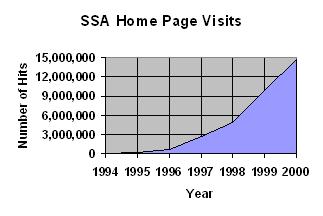
he Clinton Administration has overseen great advances in technology, enhancements in information sharing, more open systems, online access, and the emergence of a strong Internet presence throughout Government. In an increasingly complex and fast-moving society, technology has become synonymous with effective and efficient service. The new Information Highway has left the familiar communications landmarks of the past behind, and information now doubles every two to three years; available virtually everywhere, almost instantly. For example, the Library of Congress’ entire collection of books could now be transmitted over optic transmission lines in less than 10 minutes. These new developments have greatly improved Government efficiency, public access, and employee job enrichment via advanced technology. At the same time, these changes have made it difficult for many people to work through the flood of information available to find what is really useful. The increase in information vehicles that has made it easier for communicators to get messages out has also made it more difficult to get those messages through to their audiences. The Agency recognizes that in the 21st century, the Information Age, changes would continue and accelerate, and have embraced technology as an effective tool to reach and educate the American public. In January 1994, Team Internet was assembled by the Office of Systems to begin the SSA Online initiative. Their purpose was to create an Internet service including Internet gopher, file-transfer protocol, and World Wide Web servers. Its success has been recognized by other agencies and other parts of the Administration who have used this system as a model to get on to the “Information Super Highway”. The improved services have received positive media reviews in WIRED magazine and The Washington Post, and PC Computing magazine honored SSA Online as one of “101 Best Internet Sites” in the May 1995 issue. The Agency’s Internet home page, Social Security Online, has been recognized as among the most innovative and information-rich in government. The Internet site provides visitors with program information, downloadable versions of the forms used by the public, and other new interactive services that are being adopted and added to the web site. It is continually undergoing major redesigns to allow the Agency to better manage future growth, prepare for the high volume of anticipated on line transactions, and increase the overall satisfaction and usability of visitors. The tremendous surge in visitors to the site is testament to its success:
The site has grown since its start-up in 1994 (22,212 visitors), with almost 15 million projected visitors in 2000. [17] The Agency has continually worked to further expand the use of the Internet as an information source. The sites providing general public information and press information have seen increased usage since 1996, and the phenomenal growth of the Internet as an information source is expected to continue to accelerate in the next several years. The sites also offer both English and Spanish [18] language versions of most information pamphlets and fact sheets that the Agency publishes. In addition, they also provide information about the Social Security Statement for individuals who may have questions after receiving their Statement. And they also provide information to those individuals who may notice discrepancies in their name, date of birth, or earnings information. In looking to the future, a recent survey reported that 64 percent of respondents said that “information provided on a web page on the Internet” was either very or somewhat useful. When the survey was conducted, only 50 percent of American households had a personal computer, and only 38 million households were using the Internet. Both of these numbers are expected to grow dramatically in the next five years. The challenge now for the Agency’s communicators is to market the Internet site effectively. All agency publications and public service announcements carry its web address for individuals seeking additional information. In addition, SSA Online has linked with other government organizations such as the Administration on Aging and the FirstGov Initiative [19] and non-governmental organizations such as the American Savings Education Council and the American Association of Retired Persons. The biggest potential audience for the Social Security’s Internet site is younger Americans, who are most comfortable with and the most frequent users of this medium. In 1998, approximately 8.6 million children aged 8-12 and 8.4 million teenagers were online. As they reach adulthood, the Internet will be the information source of choice for most of them. The Agency is working to let younger Americans know now that there is information about its programs on the web. The Agency’s website includes a “YouthLink” page [20] with age-appropriate material that teachers, in particular, may find useful in helping their students learn about the nation’s social insurance program.
Public Information and Educational Services on SSA Online
SSA History Site: [21] The SSA History Page made its debut in October 1996. It has since been rated by an independent research service as one of the best sites on the Internet (i.e., top 5%). Among Executive Branch agencies, the SSA History Page is second only to the National Archives in making historical material available over the Internet. The SSA History Page contains a large volume of materials, including several unique collections not available anywhere else. [22] The site also makes many documents accessible that would otherwise be rare and difficult to find outside of large university libraries. In addition to written materials, the History Page also provides many audio and video recordings of individuals who were prominent in the Agency’s past and who have made significant contributions to shaping the programs of today.
This site was created in April 1998 to provide the employer community a single source for employer-related information, publications, and forms, along with wage reporting tips and how-to instructions. This site has proven to be a very popular source of information; many employer-related web sites, both in the private and public sectors, have established direct links to this site.
In May 2000, the Work Site, designed to improve service to people with disabilities who want to work, was created. This site contains important information for Social Security and SSI disability beneficiaries, and it provides specific and reliable information for employers, service providers, advocates, and others that help individuals with disabilities find work. Visitors will find a wide range of information on the site, from training programs for people with disabilities to tax incentives for employers who hire them. In addition, the Work Site is fully accessible by those with disabilities.
Launched in October 1998, this site provides direct deposit information and an enrollment form to vendors and the administrative payments community. The site also has a quick link to the Payment Advice Internet Delivery system that allows vendors to register on the web and look up payment information when a direct deposit has been made to their account.
In April 2000, the Agency premiered the “Retirement Planner” to help the public assess what income they will need in retirement, and what sources they can count on. The Planners contain valuable information about retirement, disability, and survivors benefits, and factors that can affect them. It provides links to important information on factors that can affect a worker’s retirement benefit, such as military service or federal employment. And it provides links to the web site of the American Savings Education Council (ASEC), which has excellent information on the need for pensions and savings in retirement. The Retirement Planner is an extension of the information provided in the Social Security Statement, giving customers who want more information an interactive ability to ask questions. Within the first four months of use, the Agency had more than 425,000 visitors to the site.
In March 2000, Social Security introduced eNews, a consumer oriented electronic newsletter about Social Security programs and issues. The free monthly newsletter, which gathered over 100,000 subscribers in the first six months it was published, provides the latest Social Security news in a convenient readable email format. Social Security automatically sends the general edition of eNews to subscribers. Special delivery of selected topics of interest is also available for free monthly delivery upon request. Selected topics include: disability, retirement, survivors, Supplemental Security Income (SSI), Medicare, laws and regulations, press office, wage reporting, data, studies and research, and senior issues.
A result of the partnering with other government agencies and outside organizations initiated by the Agency, this site provides a wealth of information for older Americans, together with links to other servicing agencies. The Agency sponsored this site with other organizations such as the American Association of Retired Persons (AARP). This type of partnership was a priority of Vice President Gore’s National Partnership for Reinventing Government.
An Agency web site has been established specifically to provide information and assistance to people outside the U.S. Within the current restraints imposed by the Internet’s lack of security for the transmission of private information, individuals abroad have been asking for and receiving service by e-mail at the rate of about 150 requests a month.
This site offers a variety of different Social Security forms to the public that would accomplish different Agency services. A member of the public can do such things as request a new Social Security Statement or a new Social Security Card, to downloading the form to start the disability application process.
Aside from the informational materials provided to the general public, the Agency also presents large amounts of data and analysis for the public policy community. The Office of Policy maintains a website providing various publications, research materials and policy papers, and links to other sites relating to Social Security public policy issues. [31] The Office of the Chief Actuary maintains a website putting the actuarial tables driving Social Security public policy in easy access for the public policy community, and information on the Trust Funds, COLAs, and various publications and reports. [32] These sites give the public policy community access to the same reports and figures that the Agency uses in determining the future of Social Security.
Communications Staff and Training
t the same time the Agency was expanding its communications tools, it also recognized that media efforts originating from Washington and Baltimore headquarters had limitations. Much of the public relies on local newspapers and broadcast media for information, and making use of these outlets was vital to any effective public information effort. The Agency increased the number of public affairs specialists (PASs) who work in major local media markets. Between 1998-2000, the number of PASs grew from less than 30 to about 100. The PAS position was created to address the need for coordinated public affairs activities in the major metropolitan areas after the elimination of many of the Agency’s field representative positions. In 1980, the Agency had about 1,400 field representatives who, among other duties, provided continuity of contacts within the community, especially with the local media. The effects of increased workloads and fewer staff in field offices caused the number of field representatives to diminish significantly to slightly over 400 in 2000. And the focus of the field representative’s duties has gradually changed, placing relatively less emphasis on providing public information and more on taking benefit applications. As the Social Security Advisory Board noted, “[T]he curtailment of public information work by local employees is believed by many long-time SSA employees to be linked to a decline in public understanding of the Social Security program.” Even with steps being taken to increase the number of public affairs specialists, an effective communications program must make use of all available resources. Staff professionals handled most communication efforts, and the Agency worked to increase the communications skills of its executive staff and managers. SSA also began to educate its employees about vital public issues so they can serve as its 65,000 individual representatives. In 1999, the Agency provided training to 135 members of the executive and senior staff, including all of the Regional Commissioners, on messages, media, and communications skills. From 1995 thru 1999, 1,200 field managers, public affairs specialists, and regional public affairs officers received professionally sponsored communications training. The training began in 1995 with a one-week course developed specifically for the agency’s regional public affairs officers and their assistants, together with public affairs specialists. The success of the course resulted in the development of smaller sessions (two or three days) tailored to the needs of managers and executives whose responsibilities include dealing with local or national media. The Agency also created an “Employees as Ambassadors Program.” The purpose of this program was to provide all of the Agency’s 65,000 employees with information to respond to tough questions about Social Security from the general public, or from family, neighbors, and friends. As with most organizations and government agencies, the Agency’s workforce in the past 20 years had tended to become increasingly specialized. Computer technicians, human resources professionals, and administrative personnel often had little training in Social Security programs, and even among program staff the complexity of the programs resulted in program specialists – such as title II and title XVI specialists – who knew their own programs well but had little cross-training or training in big picture issues. This increasing specialization led to the underutilization of the Agency workforce as a source of information for the public. To address this, a two-hour course on the basic facts, history, and philosophy of Social Security was developed, as well as a primer on the long-range financing issues facing the program. Every Agency employee received training through a live, instructor-based presentation, and after the initial training, the Agency developed an “Ambassador II” training program to inform employees about major Social Security issues for 1999 – such as our Y2K preparations and the new Social Security Statement. Future trainings were envisioned to keep the workforce aware of vital and current public issues. The effort proved worthwhile as Agency employees played a larger role in public education activities. The Agency has also made use of the Intranet to keep our PAS employees and other field office employees engaged in public education, public information, and public outreach efforts with up-to-date, timely information material. A Public Affairs Resource Center (PARC) was created on the Employee Information Server (EIS), and it has proven to be very popular. In July 2000, the PARC was the third most popular source of information on the EIS. The site includes such features as a Correspondence Guide, the Daily News Digest, Publications and Periodicals, and a Newsroom. The Agency continues to expand and improve the PARC.
Challenges
he Agency has identified the outlines of significant communications challenges facing it in the near future. These include satisfying public needs and desires for information about the future of Social Security, dealing with an increasingly diverse society, addressing intensified individual retirement concerns among “baby boomers,” and keeping up with technological changes.
In the present public policy context, informing the public about critical issues regarding the future of Social Security has become increasingly important. Ensuring the long-range future of Social Security and providing an adequate foundation of retirement income for Americans were and still are among the top domestic issues facing the nation. Though there are differing views as to how this can best be accomplished, the American public needs resources and information to be able to participate in this national dialogue. Throughout the national debate about the long-range financing of Social Security, there have been many claims by various sources, each seemingly authoritative, as to the dimensions of the long-range financing problem faced by Social Security. With mass media, the tendency to dramatize policy debates by seeking out and emphasizing areas of conflict did not contribute to developing an understanding of the issues involved or consensus for policy change. [33] With Social Security financing, the public was confronted with conflicting claims (sometimes called “stat wars”), and often did not know whom to rely for factual information and analysis. The American public should be able to look to SSA for factual information about the program and the issues. One of the Agency’s primary goals is to ensure that virtually all Americans are knowledgeable about the program within the next few years. Much work remains to be done in achieving this goal, but a focused and cohesive public information campaign and strategy has been in place and is currently being implemented. More importantly, tracking the progress of these initiatives through PUMS has contributed greatly to the Agency’s effectiveness. This public education role for the agency is both critical and challenging as the nation continues to struggle with resolving the long-range financing issues facing the Social Security system.
Increasing racial and ethnic diversity of the American population has caused the United States to become increasingly multi-cultural. [34] The Census Bureau estimates that by 2050 more than one-third of the population (139 million people of a projected 383 million), will be post-1970 immigrants and their descendants. This population growth raises several issues for Agency communicators. The PUMS surveys indicate that public understanding of the Social Security program is uneven, with women and minority populations having comparatively lower knowledge levels about the Social Security program and long-range financing issues. To rectify this situation, the Agency will need to engage in more minority outreach, particularly with non-English media. In addition to minority outreach efforts, the Agency must be prepared to address the Social Security information needs of women. Fully 60 percent of Social Security beneficiaries are women, and Social Security represents a larger proportion of women’s retirement income than men’s. Thus the Agency has targeted a number of public information materials to women, and many of its public information materials are available in Spanish, other non-English language versions, and also Braille. However, the challenge is in getting these materials to the audience for whom they are intended. One initiative involves using daily press and periodical publications to amplify its messages. The Agency is working to place articles regarding Social Security in national women’s magazines and to meet with editorial boards of those periodical publications about topical Social Security issues. Similarly, in 2000 there were about 500 periodicals and 325 radio and television stations with largely Hispanic audiences for which the Agency is now developing and marketing brief consumer-oriented information articles. The Internet is, as noted previously, an extremely promising information tool. And that is particularly true for certain sub-populations. For example, among Hispanic households with incomes over $35,000, nearly half had a computer at home in 1998, a 20 percent leap from just two years earlier. Furthermore, over a quarter of this population uses the Internet.
Intensified concerns about retirement among the “baby boom” generation have made financial planning an increasingly important communications issue that will remain so throughout the next decade. In 2000, there were more than 80 million members of the “baby boom” generation (those individuals born between 1946 and 1964) who are in middle-age and beginning to look toward or think about retirement. Between 2000 and 2010 the population aged 65 and older will grow slowly, by about four million, from 35 million to just over 39 million, as people born in the 1930s and early 1940s age. By contrast, between 2010 and 2030 with the baby boomers aging, the numbers will soar by about 30 million, reaching 70 million in 2030. The aging of America will alter society. In the years immediately ahead, the American public will have ever-greater concerns about ensuring financial security in retirement. The Agency has worked very hard to communicate information about a worker’s rights and responsibilities under the program, as well as basic facts about the program, the philosophy of the program, and the non-retirement benefits provided by Social Security. But the dramatic demographic changes mean that the Agency needs to broaden its public information efforts to include more data on financial planning. For example, it is anticipated that there will be far greater public demand for more information about the income replacement value of Social Security benefits, the already scheduled rise in the normal retirement age, the retirement earnings test, and cost-of-living adjustments. It is also expected, due to a relatively high divorce rate since the late 1960s, that there will be a greater need for public information about divorced spouse benefits under Social Security. Other federal government agencies, such as the Department of Labor and the Securities and Exchange Commission, are also undertaking national campaigns to increase public awareness about saving and investing for retirement. As more Americans near retirement age, there will be a need for greater coordination among federal agencies and other outside organizations regarding financial planning messages. Broad public concern about financial security in retirement also presents an opportunity for cooperative education/information campaigns between Social Security and the private sector, including banking and investment industry firms, and the life insurance industry. Because Social Security has always advocated a "three-legged" financial stool for retirement security (Social Security benefits, pensions, and individual savings), messages involving sectors such as these would be complementary, rather than competitive. In the immediate future, the Agency must do more to help those individuals now in early to mid-50s understand the complexities of retirement decision-making, and working with other government agencies and private organizations, provide them with all of the information needed to make an informed decision.
The communications revolution has not only changed the way the Agency distributes information, it has changed the way it conducts business. The reason is clear – the Internet is growing faster than all other technologies before it; radio was around for 38 years before it had 50 million listeners, television took 13 years to attract 50 million viewers, and the Internet got there in just four years. The Agency is now committed to exploring options for greater usage of the Internet, and the Commissioner has committed the Agency to deploying a suite of services over the Internet. How the Agency prepares to continue to inform the public about Social Security will be tested as the population changes, the baby boomers begin to focus on retirement, and media attention about the future of Social Security becomes more widespread. Certainly the need to develop new communications tools and new approaches will continue, and the ever evolving development of the Internet and other communications technologies will demand that the Agency be both quicker to recognize and to adapt to a changing communications environment. But the “digital divide” also means that a public service agency such as SSA must be committed to providing Social Security and retirement planning information in the ways that the American public will want it, and in a manner that is accessible to it. The need for such a communications approach by the Agency has not been greater since the creation of the program 65 years ago.
[1] The main external stakeholders are the American Public, the Congress, the White House, and the media. [2] Fast Facts & Figures: About Social Security, Office of Policy, August, 2000, pgs 9, 30. [3] “Shirley S. Chater, Ph.D., becomes 12th Commissioner of Social Security”, HHS News, Press Release, October 8, 1993. [4] The three 1991 goals were: (1) To serve the public with compassion, courtesy, consideration, efficiency, and accuracy; (2) To protect and maintain the American people’s investment in the Social Security Trust Funds and to instill public confidence in Social Security programs; and, (3) To create an environment that ensures a highly skilled, motivated workforce dedicated to meeting the challenge of SSA’s public service mission.
[6] Confirmation hearing in U.S. Senate for Kenneth S. Apfel, Social Security Commissioner Designee, September 10, 1997. [7] For example, under the Personal Responsibility and Work Opportunity Reconciliation Act of 1996 (Public Law 104-193), Congress required the Commissioner to report annually to the President and to the Congress on the status of the SSI program. The first such report was issued in May 1997, and have been issued annually since. [8] “Keeping the Promise”: Strategic Plan 1997-2002, Office of Strategic Management, September, 1997; and “Mastering the Challenge”: Strategic Plan 2000-2005, Office of Strategic Management, September, 2000. [9] Strategic Plan 1997-2002, pg 31; Strategic Plan 2000-2005, pg 44. [10] Under HHS, the Agency did not have an actual physical presence in Washington, D.C. [11] The legislation would also enable the Agency to recruit and hire personnel in anticipation of the “retirement wave” of large numbers of Social Security employees in the coming decade. [12] This will become especially important in the coming decade as more than 80 million members of the “baby boom” generation reach middle age. In 2008 the first of these individuals will begin to retire, and many are just now starting to prepare financial plans for their retirement years. [13] Increasing Public Understanding of Social Security, Social Security Advisory Board, September, 1997, pg 3. [15] The January 2000 survey results indicate that while 57 percent of the public was considered knowledgeable, 68 percent of those who received a Statement were found to be so. [17] Social Security: Performance and Accountability Report for Fiscal Year 2000, Office of Financial Policy and Operations, SSA Pub. No. 31-231, December, 2000, pg. 18. [19] FirstGov was a Clinton Administration initiative (FY 2000) to combine all online federal services into one site for the American public’s convenience (i.e., to become the portal site for government services). Its motto was: “Your First Click to the U.S. Government” www.firstgov.gov [22] The History Page posted the first Social Security Trustees Report from 1942 and the Report on Health Insurance from the 1934 Committee on Economic Security, neither of which had been previously available. [29] www.ssa.gov/international/inter_intro.html [30] www.ssa.gov/online/forms.html [33] The Securities and Exchange Commission, in the context of assessing workers’ retirement planning, noted that most people were unable to independently sort through complex economic information. [34] As of 2000, African-Americans comprise 12 percent of the general population, Hispanics approximately 11 percent, and Asian Americans, the fastest growing segment of the American population, 4 percent. Within the next 50 years, these percentages will grow dramatically. African-Americans are projected to comprise 13 percent of the population, Hispanics to more than 20 percent, and Asian Americans to more than 10 percent, with much of this increase resulting from immigration.
|