History of SSA 1993 - 2000
irtually everyone in the nation has been or will become a customer of SSA. On average, each workday, about 100,000 people visit one of SSA’s 1,300 field offices, over 240,000 people call its 800 number, and over 43,000 people visit its Internet web-site. Daily, the Agency processes an average of 20,000 initial claims for retirement, survivors, disability, and SSI benefits and annually it ensures that more than 250 million earnings items are correctly credited to workers’ accounts. Millions of Americans rely on Social Security. For many people, the Agency and its employees represent their closest contact with the Federal government. Since 1935, SSA has provided reliable and courteous customer service. In fact, in 1999, public satisfaction was at an all time high with 88 percent of customers rating its service as excellent, very good or good. [1] SSA has been recognized as a Government-wide leader in management, planning, and service to the American public. In 1999, in one of the most comprehensive studies of management performance ever conducted, the Maxwell School of Citizenship and Public Affairs of Syracuse University ranked SSA at the top of 15 Federal Government agencies. [2] Although the ratings are reflective of SSA’s long-term commitment to customer-responsive world-class service, this success did not come without challenges. In an era of rapid technological advancements and constrained resources, SSA faced many hurdles in meeting customer demands and expectations. Early on, the Agency recognized the challenges facing its ability to deliver timely, high-quality service to the American public. SSA revised service practices and strategies, automated processes, and made technology enhancements to meet more demanding customer needs, and move SSA into the 21st century. National
Partnership for Reinventing Government
On January 21, 1993 at his inaugural address, President Clinton pledged to “make our Government a Government for our tomorrows, not our yesterdays.” On September 7, 1993, Vice President Gore issued his report of the National Performance Review (NPR), Creating a Government That Works Better and Costs Less. This report outlined important principles and mandated specific initiatives to guide Federal agencies in making service improvements that the American public would notice, and made 384 Government-wide and agency-specific recommendations on how operations could be improved. The NPR later became the National Partnership for Reinventing Government. The Government-wide effort to implement and track the hundreds of recommendations made by NPR became known as “REGO I.”
In December 1994, President Clinton asked Vice President Gore to conduct a second review of agencies to identify opportunities to improve Government programs. On March 23, 1995, President Clinton issued a memorandum to all agencies kicking off “Phase II” of the Administration’s reinventing government initiative. In this second phase, or REGO II, the efforts emanating from E.O. 12862 and the NPR initiatives in 1993 were to be continued and integrated with other restructuring activities. On September 7, 1995, Vice President Gore released the publication, Common Sense Government: Works Better & Costs Less. This publication described the impact of reinvention on the American people and their Government and presented new recommendations for Government agencies. In 1997, the Administration wanted to define what it expected to accomplish during the four years of the second term. In addition to the initiatives outlined as part of REGO I and REGO II, Vice President Gore asked 32 federal agencies (including SSA) with a high degree of interaction with the American public to undertake an assessment of Agency goals and commitments. These 32 agencies, called high impact agencies (HIA), employ 1.4 million of the 1.8 million Federal employees and directly affect 90 percent of Americans. HIA leaders were asked to make commitments to the American public to achieve some specific, highly visible customer service improvements by September 2000. The service commitments were to be significant, concrete, measurable, and meaningful. A team of Agency executives collaborated over the course of a couple months and developed a package of service commitments to the public that was delivered to the NPR in August 1997. Kenneth Apfel was confirmed as Commissioner the following month and led the Agency in realizing these service improvements. While customer service has always been a top priority for SSA, the impact of the NPR recommendations and the HIA initiatives was the cornerstone of numerous customer service improvements that SSA made during the Clinton Administration. SSA’s efforts to improve customer service, however, began even prior to the NPR. When the NPR was formed in March 1993, SSA was already actively involved in several customer service initiatives. Foremost among these were the development of a Service Delivery Plan and the solicitation of customer input to validate the service objectives in SSA’s 1991 Agency Strategic Plan (ASP). When the ASP was released in September 1991, SSA received two major criticisms from the General Accounting Office (GAO) and others. The first was failing to define the process and organizational changes needed to achieve the service delivery vision described in the ASP. The second criticism was failing to solicit direct customer input on the service objectives in the ASP. The report maintained that these objectives were not based on what customers expected, but on what SSA hoped could be achieved. When the NPR report and E.O. 12862 were issued, the Agency knew there was room for improvement. To comply with NPR’s directive and address GAO’s criticism of the ASP, in November 1993, SSA conducted a series of focus group discussions with beneficiaries and the general public to get direct feedback. SSA conducted 12 focus groups in six cities to help identify the broad choices and level of services that customers expect. Two of these groups consisted entirely of non-English speaking participants.
In December 1993, SSA executives dropped proposed organizational
changes from the Service Delivery Plan, deciding that process change
should precede organizational change. Using feedback from
the customer service focus groups, the plan evolved into a discussion
paper, “Defining World-Class Service at SSA.” SSA used this
paper to initiate a dialogue with stakeholders and employee groups
about the definition of world-class service, the barriers that existed
to providing such service and recommendations for overcoming the
barriers. SSA began by surveying internal and external customers,
posting service standards, establishing a forum for customer complaints
and benchmarking standards against the best in business. Survey Front-Line Employees on Barriers
Shortly after the release of NPR’s report, SSA planned a strategy for gathering employee opinions about the barriers that exist to achieving world-class service and ideas on how to remove such barriers. In the spring of 1994, a questionnaire was given to all employees asking them to rate each of 35 specific characteristics of world-class service identified by beneficiaries and the general public in focus groups. The more than 17,500 questionnaires that employees answered and returned represented a 27 percent response rate. About 2,500 employees all over the country also participated in cross-component group discussion sessions conducted in collaboration with SSA’s unions. The purpose of these sessions was to obtain more detailed feedback than was possible through the questionnaires. By providing employees a forum to think in non-traditional ways with individuals from varied parts of the organization, ideas were generated that may not have been identified individually. This effort was important for several reasons. First, it started the Agency thinking about what world-class service meant and how to get there. It provided valuable insight about barriers to world-class service that helped shape subsequent planning efforts. And finally, it set the stage for future initiatives that, over time, helped the SSA organization evolve into a culture that emphasized world-class service and worked to make changes that helped eliminate barriers to such service. Survey Customers Since 1984, SSA had been using focus groups and surveys to “listen” to customers about service issues. But in working to achieve the goal of providing customer responsive world-class service to the American public, SSA realized it could, and in fact needed to, improve its listening capacity. In 1996, the Agency decided that expanding the feedback it collected and enhancing the way it was collected would provide important information—information to better determine how well customers were being served and ensure that the Agency was making informed decisions regarding service to the public. Also in 1996, the Office of the Inspector General began a study to catalogue SSA’s efforts to monitor its service to the public and to identify monitoring gaps. In a customer satisfaction report, released in October 1996, [4] OIG found that there was no formal process for coordinating surveys, focus groups, and other customer feedback mechanisms within SSA. OIG recommended that SSA take action to better coordinate its data activities and to make sure each activity had a specific purpose that integrated into a larger scheme. So in late 1996, SSA hired a consultant with expertise in market research and analysis to advise the Agency about highly efficient and effective data collection techniques. The objective was to develop a better-coordinated and more comprehensive program based on “state-of-the-art” thinking about the collection of information. The consultant told SSA that it was not collecting information from all major customer groups. The consultant identified 10 major customer groups on which SSA should gather information. The consultant also said that there were two other segments that had a critical impact on the Agency’s service delivery, and that information was also needed from them—major stakeholders (such as business partners, the Congress, and advocacy groups) and SSA’s workforce. An inter-component team of senior staff, SSA’s unions, and management associations considered the consultant’s recommendations and used them to develop a new data collection program for the Agency. In February 1998, Commissioner Apfel approved this new program, called the Market Measurement Program (MMP). The MMP includes a variety of data collection activities that, taken together, give SSA the information it needs to fully understand its market. SSA’s market is its customers, employees, and stakeholders. The MMP consists of data collection activities tailored to each of these segments. The information that is gathered from all the various data collection activities is then made available to all employees. SSA has in place an electronic, central repository of all data collection final reports, called the Market Measurement Program Clearinghouse, located on its Intranet. Employees can instantly access the information using an index or key word search. Easy accessibility to data helps ensure the Agency considers customer information during Agency planning and decision-making. In March 2000, Commissioner Apfel released the report, Gathering and Using Customer Information to Improve Service to the Public. The Agency believes the MMP is a step in the right direction and provides a solid foundation for keeping up-to-date about service needs, expectations, and satisfaction. SSA is using the data it collects to help determine the service enhancements needed to improve customer satisfaction. Improvement initiatives and new service strategies are discussed and approved as part of the strategic planning process.
Post Service Standards E.O. 12862 directed all Federal agencies to “survey customers to determine the kind and quality of services they want” and to “post service standards.” However, prior to the release of the E.O., SSA had already reached agreement with NPR to post an interim set of customer service standards that were published in the September 1993 report. [5] SSA agreed to post the standards while it continued to work on a more comprehensive set of customer driven service standards. SSA and OIG had undertaken a series of customer satisfaction surveys and special studies prior to 1993. The Inspector General’s report showed that customer satisfaction had fallen four years in a row due to longer waiting times in offices and increased problems in reaching someone on the phone. [6] However, these surveys did not specifically ask customers about “the kind and quality” of services they wanted. For example, SSA had no data about how long customers were willing to wait to be seen by a representative in one of the field offices or how long they were willing to wait to get through to the 800 number if their first attempt resulted in a busy signal. Therefore, SSA needed a survey to glean more specific information about customer expectations. In March 1994, SSA mailed comment cards to 22,000 customers and completed 4,000 additional cards by telephone interviews. The survey information was gathered to help validate the customer service objectives in the ASP and to respond to E.O. 12862. This was SSA’s first survey that asked customers directly about the levels of service they expected. SSA asked customers to define what good service meant to them for timeliness issues, such as waiting in field offices, claims processing, earnings postings and corrections, SSN applications, and 800 number calls. The results were used to help define specific numeric standards such as how soon after applying could a customer expect to receive a new or replacement Social Security card. After feedback from the Executive Staff and discussions with NPR, Commissioner Chater made final decisions and the customer service standards were published in September 1994. The standards were also widely circulated in a brochure, Putting Customers First. Known as “Social Security’s Customer Service Pledge,” these standards are still in use today and posted in all offices. The customer service standards published in 1994 were not intended to represent all that SSA was doing, or needed to do, to provide world-class service. Rather, they were limited to a number of specific commitments the Agency was making to address some of the important aspects of service that had been identified in customer, stakeholder and employee surveys.
Provide a Means to Address Customer Complaints In March 1996, the National Performance Review released its Federal Benchmarking Consortium Study Report on Best Practices in Resolving Customer Complaints. That study examined the complaint systems of eleven private and public organizations and found that the systems shared several common characteristics. Among other things, these organizations made it easy for their customers to complain, responded to complaints quickly and courteously, resolved complaints on the first contact whenever possible, and automated their systems to provide uniformity and a rich source of useful information. In 1996, SSA began developing a proposal for an Agency-wide customer complaint system. The initial research effort concluded that a best-in-business system would meet the following four goals: · Make it easy for customers to complain and for SSA to document complaints; · Collect data in a single, Agency-wide automated system; · Support resolution of individual customer concerns; and, · Enable the Agency to analyze and use data to make systemic changes/improvements. In November 1997, both Commissioner Apfel and the union agreed that SSA’s system should capture compliments and suggestions, in addition to complaints, and it should document feedback not only on service issues but also on topics ranging from policy to programs and laws. To further define and emulate a best-in-business system, SSA visited the headquarters of a financial services company, USAA, in San Antonio, Texas, for a closer look at that firm’s “ECHO” (for Every Contact Has Opportunity) system. Based on findings from that visit and other research, the Agency developed a system known as “Talking and Listening to Customers” or “TLC.” The TLC pilot began on September 18, 2000, in 75 Social Security offices, in Headquarters and throughout the field. During the pilot, SSA planned to conduct a continuous evaluation to determine whether and how TLC meets the goals that were set. Using surveys, focus groups and measures built into the system itself, the Agency would evaluate the TLC pilot for, among other things, cost effectiveness and employee and customer reaction.
Benchmark Customer Service Standards Against the Best in BusinessE.O. 12862 states, “The standard of quality for services provided to the public shall be: customer service equal to the best in business.” At SSA, the term “world-class” service was coined to define service equal or superior to that provided anywhere in the comparable public or private sector. Because the Agency had no process in place to identify and benchmark the best in business, in February 1994, SSA began developing and implementing a benchmarking process that could be used by all components. Also in 1994, representatives of nearly two dozen Federal agencies met to initiate a cooperative effort to benchmark customer calling Government-wide. NPR spearheaded the consortium, the first of many benchmarking consortia studies that NPR would lead. SSA, the Bureau of Census, and the IRS were asked to lead the study. The benchmarking teams visited a number of “best in business” private companies, including American Express, AT&T, GE, the Saturn Corporation, and USAA to learn how they managed and operated their 800 number call centers. They spoke with company executives, received advice and demonstrations of telephone and computer systems hardware and in-house software, reviewed copies of performance reports, and saw first hand how the best call centers operate. In February 1995, the consortium issued its final report, Serving the American Public: Best Practices in Telephone Service. The information and results from this study were used to secure Agency-level commitments to improve service and simplify procedures. SSA parlayed the telephone benchmarking effort and subsequent service improvements into a real success story.
Process Change and Technological Enhancements SSA is faced with a rapid pace in technological change that will have a profound impact on both its customers’ expectations and its ability to meet those expectations. The technological infrastructure will continue to evolve at a brisk pace; it will become faster, better, and cheaper. While advancing technology offers SSA a tremendous opportunity to increase access to and improve the accuracy, timeliness and convenience of its service to the public, it also presents challenges. SSA began to restructure business processes to make effective use of new technologies in order to meet future needs of customers. Technology will not replace employees or the in-person service for those customers who require or prefer more personalized service. Technology is the tool that allows the Agency to provide the same high level of service to all customers no matter whether they choose to conduct business with SSA in person, over the telephone, or through other electronic means.
National 800 Number Network
To improve services to both groups, the Agency established 34 local answering sites in large metropolitan areas to handle general inquiry telephone calls. This action served as an efficient method of providing improved overall telephone service for field offices on non-complex issues. Over time, the name for SSA’s answering sites changed to teleservice centers (TSC). The initial answering sites provided local service to approximately 50 percent of the national population and served as the infrastructure for the national 800 number implementation. Teleservice became a major vehicle for delivering service to the public with the introduction of SSA’s national 800 number. This toll-free system allows one of the nearly 3,900 teleservice representatives in 36 teleservice centers to answer calls from anywhere in the country. This was a major undertaking because each representative in every site needed to have a telephone and computer workstation that could interface with SSA’s system databases. In addition, software was developed so that a representative in any part of the nation could schedule an appointment for a claims interview for a caller at any field office. Since SSA began the 800 number, the public has shown an increasing desire to use the telephone to conduct business with SSA. As a result, the 800 number became the first line of contact for a large percentage of SSA’s customers. Caller reaction to SSA’s 800 number was overwhelmingly positive and from the start, SSA received high marks for the quality of its 800 number service and courtesy of its representatives. However, SSA found it difficult to maintain sufficient answering resources to meet the call demand. Access to the service was not up to public expectations. Customers experienced busy signals and long waits on hold; however, when they did get through to a representative, they were pleased with the courtesy and knowledge of the 800 number service representatives. As a result of the NPR and the benchmarking consortium, agencies were directed to provide customer service as good as that provided by the private sector. In addition, SSA conducted satisfaction surveys with both the public and its frontline employees. The results of both the benchmarking study and the customer surveys provided the impetus for implementing major change in SSA’s public service. SSA learned that the public wants better access to the 800 number and wants to have their business completed at the time of their call. Frontline employees want the authority to handle more calls to completion. The Agency committed to improve customer telephone service by January 1996 through increased staffing, simplified policies and procedures and enhanced technology. An aggressive plan was put into place to implement the short and long-term customer service improvements identified through the benchmarking effort. In addition, an Agency communications plan was put into effect to inform external and internal customers of its mission and performance goals. Public demand for telephone service steadily increased since 800 number implementation. TSC staff alone was not able to handle the increasing call volumes, and as a result, additional resources from other Agency components were needed to assist with answering 800 number calls on busy days. SSA also extended the hours of operation so that the public could reach a live telephone service representative from 7 a.m. through 7 p.m. on normal work days and provided automated telephone services to allow the public to conduct some transactions with SSA at anytime of the day or night. In September 1994, SSA announced its new customer service standards based on input from the public. Included in these standards was a pledge that calls to the 800 number network would be answered within five minutes of the first try. In 1995, however, more than 48 percent of the people who called the 800 number got a busy signal, and only 72 percent of the callers were able to reach an operator within five minutes of their first try. Clearly, SSA was a victim of its own success. The public liked the 800 Number and used it to conduct more of their business with SSA. From 1992 to 1995, the volume of calls increased from 36 million to 53 million. During this same period, the number of representatives assigned to the 800 number network declined by about 400 because of reduced staffing allocations and mandated ceilings which drastically limited the amount of hiring that could be done. Clearly, an innovative plan that went beyond merely hiring more TSRs was needed to improve telephone access. The public demand for expansion and improvement in SSA’s 800 number compelled the Agency to examine its organizational structure. Remissioning SSA operated three data operations centers (DOC) in Wilkes-Barre, Pennsylvania, Albuquerque, New Mexico and Salinas, California. These centers performed primarily data entry work using optical character recognition scanners and manual keystroke data entry terminals to process annual wage reports. In May 1993, SSA replaced the 22-year old data entry equipment used in the operation centers, which allowed it to consolidate all DOC workloads into the Wilkes-Barre site by the end of 1995. This meant that a staff of more than 600 people would be left without a mission beyond 1995. SSA needed to deal with the changes created by automating the annual wage reporting process. SSA initiated a dialogue to determine the fate of the Albuquerque and Salinas DOCs that involved examining their mission, assessing the staffing and other resource requirements that would be available to support that mission, and determining the performance requirements that must be met in the future. Input from all sources, including employees, the union, local communities and management and planning staff at SSA was considered. It was apparent that the greatest Agency need was for more capacity to answer telephone calls to SSA’s 800 number. For several years, SSA had successfully used some 1,600 program service center employees as part-time 800 number representatives to provide service during peak calling hours. However, these employees were highly trained in the technical aspects of SSA programs. It was not clear whether the program service center experience could be replicated in the DOCs, as the data operations center staff had no programmatic background and had been recruited for data entry jobs. After considering the alternatives and weighing the costs, in February 1994, Commissioner Chater announced the decision to “remission” the Albuquerque and Salinas DOCs to become teleservice centers by January 1996. The decision to restructure rather than downsize did not just save jobs for the DOC employees, it provided a unique opportunity for SSA, its employees and the union to work together to develop a more competitive work force. Employees at the DOCs had an opportunity for more interesting, satisfying jobs. And the communities of Albuquerque and Salinas would benefit by the retention of two facilities they had long supported. The missions, structures and base grade levels of the DOCs and teleservice centers were vastly different. The major difference being that the TSC was a public contact organization, while the DOC was a paper-processing organization whose staff had no direct public contact experience. When the decision to remission the DOCs to TSCs was made in February 1994, SSA had a relatively short 22 months in which to work out all of the details for implementing the decision. There were very few positions in the DOC that could be transferred to the TSC. Those that were immediately transferable were primarily positions dealing with administrative processes or facilities management. Even these positions had to have some orientation to the new organizational structure and training on some new duties. The vast majority of employees, however, would be moving to very different jobs that would require extensive training and dealing with the public. There was a great deal of anxiety and concern among data center employees. They were apprehensive about whether they had the ability to even do the teleservice representative job, and effectively deal with the public.
Management met formally with the staff to outline remissioning plans, provide status on progress, and train employees on the steps they had to take to move into the new organization. Management also met informally with the union, small groups of employees, and with individuals to address more specific needs and concerns. Commissioner Chater also visited the site to speak directly to DOC employees. While these communications were originally intended to benefit the employees, management soon learned that these interactions often provided valuable information and ideas that they could use to ease the transition. Management entered into formal negotiations with AFGE in January 1995. The implementation efforts continued during the negotiation process since areas of disagreement did not directly affect the site preparation, training and work assignment activities needed to move the remissioning effort forward. All issues were resolved and a settlement was reached allowing SSA to move forward in completing its implementation plans. The first calls of the Salinas TSC came through on May 15, 1995. The DOC remissioning effort went smoothly because of the excellent cooperation and coordination within SSA and between management and the unions. This proved to be an excellent management decision and greatly improved and increased the service that the Agency was able to provide to customers who preferred to conduct their business by phone. In addition to increasing the network’s call answering capacity, the remissioning of these sites provided promotional opportunities for several hundred employees. Because of the remissioning effort, SSA operated five teleservice center mega-sites that employ 200-600 representatives each.
As a direct result of this effort, 800 number accessibility significantly improved. Busy rates went from 48 percent in 1995 to 7 percent by 1997, after new process improvements were put into place. In 1997, as part of the HIA initiatives, SSA established an access rate goal that 95 percent of callers would get through to the 800 number within five minutes of their first attempt and that 90 percent of callers would get through on their first attempt. In FY 1999, the Agency served 95.8 of callers within five minutes. Callers reached SSA on their first attempt 92.9 percent of the time. That year, 90 percent of callers rated the courtesy of the Agency’s teleservice representatives as good, very good, or excellent. But because of increasing workloads and constrained resources, the Agency made a decision in early FY 2000 to reduce the five-minute access target, as reflected in the Agency’s FY 2000 Performance Plan, from 95 to 92 percent and the first attempt rate from 90 percent to 86 percent. Since the 800 number was implemented, SSA has made many changes and enhancements to improve the level of service provided through it. One of the many challenges the Agency faces is that the rate at which calls come into the National 800 Number Network varies by day, week and month. The busiest day is Monday or the day following a holiday, with the number of calls decreasing throughout the week. The first week of the month, the week checks are issued to most beneficiaries, is the busiest, with the number of calls decreasing weekly throughout the month. While call volumes are heavy throughout the year, the network was generally busier the first three months of the calendar year. The public continued to follow this calling pattern, despite attempts to encourage them to call at other times. In an effort to reduce heavy call volumes at the beginning of the month, in May 1997, SSA implemented payment cycling of monthly benefits. Payment Cycling Historically, recipients of OASDI benefits and SSI payments were paid in the first few days of each month. Monthly benefits were paid to all OASDI beneficiaries on the third day of each month, and to all SSI recipients on the first day of each month. While these specific payment days were never required by the Social Security Act, which commits the time for making benefit payments to the discretion of the Commissioner of Social Security, it was SSA’s longstanding administrative practice to make payments on these days. SSA’s practice of paying 45 million beneficiaries within the first three days of each month resulted in a large surge in the Agency’s work during the first week of each month. This surge included a large number of visitors to field offices and calls to the 800 number to report non-receipt of a check, question the amount paid, or ask about other payment-related issues. Approximately 9 percent of all calls during check week concerned payment delivery, compared to 3 percent during the rest of the month. SSA was concerned that, in the next 25 years, with the prospect of about 75 million beneficiaries all receiving their payments on single days, there would be a serious deterioration in the Agency’s level of service to the public. The release of all OASDI and SSI payments on single days also had an adverse effect on certain sectors of the economy. Based on meetings held with representatives of the banking and business community, the Department of the Treasury, the Federal Reserve Board, and the U.S. Postal Service, it was clear that the large, once-a-month OASDI and SSI payment files were creating many problems. These agencies had to bear the expense of providing sufficient resources and processing capacity to deal with SSA payments, as they flowed through the national payment system at the beginning of each month. This level of resources and processing capacity was not needed throughout the remainder of the month. Equally significant was the growing operational risk that was associated with SSA’s payment pattern. Representatives from several large financial institutions indicated that when the Social Security direct deposit payment file became available for processing from the Federal Reserve Board, they stopped all other business and devoted their entire operation to ensuring the file was processed quickly and accurately. Because of the inordinately large number of payments involved, these institutions had to ensure that nothing would go wrong as the file passed through the national payment system and was deposited into individual customer accounts. Any event that adversely affected the operational capacity of Treasury, the Federal Reserve Board, or a large financial institution in the one to four-day window prior to the third of the month could result in the delay or non-receipt of literally millions of Social Security benefit payments. In turn, this potentially created a hardship for SSA beneficiaries. Prior to implementing payment cycling, SSA conducted ten focus group meetings at five locations around the country to solicit comments and obtain reaction from the public to cycling payments throughout the month. The Agency also conducted a series of separate meetings with stakeholders, including representatives from the business community, financial community, other Government agencies, and advocacy groups. The overwhelming consensus of opinion from the public and among all stakeholders who participated was that SSA should implement some form of payment cycling. In order to improve service to the public, both now and in the future, SSA spread the payment of OASDI benefits throughout the month, rather than continuing to make all benefit payments on single days at the beginning of the month. It established several additional payment days (i.e., second, third and fourth Wednesdays) for each month. The payment day, or cycle, on which a beneficiary is paid generally will not be changed, so that if you are paid on the second payment day in one month, you will be paid on the second payment day in each succeeding month as well. This approach, SSA termed “cycling of payments,” levels the workload peaks associated with SSA’s past practice of paying all benefits on the same day. This schedule alleviated to the maximum extent possible the Monday workload peak experienced by SSA’s 800 number and field offices when the payment day falls on Friday, Saturday, Sunday or Monday, which occurs more than half of the time. Leveling the Social Security payment files through cycling helps prevent operational risk and resulting hardship. SSA implemented payment cycling prospectively only for new OASDI beneficiaries whose claims were filed on or after May 1, 1997. Payments to current beneficiaries were not cycled, as they were already in the established pattern of receiving their benefits on the third of the month. As of August 2000, there were approximately two million payments being made on each of the three Wednesdays and the number of payments on each Wednesday was growing at the rate of approximately 600,000 payments annually. By 2010, SSA’s Office of the Actuary projects there will be 11 million payments being made on each of the Wednesday payment days (at that time there will still be 20 million being paid on the third of the month). By 2020, when much of the baby boom generation has retired, the number of beneficiaries being paid at the beginning of the month and on each of the three Wednesday payment days will be approximately equal. The benefits to society of implementing payment cycling are potentially significant. Cycling will benefit members of the public in that they will have better access to SSA services, including shorter waiting times in field offices and when calling the 800 number, as SSA’s workloads increase in the future. Cycling will benefit the business and banking communities in that they will be better able to utilize their resources throughout the month, processing Social Security payments on a weekly basis. Cycling will also reduce the risk involved in processing large once-a-month files. If SSA continued to pay all beneficiaries on single days once a month, its service to the public could have deteriorated. The adverse impact that the once-a-month payments had on the business and financial communities would have continued, as would the growing operational risk that goes along with processing all benefit payments at one time. However, since calls and visits associated with receipt of the monthly benefit payment were distributed throughout the month, rather than concentrated in a few days, there were shorter waiting times for SSA customers. Shorter waiting times and completing business transactions at the initial point of contact were two areas where customers indicated that SSA could improve its service. Payment cycling greatly reduced the waiting times to customers calling the 800 number at the beginning of the month. An immediate claims taking process allowed SSA customer to complete transactions at the initial point of contact.
Immediate Claim Taking (ICT) Units
The original scope of the ICT initiative was as follows: To establish a process so that by September 2000, SSA would be able to take claims for retirement or survivor benefits immediately over the phone, provided the caller had the information needed and elected that option. This definition underscored the fact that ICT is a service option that customers can voluntarily elect or decline. The ICT option was not intended to eliminate alternative methods of filing an RSI claim, but to supplement them. The ICT initiative supported SSA’s goal of delivering customer-responsive, world-class service. It also supported the Agency Strategic Plan and Government Performance and Results Act performance objectives. As outlined in the ASP, SSA determined the general preferences of customers through extensive customer survey activities. Two major themes that emerged through this process were: (1) customer satisfaction is higher when customers are able to reach SSA by telephone on their first try, and (2) customers want their business to be completed in one call or visit. [7] The project objective was to make the ICT service available to all SSA customers by September 2000. SSA decided to meet this commitment through an incremental approach in order to gauge public demand for the service and to determine the resource implications. The incremental approach included pilots designed to gather data for use in determining the public demand, best process, and technology required to meet the project objective. The overwhelming success of the ICT pilot supported SSA’s decision to extend the service to all its customers by the end of September 2000. During the pilot, 87.3 percent of the customers who had an opportunity to file an immediate claim elected to do so. After extensive labor/management negotiations, a Memorandum of Understanding was signed in April 2000 that opened the way for national rollout of the ICT service. The ICT service increased customer choice and supported SSA’s goal of completing transactions at the first point of contact. After piloting ICT successfully in selected locations, SSA implemented a phased expansion of the new process. On September 25, 2000, the Agency completed the final phase of the expansion and began offering the ICT service nationwide.
In addition to the ICT units, the automated services platform has also been expanded and improved, impacting positively on customer access and satisfaction because it reduces the number of calls that have to be handled by an agent and increases the number of calls that can be handled to completion. Over the years, SSA has continuously updated and added more services through its automated platform. The use of automation allows SSA to provide customer service 24 hours a day, seven days a week. In 1997, SSA added automated services in highly populated Spanish-speaking communities. Callers from these parts of the country can conduct business in Spanish via automation. SSA also capitalized on technological advancements to improve service to 800 number customers. In 1999, SSA implemented “next available agent” call routing software, which allows for more efficient routing of calls and use of staff resources. Prior to the implementation of this software, if no agents were available, the caller received a busy signal. Now, instead of receiving a busy signal, callers are routed to the next available agent anywhere in the country. In addition to the new software, SSA also implemented a Customer Help and Information Program. This initiative helped the Agency achieve its payment and service accuracy goals as described in the Agency Strategic Plan. Experience has demonstrated that using the computer based help screens increases agent efficiency as well as response accuracy. SSA is committed to being a customer-responsive agency. It continuously strives to find ways to improve service to customers through enhanced technology and automated processes. SSA is committed to meeting customer needs and serving its customers both in the United States and abroad.
Totalization Agreements
SSA maintains international Social Security agreements with several foreign countries. These agreements, often called “totalization agreements,” have two main purposes. First, they eliminate dual Social Security taxation, the situation that occurs when a worker from one country works in another country and must pay Social Security taxes to both countries on the same earnings. Dual Social Security tax liability is a widespread problem for U.S. multinational companies and their employees because the U.S. Social Security program generally covers expatriate workers. This extraterritorial U.S. coverage frequently results in dual tax liability for the employer and worker since most countries impose Social Security contributions on anyone working in their country. The same situation exists for workers from other countries who are working in the United States for their foreign employers. Under these agreements, responsibility for Social Security coverage and taxes is assigned to one country or the other depending on the employment circumstances. The aim of the agreements is to maintain the coverage of as many workers as possible under the system of the country where they are likely to have the greater attachment, both while working and after retirement. The second main purpose of the agreements is to help people who have worked in both the United States and one of the agreement countries, but who have not worked long enough in one country or the other to qualify for Social Security benefits. Workers who have divided their careers between the United States and a foreign country sometimes fail to qualify for retirement, survivors or disability benefits from one or both countries, because they didn’t work long enough or recently enough to meet minimum eligibility requirements. Under an agreement, credits in both countries can be counted to meet those minimum requirements. The United States pays about $12 million in monthly benefits to about 80,000 individuals who would not have qualified without the agreements. SSA’s agreement partners were paying similar amounts to individuals who would not have otherwise qualified. Prior to 1993, SSA had totalization agreements with 14 countries (Austria, Belgium, Canada, Finland, France, Germany, Italy, The Netherlands, Norway, Portugal, Spain, Sweden, Switzerland and the United Kingdom). In 1993, two new U.S. Social Security agreements entered into force: the U.S.–Ireland agreement on September 1 and the U.S.–Luxembourg agreement on November 1. President Clinton transmitted the U.S.–Greece Social Security agreement to Congress on January 26, 1994. The agreement was signed on June 22, 1993, by the Deputy Chief of Mission of the U.S. Embassy in Athens, James Williams, and the Greek Minister of Health, Welfare, and Social Security, Dimitrios Sioufas. All U.S. Social Security agreements must be sent to Congress for a review period of 60 session days before they can become effective. The U.S.–Greece agreement, which entered into force on September 1, 1994, was the 17th totalization agreement for the United States.
In April 1998, following a State visit to Chile, President Clinton and former Chilean President Eduardo Frei issued a joint communiqué committing both countries to explore the mutual benefits of a totalization agreement. This served as the impetus for the subsequent successful negotiation of an agreement with Chile, the first such agreement with a South American country. On February 16, 2000, the U.S. Ambassador to Chile, John O’Leary, and the Chilean Acting Foreign Minister, Mariano Fernández, signed the U.S.–Chile Social Security Agreement and a related administrative arrangement for implementation of the agreement. The following month on March 13, U.S. Secretary of State Madeleine Albright and Korea Foreign Minister Lee Joung-binn signed the U.S.–Korean Social Security agreement in Washington, D.C. Deputy Commissioner of Social Security William A. Halter and Korean Embassy Economic Minister Hyuck Choi signed the related administrative arrangement at the same ceremony. President Clinton transmitted both the U.S.–Chile and U.S.–Korea agreements to the U.S. Congress for a 60-session-day review period on May 22, 2000, with implementation of both expected in the first half of 2001. The signing of these agreements was paramount in that they marked the beginning of expansion of totalization into South America and Asia. Until that time, with the exception of the agreement with Canada, all agreements had been with European countries. SSA estimated that, under the 17 agreements in force at the end of 2000, [8] some 39,000 U.S. workers assigned abroad were exempt, along with their employers, from $700 750 million in foreign Social Security taxes. The estimated amount of U.S. Social Security tax from which foreign workers and companies are exempt was substantially less, about $165 million a year. In addition, these same 17 agreements permit nearly 80,000 persons to receive a total of about $144 million per year in partial U.S. Social Security benefits for which they would not otherwise qualify. With the increase in automation both in the United States and world-wide, SSA delivers many of these payments through electronic funds transfers.
Direct Deposit of Benefit Payments Domestic and International Prior to 1972, only a rudimentary form of direct deposit existed, available only to beneficiaries who filed a “power of attorney” with financial institutions allowing them to deposit the beneficiary’s check that was mailed to the institution. In 1972, legislation eliminating the need for the power of attorney allowed Federal agencies to draw checks directly to financial institutions. The same legislation also authorized the issuance of composite checks by Federal agencies to financial institutions. These changes streamlined the benefit disbursement process, clearing the way for the present direct deposit program. In 1975, the Treasury Department and SSA introduced the direct deposit program for the payment of benefits. For the first time, an electronic funds transfer payment, commonly known as direct deposit, originated by the Treasury Department on SSA’s behalf, could be sent to an account at a financial institution designated by the beneficiary. The electronic credit is transmitted through the automated clearinghouse system, which is a secure computer network operated mainly by the Federal Reserve System. While the development of direct deposit by the Government and the financial community came quickly, there were some challenges to gaining acceptance by the general public. In 1985, Social Security direct deposit participation was about 40 percent; by 1990, it had reached almost 50 percent. In the early 1990s, SSA developed a two-part strategy to increase the growth of its direct deposit program. The first part involved development of a public information campaign to inform beneficiaries of the advantages of direct deposit. The second part involved simplifying the enrollment process to make it easy for people to sign up. In developing its strategy, SSA asked check receivers why they chose a check over direct deposit, and the most common response was a general preference for a “paper check.” For SSI check receivers, the most common reason for not using direct deposit was not having a bank account. There were also general concerns expressed about the difficulties of opening and maintaining a bank account. In 1993, to change customer preference for a check, SSA began to market direct deposit and streamlined the enrollment process. To address the situation of those who were unable or unwilling to open a traditional bank account, SSA participated in the development of an alternative to traditional direct deposit by creating an electronic account that is low-cost and simple to use. Beginning in 1993, the foundation of SSA’s public information activities was the creation of a strategic alliance with the financial community to promote the use of direct deposit by Social Security beneficiaries. SSA produced printed promotional material on direct deposit, such as inserts, available to financial institutions for their customers who receive Social Security benefits. The partnership worked well with the financial community committing its own marketing resources in support of SSA’s efforts. As a result, all parties benefit—SSA and the financial community and, in particular, their mutual customer, the beneficiary. Another measure SSA took was to simplify the enrollment process. When SSA’s direct deposit service began in 1976, the only way to sign up was to have the customer and his/her financial institution complete the paper direct deposit signup form and then bring or mail the form to SSA. While this worked well, it was an often slow and cumbersome process for the person wanting direct deposit. With the advent of SSA’s national toll-free number service, SSA representatives were trained to determine the direct deposit information from documents in the customer’s possession and process the direct deposit over the phone. This was a giant step in simplifying the enrollment process. In 1996, SSA totally automated the direct deposit enrollment process through its QuickStart program. This program allowed a customer to enroll for direct deposit at a participating financial institution—with no form to mail or call to make to SSA. Not only was this a fast and easy way for the customer to sign up for direct deposit, but it also freed SSA employees to process other work. On April 26, 1996, President Clinton signed into law the Debt Collection Improvement Act of 1996—Public Law 104-134 (EFT 99). This law required all Federal payments, except tax refunds, to be issued electronically by January 2, 1999, thus beginning a new era in direct deposit. The initial impact of the legislation was evident in the accelerated growth rates of direct deposit. Prior to Social Security’s implementation of EFT 99 in August 1996, there was a net direct deposit growth rate of between 1 2 percent per year. With the implementation of EFT 99, however, the direct deposit growth rate increased three-fold. In December 1996, 63 percent of Social Security payments were being made by direct deposit. By December 1998, the rate had risen to 75 percent. However, because of the many complex issues involved in converting the entire Federal payment structure to electronic payment, in September 1998, the Department of the Treasury issued a rule allowing some recipients to be paid by check if electronic payment would create a hardship. In January 1999, with the implementation of the EFT 99 final regulation allowing waivers from the electronic funds transfer mandate, direct deposit growth had returned to the pre-EFT 99 levels. SSA interviewers encouraged direct deposit for all new applicants with bank accounts, unless they alleged to have a hardship in receiving benefits electronically. However, there were individuals, particularly in the SSI program, who did not have a relationship with a financial institution and, therefore, were not able to use traditional direct deposit. To address the issue of the “unbanked,” the U.S. Treasury Department developed electronic alternatives to direct deposit. Direct deposit payments provide advantages to all parties: SSA, the financial community and SSA beneficiaries. Direct deposit gives beneficiaries quicker access to the funds, and, in the unlikely event a problem arose, it could be corrected much faster. Beneficiaries no longer had to visit a financial institution to deposit their checks. Direct deposit also offers cost savings to Federal agencies. A significant portion of the savings can be attributed to the fact that the cost of issuing an electronic payment is only $0.02, compared with $0.43 for a check. Additional savings come from a reduction in the workload for handling payment-related problems, including fewer claims of nonreceipt, as well as a reduction in overpayments caused by double check negotiations. In fact, the U.S. Treasury reported that an individual paid by direct deposit is 20 times less likely to have a payment-related problem compared to individuals paid by check. There are economic advantages of EFT for beneficiaries as well. Benefits are credited to accounts at the opening of business on the scheduled payment date. Beneficiaries can write checks to pay bills or use automated teller machine cards to obtain money immediately without the inconvenience of first having to cash a check. Also, direct deposit avoids check cashing fees and fees for money orders and similar charges. Many financial institutions offer free services for customers who use direct deposit. There are also economic advantages to society. Direct deposit avoids the costs included in Secret Service investigations and financial institution liability associated with forged checks. Direct deposit is also more convenient. Beneficiaries are not required to be home to receive their payment, nor do they have to be concerned about their check being delivered during an unexpected absence from home, such as a medical emergency that requires a hospital stay.
International Direct Deposit As mentioned in the previous section, residing in the United States is not a condition of receiving benefits. As of August 2000, 392,000 Social Security beneficiaries residing outside the United States receive monthly benefits, totaling $167 million. Social Security makes payments to beneficiaries in 190 countries. SSA’s international direct deposit program began in 1987. Prior to that time, the only way to receive a Social Security payment overseas was by mail. Foreign mail delivery was a costly and delay-prone process. SSA was the first Agency to implement cross-border payments to its beneficiaries. As of August 2000, 209,000 Social Security beneficiaries residing outside the United States were paid by direct deposit. International direct deposit arrangements have been established in 37 countries. SSA’s international direct deposit service was developed when the increased automation of international banking services among industrialized countries offered an opportunity to provide better payment services to foreign-resident beneficiaries. The Federal Reserve Bank of New York, acting as fiscal agent for SSA, established the financial agreements for international direct deposit and has worked with Social Security to implement and maintain the international direct deposit service. Overall, the percentage of beneficiaries outside the U.S. being paid by direct deposit to a U.S. or foreign bank increased from 26 percent in January 1993 to 54 percent in August 2000. SSA has long been a proponent of EFT as the preferred method of payment delivery. The Agency has historically encouraged and promoted its use both from the perspective of efficiency, as well as for the convenience and safety of its beneficiaries. SSA has also sought out ways to provide more convenient services for its customers through forming partnerships with other agencies, to provide “one-stop shopping.”
Data Exchange between Agencies One of the initiatives outlined in Vice President Gore’s NPR was for agencies to develop customer service across agency lines so that customers do not needlessly go from one agency to another. Early on, SSA recognized the benefits of following this principle, both in terms of customer satisfaction and operational efficiencies. SSA has established numerous working relationships with other agencies in the Federal sector. Many of these relationships help SSA accomplish its mission and help other agencies accomplish theirs. The character of these relationships ranges from simple data exchange through program coordination to the actual processing of each other’s work. Many of these partnerships were formed prior to the Clinton years, and include examples such as: SSA receiving reports of self-employment income from the Internal Revenue Service (IRS); SSA and the Health Care Financing Administration (HCFA) exchanging data regarding Medicaid eligibility; and SSA taking claims for Black Lung benefits for the Department of Labor. SSA partnered with several Federal, State and local agencies to provide services more transparent to customers and cultivate the concept of “one-stop shopping.” One partnership that SSA formed was with the Immigration and Naturalization Service (INS). Since 1993, SSA offices in New York had been operating and staffing an enumeration unit designated to expedite the processing of Social Security card applications (SS5) from non-immigrant aliens. Individuals who had just received their I-688B work authorization documents from INS were directed to SSA offices to complete the SS5. This enabled new immigrants to receive their Social Security numbers and begin work more quickly. Since the passage of welfare reform legislation in 1996, it is important that SSA records correctly reflect a person’s citizenship status. In Sacramento, California, SSA partnered with INS to provide enumeration services to new citizens after their naturalization ceremony. The opportunity to enumerate a large number of new citizens in one place has contributed to improved customer service delivery. Many new citizens expressed their appreciation for the Administration’s presence and concern, as well as making a cumbersome two-agency process into one-stop service. The Sacramento enumeration process exemplifies a responsive government that goes to the people, instead of requiring the people to come to a Social Security office to update their records. SSA also partnered with IRS to help eliminate some inconveniences of income tax filing. One example is a pilot between IRS and the SSA office in Albany, which are co-located in a federal building. More and more taxpayers are visiting the IRS during tax filing season to use the IRS electronic filing procedure. As a prerequisite to electronic filing, IRS requires verification of the Social Security number. To improve customer service, SSA and IRS agreed to work together in a joint venture to make tax-filing hassle free and eliminate multiple contacts with SSA. The Agency benefits from the first point of contact because IRS educates taxpayers that do not have documentation, which reduces unnecessary walk-in traffic during the busiest time of the year. While this procedure is limited in scope and nature, it does promote good customer service for both agencies by allowing for smooth, efficient processing of replacement cards during the busy tax-filing season. This initiative has been piloted successfully for the past two years. A successful alliance between SSA and Veterans Affairs (VA) streamlined service to people with disabilities who have served in our Armed Forces. Since both SSA and VA spend money on making disability determinations and recertifications, the two agencies worked to join forces in order to optimize service to common customers. A joint SSA/VA cooperative workgroup met regularly to discuss potential initiatives that resulted in improved processes, processing time savings, and better service. Among these was a joint SSA/VA website aimed at providing one-stop service to both veterans and technicians. In Los Angeles, SSA working with VA and the California State DDS has significantly improved the quality of disability applications filed by homeless veterans. The partnership to improve customer service to this particular community began in 1995 and is ongoing. The re-engineered process significantly reduced the handling and mail time for these applications cutting 45 days off the 100-day average processing time. Veterans receive their first payment in a much shorter period of time. The three agencies working together have re-invented how disability claims are processed for this vulnerable group. SSA took particular interest in using innovative claims processing techniques and partnering with agencies to enhance service delivery to the HIV/AIDS population. From the AIDS Demonstration Project in the Philadelphia Region to the CORE Center in Chicago, one of the largest HIV/AIDS treatment centers in the country, SSA has been diligent in pursuing partnerships throughout the nation to assist these individuals. In many instances, the Agency trained social workers in other agencies, to take disability claims for Social Security. SSA representatives assisted DDS in obtaining medical evidence. The claim and expedited medical evidence were sent to a specialized unit in DDS where it received priority handling. Due to the partnership of SSA, DDS, and workers in medical treatment facilities, patients received faster decisions and payment. In addition, expediting the processing of these claims, SSA worked closely with representatives from other agencies to ensure that patients were receiving all possible assistance, such as financial help, substance abuse counseling, and mental health screening. SSA also formed partnerships nationwide to reach out to parents of low birth weight infants. Recognizing that low infant birth weight is often associated with costly, serious health problems later in life, SSA saw an urgent need to “reinvent” its lengthy and confusing process for providing benefits to children who face disabilities and are entitled to SSI. The Agency has worked with various hospitals nationwide to reach out to parents of low birth weight infants. As a result of these efforts, children now receive the support they need during their critical first months and years of life. One early effort in partnering was a project called Georgia Common Access, initiated in reaction to vocal concerns in the Atlanta area relating to the number of agencies that a poor person, often with limited education, needed to contact to access services. The solution was a common application for public assistance benefits. Based on this challenge, a coalition of state and federal agencies collaborated to improve service delivery by reducing 64 pages of applications, representing six programs (including SSA’s Supplemental Security Income program), to eight pages. A pilot program began in March 1994 using a paper application. The pilot was well received. In fact, in June 1994, the initiative received a Hammer Award from Vice President Gore. After the paper pilot, an effort was made to automate the Georgia Common Access application because all partners were incorporating personal computers into the daily work. Unfortunately, formidable barriers prevented further implementation of this project, from the impact of the August 1996 welfare reform legislation to lack of funding to develop a common system among the six agencies. While this particular project never fully got off the ground, it sparked later partnership projects that did. One of the most successful partnerships in this era of automation was SSA’s efforts to partner with other agencies to access data online. As there are no legal mandates, participation by State agencies was completely voluntary. Therefore, each online access project depended on the trust and good working relationships established between SSA and State agencies. One example was in the Dallas Region where SSA employees had online query access to several State agency databases in four States. This enabled SSA employees to obtain online birth verifications. It greatly expedited processing claims for benefits and almost completely replaced the previous labor-intensive practice of obtaining paper certifications. Other online access projects allowed SSA employees to query human services, workers’ compensation, prisoner, child support, wage, and unemployment records maintained by the responsible State agencies. This summarizes a few of the many partnerships that SSA formed throughout the country to improve service to the American public. SSA will continue to coordinate with other agencies to prevent conflicting goals, eliminate any redundancy, and find new opportunities for giving better value and information to the public.
Notices
Producing clear notices had been a priority for SSA for some time. In 1985, the Agency established notice standards for producing clear notices. The standards were validated both by the Office of the Inspector General and repeatedly by customers through focus group tests. Nevertheless, the length of some notices was a continuing concern. While the language used in a notice may be essential and clearly written, a lengthy notice will negatively affect comprehension. Under this initiative, SSA tested notice formats with customers to find out if there is a more concise presentation of information that will also positively affect comprehension. Based on the results of customer surveys, the future presentation of notice information could change. All of the 250 million notices SSA sends annually had been or will be improved in some way by this project, either by improved language, faster delivery and/or increased accuracy of information. SSA estimated that approximately 50 million beneficiaries and recipients will benefit from the notice improvement effort. Notices will be more responsive to their needs due to the Agency’s ongoing efforts to get public reaction and suggestions for improvements. Because of increased automation, the notices will also be more accurate. In November 1998, SSA implemented the Online Notice Retrieval System, which is a “document management” system that allows employees to quickly and efficiently answer questions from customers about notices they receive. Before this, employees did not have access to notices that customers received. Now, employees can bring up copies of the notices on their computer screen electronically within a few seconds, and respond immediately to questions about the notice. The electronic archival and retrieval of notices help SSA employees serve customers more quickly when they call with questions related to notices. As part of this initiative, SSA streamlined its notice process by standardizing, consolidating and centralizing the control over notice language. The Agency eliminated the duplicate notice systems that existed and made notice changes more quickly and efficiently, with fewer resources. SSA also has eliminated the multipurpose form notices used in some applications. As a result, the number of inquiries to the field offices and 800 number about overpayment and other types of notices had dropped. SSA continues with numerous initiatives to improve the content, format and clarity of its notices. One initiative involves notices sent to its Spanish-speaking customers. In January 1997, the Office of the Inspector General conducted an extensive literature search and personal and telephone interview with 46 individuals at 39 agencies. The purpose was to provide SSA with information concerning the appropriate reading level of Spanish-speaking clients to ensure that SSA notices are understandable. [9] Respondents indicated that SSA’s reading level established for English language material was appropriate for materials sent to Spanish-speaking individuals. The Spanish notices from this initiative helped the largest non-English speaking group of beneficiaries by eliminating the need for them to contact the Agency about English notices. SSA intends to measure the success of this initiative by using the Market Measurement Program, as well as additional performance measures.
Responsive Service To Customers
Diverse Customers The United States is becoming increasingly multi-cultural. In the year 2000, African-Americans comprised about 12 percent of the general population; Hispanics, approximately 11 percent; and Asian Americans, about 4 percent. [10] Within the next half-century, these percentages will grow, in some ways quite dramatically. African-Americans will comprise 13 percent of the population; Hispanics, more than 20 percent; and Asian Americans, more than 10 percent. Much of this increase in minority populations will result from immigration. The Census Bureau estimates that the U.S. population will reach 383 million by 2050. At that point, more than one-third of the population, or 139 million people, will be post-1970 immigrants and their descendants. [11] The vast majority of these immigrants will be from Latin America and Asian nations. This population growth raised several issues for SSA, and particularly for SSA communicators. In September 1998, the Advisory Board on the President’s Initiative on Race concluded its work and presented a report containing its final recommendations to President Clinton. The President’s Initiative for One America is devoted to helping bridge the racial and ethnic divides in our society. Although the President’s Initiative for One America was not instituted until 1998, the Social Security Administration (SSA) has a long history of activities supporting the Initiative that precedes 1998. SSA’s customers are a diverse group, and the Agency realizes the importance of its workforce being a reflection of the people it serves.
In March 2000, SSA hosted an American Indian and Alaska Native Service Delivery Conference in Denver, Colorado to explore how to better serve the American Indian and Alaska Native communities. The conference served as a catalyst shifting attention and focus to this group, and representatives from over 120 tribes attended. Conference programs and activities focused on ways to improve outreach and service delivery to American Indians and Alaska Natives and increase their representation in the Agency’s workforce. As a result of the service delivery conference, the Agency established an American Indian and Alaska Native Executive Steering Committee to develop and implement projects that would achieve the goals of increasing the workforce representation of American Indians and Alaska Natives and improving services to their communities. Under the Committee’s leadership, exciting initiatives and projects are already in various stages of development:
SSA was also developing activities to ensure compliance with the provisions of Executive Order 13125, signed by President Clinton on June 7, 1999. The E.O. was designed to improve the quality of life for Asian Americans and Pacific Islanders. SSA established a plan to meet the objectives of the E.O., and to improve service to its non-English speaking customers.
Non-English Speaking/Limited English Proficient (NES/LEP)
In July 1993, the Deputy Commissioner for Operations issued an advisory report, “Improving Service to the NES Public. This report cited the growing concern and interest of advocacy groups and the Congress in improving access for the NES public.” It acknowledged that SSA had already taken many steps to improve service and stated that given the predicted NES population growth, more needed to be done. This report’s recommendations focused both on improving service delivery and on providing relief to offices and employees involved in direct NES service delivery. In 1995, Commissioner Shirley Chater asked for an Agency-wide position on providing service to the limited English proficient (LEP). SSA adopted the vision statement and guiding principles that “SSA’s policy is to ensure that individuals have access to SSA’s services regardless of their ability to communicate in English.” The Customer Service Pledge and the General Business Plan established the standards for service to all the Agency’s customers. The policy principles, signed by Commissioner Chater on September 20, 1995, did not establish a different standard, nor a special set of mandates for the Agency to serve LEP customers to the detriment of the Agency’s responsibilities toward the general population. Rather, these principles articulated SSA’s policies toward the LEP population within the overall customer service standards the Agency established for providing world-class service to its customers. SSA’s policy is to ensure that individuals have access to SSA’s services regardless of their ability to communicate in English. The Agency recognizes that not all of its customers are alike --they are from diverse cultural backgrounds and many do not speak English. NES/LEP customers generally need help in communicating with SSA (e.g., interpreter services for interviews and assistance in translating documents). In FY1999, approximately 8 percent or 1,623,000 customers preferred to have their interviews conducted in a language other than English. Recognizing that there will be continued constraints on staffing and funding, SSA is committed to “working smarter” with available resources to develop better ways of serving all its customers. It is in SSA’s best interest to be proactive in providing for the special communication needs of its NES customers. SSA benefits from more efficiently providing services at the initial point of contact, thereby minimizing follow-up contacts, and by obtaining accurate and complete information that enhances the integrity of its programs. NES customers benefit from having full access to SSA’s programs. SSA determined that the most effective method of providing quality service to its NES customers is through bilingual field office and teleservice employees. Hiring bilingual staff is a major consideration for every hiring decision in FOs and TSCs. Hiring initiatives have focused on achieving the right mix of employee language skills to serve its NES/LEP customers. Since 1996, 32 percent of newly hired field office and teleservice employees have been bilingual. Seventy-nine percent of the bilingual hires speak Spanish. Further, SSA has hired bilingual employees giving the Agency the ability to communicate in over 90 additional languages including French, Polish, German, Cantonese, Greek, Italian, Korean, Tagalog, Vietnamese, Arabic, Portuguese, and Native American languages. In the past, SSA sometimes placed the responsibility upon the LEP client to bring in an interpreter. This reliance on outside interpreters resulted in clients’ use of family members who were not themselves skilled in English, were minors, or in use of middlemen that sometimes affected the integrity of SSA’s programs. In 1997, SSA revised its policy on providing service to its LEP customers by placing the burden for providing interpreter services on the Agency. Social Security’s policy strikes a balance between accommodating the customer’s wishes and the Agency’s need to promote program integrity. The Agency recognizes the value of reliable, qualified interpreters to facilitate its processes. It allows for the use of a qualified interpreter of the customer’s own choosing. However, SSA will not use minors as interpreters in dealing with complex or sensitive matters unless it is clear that they also meet the requirements of a qualified interpreter. If the NES customer does not have a qualified interpreter and bilingual staff is not available, Social Security will provide one. The Agency’s intent is to ensure that the claimant and Agency’s interests are well served. The Agency recognizes that the services of a qualified interpreter facilitate its processes and deter fraud. Since 1995, SSA has provided funding for the use of qualified interpreters in the following amounts: 1996
$150,000 Non-English speaking customers will have access to SSA’s services by phone, fax, mail, and other forms of electronic media. SSA’s efforts to foster communications with all of its clients, including its non-English speaking clients, helps to increase their satisfaction and level of confidence with SSA.
Domestic Violence
Prior to November 1998, before it would assign a new SSN, Social Security required victims of domestic violence to provide proof that their abusers had misused their numbers. Feedback from SSA field personnel and advocates working with victims indicated that providing such proof was often difficult, if not impossible. For those who could not provide proof, only those individuals who were determined to be “severely abused” or in danger of losing their lives could be assigned new numbers. In partnership with the Department of Justice and victim advocates, SSA reexamined its role in the fight against domestic violence. The Agency resolved to find new ways of empowering victims through the policies and resources under its jurisdiction. On November 4, 1998, Commissioner Kenneth Apfel joined Vice President Al Gore in announcing major procedural changes to make it easier for victims of domestic violence to secure new SSNs. Under those changes, SSA now assigns new Social Security numbers based on a written affirmation of the domestic abuse, supported by third-party evidence from sources such as police, medical professionals, or locally-recognized battered victims’ shelters. The prior requirement to provide proof that the abuser had misused the SSN was eliminated. Social Security also helps victims by assisting them in obtaining the information needed to receive a new SSN, including securing the necessary affidavit of abuse. SSA employees work closely with local shelters that provide services to victims of domestic violence, and that can often provide the supporting documentation needed. The Agency also works with police, the courts, treating physicians and psychologists, medical facilities, local battered victims’ shelters, churches, and other community support organizations to obtain the supporting documentation. To ensure that requests for new SSNs are processed expeditiously and in a uniform, consistent manner, all such requests are processed in one central location at headquarters. During the first 12 months of processing SSN requests under the change in policy, SSA assigned 369 new SSNs. This was more than 3.5 times the number assigned before the policy change. Requests approved for new SSNs for harassment/abuse victims increased from approximately eight requests per month under the prior policy to more than 30 per month under the new policy. Social Security has also taken other steps to improve service to these victims. Its website includes information about obtaining new SSNs and its field office employees also provide important referral information and advice on further steps victims can take to protect themselves. As SSA continues to monitor its experience in the area of domestic violence, it will explore ways of increasing public knowledge about how a new SSN can help break the cycle of violence. The Agency’s message must continue to reflect the reality that a new Social Security number alone cannot offer complete protection to victims. Recognizing that SSA has a critical role in the battle against domestic violence, the Agency has continued to work with community partners in ongoing discussions in this critical area.
Tragedies and Natural Disasters
Local offices used television, radio and loudspeaker trucks touring the area with messages in English, Spanish, and Creole. The Agency also hired an airplane to tow a banner with SSA’s toll-free 800 telephone number over the hard-hit Homestead area. SSA was instrumental in calming the fears of many of its beneficiaries. Social Security uses special procedures to assist victims of disaster in filing for benefits. This involves sending an Agency representative to the site of the disaster to take claims, working with relief agencies to help identify victims, using a passenger manifest or newspaper account listing the identified victims as evidence of death, and estimating the most recent earnings to compute the highest possible benefit. On April 19, 1995, at 9:02 a.m. CST, our nation experienced an unprecedented tragedy in the terrorist bomb attack on the Alfred P. Murrah Federal Office Building in Oklahoma City. Sixteen SSA employees were among the 168 people who lost their lives. SSA employees across the nation joined together to provide support for families who lost loved ones, as well as support for the American public as a whole. World-class service went world-wide following the tragedy of TWA Flight 800, when it exploded in the sky off Long Island on July 17, 1996, killing all 230 people aboard. At 11:30 a.m. the following day, a message came from Italy across the Internet to Social Security headquarters in Baltimore. It said simply, “I lost my wife in the TWA flight 800. She was part of the working crew. What do I need to do to settle the matter with Social Security? Please give me all useful information.” The receiving office recognized the urgency of the message and took it to the office responsible for handling international claims. By 4 p.m., using the Internet, Social Security sent the names, addresses and phone numbers of persons to contact at the U.S. Embassy in Rome or the American Consulate General in Naples. Both offices were alerted that the widower might call. One week later, the widower caught a train to the Consulate in Naples and applied for the $255 lump sum death benefit. He returned later to file claims for survivor’s benefits for the couple’s two children.
On May 5, 1999, the first 450 resettled refugees from Kosovo landed at McGuire Air Force base in New Jersey. SSA joined forces with other federal agencies to assist the refugees. Employees took Social Security number applications and assessed them for potential SSI benefits. The first and youngest refugee to get a Social Security number was baby Amerikan Karaliju, born just days after his parents arrived in the U.S. As illustrated above, SSA has a history of providing world-class service in a time of tragedy, crisis, or turmoil. One of the greatest challenges to its service reputation occurred in 1995 when there was a nationwide shutdown of Federal Government agencies. Government Shutdown
In the fall of 1995 as budget talks between President Clinton and members of Congress intensified, Federal agencies were instructed to prepare for a possible lapse in appropriations and a Government-wide shutdown. Between November 1995 and January 1996, the Federal Government shut down not once, but twice, and employees were furloughed for an extended period of time. This had a severe impact on many Government agencies, particularly those in direct service to the American public. When the possibility of a lapse in appropriations first surfaced in 1995, SSA began fine-tuning its contingency plan to ensure the continuity of operations in the event of an employee furlough and Government-wide shutdown. When the possibility of a furlough materialized, SSA made a conscious effort to keep all employees fully informed of the status of funding discussions and potential outcomes if agreement could not be reached. On September 14, 1995, Commissioner Chater sent a letter to the Office of Management and Budget (OMB) providing the staffing decisions to be implemented in its contingency plan. The plan provided for sufficient staff presence to ensure the continued issuance of Social Security and SSI payments to those already entitled to receive them. This included the retention of approximately three employees per SSA’s 1,300 field offices and an additional 160 employees in other direct service positions. A total of 4,780 employees would be needed and 61,415 employees would be placed in furlough status. Under this plan, the national 800 number would cease operation and callers would hear a recorded message advising them of the situation. Applications for Social Security numbers would not be processed, nor would applications for Social Security benefits. SSA would not process postentitlement actions, except for critical matters that affected payments. The entire appeals process would shut down and the State Disability Determination Services (DDS) would be drastically curtailed. The plan also called for a reassessment to take place when the funding lapse began to ensure the provision of basic services to beneficiaries and recipients. On November 14, 1995, SSA was advised to begin a shutdown of operations beginning at 10 a.m. The Agency’s contingency plan was implemented. Employees were instructed to pay close attention to the media to determine when the impasse was resolved and when to return to work. SSA furloughed 61,415 employees and retained 4,780. The majority of the employees retained were in direct service positions to ensure the continuance of benefits to currently enrolled Social Security, SSI and Black Lung beneficiaries. Because appropriations were available to fund the program costs of paying benefits, this implied authority to incur obligations for the costs necessary to administer those benefits. Other functions considered essential and permitted under applicable statutes (including the Anti-Deficiency Act) during a lapse in appropriations related to areas of health and safety, oversight and coordination of all human resources and financial functions related to the furlough. SSA’s contingency plan was altered shortly after the shutdown began when the Commissioner approved the recall of an additional 130 Office of Hearings and Appeals employees to handle time-sensitive mail in the hearing offices. Without the assistance of these employees, this claims-related mail would have been returned to the sender, further delaying claims processing. While there was a view by some that Government wasn’t important, and that Americans barely noticed the impact that Government has in their lives, it became clear immediately that this was not the case. The American people who could not visit the national parks or museums, who could not update their passports, and who could not conduct business with Social Security are just a few examples of Americans who certainly felt the impact of the Government shutdown. Social Security serves millions of customers each year, and each day of the shutdown meant that thousands of Americans could not visit its offices to conduct their business. Social Security and its customers immediately felt the impact of the shutdown. From the very first day, the Agency received telephone calls from customers needing a Social Security card to work or who needed to change the address where their check should be mailed for the following month. It was evident to Agency executives after a couple of days that the shutdown was not acceptable, and that it was affecting some of its most vulnerable people, namely its elderly, disabled, and low-income recipients. It became very clear that it was important that SSA reopen its offices to conduct business, even during the shutdown. There was tremendous concern internally, as well as within the White House that SSA not providing service would cause harm to too many Americans. Considering the impact of this brief shutdown, it was obvious that an appropriations lapse of one to two weeks or longer would cripple SSA’s ongoing ability to properly administer the programs for which it is responsible and could seriously impair its capacity to provide acceptable public service. Both the ability to distribute accurate payments to beneficiaries and to process pending claims and appeals would be severely impacted and the mission of the organization seriously compromised. To guard against such an occurrence, SSA’s contingency plan provided for a range of appropriate adjustments that could be made in the event of a prolonged shutdown. In a letter dated November 16, 1995, [13] Commissioner Chater advised OMB that the Agency would have to implement Phase II of its contingency staffing plan on Monday, November 20, 1995, should the furlough continue. President Clinton held a press conference that afternoon and announced to the public that this shutdown was unacceptable, that Americans needed to be able to conduct business, and that SSA was recalling approximately 49,715 more employees in direct service positions back to work. This involved recalling sufficient staff to effectively administer its programs, including processing new claims for Social Security benefits. This put field offices, the toll-free 800 number service and State DDS facilities back in business. Although SSA would take and process new applications for benefits and resume processing appeals, it would not process applications for SSNs, perform personal earnings and benefits estimates or conduct annual wage reporting activities. A total of 54,495 staff would be retained. There was a great deal of discussion and some dissention internally over which employees should return to work, and that if SSA was going to recall 54,000 employees, why not recall all 66,000. The concern was that by recalling all but 12,000 employees, what message were you sending to them? SSA is an employer that values its employees and believes that every employee is essential. It requires each employee to perform his or her individual job to make the organization work together as a whole. The Commissioner assured employees that they were all essential to the important mission of SSA. However, under the law governing a lapse in funding, the majority of employees not in direct service positions would have to be furloughed. Commissioner Chater expressed her strong commitment to continue working hard to get all 66,000 employees back on the job. The four-day furlough severely impacted SSA’s ability to provide the quality service that the American people expect. The following activities are examples of basic services that were curtailed or denied during the November shutdown: · About 112,000 claims for retirement and disability benefits were not taken (about 28,000 per day); · About 212,000 applications for Social Security numbers were not taken (about 53,000 per day); · About 800,000 callers were denied service on SSA’s 800 number (about 200,000 per day); and, · About 5,000 previously scheduled hearings were canceled and decisions related to another 7,000 hearings that had already taken place were not written. The second shutdown was the longest in history and presented new challenges to Agency management. When the threat of a second shutdown surfaced, SSA determined that the trust funds and benefit programs could not tolerate another interruption of claims-taking activities. Based on the experience during the November lapse in appropriations and the loss of four full days of production time, any further interruption in service would have a devastating long-term impact on SSA’s ability to process Social Security, SSI and Black Lung claims. The Agency was still attempting to recover from the effects of the November furlough. Therefore, employees in direct service positions would remain operational, while staff support employees would be furloughed. When the partial shutdown began December 16, 1995, about 55,000 Agency employees, most of whom processed claims and/or provided direct public service, were told to report for work. A total of approximately 11,000 staff employees remained furloughed. On January 5, 1996, Commissioner Chater informed OMB that SSA’s contingency plan was amended to include the processing of annual wage reports (AWR). SSA would be receiving nearly 235 million earnings reports for calendar year 1995 from employers and self-employed individuals. If processing was not accomplished timely, the accuracy and reliability of SSA claims processing would be seriously compromised and a permanent disruption of SSA’s ability to administer the trust funds would occur. Timely posting of wage information was essential to enable SSA to recompute the benefit payments of three million working Social Security beneficiaries, as well as to compute the national average wage index for 1997. If AWR processing did not begin immediately, SSA would not be able to accurately compute the 1997 wage base by the statutorily required date, resulting in a permanent loss of receipts for the trust funds, as well as untimely or inaccurate benefit adjustments for 1997. SSA recalled approximately 950 employees, and following past practice, hired 250 seasonal employees to process this workload. A total of 9,255 employees remained furloughed. On January 6, 1996, all Government employees returned to work. The Government operated under a continuing resolution, pending passage of a budget for FY 1996. On February 20, 1996, Commissioner Chater provided a statement to the Committee on Appropriations on the adverse effects of the budget turmoil. She indicated that SSA managed to operate under the funding limitations imposed by the continuing resolution, but did so at a significant cost. If funding continued to be limited to the rate specified in the continuing resolution, the impact on SSA would be devastating to employees and the public that it serves. On April 26, 1996, President Clinton signed legislation providing appropriations for the remainder of FY 1996 for agencies and departments not having regular appropriations bills enacted. The Commissioner advised employees of this action and thanked them for their patience during the FY 1996 budget crisis. The shutdown had a devastating effect on the Agency and, in particular, the 11,000 employees who were deemed non-essential. During the shutdown, the work piled up in the offices, and when employees returned to work, they felt pressure to reduce the backlogs. The furlough was followed by a major snowstorm in January 1996, which closed many Federal offices in the Baltimore-Washington area for three days. This resulted in even further backlogs, which took several months for the Agency to reduce. This was an unprecedented journey for both SSA managers and employees. Although it was a time of anxiety and stress, there was some comfort in the fact that SSA was able to provide basic services to the public and to provide employees with up-to-date information as the long budget process unfolded. The professional demeanor presented by all employees throughout this extremely difficult period in our history reveals their inner strength, sincere dedication to the public they serve, and commitment to moving the Agency forward. Year 2000 Transition (Y2K)
In most instances, when a computer crashes or experiences problems, it means trouble to a user or organization. However, in 1989 when SSA experienced an internal problem in the debt collection system, it was the best thing that could have happened to the Agency. Why? Because the system that crashed tracked repayments of people who owed the Agency money, and when an employee tried to project a repayment date of 2000, the system came to an abrupt halt because it could not handle the 2000 date. At this point, SSA’s Deputy Commissioner for Systems, Dean Mesterharm, realized that the year 2000 was not that far off. This problem would affect the Agency’s other systems, and therefore SSA needed to begin to take steps to ensure that the more than 48 million payments to beneficiaries would not be in jeopardy. Because of this insight, SSA was at the forefront of the Y2K issue and served as a model for other government agencies. The General Accounting Office recognized the Agency as a federal leader in addressing Y2K readiness. [14] In the fall of 1995, the Office of Management and Budget (OMB), recognizing the critical nature of the problem and that Social Security had taken positive steps to address it, asked SSA to be the champion for Year 2000 and increase awareness of the Year 2000 issue. In this role, the Agency organized an informal committee that was called the Year 2000 Interagency Committee. Assistant Deputy Commissioner for Systems, Kathleen Adams, was asked to chair the Chief Information Officers (CIO) Council Sub-Committee on the Year 2000. The purpose of the Committee was to raise awareness of the Year 2000, address cross-cutting issues that affected many or all Federal departments and agencies, and share best practices. The Committee began meeting in November 1995 with only a few representatives attending. The number of participants grew steadily with each regular meeting as more and more departments and agencies became aware of the Committee's purpose. In the spring of 1996, Congressman Stephen Horn, Chairman of the Subcommittee on Government Management, Information and Technology, began to hold hearings on the Y2K issue, and participation in the Year 2000 Interagency Committee grew rapidly as a result. In August 1996, the Information Technology Management Reform Act, which was enacted as part of Public Law 104-106, became effective and mandated a CIO Council to review and provide guidance on information technology issues across the Federal Government. At the CIO Council's first meeting in August 1996, it decided that the Year 2000 issue was one of the most pressing information technology issues facing the government. In November 1996, the Council made the Year 2000 Interagency Committee an official subcommittee of the Council, and the name became the CIO Council Subcommittee on Year 2000. As SSA had already done a lot of the analysis, the Agency prepared a paper to share with the subcommittee members outlining the results of its analysis, and recommendations for how to solve the Y2K problem. Ultimately every CIO and every agency head was responsible for its own software, so these efforts greatly assisted other agencies because much of the groundwork had already been completed. When the Y2K problem first surfaced, no one had a clear definition of what it meant to be Year 2000 compliant. The subcommittee addressed this issue and came up with a definition. In January 1997, it was published as an interim rule in the Federal Acquisition Regulation and became final in July of that same year. Under these regulations, government agencies had a standard warranty language, which meant that the industry was not dealing with different definitions from every federal agency. In March 1998, intensity grew on the Hill as Congressman Horn continued holding hearings on Y2K issues and issuing report cards showing where each agency stood. There was an immense amount of pressure on all agencies, particularly those that did not fair well. From the start, Social Security was one of the few Federal agencies to receive a grade of “A.” In the months leading up to Year 2000, one of the primary goals of SSA was to ensure that January 2000 Social Security benefit payments were issued and delivered timely. The Agency tested its personal computers, network servers, peripheral devices and software for Y2K compliance and took appropriate action to remedy any identified compliance problems. SSA’s systems were tested and certified as Y2K compliant and validated by a panel of independent experts. Although SSA was confident that its systems were fully Y2K compliant, it took measures to ensure that payments to beneficiaries would not be interrupted in the event of unforeseen circumstances. A contingency plan was designed to analyze and review the Agency's payment processes in the period affected by the Y2K rollover date, identify any payment-related problems that might occur and apply contingency strategies to act on them. To accomplish its Y2K transition goal, SSA partnered with the Department of Treasury and the U.S. Postal Service to ensure timely check processing and delivery. With contingency plans in place, SSA did not experience any payment-related problems during or after the Y2K date change. Together, SSA, Treasury and the Postal Service, in cooperation with the Federal Reserve Bank, designed and implemented an innovative and effective plan. It resulted in staging and processing of benefit checks so that they were issued and delivered timely and without incident.
The Y2K problem evolved from a technology problem to a business problem to a public relations problem. SSA’s systems were Y2K compliant by the end of 1998. Its systems had been tested and certified. From that point, the focus was getting information out to the public that SSA’s systems were ready and that there was no need for public hysteria. The Agency reassured the nation and the public by keeping them informed on its progress. In an interview with Government Computer News in 1997, Kathleen Adams was asked if SSA was ready for Y2K. She responded, “We have no choice but to make it, and we will make it. We cannot manually issue 50 million payments.” And SSA did make it. On January 3, 2000, Commissioner Apfel announced that Social Security checks were “signed, sealed and delivered!” There was no interruption in benefit payments or service to the American public. With the Y2K challenge behind it, SSA geared its focus toward other technology challenges including serving its customers in the new millennium. Electronic Service DeliveryQuickly changing demographics, which caused substantial increases in the public’s demand for services, created the need for Social Security to develop new and automated methods of handling workloads. At the same time, the rapid technology growth of the Internet made it possible for this medium to become a new channel for transacting business with SSA. Public information from the Social Security Administration is part of the information superhighway. Electronic service delivery is a key Agency initiative and is the cornerstone of SSA’s vision for 2010. [15]
Internet ServicesSocial Security has been a participant on the Internet since 1989, providing statistical data to educational facilities and other researchers. Several issues and challenges faced the Agency as it considered how to develop Internet applications that were capable of completing the public’s business. First, the aging of the baby boom population projected large increases in disability and retirement claims, as this segment of the population aged. Also, as the personal computer use grew in the nation, the public expected and demanded that SSA develop the Internet as an alternate channel for conducting business. Other catalysts in Internet service delivery were the Government Paperwork Elimination Act of 1995, which required SSA to provide electronic options to conducting business by October 2003 and the Information Technology Management Act of 1996. These acts directed the Agency to significantly improve the management of its information systems, refocus information technology management to directly support mission strategies, establish clear accountability for information management, build a greater interagency support structure, and cooperate in the use of information technology government-wide. On May 17, 1994, SSA announced Social Security Online to the public at http://www.ssa.gov. Since its inception, Social Security Online has established itself as one of the premier government online services. It has been recognized by such publications as The Washington Post, which called Social Security Online “the ultimate website,” PC/Computing Magazine, which recognized SSA’s website as one of “101 Best Net Bets,” and the Government Executive Magazine website, which named Social Security Online as one of the “Best Feds on the web.” Team Internet was also presented with a Hammer Award for its efforts. Since going live, more than 26.1 million people have visited the site. Public use of the services has dramatically grown since 1994. The following chart depicts the growth of visitors to Social Security Online since its launch.
SSA issues “certificates of coverage” for expatriate U.S. workers to document their continued coverage under U.S. Social Security and their exemption from foreign Social Security taxes in accordance with the terms of international Social Security “totalization” agreements. In 1995, SSA issued over 26,000 certificates. (This number would grow to 40,000 by the year 2000.) In the past, U.S. employers requested certificates of coverage via fax, telephone or mail. In 1995, SSA began a pilot program to allow employers to also request the certificates over the Internet, thus becoming one of the first U.S. Government agencies to offer web-based services. Using the Internet to request certificates of coverage improves accuracy by providing automated online data review and speeds up the issuance of certificates. The pilot proved very successful and a large percentage of certificate requests are now processed electronically. In response to the fast-growing use of the Internet by the public and major organizations, both public and private, in 1994, SSA began investigating an enhancement to put the Personal Earnings and Benefit Estimate Statement (PEBES) on the Internet. On March 5, 1997, SSA began testing a new feature in which Internet users could request a PEBES from Social Security and receive the statement immediately at their personal computers. Internet processing of a request for a Social Security Statement saves 98 percent of the cost of a statement sent to the customer in the traditional manner. This statement, which had been available from SSA in printed form for nine years, has become an important financial planning tool for Americans. PEBES gives people ready access to important personal information in Social Security records, namely a year-by-year breakout of a worker’s earnings history and estimates of his or her present and future Social Security benefits. It offers an important service to the public by providing wage and benefits information which workers and their families can use to help make financial plans for retirement. Despite the Agency’s careful preparations prior to launching the online PEBES, concerns were raised by the public that SSA had not done enough to protect the online PEBES from the eyes of other Internet Users. Nothing is more important to the Social Security Administration than maintaining public confidence in the privacy of the personal information that it maintains on American citizens. The Agency recognized that the public’s perception about the online PEBES could undermine confidence in the safety and security of the sensitive data SSA maintains. For this reason, on April 9, 1997, Acting Commissioner John J. Callahan suspended the online PEBES until SSA could get expert advice on what it needed to do to provide this service while assuring strict protection of personal privacy. In September 1997, SSA issued a report to customers entitled Privacy and Customer Service in the Electronic Age. A further discussion of Internet security is found in the subsequent chapter on Program Integrity. Even with the challenges of electronic service delivery, Commissioner Apfel and Deputy Commissioner Halter shared a vision that called for SSA providing a full-range of Internet-based services. The Agency adopted and began to implement an aggressive schedule for providing these services. The Social Security website was transformed from a medium for sharing information with customers to an option that customers can use in transacting some Social Security business. Electronic service initiatives implemented have improved customer options for contacting Social Security and established the Agency as a leader in the movement toward a more efficient and effective electronic Government. As of December 2000, Social Security Online maintained approximately 15,000 pages for public browsing and downloading. Some of the Agency’s electronic service delivery achievements follow. SSA embraced the National Performance Review’s recommendation to expand electronic commerce for Federal acquisition by conducting an electronic commerce pilot in 1997. Use of the Internet and electronic commerce has been expanded in each subsequent year. SSA posts all of its acquisition notices and solicitations on its Internet home page, allowing interested vendors to read and download them. In FY 1999, the SSA discontinued the years-old practice of mailing paper copies of these documents to vendors. Contracting opportunities are instead announced exclusively by electronic means. All of the requirements are posted with the Electronic Posting Service, which will, in the near future, be the one place a vendor needs to go to see all Government requirements. Using electronic commerce methods is faster and more economical for SSA—i.e., saving the cost of printing paper copies of solicitation, labeling and mailing them and maintaining a bidders mailing list. Benefits to vendors who register with the Electronic Posting Service include automatic email notification of Federal business opportunities of interest to them. The address of SSA’s Acquisition Home Page is: www.ssa.gov/oag/. In April 2000, Social Security launched an online Retirement Planner that allows workers to compute estimates of their future Social Security retirement benefits. This service allows workers to better prepare and plan for their future financial security. The Agency enhanced the suite of services available through the online Retirement Planner in October 2000 to include important information on disability and survivors’ benefits. This new tool (called The Benefits Planner) now contains a Retirement Planner, a Disability Planner and a Survivors Planner and can be accessed from the home page of Social Security’s website. The online calculators have been enhanced to add estimates for disability and survivors benefits. The Agency has also added an “earnings limit” calculator to the Retirement Planner. This feature allows workers to compute the effect of earnings on their Social Security retirement benefits. The Retirement Planner also links to the American Savings Education Council’s “Ballpark Estimate” worksheet. This link lets individuals combine their estimates of future Social Security benefits with estimates of income from pensions and savings to see if their current savings practices will provide for a comfortable retirement. In July 2000, in conjunction with the Health Care Financing Administration (HCFA), Social Security developed an online application that allows individuals to request a replacement Medicare card. A user can go to Social Security’s website to access the online application. Customers enter the requested information and the replacement card is mailed to the address of record. In the first four months this service was available, over 6,000 requests were processed. In October 2000, Social Security rolled out an Internet Retirement Insurance Benefit application, making it possible for individuals to apply for their Social Security retirement benefits over the Internet. Individuals age 61 and 9 months or older, who are ready to apply for their benefits and want to use the Internet, may use this new service to complete their application online. This new service makes it possible for individuals to complete their application for retirement benefits at their convenience and save a visit or telephone call to their Social Security office. A user can go to Social Security’s website to access the application, directions for completing the application, and an explanation for submitting the completed form. The application page provides information on security and privacy. In the testing phase, with a limited universe of potential filers, an impressive 5 percent of all filers elected to use the electronic benefit application. Social Security is working with partners in the public and private sector in piloting emerging technologies to gain experience in their use and effect on key business processes. These projects include: Electronic Medical Evidence: In anticipation of the requirements of the Health Insurance Portability and Accountability Act (HIPAA) for special protection of electronic medical information, the California Medical Association initiated a pilot to test public key infrastructure (PKI) encryption and authentication for transferring medical evidence in the medical community. SSA was invited to join the pilot. The Agency will use PKI certificates to exchange digitally signed and encrypted medical evidence between selected California healthcare providers and Social Security components. The pilot will give SSA experience in implementing and testing PKI technology, as well as a promising tool to address privacy, security, and authentication for medical records. The pilot will also position Social Security to better respond to changes in medical evidence requirements brought on by HIPAA, and move the Agency forward in the electronic disability initiatives. Channel Convergence: In July 2000, Deputy Commissioner Halter announced the Agency’s partnership with CommerceNet, a nonprofit consortium, to test a variety of Internet technologies that have the potential to dramatically enhance customer service. CommerceNet member organizations worked with SSA to test a variety of technologies and to develop ways to integrate various methods of providing customer service such as the telephone and the Internet. This integration is called channel convergence. Social Security envisions using Internet services that will allow customers to verbally interact with an Agency representative while they are online doing various business applications. This partnership with CommerceNet allows SSA to learn about new technologies in a controlled laboratory environment, and will help the Agency determine the viability of these customer service options. As of December 2000, at the Social Security Administration, teleservice is the preferred way for its customers to conduct business. However, as technology changes, the Agency realizes that customer preference will also change. The reason is clear: the Internet is growing faster than all other technologies before it. Radio was around for 38 years before it had 50 million listeners; television took 13 years to attract 50 million viewers; the Internet got there in just four years. SSA views the Internet as an integral method of doing business with the American public and recognizes that particularly for younger Americans, the Internet will be the information source of choice for most of them. Electronic Wage Reporting In 1993, SSA first visualized a system that would accept and process Forms W-2 (Wage and Tax Statement) electronically. The Agency receives approximately 250 million W-2s annually from approximately 6.4 million employers. Approximately 80 percent of these W-2s come to SSA on paper, although it is estimated that more than 60 percent are prepared using personal computers. In 1993, SSA recognized the growing availability of personal computers in the private sector and, in particular, their growing use by the small business community. In recognition of these trends, and to take the opportunity to improve Government operations and reduce the reporting burden on the private sector, the Agency developed the first electronic filing option for submitting W-2s to SSA. The Online Wage Reporting Bulletin Board Service could be accessed by employers utilizing a personal computer and modem to voluntarily transmit wage information to SSA electronically. The development of a personal computer-based electronic filing option for wage reporting affords employers with a simple, cost-effective alternative that also provides an acknowledgment that SSA received their transmission. This dated evidence of their submission is not currently available to paper filers, and many transmitters desiring such acknowledgement pay additional postage costs to transmit their reports by certified mail or other evidentiary methods. In the first year of the bulletin board service’s operation, SSA received 21,276 Form W-2s from 51 submitters; by the 1995 tax year, this number increased to more than 477,000 from over 200 submitters. This innovation saved substantial clerical time that the Agency would have had to devote to processing these same reports on paper. By 1996, SSA began a major expansion of its electronic reporting options. The Agency successfully received electronically and processed more than six million W-2s in tax year 1996, 13.9 million in tax year 1997, and 15.8 million in tax year 1998. SSA is currently processing tax year 1999 W-2s. As of September 15, 2000, 45 million W-2s had been received and processed. SSA’s electronic filing process is one year ahead of its goal to “…become operational in tax year 2000 and have the capacity to support tax year 2000 electronic submittals involving 40 million Form W-2s.” In tax year 2000, employers have the option of filing over the Internet or using value-added networks. Additionally, State and Federal agencies can file W-2s by connecting directly with SSA using dedicated telecommunications. Obstacles relative to security and electronic signature issues have been overcome by using the highest level of encryption for all Internet applications which include secure sockets layer and 128 bit encryption. A registration module was developed to enable SSA to authenticate the person who is using the system and issue a Personal Identification Number and Passcode, which is used in lieu of a written statement. The Agency will add an option for tax year 2001 that will permit employers to utilize public key infrastructure technology to further enhance security. The new Employer Services Online web page went live on December 1, 2000. This page offers employers online registration and access to the online wage reporting system for uploading and checking status of submissions filed over the Internet. Additionally, Internet connection specifications have been developed and are currently being marketed to the software community for inclusion in their wage reporting products. Electronic wage reporting has had and will continue to have a positive impact on many aspects of SSA’s earnings activities including improved accuracy, improved customer service and reduced cost. For example, it costs an employer from $12-$26 to report FormsW-2 to SSA on magnetic media, versus pennies to send the same data electronically. Additionally, this project has positioned the Agency to accommodate the business community’s growing interest in filing wage and tax returns electronically. It is estimated that 70 percent of all W-2s filed in tax year 2005 will be electronic. This supported the Agency’s efforts to realize workyear savings by eliminating labor-intensive processes and to provide world-class service. SSA also moved forward in other areas of electronic service delivery. One of the HIA initiatives that SSA committed to in 1997 was to provide employers with overnight electronic verification of the Social Security numbers of its employees. Currently, SSN verification service is available to employers over the telephone for up to five employees. SSA can also verify larger numbers submitted via magnetic media or paper listings. SSA will pilot an electronic Online Employee Verification Service to test a process that will allow employers to use the Internet with online screens to key their information in order to receive immediate feedback. Employers will also have the option to use an overnight service, where they will receive feedback the next business day. This will greatly streamline the hiring process for employers in the private sector.
Conclusion
FOOTNOTES [1] Commissioner Apfel’s Testimony before House Committee on Ways and Means, Subcommittee on Social Security, March 16, 2000, page 1. [2] Alan K. Campbell Public Affairs Institute, Maxwell School of Citizenship and Public Affairs, Syracuse University, Federal Report 1999. See also Government Executive Magazine, February 1999. [4] Office of the Inspector General Evaluation Report – Test of Satisfaction Scales, A-02-96-02204, October 23, 1996. [9] OIG’s report on Reading Level for Spanish-Speaking Clients Receiving Social Security Administration Spanish Language Notices, A-06-96-62200, January 30, 1997. [13] See letter to Alice Rivlin, Director OMB from Shirley Chater, Commissioner SSA, dated November 16, 1995. [14] Social Security Administration: Update on Year 2000 and Other Key Information Technology Initiatives, GAO/T-AIMD-99-259, July 29, 1999. [15] Social Security 2010 Vision, SSA Pub. No. 01-017, August, 2000. See Exhibit 1: Status of Totalization
Agreements: September 29, 2000
|
|||||||||||||||||||||||||||||||||||||||||||||
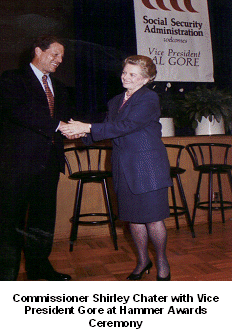 At the same time, with Executive Order (E.O.) 12862, “Setting Customer
Service Standards,”
At the same time, with Executive Order (E.O.) 12862, “Setting Customer
Service Standards,”  In
November 1998, SSA began to pilot an “immediate claims” service
option that enabled customers who call the 800 number to file a
claim for retirement or survivors benefits at the time of their
call, without having to schedule an appointment or visit their local
field offices. SSA had always offered immediate claims taking
service for customers who visit or call a field office, when the
offices have the capacity to provide immediate service. With
ICT, customers who prefer to do business with SSA through its national
800 number were given the same level of access to its services.
The ICT option closed an existing service gap and increased customer
choice.
In
November 1998, SSA began to pilot an “immediate claims” service
option that enabled customers who call the 800 number to file a
claim for retirement or survivors benefits at the time of their
call, without having to schedule an appointment or visit their local
field offices. SSA had always offered immediate claims taking
service for customers who visit or call a field office, when the
offices have the capacity to provide immediate service. With
ICT, customers who prefer to do business with SSA through its national
800 number were given the same level of access to its services.
The ICT option closed an existing service gap and increased customer
choice.


 Although the last new agreement was implemented in 1994, SSA continued
to be active in the international agreement arena. From 1993
through 2000, SSA hosted or attended 10 post-implementation meetings
with its agreement partners. The purpose of these meetings
was to assess how well arrangements made at the initial implementation
meeting were working, to discuss issues of mutual concern and, in
general, to reach agreement on the most efficient and practical
methods for exchanging information and processing claims from its
shared clientele. SSA also implemented supplementary agreements,
revising the previously concluded agreements with Austria, Canada,
the United Kingdom and Germany. These supplementary agreements
simplify the administration of the agreements and extend additional
benefit rights under the foreign Social Security systems to U.S.
citizens and residents.
Although the last new agreement was implemented in 1994, SSA continued
to be active in the international agreement arena. From 1993
through 2000, SSA hosted or attended 10 post-implementation meetings
with its agreement partners. The purpose of these meetings
was to assess how well arrangements made at the initial implementation
meeting were working, to discuss issues of mutual concern and, in
general, to reach agreement on the most efficient and practical
methods for exchanging information and processing claims from its
shared clientele. SSA also implemented supplementary agreements,
revising the previously concluded agreements with Austria, Canada,
the United Kingdom and Germany. These supplementary agreements
simplify the administration of the agreements and extend additional
benefit rights under the foreign Social Security systems to U.S.
citizens and residents. Upon his appointment, Commissioner Apfel affirmed his commitment
to establishing a diverse work force. In 1997, SSA published
its first strategic plan as an Independent Agency. The importance
of workforce planning was reflected in the plan. One of the
objectives listed in the strategic plan was “to create a workforce
to serve SSA’s diverse customers in the 21st century.”
Upon his appointment, Commissioner Apfel affirmed his commitment
to establishing a diverse work force. In 1997, SSA published
its first strategic plan as an Independent Agency. The importance
of workforce planning was reflected in the plan. One of the
objectives listed in the strategic plan was “to create a workforce
to serve SSA’s diverse customers in the 21st century.”
 In
May 1992, the Deputy Commissioner for Human Resources issued a report
on “SSA’s Capability to Accommodate the Needs of the NES Public.”
This report concluded that a large gap exists between the public’s
need for bilingual services and SSA’s capability to meet that need
with its own resources. It identified the five largest language
groups requiring field office service as Spanish, Vietnamese, Russian,
Chinese and Korean.
In
May 1992, the Deputy Commissioner for Human Resources issued a report
on “SSA’s Capability to Accommodate the Needs of the NES Public.”
This report concluded that a large gap exists between the public’s
need for bilingual services and SSA’s capability to meet that need
with its own resources. It identified the five largest language
groups requiring field office service as Spanish, Vietnamese, Russian,
Chinese and Korean.