President Tours Bureau of Public Debt
Bureau of Public Debt
Parkersburg, West Virginia
April 5, 2005
10:00 A.M. EDT
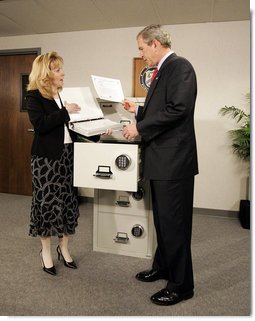
THE PRESIDENT: See, what's interesting is a lot of people believe that
the Social Security trust is -- the government takes a person's money,
invests it, and then pays it back to them upon retirement. It doesn't
work that way.
MS. CHAPMAN: That's right, that's exactly right.
THE PRESIDENT: This is what exists. And it's very important, then, to
make sure that in the future that there's real assets for retirees.
But I want to thank you all for having me come. I want to thank all the
workers here for representing the mighty United States. I'm proud to work
with you. I thank you for what you do. And my message here in town is
that we have an obligation to take the system that Franklin Roosevelt
created and make it work for a younger generation of Americans. I'm looking
forward to working with Congress to do that. That's what the American
people expect. They expect us to modernize the system.
Anyway, thanks for having us.
MS. CHAPMAN: Well, thank you for coming. We're proud to have you visit
us.
THE PRESIDENT: Thanks.
END 10:52 A.M. EDT
President Participates in Social Security Conversation
in West Virginia
West Virginia University at Parkersburg
Parkersburg, West Virginia
April 5, 2005
11:14 A.M. EDT

THE PRESIDENT: Thank you all. Thanks for coming. (Applause.) Thank you
all. Please be seated. (Applause.) Thank you all. It is nice, nice to
be back in Parkersburg. Thanks for having me. (Applause.) It just seems
like yesterday that I was here. (Laughter.) It's great to be back in West
Virginia, as well. I'm struck by the -- every time I come here I'm struck
by the beauty of this state. And of course, you put on a beautiful day,
for which I'm grateful.
One of these days I'm going to bring my mountain bike. (Applause.) I
love to exercise. I'm doing -- I'm doing it to make sure that I do the
job you expect me to do, and I'm doing it to set an example, as well.
I think people need to get out all around our country, walk every day,
or ride your mountain bike every day, get a little exercise every day.
Stay fit and healthy. (Applause.)
Speaking about staying fit and healthy, that's what we need to make sure
we do for our Social Security system, too. (Applause.) I'm here to remind
the good folks of West Virginia that we have a problem and we have a duty
to renew one of great -- America's great institutions, and that's the
Social Security system.
I've now traveled to 20 states to talk about Social Security, 20 states
in two months, all aimed at making sure that the American people understand
the situation with Social Security. And more and more Americans understand
there is a problem, and I hear from more and more Americans that they
expect those of us who are honored to serve in Washington to fix the problem.
(Applause.)
I have just come from the Bureau of Public Debt. I want to thank Van
Zeck, Keith Rake, and Susan Chapman. Susan was the tour guide there at
the Bureau of Public Debt. I went there because I'm trying to make a point
about the Social Security trust. You see, a lot of people in America think
there's a trust, in this sense -- that we take your money through payroll
taxes and then we hold it for you, and then when you retire, we give it
back to you. But that's not the way it works.
There is no "trust fund," just IOUs that I saw firsthand, that
future generations will pay -- will pay for either in higher taxes, or
reduced benefits, or cuts to other critical government programs.
The office here in Parkersburg stores those IOUs. They're stacked in
a filing cabinet. Imagine -- the retirement security for future generations
is sitting in a filing cabinet. It's time to strengthen and modernize
Social Security for future generations with growing assets that you can
control, that you call your own -- assets that the government cannot take
away. (Applause.)
I'm sorry that Laura is not traveling with me today. (Applause.) She's
doing great. She and I will be taking off tomorrow morning to pay -- to
pay our country's respects to a great world leader in His Holiness. He
shows that one man can make an enormous difference. And I look forward
to honoring the memory of Pope John Paul II. (Applause.) So she's packing
her bags. (Laughter.)
I want to thank the President of West Virginia University at Parkersburg.
Madam President, I'm sorry I missed your inauguration. (Laughter.) But
thank you for serving. Dr. Marie Gnage is with us. I appreciate you letting
us use this facility. (Applause.)
Before coming out here I had the honor of saying hello to a lot of folks
who are involved with the community college system of West Virginia. I'm
a strong believer in the community college system around our country,
because I understand that the community college system is a -- provides
a great opportunity for many of our young and for many of our workers
to gain the skills necessary to fill the jobs of the 21st century. The
community college system provides a wonderful opportunity for states and
communities to say to potential employers, we have got a fantastic asset
in our midst to make sure that the workers can fill the jobs that you
desire.
And so for those of you involved in the community college system around
the state of West Virginia, thanks for being here and thanks for what
you're doing. (Applause.)
I want to thank -- I want to thank the Secretary of State, Betty Ireland,
for joining us. I'm proud you're here, Madam Secretary. Thanks for taking
time. (Applause.) I want to thank Mayor Jimmy Colombo for joining us.
Mr. Mayor -- there he is. Thank you, Jimmy. (Applause.) I appreciate the
way the Mayor approaches his office. He doesn't care whether I'm a Republican
or Democrat or independent, he just -- he's a hospitable fellow. (Laughter.)
Every time I come to this part of the world he says, welcome. And I appreciate
you, Mr. Mayor, and I appreciate you being here today. Thanks for coming.
(Applause.)
I want to thank all the state and local officials for joining us today.
When I landed, I met June Roberts. She's a volunteer with the Retired
and Senior Volunteer Program. We call it R.S.V.P. They exist all around
the country. In 2001, she founded Senior Stitchers. Listen to what these
good folks do: They prepare sewing and craft projects, including wheelchair
pads, blankets for local child service agencies, senior centers and hospitals.
These are good folks. They're taking time out of their lives. (Applause.)
June and her buddies -- I think she said there's eight or nine of them
-- take time out of their day to volunteer to help make somebody's life
better.
Let met tell you one way you can help the good folks in Parkersburg.
A way to serve our country is to find somebody who hurts, take time out
of your life, surround them with love, feed the hungry, find shelter for
the homeless, listen to that universal call to love a neighbor just like
you'd like to be loved yourself and you'll be serving America. (Applause.)
So where is June? (Applause.) I think June is here somewhere. June, thank
you for coming. Thank you for setting such a good example. (Applause.)
On my trips around this country I have made it as clear as I possibly
can that the government will keep its promise to those who have retired
or near retirement. And that's very important for a lot of people to hear.
I understand how important the Social Security check is to a lot of our
citizens. A lot of people depend on that Social Security check. And, therefore,
I understand that when it comes time to talking about making sure the
system is strong for a younger generation, sometimes the message can get
confused. In other words, when a senior hears the President talking about
Social Security, he or she may be concerned about whether or not that
check that they're getting today is going to continue to come tomorrow.
I understand that.
And I can understand why people are sometimes confused because there's
a lot of propaganda in the mix. In other words, people are saying things
that simply aren't true. They're saying, well, if you try to reform the
system for a younger generation of Americans, then you may not get your
check.
I'm here to tell you those who've retired are going to get their check.
Those who are near retirement are going to get their check. (Applause.)
The system will not change in any way
for people who have been born prior to 1950. And I'm going to keep saying
it over and over again.
The problem is that the government is making promises to younger Americans
that it cannot keep. And that's important for folks to hear. You see,
Social Security was designed as a pay-as-you-go system, not as a trust
system. Pay-as-you-go, you know, the workers will pay into Social Security
through the payroll taxes, and then it immediately gets paid out. It gets
paid out to pay for benefits; and if there's any money left over, it pays
for a lot of other government programs. What goes in, goes out. Right
now, more money is coming into the Social Security system than going out.
And that's how we help fund the programs. A lot of people in West Virginia
don't understand that, that the system is a pay-as-you-go system. And
this works fine, so long as you got enough workers paying for the benefits
of those who've retired.
In 1950, there were 16 workers paying into the system for every beneficiary.
In other words, the government promised you your retirement check and
there's 16 people paying for that check. That kind of keeps the load relatively
light. Today, there are three workers paying for each beneficiary. In
other words, one of the things that's happened to the Social Security
system that people must understand is that there are fewer people paying
into the system per beneficiary. In a relatively short order, there will
be two workers paying into the system for every beneficiary.
And that's just only half of the equation. And here's the other half:
Americans are living longer, and enjoying longer retirement. Life expectancy
has increased. They're collecting benefits for longer periods of time.
In other words, if you've retired and you're living longer, the system
must pay your benefits longer -- fewer people paying in the system and
people are living longer, collecting their benefits longer. So you're
beginning to get a sense to where the bind is coming.
And not only that, there's a lot of us who are getting ready to retire.
We are called the baby boomers. There's a big bulge of baby boomers, when
you look at the charts. I know; I'm one. As a matter of fact, my retirement
age -- or when I become eligible for retirement benefits is 2008. That's
when I turn 62. It's quite a convenient date in my case. (Laughter and
applause.) And to compound the issue even further, a lot of people running
for office in the past have said, vote for me, I will increase your Social
Security benefits. And so my generation has been promised greater benefits
than the previous generation. So you've got a lot of people living longer,
getting greater benefits, with fewer people paying into the system.
And when I start drawing out, and when my generation starts drawing out
of the system, instead of paying in the system, the stresses on the system
will really begin to grow. And that's important for you to understand.
In other words, when you start thinking about whether or not the system
is solvent for younger Americans, think about this: In each passing year,
we'll have fewer workers paying even higher benefits to a larger number
of retirees. And therein lies the problem.
Social Security is going to be fine for those of you who have received
your check. It's going to be fine for people who have retired, or who
will retire and your birth date is prior to 1950. You're -- nothing is
going to change. The system is in good shape for you. It is not going
to be fine for younger workers coming up. In 2017, the Social Security
system will go into the red. That means more money will be going out of
the system than coming in. In other words, baby boomers will be retiring,
start to living longer, greater benefits promised to us, and the pay-as-you-go
system goes negative. More money will be going out than coming in through
payroll taxes. And every year after that the shortfall gets worse. In
other words, it's an accelerating problem.
As a matter of fact, according to the Social Security trustees, waiting
just one year adds $600 billion to the cost of fixing Social Security.
The longer we wait, the more the problem becomes severe. In 2027, there
will be $200 billion going out more than coming in. Somebody is going
to have to pay for that. Somewhere there's got to be a give in the system.
We have a real problem.
The good news is more and more Americans are beginning to understand
we have a real problem. And more and more Americans -- (applause.) And
more and more Americans who are receiving a Social Security check are
being reassured that nothing will change. And when that happens, there's
a fundamental question that's being asked. A lot of grandparents are now
starting to ask, what are you going to do for my grandchildren? I believe
this is a generational issue. This is an issue where once folks understand
nothing is going to change, and they understand we have a problem, the
logical question to people like me and others in Washington, D.C. is,
how are you going to take care of my grandchildren? It's a natural inclination
for grandparents, to start worrying about their grandchildren. And it's
a legitimate concern.
I met with Betty Earl coming in. She's lived in Parkersburg for about
40 years -- or the area for 40 years. She has two daughters in their 30s.
She doesn't think the Social Security system will be there when they retire.
She represents the attitude of a lot of folks, now that this issue is
becoming clarified. She said, "It doesn't take an Einstein to see
where Social Security is headed." And she doesn't want Congress to
wait until Social Security goes bust before starting to fix it.
I appreciate that understanding. I appreciate Betty Earl -- I doubt she's
got a Ph.D. in economics -- maybe she does. But it doesn't retire -- doesn't
require much education and brilliance to figure out we've got a serious
problem, when you think about the math: More people living longer, with
greater benefits, and fewer people paying into the system.
And so Betty wants to know, like a lot of other people want to know,
what you going to do about it? And I'm here to tell you, I'm willing to
listen to any idea. This isn't a Republican problem, or a Democrat problem;
this is a problem for the United States of America. (Applause.) And I
think now is the time for people in Congress to stop playing politics
with the issue and come to the table with how they think it ought to be
fixed. (Applause.)
I recently traveled the country on some stops with former Democrat Congressman
Tim Penny, a Democrat from Minnesota, who has some good ideas. As a matter
of fact, I mentioned his name, I think, in my State of the Union address.
I mentioned former President Clinton's name in the State of the Union
address, because when he was President he put forward some interesting
ideas as what we ought to consider as to how to fix this issue permanently.
He spoke of increasing the retirement age. Then he talked about tying
Social Security benefits to prices rather than wages.
In 2001, I put together a commission in anticipation of Social Security
becoming a greater issue. As a matter of fact, I campaigned on the issue
in 2000. And I asked the Democratic
-- former Democrat Senator Daniel Patrick Moynihan of New York to chair
the commission. He's a thoughtful fellow. He -- I put Republicans and
Democrats on the commission; I said, why don't you all come together and
make some recommendations, which they did, all aimed at strengthening
Social Security for a younger generation, and permanently fixing the problem.
And there's some basic principles that ought to guide our efforts. First,
we should not raise the payroll tax rates, in order to make sure that
-- (applause.) The reason I say that is that it would cost our economy
jobs. One of the things, when we put policy in place, we ought to make
sure that policy encourages economic vitality and growth, and that we're
stimulating the small business sector of our economy. We must make sure
that Social Security continues to provide dignity and peace of mind for
low-income Americans. In other words, the system ought to be structured
so low-income Americans are -- have got dignity in retirement. (Applause.)
Americans must reject temporary measures. In other words, you'll hear
people in Washington say, well, we got a 75-year fix, for example. You
know, in 1983, the issue came to focus, and President Reagan and Speaker
Foley, as well as other Republicans and Democrats, set aside their partisan
differences and said, look, we have an obligation to act on behalf of
the country. And they came together and put what they thought was a 75-year
fix to the problem. The problem is that the 75-year fix wasn't a 75-year
fix, because here we are, 22 years later, talking about it again. See,
that's a misnomer.
What was -- I like the spirit of them coming together, trying to work
it out. But they didn't permanently solve the problem. See, the job of
the President is to fix problems, not pass them on to future Presidents
and future Congresses. (Applause.)
And so I'm going to continue to call upon Congress and say, one, I'm
going to work with you, I'm interested in your ideas, and when we get
together let's permanently fix the problem; let's do our duty; let's do
that which the American people expect of us.
The Senate I thought passed an interesting resolution the other day;
on a 100-to-nothing vote, they called for a permanent fix. That was constructive.
(Laughter.) That was step one. (Laughter.) Step two is, now let's just
follow through and deliver one.
As we make Social Security permanently solvent for a younger generation
-- senior citizens are receiving their check today, going to get their
check, nothing will change. People, baby boomers, like me, are -- born
prior to 1950, the system is strong enough to take care of us. We must
worry about a younger generation of Americans. And as we work to make
the system permanently reformed, we need to make it a better deal for
our younger workers, too. And here's an idea that I think people ought
to consider.
I think people ought to have a -- given an opportunity to have more control
over their own retirement funds, the chance to tap into the power of compound
interest; the ability, if they so choose, to watch their money grow in
an account, a savings account of bonds and stocks. That's why I proposed
that Congress consider allowing younger workers to set aside part of their
Social Security contributions in a voluntary personal retirement account.
A voluntary account -- you notice I keep saying "voluntary."
I mean, doesn't it make sense for government to say to a younger worker
"if you so choose" you should be allowed to take this option?
Nobody is saying you "must take the option" or you "can't
take the option." What we're saying is, if you decide to, you should
be allowed the opportunity to invest about a third of your payroll taxes
in a conservative mix of bonds and stocks. The money would grow over time.
It could provide a better rate of return than anything the current Social
Security system can provide. And that's important. It's that difference
between what the current system provides and what you can earn in a conservative
mix that makes a big difference about what you have when it comes time
for you to retire.
A younger work earning an average of $35,000 a year over a career could
retire with a nest egg, under this plan, of nearly a quarter million dollars
-- a nice addition to that worker's Social Security check. You see, the
savings account is in addition to, a part of the retirement plan -- not
the retirement plan, it's a part of a Social Security retirement plan.
(Applause.)
Since 1983, the last time Congress tried to reform stock investments
-- tried to reform, the stock investments on average have returned more
than a thousand percent. That's how your money grows. Notice I said "conservative
mix." You can't -- you can't take your money and put it in the lottery,
or take it to the track. I mean, there's a conservative mix. When I say
"conservative mix," I mean conservative mix. But a conservative
mix will get you a better return on your money than the current system.
And it's that differential, that rate differential which grows over time
to enable a younger worker who only makes $35,000 over his or her lifetime
to end up with a nest egg of $250,000 as part of a retirement package.
And that's your money.
Again, I repeat, younger workers can choose to join this if they want
to. You know, a lot of folks say, well, you know, the investment may be
too difficult. But just think about what's changing in America today.
Mayor, when you and I were coming up, they didn't talk much about 401(k)s.
The 401(k) now is available for a lot of workers. A lot of workers are
watching their own money grow through a 401(k) account. They understand
what the investment world is like. I don't remember, when I was growing
up, worrying about the solvency of the Social Security system. I hear
from a lot of younger folks, a lot of your grandchildren are saying, what
you going to do about it, Mr. President, and, by the way, just give me
a chance to make decisions for myself; give me a chance to build up hard
assets, instead of paper assets in a file cabinet.
We've got to make sure that there are strict guidelines. We've got to
make sure the earnings aren't eaten up by hidden Wall Street fees. We'll
make sure the good options to protect investment from market swings on
the eve of retirement -- there are ways to make sure the system works.
You're not going to be able to empty all your account out when you retire;
it's going to be a part of a retirement plan.
But this concept isn't new, and this is what people must understand.
You see, we've had what's called the Thrift Savings Plan for federal employees
and members of Congress for a long period of time. And you know what the
Thrift Savings Plan says? It says members of Congress, United States senators,
people who work in Washington or elsewhere for the federal government
can set aside some of their own money as part of their retirement plan
-- in a conservative mix of bonds and stocks.
I found that to be really interesting. You see, it's pretty interesting
that Congress a while ago thought this was a good idea, to allow their
money to grow at a decent rate of return in a conservative mix of bonds
and stocks. And it seems to make sense to me that if it's all right for
the United States Congress and the United States Senate to give people
the option of watching their own money grow, then it ought to be good
enough for workers all across the United States. (Applause.)
I just talked to Drew Kefeli. He's a single dad. He became interested
in Social Security reform because of his 16-month-old daughter. Interestingly
enough, he named his daughter Jenna. (Laughter.) The guy has got great
taste. (Laughter.) He likes the idea of personal accounts because he wants
to build, to leave something to Jenna. Under the present system, the government
will keep the money it's putting in Social Security if he dies before
he can collect.
Think about the system today. I met with widows whose husband pre-deceased
them -- and he might not have been 62 years old when he died, and there
she is, with maybe family members and nothing but a small amount of money
for burial. Yet, all the money that the person put in the system is just
kind of -- it's not around. Or you take a spouse who's been working all
his or her life, and both spouses worked, which is very common in America
today, both contributing to the Social Security system. One dies early,
and then the remaining spouse gets to keep their survivor benefits, or
his or her own retirement benefits, but not both. In other words, one
of the two have been contributing to the system and they get nothing for
the contribution.
See, if you're allowed to set aside some of your money, like Drew wants
to do, into your own asset base, if a tragedy strikes early it will give
you an asset to leave to somebody you love. It's your money. You get to
decide what to do with it. As Drew said, he said the personal account
would give him greater peace of mind about Jenna's future. I like that
idea. I like the idea of making sure inheritance is not just a privilege
limited to the wealthy. I like the idea of encouraging an ownership society,
where a mother or father, as a result of hard work, can set aside money,
if he or she chooses, in a personal account that he or she can leave to
whomever she wants, or ever [sic] he wants. I think it's healthy for a
society to have assets passed on from one generation to the next. (Applause.)
The American Dream is built on the independence and dignity that come
from ownership. Ownership shouldn't be restricted in America. We want
more people owning their own home, and that's happening all across our
country. Do you realize more minority families own a home today than ever
before in our nation's history? And that's important. I want more people
owning their own business. I love the idea of people saying to me, Mr.
President, I'm proud of my business, I started my own business. And I
think it makes sense to have people being able to own and manage their
own money -- a part of their own money in the Social Security system.
After all, the payroll taxes are contributed -- that's not government
money, that's your money. And the government ought to give you -- be wise
enough to let you manage some of it. (Applause.)
I'm going to continue to discuss this issue around the country. It's
an important issue. Once the grandmoms and granddads understand that they're
going the get their check, a lot of them are going to start saying to
the elected officials, what are you going to do about my grandchildren?
Franklin Roosevelt did a good thing when he created the Social Security
system. It's worked. But the math has changed. A lot of people are getting
ready to retire. They're going to live longer, receive greater benefits
and fewer people paying in the system. The longer we wait, the more costly
it's going to be to a future generation of Americans. And now is the time
-- and now is the time to act. Because your retirement security is a lot
more important than partisan politics.
Thanks for letting me come by. (Applause.) God bless. Thank you all.
(Applause.)
END 11:46 A.M. EDT
President Participates in Social Security Roundtable
in Ohio
Lakeland Community College
Kirtland, Ohio
April 15, 2005
1:03 P.M. EDT
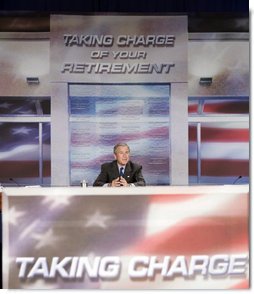
THE PRESIDENT: Thank you all for coming. Please be seated. I appreciate
you coming, Steve, thanks. Glad to give you a ride home on Air Force One.
(Laughter.) I really do like working with Steve. He's a thoughtful fellow
who cares about issues, and this is -- what we're going to talk about
is an important issue, which is Social Security.
Before I do, I want to thank the community college for hosting us. I'm
a big believer in community colleges. Community colleges have got the
capacity to change curriculum to meet the needs of a local work force,
for example. And one of the real challenges of the 21st century is to
make sure people have got the skills necessary to fill the jobs of the
21st century. And a fabulous place to find those skills is our community
colleges.
So, thanks for what you do; thanks for being a host; thanks for letting
us come and have a -- what I think you'll find to be a really interesting
educational experience about a vital issue confronting the country.
I want to thank Lt. Governor Bruce Johnson for joining us. I appreciate
State Treasurer Jennette Bradley for joining us today. I want to thank
the Mayor, Ed Podojil, who is here. I appreciate you, Mr. Mayor. And I
want to thank Dave Anderson. The last time I saw Dave, I said to Dave,
I said, "Dave, fill the potholes." (Laughter.) That's just a
piece of advice. (Laughter.) And so I saw him in line coming in. He said,
"I'm just here to report for duty Mr. President. I did fill the potholes."
(Laughter.) You'd get reelected if you want to run again. (Laughter.)
Anyway, I want to thank Anita Isom, who's with us. Anita is a young lady
I met when we landed there at the airport in Cleveland. She is a volunteer
and she has helped, and been awarded because of her reading-related activities
that benefit others. The reason I like to mention a soul like Anita is
that, no matter what your age, no matter where you live, you can help
this country by becoming a volunteer, by helping somebody who hurts, by
teaching somebody to read, or feed somebody who's hungry, or put your
arm around somebody who needs love.
I like to remind people that the greatest strength of this country is
the heart and souls of our fellow citizens, and the great compassion of
our people. And so if you're interested in serving America, do so by becoming
a volunteer in the community in which you live, and help change this country
one heart and one soul at a time.
So, Anita, thanks for coming. Thanks for meeting me at the airport.
Let me talk about Social Security. I could be talking about a lot of
things -- peace and freedom. The world is changing right now because societies
are becoming more free. And as societies become more free, more democratic,
the world will become more peaceful.
Today I went to a little restaurant, and the owner happens to be Lebanese
American. And he said, thank you, Mr. President, for staying focused on
a country like Lebanon and insisting that Lebanon be allowed to have free
elections. And I assured him, like I'll assure you, that when America
speaks, we mean what we say; when we say free elections to the Syrians,
we mean free elections. Get out of Lebanon and let this good country have
a free election, as scheduled. When I say, get out of Lebanon, I mean
out of Lebanon with all your troops and all your security services and
all the people trying to influence that government. It is in the world's
interest that Lebanon be allowed to have free elections, because a free
society will help spread the peace. (Applause.)
We're dealing with a lot of issues, and in Washington, D.C. I've submitted
a tough budget and expect the Congress to be wise about how you spend
your money. I also know that Congress needs to stop debating and get an
energy bill to my desk -- now, during this session. (Applause.)
Congress also needs to take serious this issue about Social Security.
People say, well, why did you bring it up? I said, I brought it up because
I see a serious problem that needs to be fixed now before it's too late.
I also brought it up because the job of a President is to confront problems,
and not pass them on. The easy route in politics is to say, well, we got
us a problem, we'll just let the next person handle it. The easy route
for a member of the United States Senate is to say, there is a problem,
but it perhaps can wait. We'll just let another United States Senate fix
it, or send it to the House. That's not the way I think. I think I got
elected because people expect me, when I see a problem, to bring it to
the fore and to work with people to get it solved.
And here's the problem in Social Security. There's a lot of people like
me getting ready to retire. (Laughter.) As a matter of fact, I'm retiring
in four years -- at least I hit retirement age in four years -- which
is convenient -- (laughter) -- in my case. I turn 62 in 2008. And I'm
not the only one turning 62 in 2008. As a matter of fact, there's a lot
of us. We're called the baby boomer generation. And not only is my generation
fixing to retire, we are living longer than previous generations. And
not only are we living longer than previous generations, we have been
promised greater benefits than the previous generation. In other words,
people running for office say, put me in office and I'll increase your
Social Security benefits for you. And guess what -- they did.
And so a lot of us are getting ready to retire. And the problem comes
because there's not a lot of people paying into the system. See, in 1950,
there were 16 workers for every beneficiary. So you can imagine the load
was somewhat lighter than today, when there's now 3.3 workers for every
beneficiary. And soon there's going to be two workers for every beneficiary.
You've got fewer workers paying into a system that is going to require
more and more out-flow, because a lot of us are retiring, living longer,
and been promised greater benefits. And the math just doesn't work.
It's a pay-as-you-go system, by the way. That means, when the money goes
in, it comes right out. It's not a trust. I mean, some people in America
I suspect think that the federal government all these years has been collecting
your payroll taxes and we're holding it for you. And then when you get
ready to retire, we give it back to you. That's not the way it works.
The way it works is, is that we collect your payroll taxes and we pay
the current retirees their benefits, and then with leftover money we spend
it on other things. That's the way the system works. It's pay-as-you-go.
And in 2017, the pay-as-you-go system is going to go negative. In other
words, more money goes out than comes in through payroll taxes. And every
year thereafter, if we don't do something, it gets worse and worse and
worse and worse. To give you an example of how bad it gets, in 2027, the
federal government is going to have to come up with $200 billion more
a year just to make good on the payments. And it gets worse the next year,
and the next year, and the next year.
I also want to assure those of you who are on Social Security, you will
get your check. See, nothing changes for somebody born prior to 1950.
And that's very important for people in Ohio to hear, because I fully
understand a lot of people count on that Social Security check. That Social
Security check means a lot to a lot of people in America, and they're
counting on it. That's why, for example, in some political campaigns people
try to say to seniors, you know, if so-and-so gets into office, he's going
to take your check away from you. That's the old scare tactics. Sometimes
during this debate it seems like people are resorting to those scare tactics.
They're telling seniors, really what they're talking about is taking your
check away. Let me just tell you, point-blank: If you're receiving a Social
Security check in Ohio, this government of ours will continue to honor
you, honor that commitment.
This issue isn't about you. This issue is about your grandchildren. The
issue confronting the Social Security system is an issue for young workers,
young people coming up. One time I was having a discussion and the person
said, I saw a survey -- I said, oh, yeah, what did it say? It said young
workers like me are more likely to see -- think we're more likely to see
a UFO than get a Social Security check. (Laughter.) That may be pretty
close to accurate.
I'll tell you this: If this federal government doesn't act, your bill,
your payroll taxed are going to have to go up a lot in order to pay the
promises made to me. Or the government is going to have to slash the benefits.
Or the government is going to have to make dramatic cuts in other programs.
And so I see a problem. I think the math is clear. And so now is the time
to get something done.
And so I stood up in front of the United States at my State of the Union
address and said to the Congress, here's the problem. And I'm going to
put some ideas on the table, ideas that I didn't necessarily think of;
ideas that President Clinton had thought of, or Senator Moynihan, a great
member of the United States Senate from New York, who, unfortunately,
has passed away -- or former congressman Tim Penny -- good ideas about
different ways to permanently fix the problem. And that's what Congress
must do; it must permanently fix the problem.
In 1983, one of my predecessors, President Ronald Reagan, got together
with Speaker O'Neill from Massachusetts, and they said, we got a problem,
let's fix it. See, the math wasn't working then either. It was called
a 75-year fix. They signed a bill -- I love the spirit, by the way, of
Republicans and Democrats setting aside their political parties and focusing
on getting something done for the American people. And the President did
that, the Speaker did that for the 75-year fix. The only problem is, 22
years later we're still talking about it. And so now is the time to bring
people together from both parties to have a permanent fix. And all ideas
are on the table. And I'm looking forward to discussing any good idea
with a Democrat or a Republican.
I imagine there's some people fearful in Washington, D.C. about maybe
laying out an interesting idea and that one of the political parties will
get all over them for laying it out. If I had anything to do with it,
it would be political amnesty for people bringing good ideas forward.
Now is not the time to play political "gotcha" with a member
of any political party, for stepping up and bringing forth ideas to do
what they think is right to help solve this problem permanently for generations
of Americans to come.
Now, one of the ideas that I think is important for the Congress to consider
is to allow a younger worker to be able to set aside some of her, or his
own money in a personal savings account, as a part of a Social Security
solution. See, I think government ought to say, we'll give you an opportunity,
if you want to -- your choice. We're not saying, you must set aside money.
We're saying you ought to have the opportunity to, it ought to be voluntary
to set aside some money so that you can earn a better rate of return on
your money. People ought to be given a chance to invest in a conservative
mix of bonds and stocks.
In other words, it's part of a permanent solution in order to make sure
the younger worker gets a better deal. The younger worker ought to be
allowed to set aside some of the payroll taxes. And this is a concept,
by the way, that has been tried before. I haven't invented the idea. As
a matter of fact, the federal -- Congress before has said, we ought to
allow people working in the United States Congress, and congressman and
United States senators to do just what I described. The Federal Employee
Thrift Savings plan allows members of Congress and the United States Senate
to take some of their money and set it aside in a personal savings account.
Why? Because they know they'll get a better rate of return on their money
than if the federal government held it. And it seems fair to me that if
setting aside money in a personal savings account is good enough for a
member of the United States Congress, it's good enough for workers all
across America. (Applause.)
Okay, so I went to school with a guy who made all A's. It's probably
recognized by now I didn't do all that well in college at times. (Laughter.)
And I brought him with me. He's an expert. He's my National Economic Advisor.
But I want you to notice, you students out there, who's the President
and who's the advisor. (Laughter and applause.)
I've got a fabulous staff. People need to judge the President based upon
who he listens to. And as you know in foreign policy matters, I listen
to some really capable people -- Condi -- Condoleezza Rice, the Secretary
of State; Secretary Rumsfeld. And on the domestic side, I've got great
people working with me. One of them is Al Hubbard, a business guy out
of Indiana, started businesses, ran businesses, entrepreneur. He's agreed
the come and serve as the National Economic Advisor to the President.
He briefs me on a regular basis. And one of the big issues that I've got
him working on is Social Security.
I want to thank for coming, Al. And if you got something to say, now
is your opportunity. (Laughter.) Please don't try to defend yourself because
the President always has the last word. (Laughter.)
MR. HUBBARD: Yes, sir, I've learned that very quickly. Thanks for giving
me this opportunity.
* * * * *
THE PRESIDENT: You're the guy who authored the bill?
MR. SINES: I had the first bill in 1994.
THE PRESIDENT: Really.
MR. SINES: Introduced it.
THE PRESIDENT: If you got any spare time, you might want to come up to
Washington and work the issue with me. (Laughter.)
MR. SINES: Well, Mr. President -- I really like Lake County. (Laughter.)
* * * * *
MR. SINES: I have three daughters, and kind of in the same mode as you,
we're in a special club when you raise daughters.
THE PRESIDENT: Yes. Your hair is about as white as mine. (Laughter.)
MR. SINES: Yes, it is and it's getting whiter. And it's getting whiter.
* * * * *
THE PRESIDENT: It must make you feel good to be able to sit here in front
of all these TV cameras and say, I saw a problem, I worked with people
from both sides of the aisle to fix it, and it's working. That's the spirit
the people in the United States Congress must hear. It's not time to play
politics, it's time to fix the problem. It's time to set aside all this
business about, my party may look good, or so-and-so may look good, and
so-and-so may look bad -- we've really got an opportunity, a need to fix
it.
And secondly, I am -- I just want you to know that like you went through,
there were some moments as to whether or not you thought the thing would
pass. Yes, well, you know something -- I'm going to be relentless on the
subject because I believe the American people, once they understand there's
a problem, once they understand the math, and once seniors understand
that nothing is going to change, the next question to members who have
been elected is why aren't you doing something about it? See, if there's
a problem, you saw the problem, and people begin to recognize the nature
of the problem and the size of the problem and the cost of inactivity,
and senior citizens understand that the propaganda they may have heard
about somebody taking away their check simply isn't true, the next logical
extension of the debate and the discussion is, say, if we got a problem,
and I'm going to get my check, what are you going to do about my grandkids?
It's a generational issue.
And we're just starting. So don't worry about me, Ray. I'm feeling pretty
good about -- feeling pretty good about where we stand. The American people
are wise. They just need to know the facts.
Part of the facts is understanding we have a problem, and part of the
facts is what you're going to do about it. And today, this is an interesting
opportunity for people to see a system that is -- I bet most people in
America don't understand what happens here in Ohio when it comes to the
retirement system. And so, thank you, for being an innovator, and thank
you for being a leader.
Now, who's next, Hubs.
MR. HUBBARD: Mr. Scott Johnson, who is very involved with the Ohio Public
Employees Retirement System. And he can describe this new innovation that
Ray provided through the legislature.
THE PRESIDENT: Good, tell us what you do.
MR. JOHNSON: Thank you, Mr. President. I'm Scott Johnson, I'm Governor
Taft's director of administrative services. That's a central services
organization similar to your General Services Administration, only added
human resources and personnel.
* * * * *
THE PRESIDENT: By the way, I went to West Virginia the other day and
saw the asset base of the so-called Social Security trust: You know what,
it was about four or five file cabinets full of paper. (Laughter.) It
was the IOU left behind from one hand of government to the other hand
of government.
MR. JOHNSON: We've been operating since 1935, but of course, society
has changed a bit over that period of time.
* * * * *
THE PRESIDENT: Sorry to interrupt you. Presidents do that sometimes.
(Laughter.) Portability -- so if somebody is listening and they're not
exactly sure what that means and why that would be important to them --
MR. JOHNSON: University professors typically move around.
THE PRESIDENT: Right.
MR. JOHNSON: And in mid-career may move from one university to another.
And so they've already gotten some sort of retirement system underway
and would like to move that from where they are, to where they're going.
THE PRESIDENT: If they change jobs they could take their retirement account
with them.
MR. JOHNSON: Exactly.
THE PRESIDENT: Yes. That's important for people to know. That's a concept
that's an important part of any good plan, would be to recognize the needs
of the person that is receiving a part of their retirement. They can move.
Go ahead.
* * * * *
THE PRESIDENT: I think that's a reasonable concept, don't you, folks?
Government says to the people you have a choice to make, you know? (Applause.)
MR. JOHNSON: So what you, therefore, have with that combined program
is a system where the portion that the employer -- the state, or the county,
or the city -- contributes is administered by the professionals at the
system. And the amount that the employee himself or herself contributes
could be managed by that employee.
* * * * *
THE PRESIDENT: Yes, I guess, you can't take the money and put it in the
lottery?
MR. JOHNSON: Well, even though we run a lottery --
THE PRESIDENT: Or on the trotting jockey -- trotters or whatever it is
next door here.
MR. JOHNSON: No, sir, you can't do that.
THE PRESIDENT: The point is that there is a relatively conservative,
or conservative mix of what's available for people to invest in. Is that
an accurate assessment of the choices people have to make?
MR. JOHNSON: The choices are all responsible ones, Mr. President.
THE PRESIDENT: I don't know about the lottery being irresponsible --
(Laughter.)
MR. JOHNSON: But there is a great deal of variety and individual ability
to be aggressive or not so aggressive as one chooses.
THE PRESIDENT: That's right. See, it's an interesting concept that the
people of Ohio have put in place. And the government basically said, hey,
why don't we trust people. After all it's their own money. Why don't we
give them a chance to -- (applause.) But you just can't go -- there is
a certain set of parameters, I presume, Scott, that -- just like there
is for the federal employees, by the way. In other words, here's some
options for you.
Some people think about whether or not people ought to be allowed to
invest. They call it risky. I don't think it's risky to let people earn
a better rate of return on their money, but obviously there's some parameters,
there's some go-bys. And as you said I think there's eight different options
-- nine different options.
MR. JOHNSON: Nine, yes.
THE PRESIDENT: In other words, the government says -- the government
does play a role and says here's nine different opportunities for you
to have a mix of stocks and bonds, or it can go totally bonds, totally
stocks, or is it generally a mixture? How does it --
MR. JOHNSON: Mr. President, there are layers of choices you can make.
You could if you wish choose one of three pre-mixed options.
THE PRESIDENT: Got it.
MR. JOHNSON: One would be conservative, one less conservative, and one,
frankly, aggressive. Or you could if you wish develop your own asset mixture.
You could have some bonds. You could have some equities. You could have
TIPS. Conceivably, you could invest it all in bonds.
THE PRESIDENT: Yes.
MR. JOHNSON: You could do that if you wish to do so.
THE PRESIDENT: Okay, you got any average rate of return on these programs?
Or is that impossible to do?
MR. JOHNSON: It's not impossible to do, but it's beyond my level of expertise.
(Laughter.)
THE PRESIDENT: Okay. Well, I was talking with Senator McCain who told
me that he thought his rate of return I think was over 7 percent, in his
employee retirement Thrift Savings Plan, over time. In other words, a
conservative mix of stocks and bonds that the government -- federal government
allows federal employees to make, a rate of return over 7 percent. You
see, if you're keeping you money in the Social Security system, it's about
1.8 percent. And the difference for a younger worker between 7 percent
and 1.8 percent over time is a lot of money because interest compounds.
It grows. Money grows over time.
And I think that's one of the reasons why the employees said if it's
good enough for professors, why don't you let me have a taste of this,
too? Why don't you give me a chance to watch my money grow and let me
control it, and let me own it.
So, I appreciate you bringing that forward, Scott, thank you.
MR. JOHNSON: Yes, sir.
THE PRESIDENT: Very good job. (Applause.)
Betty Young, welcome. What do you do, Betty?
MS. YOUNG: Thank you, Mr. President, and it's an honor and a pleasure
to be here. I'm the executive director of Human Resource Services for
the University of Cincinnati.
* * * * *
THE PRESIDENT: First, you notice that Betty talked about 401(k)s and
IRAs. I don't remember 401(k)s when I was growing up. In other words,
there is a new culture in America when it comes to people managing their
own assets -- 401(k)s encourage management of your own assets -- IRAs.
In other words, more and more people in America are now becoming used
to controlling their -- managing their own money.
I presume you find a certain reticence initially, when -- that says I'm
not so sure I can do this.
MS. YOUNG: But you don't have to be a Wall Street wiz.
THE PRESIDENT: Right.
MS. YOUNG: For example, the university requires that the different providers
that offer these programs, that they provide educational materials.
* * * * *
THE PRESIDENT: That's good. You know interesting thing that Betty talked
about was encouraging people to open up a quarterly statement, or if you
so choose, you can look at your wealth on a daily basis. I think that's
an interesting concept. It seems like to me we'd like all of America doing
that, watching their assets grow. Not just Wall Street wizzes, but everybody.
I mean, if more people owned something -- (applause.) I like the idea
of having a program in Ohio where it encourages ownership. Not just one
type of person, but all people have got access to ownership.
It seems like to me a more hopeful America is going to be one in which
people say, I'm watching my assets grow and I'm more -- let me just say,
politicians will be -- their actions will be a lot more scrutinized when
somebody is watching whether or not the decisions made in Washington is
affecting their work, on a daily or quarterly basis. In other words, the
more people paying attention to their assets, the more people will be
paying attention to what happens in Washington, D.C., or in Columbus,
Ohio.
So thanks for bringing that to my mind. Let me ask you this: Obviously,
there's a certain role for the state, and that is the state has chosen
the providers -- is that right -- screened and chosen the providers?
MS. YOUNG: Yes. The Ohio Department of Insurance screens and chooses
the providers that participate in the Ohio Alternative Retirement Program.
THE PRESIDENT: So the charge that somehow a fly-by-night is going to
get a hold of somebody's retirement account and fritter it away is frivolous.
MS. YOUNG: Correct, because if there's ever a problem, for example, with
one of the providers, then as the person that manages the program at the
University of Cincinnati, then I can contact the Department of Insurance,
or go directly to that company about any issues that we may have.
THE PRESIDENT: One of the other things that Betty talked about was mixing
risk. And people need to understand that you can constantly change the
risk of your asset base -- that, for example, if you're 20 years old,
you can take a little more risk. And when it comes time for fixing to
retire, you switch from, perhaps, stocks -- mix up stocks and bonds to
a greater mix of bonds to stocks, so that you're able to decide for yourself
what kind of asset base you have, relative to where you are in the retirement
-- how close you are to retirement age. And I presume people are doing
that, constantly switching in and out all the time to manage their assets.
* * * * *
MS. YOUNG: I have funds in a portion that is guaranteed 6 percent --
that won't change during the life of the account.
THE PRESIDENT: About 6 percent. It's a lot better than 1.8 percent in
the Social Security system. And the difference between the 6 percent and
the 1.8 percent over Betty's lifetime is a significant amount of money.
And that's important for people to understand. What we're trying to do
is to learn lessons from a state like Ohio, apply it at the federal level,
so workers get a better deal. And part of a better deal is a better rate
of return. And part of a better deal, by the way, is saying, I own it.
You listen to Betty's language -- she's talking about her assets. She's
not relying upon the government, she says, these are my assets and I own
these assets. And that's important. The more people own an asset, and
the more people are able to say, I'm going to pass it on to my son or
daughter, whoever I choose, the better off America is. You see, being
able to spread wealth. (Applause.)
Thank you, Betty. Good job.
Let me say one thing about the Social Security system before we get to
Rick. Do you realize the system today is structured so that if you die
early and you leave behind a spouse -- say, you started working and contributing
to the system at age 21, and you died at 51, 30 years of work, and you
leave behind a spouse, and the spouse works, like many families in America,
there's two spouses working -- that the -- and the spouse is the same
age as the husband or wife, there are no death benefits if you're younger
than 62 years old. And secondly, when the surviving spouse retires, he
or she will get to choose between the survivor benefits or the contributions
that he or she has made -- is owed by the government, whichever is greater,
but not both.
Now, think about that. That's a system in which the person who's worked
for 30 years, put in the money and it's just gone. I don't think that
makes sense for a good retirement system. The system here in Ohio essentially
says that, if the principle were applied to the federal government, you
have an asset. It grows. You watch it, you manage it, and if you pass
away you can leave it to your spouse to help that person transition, then
help that person live life. It's an asset. This asset doesn't exist in
a file cabinet in West Virginia, it's yours. It's an asset that you call
your own, that can help you.
Now, when people retire here, I presume you can't spend all your asset
base at once.
MS. YOUNG: You could take a withdrawal on a lump-sum basis, but normally,
again, your AARP provider is going to work with you to design how you
should now start drawing down on your money to ensure a level of income
throughout your remaining lifetime.
THE PRESIDENT: That's what the -- that's the vision at the federal level
for a personal account, is that there will be a draw-down to help complement
the check, however big it's going to be from the federal government. All
I'm telling you is we made promises to younger workers we can't keep.
In other words, we've said we can pay you; we can't. Do you realize that
in order to make sure that the payments that we promised to retirees are
kept, that a younger worker may have to pay upwards of an 18-percent payroll
tax. Try that on if you're a small business owner. Try that on if you're
struggling to get ahead. We need to fix it now, and one way to -- a part
of making sure the retirement system works well is to listen to the example
right here in the state of Ohio.
Rick, ready to roll?
MR. STENGER: I certainly am.
THE PRESIDENT: Okay. What do you do?
MR. STENGER: I'm currently one of the directors of the Lake Metropark
System. We want to welcome you back to Lake County. The last time you
were here --
THE PRESIDENT: Yes, I know -- thank you.
MR. STENGER: You and 20,000 friends came and had a good day. (Laughter.)
THE PRESIDENT: I hope LaTourette stayed behind to clean up. (Laughter.)
MR. STENGER: Steve got busy. He was there, but he was watching us. (Laughter.)
THE PRESIDENT: Okay. He was an executive. (Laughter.)
* * * * *
THE PRESIDENT: How did your money do in the Social Security system?
MR. STENGER: Yes, 1.8, I think, right?
THE PRESIDENT: Yes. You take a 6-percent differential, or 5.2 percent
differential over a number of years, and you're going to see some serious
money. And it ought to grow. The government ought to give opportunities
to our fellow citizens to have their money grow in a conservative mix
of stocks and bonds just like they did. It seems to make sense to me.
(Applause.)
MR. STENGER: Mr. President, one of the things that I found very helpful
and interesting is the system does a good job of educating, because you
come in and you're not sure what to do, and many people are afraid of
change -- they had a battery of questions to answer, I think 20-some questions,
and it sort of guided you as to where you fit on the investment scale.
If you answered the questions, it would give you a score, and the score
would sort of catagorized you into you're okay to aggressively do it,
conservatively do it, moderately do it. So people who are afraid of it
don't know -- you answer this batter of questions and it gives you a pretty
neat answer.
THE PRESIDENT: Yes. See, that's an interesting point. I think some people
are fearful of the obligation, I guess is what it -- of investing their
own money. They're not exactly sure what the words mean. It's kind of
an interesting assumption here in America, the investor class is only
a certain type of person. I don't buy into that. I think all people are
capable of learning what investment means. People from all walks of life,
all neighborhoods have got the capacity to manage their own money. And
you say the system helps people learn the words and learn what all this
means. I mean, it's kind of fancy -- rate of return, bonds and stocks.
MR. STENGER: And the nice thing about it, too, as Betty mentioned earlier,
you can change. If you realize, well, I went real aggressive and your
lifestyle changes for whatever reason and you want to change, you can
get on-line. You can do it daily, if you so desire. You can take your
quarterly statement, analyze it, make changes appropriately if you so
desire. It's not like you're stuck with the choice you made.
THE PRESIDENT: How do you make sure like these firms don't gouge you
when it comes to fee? They've got a captive audience, they've got you
pretty well roped in once you make the decision. How does Ohio make sure
that these fees aren't going up, that they're reasonable?
MR. STENGER: Scott would know more than I do, but if I read right, the
fees are defined, depending on the plan you chose. I think the plan I
chose they're about .24, if I'm not mistaken.
THE PRESIDENT: -- .24, sounds reasonable.
* * * * *
THE PRESIDENT: I appreciate that. Listen, thanks for sharing this with
us.
I got on the airplane, I started paying attention to what I was going
to hear today, and I was amazed at the willingness of the great state
of Ohio to think differently on behalf of the people who live here. And
it struck me about how relevant this conversation was going to be, for
others to listen to what is possible for Social Security.
Now, look, we need to come together in Washington and we need to work
on a permanent fix, all options are on the table. But part of that solution,
in order to make it a better deal for younger workers, is for people of
both parties to trust people with their own money, to devise a system
that would work similar to the state of Ohio, that would say, we're going
to let you earn a better rate of return for your money, that would enable
a mom or a dad to pass on their assets to whomever they chose, that would
encourage portability, but that makes sense. It makes sense. The more
somebody owns something in America, the more they're going to have a vital
stake in the future of this country.
The state of Ohio has incorporated a lot of really important principles
in this bill, Ray, and I want to thank you for that. One of the key principles
is government has got to trust people. The more government trust people,
trust people with their own money, the more content, the more prosperous
our society will be.
And so I want to thank you all for sharing with us. I hope you found
it as educational as I have. I look forward -- (applause.) I look forward
to continuing to take this message to the people of the United States
of America. I have great faith in the wisdom of the people of this country,
and I fully understand that when the people of this country understand
the depth of the problem that a young generation of Americans is going
to face, and when senior citizens understand that they're going to get
their check, the question is going to start to be to members of Congress
of both political parties, how come you're not fixing it. Because America
is going to realize that every year we wait it's going to cost the young
generation of Americans $600 billion to make this right.
And here's a fascinating idea, started right here in the great state
of Ohio, sponsored by both Republicans and Democrats, that's working.
And Congress needs to pay attention to things that work.
Thank you all for coming, and God bless. (Applause.)
END 1:55 P.M. EDT
Discusses Strengthening Social Security in South
Carolina
South Carolina Statehouse
Columbia, South Carolina
April 18, 2005
12:17 P.M. EDT
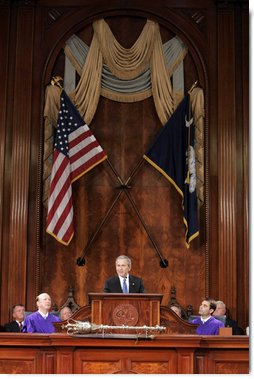
THE PRESIDENT: Thank you all very much. Mr. Speaker, thank you for that
kind and short introduction. (Laughter.) I appreciate Governor Sanford
being here. I want to thank the Lt. Governor. I appreciate President Pro
Tem McConnell, Majority Leader Leatherman, members of the South Carolina
legislature. I appreciate my traveling party from Washington. Hope you
appreciate them, too. That would be Senator Lindsey Graham, Senator DeMint,
members of the United States House of Representatives from the great state
of South Carolina. I appreciate the justices of the South Carolina Supreme
Court being here. I thank those of you who have taken time to come and
listen. I appreciate your warm welcome.
It is an honor to be speaking in this chamber. It is great to be back
in the capital of South Carolina. The last time I came to this city I
gave the commencement speech at USC. I was proud to have received an honorary
degree. When I told Laura about it, she said, "I thought your first
degree was honorary." (Laughter.) She sends her best and she sends
her love. She's, by the way, a fabulous First Lady. She is -- (applause.)
I appreciate our escort committee. I told the members that this is the
first time I have spoken to a legislative body, state legislative body
since I was the governor of Texas. So thank you for having me. It's --
there's some differences, of course. There are a lot of cowboy hats back
in Austin. (Laughter.) And I'll be honest with you, a lot of us didn't
know anything about dancing the shag. (Laughter.) And I imagine we could
have a pretty good debate about which of our states has the best barbecue.
(Laughter.) Now is not the time. (Laughter.)
But one thing is, no matter whether you serve at the federal level or
the state level, we share serious responsibilities. See, our constituents
have put us into office to solve problems now. That's what they've done.
They said, we've elected you to go to your statehouse, or in my case,
Washington, D.C., to solve problems. The people expect us to confront
problems without illusion. They expect us to lead with conviction and
confidence, not by reading the latest poll or listening to the latest
focus group. And above all, they expect us to deliver results.
And here in South Carolina, you've delivered results. You've faced serious
challenges, especially in your economy. Listen, we've had a stock market
decline, we've had a recession, we've had corporate scandals, we had a
terrorist attack on September the 11th, 2001, we've had the demands of
war. And all these have tested our nation's economy. And they hit particularly
hard here in your state. South Carolina's economic growth slowed; small
businesses moved out or shut down; workers lost their jobs; and state
finances were headed toward a free fall.
The people of South Carolina look to you and they look to your Governor
for leadership. And you delivered. You set clear priorities for your budget,
and you made hard decisions when it came to spending. To rein in the rising
costs of health care, you became one of the first states in the nation
to offer health savings accounts to state employees. To reward hardworking
families and job creators, you refused to raise taxes on the working people
of South Carolina. You focused bipartisan actions; you've lifted your
state out of fiscal crisis; you've erased a $155 million deficit, and
you've done it two years ahead of schedule. Today South Carolina families
are planning for the future with confidence.
I found this to be an interesting statistic about your state: More than
76 percent of the people in your state own their own home, one of the
highest rates in the United States. Small businesses are investing and
expanding, exports are on the rise. Thanks to your leadership, thanks
to your hard work, thanks to your willingness to set aside partisan differences,
jobs are coming back to the great state of South Carolina. (Applause.)
In Washington, we're moving forward with an ambitious agenda to keep
this country safe, prosperous and free. The war on terror goes on. There
are still ruthless enemies that would like to do harm to our people. We
will continue to keep the pressure on these folks. We'll work with our
friends and allies to be unrelenting in our search to bring them to justice.
We will not rest until America is safe. (Applause.)
We'll continue to work to improve security here at home, but in the long-term,
in the long run, the best way to protect America and to keep the peace
is to change the conditions that give rise to hopelessness and extremism.
And the best way to do that is to spread freedom around the world. (Applause.)
I don't believe freedom is America's gift to the world. I believe freedom
is the Almighty God's gift to each man and woman in this world. (Applause.)
My administration will continue to pursue pro-growth policies to ensure
that America is the best place in the world to do business. To keep the
economy growing and create jobs, we will keep the taxes low. (Applause.)
We'll continue to confront the problems of junk lawsuits by pushing for
meaningful asbestos and medical liability reform. We'll work with Congress
to pass an energy bill that will make America less dependent on foreign
sources of energy. (Applause.)
I sent to Congress a disciplined federal budget, and both the House and
the Senate have passed budget resolutions. And now they need to work out
their differences and send me a budget that meets America's priorities,
that restrains federal spending, and that keeps us on track to cut the
deficit in half by 2009. In Washington, and in Columbia, South Carolina,
government needs to follow a straightforward principle, a taxpayer's dollar
must be spent wisely, or not spent at all. (Applause.)
Strong leadership means rising to the challenges of the day. It also
means looking down the road. There will always be problems that arise
unexpectedly; yet problems -- some problems are completely predictable.
And as leaders, you and I have a responsibility to confront those problems
today, and not pass them on to future generations. (Applause.)
Over the past few weeks I've been traveling around the country talking
about one of the most serious and most predictable challenges which face
our nation, and that is the long-term fiscal health of Social Security.
Social Security has been a great success. Franklin Roosevelt did a really
smart thing in setting up the Social Security system. It has provided
an important safety net for millions of Americans. Seniors in South Carolina
and seniors across this country depend on their monthly checks as an important
part of their lives, as an important source of income for their retirement.
And today I have a message for every senior in South Carolina, and every
senior across this country: Do not pay attention to the propaganda and
scare ads. If you're receiving a Social Security check this month, you
will continue receiving a Social Security next month, and the month after
that, and every month for the rest of your life. (Applause.)
There are other Americans who are now approaching retirement and have
been paying into Social Security throughout their lives. These workers
are counting on Social Security as part of their retirement plans, and
there's money in the system for them. If you were born prior to 1950,
America will honor the promise of Social Security for you. The problem
is that the government is making promises for younger Americans that it
cannot pay for. In other words, there's a hole in the safety net for younger
Americans.
See, Social Security is a pay-as-you-go system -- you pay and we go ahead
and spend here in Washington. (Laughter.) We spend on -- to provide benefits
for current retirees, and with money left over, we have spent your payroll
taxes on government programs. Some people think there's a Social Security
trust, where the government is holding your money, in an account with
your name on it. It just doesn't work that way. That's not the way the
system works. There is no vault holding your cash, waiting for you to
retire. Instead, because we spend Social Security taxes on current retirees
and other government programs, all that is left over in the so-called
security trust is a bunch of filing cabinets with IOUs in them.
As a matter of fact, I went to West Virginia the other day to look at
the filing cabinets, to make sure the IOUs were there -- paper. And it's
there. And it's, frankly, not a very encouraging sight. It's not encouraging
especially when you consider that times are changing in America, that
the math for Social Security is changing significantly. By the math I
mean this: In 1950, there were about 16 workers paying taxes for every
beneficiary -- 16 workers for beneficiary. And today, there's 3.3 workers
for every beneficiary. By the time our children and grandchildren are
ready to retire, there will only be 2 workers paying for every beneficiary
in the system.
That's only part of the problem. To compound the problem, the first baby
boomers will soon start retiring. I happen to be one of them. As a matter
of fact, I'm eligible to start collecting benefits in 2008 -- which happens
to be a convenient year for me. (Laughter.) The retirement of the baby
boomer generation is going to have a huge impact on Social Security, because
my generation is about 50-percent larger than my parents' generation.
Today there are about 40 million retirees receiving benefits. By the time
all the baby boomers have retired, there will be more than 72 million
retirees receiving benefits. And thanks to advances in modern medicine,
these retirees will live longer and collect benefits over longer retirements
than the previous generation.
And to compound the problem even further, Congress has ensured that
benefits to my generation will grow faster than our economy or the rate
of inflation. In other words, people went around the country saying, vote
for me, I'll make sure your benefits are higher. And so this sets up an
enormous fiscal challenge facing Social Security. With each passing year,
there will be fewer workers paying ever higher benefits to a larger number
of retirees who are living longer.
And so here's the result: Three years from now, when the first baby boomers
start collecting Social Security benefits, the system will start heading
toward the red. Less than a decade later, in 2017, Social Security will
go negative. And by that I mean it will be paying out more in benefits
than it collects in payroll taxes. More money going out than coming in.
And every year after that the shortfall will get worse.
In the year 2027, the government will somehow have to come up with an
extra $200 billion to fund the system -- $200 billion more going out than
coming in through payroll taxes. In 2034, the annual shortfall will be
more than $300 billion a year. And by the year 2041, the entire system
will be bankrupt. Now, think about that. If we don't do something to fix
the system now, the students graduating this spring from the University
of South Carolina, or, in deference to the Speaker, Clemson -- (laughter)
-- will spend their entire careers paying Social Security taxes only to
see the system go bankrupt a few years before they retire.
And I don't care if you're a Republican or Democrat, these are the facts.
And the question is, do we have the will to do something about them. Now,
in South Carolina, you know that once you're in the red, the options of
getting out are never very appealing. If we allow Social Security to continue
on its current path toward bankruptcy, we will leave our children and
grandchildren with only a few drastic options to keep the system afloat.
In other words, the longer you wait, the longer we don't do anything in
Washington, the more drastic the solutions become.
For example, some estimate if we don't do anything, the payroll tax will
get up to 18 percent. Is that a legacy we want to leave on younger generations
of Americans? I don't think so. Or we're going to have to dramatically
slash benefits, or cut other federal programs. The Social Security trust
reported this: They said, every year we wait to fix the system will add
an additional $600 billion to the cost of reform.
I understand why some in Washington don't want to take on this issue.
I guess they calculate there's a political cost when dealing with a tough
issue. I think there's a political cost for not dealing with the issue.
And so I've been traveling this country of ours, making it absolutely
clear what the problems are. See, my strategy is pretty simple: Take the
message to the people and define the facts of the problem, and let the
people draw their own conclusions. I've been to 22 states to explain the
facts. I've been to those states to explain the urgent need for the United
States Congress to work with the administration to get something done
now. And more and more Americans are beginning to hear the message.
I'm just starting, I'm just warming up. As a matter of fact, I like getting
out of Washington, D.C. I like coming to places like South Carolina, to
put the facts on the table so the people can make their own mind about
what's happening in Social Security.
I don't know if you've ever heard of Dutch Fork High School in Irmo.
I met a very innovative teacher who assigned her students this assignment:
Why don't you write letters to the editor about their impressions of Social
Security? Here's what one of her students wrote: "By the time my
generation gets to the age to draw Social Security, there will be no money
left for us to draw on." This is a young high school student writing
that. This isn't a professor in economics. This is a high school student.
He said, "I don't know about other people, but I don't like the sound
of that." People are beginning to get the message that there is a
problem in Social Security.
Today I met an 80-year-old -- 80-year-old young woman from Silverstreet
named Shirley. She said she's counting on Social Security. She gets a
Social Security check every month, and she's confident she'll keep getting
her checks. And there's no doubt in her mind she's going to get her checks,
but there's a doubt in her mind as to whether or not her granddaughters
are going to have comfort in their retirement, whether or not the safety
net will be there for them. Here's what she said: She said, "I don't
know what I would do without it. It's my granddaughters that I'm worried
about, and I want to do whatever is possible to fix the system for them."
Folks, we're talking about a generational issue here in America. The
grandfolks are going to get their checks, and the fundamental question
is, do we have the will in Washington, D.C. to make sure the system works
for the grandchildren of America. And that's what I'm here talking about.
I believe I have a duty to ask people to bring ideas forward. I brought
a few myself, and I appreciate the response of Senator Lindsey Graham.
He's brought some ideas forward, as has Senator Jim DeMint, as has your
Governor. These men have been leaders in the debate. They've stepped up,
and said, here are some ideas I'd like you to consider. But they're not
the only ones who have set up good ideas. Former Congressman Tim Penny,
a Democrat from Minnesota, has suggested tying Social Security benefits
to prices rather than wages. My predecessor, Bill Clinton, had time --
had meetings all around the country on Social Security and he spoke of
increasing the retirement age at one time.
I put together a commission of Republicans and Democrats, headed by the
late Senator Daniel Patrick Moynihan of New York. And they did fine work.
They recommended changing the way benefits are calculated. In other words,
people are putting ideas on the table. An interesting idea was put forward
by a Democrat Social Security expert named Robert Pozen, who has proposed
a progressive way of structuring benefits that will be more generous to
low-income workers. And that's an important idea.
In other words, all these ideas are on the table, but they have one thing
in common -- they all require us to act now. Saving Social Security is
not a Republican goal, it is not a Democrat goal; it is a vital goal to
all our country. And people of both political parties need to get the
job done now. (Applause.)
There are some basic principles that must guide our efforts to fix Social
Security. We should not raise the payroll tax rate. That would hurt the
economy and cost jobs. We must ensure that Social Security continues to
provide dignity and peace of mind for Americans in retirement, and include
extra protections for those with low incomes. We must reject temporary
measures that put off Social Security problems for another day.
You need to be skeptical about any talk that talks about a 75-year fix.
Back in 1983, Republicans and Democrats came together on what they thought
was a 75-year fix. You know, I like the spirit of people of both parties
coming together, and that was great. President Reagan and Speaker O'Neill
said, we got a problem, let's come together to fix it. But they thought
it was a 75-year fix; here we are, 22 years later. It's time to come up
with a permanent solution. When people bring forth their ideas in Congress
I will insist that we not have a band-aid approach to Social Security,
that we have a permanent fix. And I'm optimistic about the chances for
meaningful Social Security reform.
You know, a few weeks ago the United States Senate voted on a resolution
guaranteeing that any Social Security fix must be permanent. The vote
has the agreement of the two senators from South Carolina, the two senators
from Texas, the two senators from Massachusetts. Anytime that happens
you've got yourself a bipartisan agreement. (Laughter.) In fact, the vote
in Congress was unanimous. Think about that. Every single United States
senator is on the record supporting a permanent fix. Now those senators
need to keep their word and make Social Security solvent once and for
all. (Applause.)
Bringing permanent solvency to Social Security is an important start,
but it's only part of our duty. Preserving Social Security should not
mean preserving its problems. Today we have an opportunity to offer younger
Americans a better deal than the current system. Today we can give every
American the chance to tap into the power of compound interest, so they
can get a higher rate of return on their money than the current system
allows. You might notice I said, "their money." See, we're not
spending the government's money. The payroll taxes are the people's money.
It's coming from hardworking people.
We can build this opportunity into Social Security by giving younger
workers the option to set aside some of their own money in a personal
retirement account. The account would be a conservative mix of bonds and
stocks that grows over time and can deliver a greater return than the
Social Security system does. That would be a good deal for younger workers.
Since 1983, since that reform took place, stock investments have returned
about 9 percent more than inflation per year, while the real return on
Social Security is about 2 percent a year. That means that a dollar invested
in the market in 1983 would be worth $11 today -- one dollar would grow
to eleven -- while the same dollar would be worth about three if it had
been put in Social Security. Every young American should have the opportunity
to take advantage of the compounding rate of interest, to earn a better
return on his or her own money.
Personal accounts would be completely voluntary; younger workers could
choose to join or choose not to join. That seems to make sense for government
to provide opportunities of choice for individual Americans. Workers opting
to open an account would be able to put about a third of their payroll
taxes in investments, instead of sending their money to Washington. For
example, a younger worker earning an average of $35,000 a year over a
career, because of the growth of money, would be able to retire with a
nest egg of nearly a quarter-million dollars. That would be a nice addition
to the other Social Security benefits.
These voluntary accounts would come with strict guidelines to make sure
they're secure. You couldn't take -- put them in the lottery -- sorry
to say, Speaker. (Laughter.) You could make sure the earnings aren't eaten
up by hidden Wall Street fees. We'll make sure there are good options
to protect investments from sudden market swings on the eve of retirement.
You won't be able to withdraw all your money and take it to the racetrack.
These accounts will offer straightforward investment choices that are
easy to understand.
By the way, this concept isn't new. After all, in South Carolina, all
state employees can choose to put part of their retirement savings in
a traditional retirement plan, or in a conservative mix of bonds and stocks
that can deliver a better rate of return. So when I talk about personal
accounts available for younger workers, you know what I'm talking about
right here in South Carolina. You've already made that decision for people
who are serving the state.
I don't know if you know this or not, but federal employees have that
same opportunity to watch their money grow, through a program called the
Thrift Savings Plan. It's a plan that allows members of the United States
Congress and the United States Senate to set aside some of their own money,
if they so choose to do so, in a conservative mix of bonds and stocks.
It seems fair to me that if setting up a personal savings account is good
enough for a member of the United States Congress, it is good enough for
workers all across America. (Applause.)
By giving younger workers an option to set up a personal savings account,
we have an opportunity to modernize and strengthen a great American program.
We have a chance to bring the Social Security system into the 21st century.
The reason I say that is, today young people are comfortable investing
in bonds and stocks. Millions of workers now choose to plan for retirement
with their own savings accounts, through programs like 401(k)s. I don't
remember growing up hearing the word 401(k) -- I don't think you remember
that. You're old enough to be around when they didn't have 401(k)s --
(laughter) -- or IRAs. We're not talking about a new culture, we're talking
about a culture that's already taken hold in our society, where workers
from all walks of life are watching their money grow and making decisions
on behalf of their families with where they invest.
See, telling younger workers they have to save money in a 1930s retirement
system is like telling them that they have to use a cell phone with a
rotary dial. (Laughter.) If young people are confident they can improve
their retirement by investing in a conservative mix of bonds and stocks,
the government should not stand in their way.
Creating these accounts will also give our children and grandchildren
a chance to replace a burden of uncertainty with a new opportunity. Instead
of leaving their full retirement in the hands of future politicians, younger
workers will be able to take part of their retirement into their own hands.
Instead of sending all the payroll taxes to Washington, younger workers
would be able to transfer part of their money directly into an account
they own and that the government can never take away. Instead of forfeiting
years of Social Security contributions if they die before retirement,
younger workers would have peace of mind that their personal accounts
could be passed on to a loved one.
Young people are learning more about the opportunity to own part of their
retirement, and they're making their opinion pretty clear. I met Philip
Meador today. He's a graduating senior from The Citadel. He told me he's
going to be starting a new job in June. He knows he's going to start paying
Social Security taxes. What he's not sure about is whether or not he'll
ever be seeing a Social Security check. He certainly will be paying in;
he's not so sure what's going to be coming out. He likes the idea of keeping
part of his money in an account that he controls. He said, "I like
the options. You choose what to put in, you choose the investments. It
depends on what you're looking for. I think every individual should be
able to choose a plan that fits them."
A lot of young people are beginning to say that. A lot of young people
want this United States government to come together of young people want
the government to give them the option of making choices with their own
money.
And I know you all feel the same way in this chamber. That's why you
passed resolutions calling the United States Congress to strengthen this
important program, Social Security, and to give younger workers the option
of voluntary personal retirement accounts. You recognize that a Social
Security system that includes personal accounts will give all Americans
-- not just a few, but all Americans -- a stake in the greatest creator
of wealth the world has ever known. You recognize that personal accounts
will bring the security and independence of ownership to millions of our
citizens. And you recognize that personal accounts are critical to building
an ownership society, a more optimistic and more hopeful America, in which
more people own their own homes, more people own their own businesses,
more people have a ownership in a retirement account, more people have
an asset base they call their own that they can pass on to whomever they
choose.
You see, owning assets ought not to be confined to a few people in our
society. Owning an asset and being able to pass it on to your son or daughter
ought not to be the purview of a few. In this great land, it ought to
be spread -- ownership ought to be spread to everybody who is lucky enough
to be an American. You recognize that when people own something, they
have a vital stake in the future of our country, and that personal accounts
will help give every citizen the chance, the opportunity to realize the
dreams of this land.
The legislature of this great state of South Carolina has shown leadership
on this important issue, and now the United States Congress needs to do
the same. I understand that Social Security is a tough issue, but Congress
has tackled tough issues before. We've seen in the past how leaders from
both parties can rise above partisan politics to meet great responsibilities.
And now is the time for them to do so again. (Applause.)
I am confident that members of Congress will come together to reach a
permanent solution. And when they do, our children and grandchildren will
one day look back and be grateful that our generation made the difficult
choices and the necessary choices to renew the great promise of the Social
Security system for the 21st century.
I want to thank you all for the invitation to come to your great state.
I appreciate you giving me a chance to come and visit. It's an honor to
talk about such an important topic with those who have been willing to
serve. May God bless you in your efforts, and may God bless your families,
and may God continue to bless the United States of America. (Applause.)
END 12:53 P.M. EDT
President Discusses Strengthening Social Security
in Washington, D.C., April 21, 2005
Grand Hyatt Hotel
Washington, D.C.
9:24 A.M. EDT
THE PRESIDENT: Good morning. Thanks for the warm welcome. It's a little
early for the Texas delegation. (Laughter.) I hope you're behaving yourselves.
I know you are, since Billy Gammon isn't here. (Laughter.) I am pleased
to be with the Independent Insurance Agents and Brokers of America. Thanks.
Laura told me on the way over to give you all her best. (Applause.) Generally
what happens when I mention her name, most people say, well, I wish you'd
have sent her. (Laughter.) She's doing great. She is a -- really a fine
person; a great mother, great wife and a great First Lady for America.
(Applause.) I'm a really lucky guy when she said, "yes," when
I asked her to marry me.
I really appreciate your inviting me and I appreciate your work. I appreciate
the way more than 300,000 of you around America help our fellow citizens,
help our fellow citizens protect their property, help our fellow citizens
provide for their families in case of calamity. Thanks for what you do.
Thanks for being good stewards within the communities in which you live.
I oftentimes tell people that the great strength of America is not our
military -- although we'll keep it strong -- the great strength of America
is not the size of our wallets. The great strength of America is the hearts
and souls of our fellow citizens who work in the communities in which
they live to feed the hungry, provide hope for the hopeless, provide shelter
for the homeless, who love a neighbor just like they'd like to be loved
themselves. I know that's what you all do on a daily basis in the community
in which you live, and thank you for making America a better place. (Applause.)
I welcome to you the nation's capital, where sometimes politics gets
in the way of doing the people's business. Take John Bolton -- he's a
good man I nominated to represent our country at the United Nations. John's
distinguished career and service to our nation demonstrates that he is
the right man at the right time for this important assignment. I urge
the Senate to put aside politics and confirm John Bolton to the United
Nations. (Applause.)
Politics in Washington has also made it hard for some to put aside their
differences to come to the table to strengthen Social Security. And that's
what I'm here to talk about today. I want to spend some time with you
talking about the fact that Social Security is headed for deep trouble,
and that those of us who have been entrusted by the people to serve our
country need to act now to make sure the Social Security system is there
for our children and our grandchildren.
I want to thank Bob Rusbuldt for giving me a chance to come. I appreciate
the invitation. I want to thank Tom Grau for his leadership role, as well.
But most of all, thank you all for your interest.
The men and women of the "Big I" -- I think that's what you
call yourselves -- (laughter) -- appreciate the principles that are important
for a healthy and strong -- a healthy and strong America. And I appreciate
the principles that you stand for, planning for the future and providing
Americans with more choices, and working to get your friends and clients
a better deal. I appreciate your commitment to standing with your clients
until their claims are settled, to help people through the rough spots.
You're ensuring the American Dream, and I appreciate that, as well.
By protecting homes and the savings of millions of families, you're helping
this nation be more secure for a lot of folks. And that's what I'm interested
in. I'm interested in a secure nation. I'm working to make sure this nation
is a prosperous nation. And we're working hard to spread freedom and the
peace we all want.
We have an ambitious agenda here in Washington. There's a lot to do.
The war on terror goes on. We're still at war. There's still a ruthless
enemy that would like to harm our country. They want to do us harm because
of what we believe. We stand for freedom and liberty and human dignity
and the rights of minorities, the right for people to worship freely.
And we're not going to change. And they don't like it. But we're going
to keep pressure on them. We'll work with friends and allies. We will
be unrelenting in our efforts to bring the terrorists to justice, and
we will not rest until America is safe. (Applause.)
In the long run, the best way to protect America is to change the conditions
that give rise to hopelessness and extremism. That's the best way to protect
generations of Americans to come. And the best way to change the conditions
that give rise to hopelessness and extremism is to spread freedom.
I oftentimes tell audiences this -- and it's important for our fellow
citizens and people around the world to hear this -- that freedom is not
America's gift to the world, freedom is the Almighty God's gift to each
man and woman in this world. (Applause.) I believe all people desire to
be free. I believe moms in the Middle East want their children to grow
up in a peaceful world so their children can have -- can realize their
God-given potential. That's what I believe. And if you believe that, then
you have an obligation to help spread that freedom. And freedom is on
the march.
Incredibly exciting times to live in, when you think about what has taken
place in a relatively quick period of time. The other day at the Lincoln
Library opening in Springfield -- and if you're here from Springfield
or Illinois, you've got yourself a heck of a library. (Applause.) You
know what I'm talking about. Well, you don't know yet. Go see it, and
then you'll know what I'm talking about. (Laughter.)
Just sometimes freedom moves slowly, like water cutting through a rock.
I said, but sometimes, when people see the example of courage, freedom
moves like a wildfire. Think about what's happened in a quick period of
time. Afghanistan is free. Millions of people voted for a President, in
spite of the fact that only a short time before that, they were under
the brutal control of the Taliban. Or in Ukraine, when people went to
the streets to demand free and fair elections. Or Kyrgyzstan, or in Lebanon.
By the way, our message is very clear to Syria: Take out all your troops,
take out all your intelligence services, and give the good people of Lebanon
a chance to have free and fair elections. (Applause.)
The world saw the courage of those who have freedom etched in their souls
in Iraq, courage of over 8 million citizens who are willing to defy terrorists
and killers and car bombers, to say with a message that resonated around
the world, we want to be free; we're willing to take risks to vote. A
free Iraq is important to America's security, is important for generations
of Americans to come to have an ally in the war on terror, like Iraq.
Today, the people of Iraq decide the fate of their government, and not
the other way around.
I look forward to working with the new government of Iraq. I look forward
to working with those who have been chosen by the people to meet the challenges
that this country faces. As Iraqis stand up for their freedom, this country
will stand with the people of a free Iraq. As a new government assumes
increasing responsibility for their country, security operations are entering
into a new phase. Iraqi security forces are becoming more self-reliant,
they're becoming better at what they do. They're taking on greater responsibilities,
and that means America and its coalition partners are increasingly playing
a more supportive role.
Today -- I don't know if you realize this or not -- over 150,000 Iraqi
security forces have been trained or equipped; for the first time, the
Iraqi army, police and security forces now outnumber U.S. forces in Iraq.
We're working on establishing chains of command. We're working to make
sure civilian government understands that there needs to be stability
in the security forces. Like free people everywhere, Iraqis want to be
defended and led by their own countrymen. That's easy to understand that
thought and desire. And that's what we want. That's the strategy of the
United States. And so we'll help them achieve this objective so they can
secure their own nation. And when they're ready and equipped, our troops
will come home with the honor they have earned. (Applause.)
We've got a lot of work to do to spread freedom abroad and we've got
work to do to pursue pro-growth economic policies here at home. And our
goal is pretty clear: We want America to be the best place in the world
to do business. That's what we want. We want it to be the best place to
risk capital. (Applause.) We've overcome a lot. We've overcome a recession
and a terrorist attack and corporate scandals and war. But our economy
is growing.
Let me tell you what I think we need to do to continue to grow our economy
so people can realize their dreams. First, one of the heaviest burdens
on business is the litigations costs in America. Recently I was -- (applause)
-- I was proud to sign the Class Action Fairness Act, a good piece of
legislation. It was a critical first step toward ending the lawsuit culture
in our country. (Applause.) Class action reform succeeded because members
of both parties saw a serious problem and joined together. That's a hopeful
accomplishment in a town too often bitterly divided because of politics.
And so my message to the Congress is, stay focused on what you can do.
Now we can do more work on -- when it comes to legal reform.
We need to take action on asbestos legal reform. (Applause.) We need
to make sure health care is available and affordable and one of the ways
to make sure health care is available and affordable is to do something
about the junk lawsuits that are running good doctors out of practice.
(Applause.)
When I first came to Washington, I thought medical liability reform would
-- could best be handled at the state level, until I realized what the
cost of the defensive practice of medicine, the cost of settling lawsuits,
the rising costs of premiums do to the federal budget. I mean, if you
think about the cost in the federal budget and the cost of frivolous lawsuits
in the federal budget, you begin to recognize why I think it's now a national
problem.
Listen, we pay for Medicare, we pay for Medicaid, we pay for veterans'
health benefits -- all those costs are affected by junk lawsuits. Medical
liability reform is a national problem that requires a national solution,
and now is the time for the United States Senate to listen to doctors
and patients and concerned citizens -- not to the powerful trial lawyer
lobby -- and get me a medical liability bill. (Applause.)
I also understand the importance of small business in creating jobs in
our country. That's why I worked with Congress to help reinvigorate our
economy, to help strengthen the entrepreneurial spirit by enacting the
largest tax relief in a generation. (Applause.) It's important to have
certainty in the tax code. Congress must understand that. And that's why
I've been urging to make sure that Congress makes the tax relief we passed
permanent. (Applause.)
Today, in large part to small businesses such as -- like yours, more
than 3 million new jobs have been added to our economy since May of 2003.
Today, more workers -- more Americans are working than ever before in
our nation's history. I applaud the House of Representatives for taking
the side of small businesses last week for voting to repeal the death
tax. (Applause.) The death tax results in unfair double taxation. They
tax your assets while you're alive, then they tax your assets when your
dead. (Laughter.) I believe we ought to bury the death tax forever. (Applause.)
By doing so, it will inject vital life into the small business community;
it will increase fairness in the tax code; it will help promote economic
security. The Senate -- the Senate needs to join the House in repealing
the death tax forever. (Applause.)
I want to spend a little time with you on Social Security. You know,
I know this is one of these issues that some wish I hadn't have brought
up in Washington. It's one of these issues that I suspect some of them
are really saying, gosh, I wish the President hadn't decided to take this
issue on. I campaigned on the issue. I said to the American people, if
you give me a chance to serve I will bring this issue to focus. That's
what I said in campaign stop after campaign stop -- if you give me a chance,
I'm going to talk about reforming the Social Security system. I'm confident
members of Congress, when they really think about that, will say, gosh,
it's good to have a President who does in office what he said he would
do on the campaign trail. (Applause.)
I also believe it is my duty and my obligation as your President to confront
problems now, and not pass them on to future Presidents and future generations.
(Applause.) That's why I've traveled the last few weeks to over 22 --
to 22 states, talking about Social Security. I mean, I have a strategy.
First I want to lay out to the American people we have a problem, because
I believe once the American people hear the problem, they're going to
then say to those of us who have been elected, what you going to do about
it. So I'm going to spend a lot of time talking about this issue.
You see, I think it's -- and the reason why is because I know how important
Social Security is to the country. Franklin Roosevelt did a good thing
when he created the Social Security system in 1935. I'm sure you've got
relatives who depend upon the Social Security check. I meet people all
the time in our country who say, you got to understand, Mr. President,
how important that check is to me. There's a lot of folks in this country
who count upon that check when it arrives. In other words, the system
has provided an important safety net for a lot of our fellow citizens.
And so the seniors who receive their checks must hear this loud and clear:
Don't fall prey to the propaganda, those who are trying to scare you when
there's talk about making sure the Social Security system is modern. If
you're receiving a check from Social Security today, you'll receive a
check next month and the next month after that and for every month you're
alive. The federal government will keep its commitments to the seniors
who are relying upon Social Security. (Applause.)
If you were born before 1950, you're in good shape with the system as
it exists today. You're going to get your check. The problem is, our government
has made promises to younger Americans that it cannot keep, and that's
important for our fellow citizens to know. It's important for them to
know that there is a hole in the safety net. The safety net for citizens
who retire is in good shape if you've been born before 1950. If you were
born after 1950, you better pay attention to the issue.
First, as I travel the country, I find out some people think there's
such thing as a Social Security trust. By that I mean we collect your
money through the payroll tax, and we hold your money for you, and then
when you retire, we give you your money back. No -- (laughter) -- that's
not the way it works. That's what you call a -- it was set up as a pay-as-you-go
system, in other words, you pay and we go ahead and spend. (Laughter.)
You pay through payroll taxes, and we spend your payroll taxes on making
sure we cover the benefits of the retirees. And with the money leftover,
like there's money leftover now, we spend it on other government programs.
So instead of having a trust, we have a pay-as-you-go system, and that
which exists in the system is a filing cabinet, or a series of filing
cabinets, full of IOUs. In other words, we've got paper.
And the reason I bring this up to you is that it's really important for
our citizens to understand how the system works, first and foremost. In
other words, when you're talking about strengthening and modernizing,
you've got to understand that all that is leftover in the system today
is paper.
This pay-as-you-go system worked just fine for a while. In 1950, there
were 16 workers paying taxes for each beneficiary. That's not a very heavy
load for a worker to pay one-sixteenth of the promise to the beneficiary.
Today, there's 3.3 workers per beneficiary. By the time our children and
grandchildren retire, there will be 2 workers for every beneficiary. As
you're beginning to see, the math is changing for Social Security -- fewer
people paying in the pay-as-you-go system per beneficiary, but that is
only part of the problem.
To compound the problem, baby boomers like me and a lot of you will be
eligible to retire in four years. See, I'm turning 62 in four years. It's
a convenient time, four years for me to retire. (Laughter and applause.)
The retirement of baby boomers will have a huge impact on the pay-as-you-go
Social Security system. And here's why: my generation's about 50 percent
larger than my parents' generation. Today, there are about 40 million
retirees receiving benefits. By the time all the baby boomers have retired,
there will be more than 72 million retirees receiving benefits.
We're going to be living longer, too. Medicine has changed to help us
live longer. A lot of us are exercising a lot. I would strongly urge exercise
if you want to live longer and make right choices for what you put in
your body. But we're living longer than the previous generation. And the
problem even gets further magnified because Congress has made sure benefits
to my generation grow faster than the rate of inflation or even the economy.
In other words, people who ran for office said, vote for me, I'm going
to make sure your benefits go up.
So think about what has taken place and what will take place relative
to the pay-as-you-go Social Security system. You've got a lot of people
retiring who are living longer who have been promised greater benefits,
with fewer people paying into the system. Those are the dynamics that
have made this issue a critical issue, particularly for younger generations
of Americans coming up.
Social Security system three years from now will start heading into the
red. In 2017, Social Security will start paying out more in benefits than
it collects in payroll taxes. A pay-as-you-go system, money coming in,
money going out. More money will be going out than coming in, in 2017,
and every year thereafter the situation gets worse. In other words, the
cash deficit for that year accelerates. In 2034, the annual shortfall
will be more than $300 billion. In 2041, the system will be broke, bankrupt.
So we've got a problem coming down the road.
Now, I recognize here in Washington 2017 may seem like a long way away.
It's not all that far away. It's 12 years from now. If you've got a 6-year-old
kid, your kid is going to be voting. If you think that's long, you haven't
raised a kid yet. (Laughter.) It happens just like that. If you're a grandparent,
you're going to get your check. But you've got to be wondering about whether
or not the burden is going to be so heavy on your grandchildren that the
America they grow up in is going to be a country burdened by obligations
that a Congress in 2005 was unwilling to confront.
You see, the longer we wait to fix this problem, the more drastic the
solutions become. As a matter of fact, the Social Security trustees say
every year we wait to fix the system will add an additional $600 billion
to the cost of reform. In other words, if this city gets locked down because
of politics, that lock-down costs a future generation $600 billion every
year. In other words, we've got a serious problem. And the point the trustees
make is, why don't you fix it now; why don't you come together to get
something done?
If we wait -- in other words, if you say, oh, gosh, well, it's too difficult
to do, or, we don't want to make so-and-so look good relative to such-and-such
-- if we wait, it's conceivable younger workers will have to have a payroll
tax of about 18 percent in order to make good on the promises. That's
not going to work, folks. If we wait, the benefits promised to a lot of
folks are going to have to be slashed dramatically, or other government
programs affected.
So recognizing this problem, I stood up in front of the Congress at the
State of the Union and said, here's the problem. I also said, bring forth
your ideas. See, I don't view this as a Republican problem, I don't view
it as a Democrat problem; I view it as a national problem that requires
people to come forward, say, here's my idea, or here's another idea. We've
had a lot of people starting to come forward; people have come forward
in the past. I was telling President Clinton when I traveled with him
to the Pope's funeral -- which, by the way, was a magnificent event. It
was just unbelievably spiritual and -- it was great, in recognition of
a great man.
But I said, I remember your -- I think it was 1996 town hall meeting
in Albuquerque. He probably said, what are you watching C-SPAN at such
a late hour for? But, anyway -- (laughter.) And people were encouraged
to bring forth ideas on how to permanently solve the Social Security problem.
That was in '96. Former Democrat Congressman Tim Penny has come forth
with good ideas. I asked the late Senator Daniel Patrick Moynihan of New
York to put together a bipartisan commission to look at Social Security
--this was in 2001. They came forward with a lot of good ideas. There's
a Democrat Social Security expert named Robert Pozen who believes we ought
to restructure benefits and be more generous to low-income workers. That's
a good idea. All ideas are on the table. That's how you get the job done.
And when somebody puts an idea on the table, you can rest assured the
White House will not attack them. And that's important for people to hear,
as well. Now is the time for a civil debate on how to solve this national
problem. Now, I do believe the reforms ought to be guided by certain principles:
We ought not to raise the payroll tax rate. (Applause.) Social Security
must continue to provide dignity and peace of mind for those with lower
incomes. That's an important principle for a good retirement system. We've
got to make sure that the solution is a permanent solution, by the way,
and not a temporary fix.
I really appreciated the spirit in 1983 of President Reagan and Speaker
O'Neill and others who said, we got a problem with Social Security, let's
come together and fix it. That's the kind of spirit that I'm confident
will prevail eventually here in Washington. By the way, this is the 22nd
anniversary of the 75-year fix on Social Security. (Laughter.) In other
words, at the time they said, we got us a 75-year fix. The problem is,
22 years later we're now talking about, let's make it permanent this time.
And so, when Congress debates these issues, it's really important to make
sure that we have a permanent fix, that we get it done once and for all.
I'm looking forward to hearing more good ideas, as people discuss the
issue. By the way, I'm encouraged; I believe we're going to get something
done. After all, the United States Senate looked at the issue and passed
a resolution that said we ought to fix Social Security permanently. That's
an interesting vote. You had the two senators from Texas voting "yes,"
and the two senators from Massachusetts voting "yes." That's
called bipartisanship. (Laughter.) See, they made it clear; they're on
record. Every single United States senator is on record supporting a permanent
fix for Social Security. And now those senators need to keep their word
and make Social Security solvent once and for all. (Applause.)
Bringing permanent solvency to Social Security is an important start,
but it's only part of our duty. Preserving Social Security should not
mean preserving its problems. Today, we have an opportunity -- as we permanently
solve Social Security we have an opportunity to make -- to give younger
Americans a better deal when it comes to the Social Security system. And
I want to spend a little time talking to you about what I mean by that.
See, I think we ought to give every American the opportunity to own assets.
I love the concept of spreading ownership throughout America. And I know
we've got to give younger Americans the opportunity to tap into the power
of compound interest so they have a chance to get a higher rate of return
on their own money, on their own assets than the current system allows.
Sometimes in Washington we seem to forget whose money we spend. You see,
those payroll taxes, that's not the government's money -- the payroll
taxes are hardworking people's money. And it seems like it makes sense
to me to give the hardworking people a chance to earn a better rate of
return on their money than the government does.
And so I think we ought to give younger workers the opportunity to save,
in the Social Security system, through what's called a personal retirement
account. Essentially, that would be a conservative mix of bonds and stocks
that grows over time. Today, the real rate of return on the Social Security
for your money is about 1.8 percent. At that rate, it will take you nearly
40 years to double your money. If you put the money in the market and
get a 4-percent return, your money will double in about 18 years. If you
get the historical market average of 7 percent, your money will double
in just over 10 years. That's what's called the miracle of compound interest
at work.
We have a fellow with us today named Wright Noll. He's 67 years old;
he's married with five children. He spent about 30 years as a schoolteacher
and an assistant principal, and most of that time in Bend, Oregon. By
the way, it's a nice place to live, right? He took what you might call
a sabbatical and spent six years as a dairy farmer. This guy is a hardworking
guy. At one point he held three jobs.
Wright says he paid roughly the same amount of money into both Social
Security and the Oregon state pension plan for government employees. Unlike
the money Wright put into Social Security, the money he paid into Oregon's
plan was saved and invested. As a result, the money in the Oregon plan
benefited from the power of compound interest, and he got a better --
bigger retirement check. Today, Wright's monthly Social Security check
is about $1,152 a month; his monthly check from the Oregon retirement
system is nearly $5,400. That's the power of compound interest.
When he said he started getting his retirement checks, he went out and
bought himself five brand new shirts. (Laughter.) He said, "I never
did that before because, being a schoolteacher with five kids, you have
to shop at the used clothing store."
I appreciate you coming, Wright. I appreciate you letting me use you
as an example of missed opportunity for a lot of people because of the
way the current system is structured. You see, I think we need to give
everybody a chance, if they so choose, to put some of their money in a
personal savings account, a conservative mix of bonds and stocks, so they
can get a better rate of return on their money. It's a voluntary idea.
I mean, government ought to not mandate this idea. But government ought
to say, we ought to give you the opportunity, give you a chance, if you
so desire.
In my proposal to Congress, I said, well, why don't you let a person
set aside a third of their payroll tax into a personal savings account?
Let me give you what that would mean for a younger worker who earned $35,000
over his or her lifetime. If you allow that person to set aside a third
of their payroll taxes with a reasonable rate of growth on their money,
that person earning that amount of money over their lifetime would have
a nest egg of about $250,000 upon retirement. That would be a nice addition
to other Social Security benefits. It's a part of the retirement plan.
That would mean that person would have their own assets. Their asset wouldn't
be tied up in a file cabinet in West Virginia. Their asset would be theirs
to call their own, an asset they can pass on to a -- to whomever they
choose -- a son, or a daughter.
These voluntary accounts would -- obviously, you'd have strict guidelines.
You couldn't take your money and put it in the lottery. In other words,
there's go-bys, there's a -- the investment vehicles are conservative
in nature. You've got to make sure your -- we'll make sure the earnings
aren't eaten up by hidden Wall Street fees; make sure there's good options
to protect investments from sudden market swings on the eve of retirement.
That happens all the time in the financial community, where if a person
is getting ready to retire and wants to convert from stocks and bonds
to annuities -- it happens all the time. You know what I'm talking about;
you do it all the time in advising people.
These accounts will offer straightforward investment choices that are
easy to understand. And I'm not talking about something new here. This
isn't a new invention. In Ohio -- if you're from Ohio, you know what I'm
talking about -- thousands of government employees at the state, county
and local level have personal retirement accounts as part of their retirement
system. I just went to South Carolina; all new state employees can choose
between their traditional retirement plan and a personal retirement account,
with a conservative mix of bonds and stocks to deliver a better rate of
return for them.
I don't know if you know this, or not -- Congress knows it -- federal
employees, including members of the United States Congress, have the option
of taking some of their money and putting them into a conservative mix
of bonds and stocks. They've got the opportunity to do that. Do you know
why they gave themselves the opportunity? Because they want to get a better
rate of return on their money. I believe if this opportunity to put aside
personal savings account -- money in a personal savings account is good
enough for the United States Congress, it's good enough for working people
all across the United States. (Applause.)
Do you know what's really interesting about today's society? Some of
you older fellows out there probably didn't spend much time talking about
401(k)s, when we were in our 20s -- or IRAs. I mean, the investment world
has changed, hasn't it? It really has. I mean, there's a lot of young
people who are comfortable with the idea of taking some of their own money
and watching it grow. They're used to making decisions about their money.
I mean, after all, the world really has changed when it comes to retirement
plans and companies trusting people with their own decision-making. Offering
young workers a 1930's-era retirement system is like trying to persuade
them that vinyl LPs are better than iPods. (Laughter.)
Voluntary personal accounts are a way of bringing Franklin Roosevelt's
promises of retirement into the 21st century. Creating accounts will give
children and grandchildren a chance to replace a burden of uncertainty
with new opportunity. Instead of leaving their full retirement, all their
retirement in the hands of future politicians, younger workers will be
able to take part of their retirement in their own hands. I like that
idea.
Instead of sending their money to Washington so politicians can spend
it, younger workers will be able to put part of their money into an account
they own that nobody can take away from them. Instead of forfeiting years
of Social Security contributions if they die before retirement, which
happens in the current system, younger workers would have peace of mind
that their personal accounts could be passed on to a loved one. (Applause.)
My administration works hard to spread ownership throughout America.
I want more people owning their own home, I want more people owning their
own small business, I want more people owning a piece of their retirement,
because I know that when a person owns something they have a vital stake
in the future of this country. And ownership should not be confined to
just a few people in our society. Owning an asset and being able to pass
it on to your son or daughter should not be the purview of a few. In this
great land, ownership ought to be spread to everybody -- every single
person.
As Wright Noll will tell you, the power of compound interest is important,
as well. He sees that every month in the checks he gets. Members of Congress
need to listen to the people. A lot of people in America now understand
we have a problem. A lot of people are sorting through the data. They're
listening to the debate. They're hearing all the noise coming out of Washington.
But they're hearing we got a problem. I'm going to keep talking about
it over and over again because I want the people to understand the stakes
of doing nothing.
Older Americans are beginning to hear loud and clear that if you get
your check nothing changes. And that's important for our citizens to hear.
I'm sure some of you all have got a mom or a dad wondering what old --
why is George W. talking about this. I want to make -- just tell him,
make sure I get my check. (Laughter.) You'll get your check. You'll get
your check.
There are some folks around this town trying to scare you because they
don't want to see anything happen. But our citizens who count on Social
Security will get their check. Baby boomers like me, we're fixing to retire,
and there's a lot of us. This is an important issue for us, but it's really
an important issue for your children and grandchildren.
We have an obligation to save and strengthen this important program for
generations of Americans to come. And when Congress acts, there will be
plenty of credit for everybody involved. And when they do, our children
and grandchildren will one day look back and be grateful that our generation
made the difficult choices and the necessary choices to renew the great
promise of the Social Security system for the 21st century.
Thank you all for giving me a chance to come by. (Applause.)
END 10:08 A.M. EDT
President Participates in Social Security Roundtable
in Texas, April 26, 2005
The University of Texas Medical Branch
Galveston, Texas
12:33 P.M. CDT
THE PRESIDENT: Thank you all for coming. (Applause.) It is nice to be
home. I want to thank the Mayor for being here. Lyda Ann Thomas greeted
me coming in. I said, "Do you still have Splash Day?" (Laughter.)
You have to be a baby boomer to know what I'm talking about. (Laughter.)
I'm not saying whether I came or not on Splash Day, I'm just saying, do
you have Splash Day. (Laughter.)
It's great to be back in Galveston. What a cool city. Thanks for having
me. (Applause.) And thank you all for giving me a chance to come and talk
about Social Security. I've got some things I want to say before we get
there, and as you can tell, I'm joined by some of our citizens who are
willing to discuss some interesting ideas when it comes to making sure
the safety net of Social Security is available for younger generations
of Americans.
Before I get there, though, Laura sends her love. (Applause.) I know
the Vogelpohls are here -- there's Kris Anne, sitting over there. She
always was my kind of southeast Texas mother, constantly telling me what
to do. (Laughter.) Like my Houston mother would do. (Laughter.) But Laura
sends her best to you and Elmer. Thank you all for coming. And we're really
pleased to be with a lot of other friends, as well. When I come back to
Texas, I get a little nostalgic. It reminds me of the days when I was
knocking on doors, asking for votes, and a lot of people in this county
and around our state were so gracious and kind to me and Laura. I got
to tell you, there's nothing better than coming home to make sure you
don't forget the culture from where you came. (Applause.)
I really want to thank Dr. Stobo and the University of Texas Medical
Branch for hosting us. This is a fabulous facility. It is -- (applause.)
A lot of my friends were trained here. Most of them ended up being pretty
good doctors. (Laughter.) It is really neat to be back to this facility.
And I was talking to Congressman DeLay, who kindly joined us today, and
he was saying that this was -- this hospital is going to be the Texas
center for bioshield research, to help us make sure that -- (applause)
-- to make sure that our country is well-prepared, as we engage in this
war on terror.
No better place, by the way, to do substantial research than right here
at the University of Texas. I used to call it, Texas- Galveston. I guess
we've got a new fancy name for it. Anyway, right here at University of
Texas on the island of Galveston. So, Doc, thanks for having me. I appreciate
the doctors who are here, and the nurses. Thank you for working in medical
care.
We got a lot to do in Washington. We got to make sure the Medicare system
functions well. We've got to make sure that we bring electronic records
to the health care industry so that it becomes modern, as we deal with
-- as we deal with patients' needs. We got to spread health savings account,
which empowers consumers to make decisions. And most of all, it seems
like to me, one way to send a clear message that we're interested in making
sure health care is available and affordable is to pass medical liability
reform out of the United States Senate to protect our docs around the
country. (Applause.)
And I appreciate the leadership of Congressman Tom DeLay in working
on important issues that matter to the country. (Applause.) We've got
us a good medical liability bill out of the House. It's, of course, stuck
in the Senate. We've now got us a good energy bill out of the House. And
for the sake of our national security and the for the sake of our economic
security, the United States Senate needs to get an energy bill to my desk
as soon as possible. (Applause.)
I also appreciate Kevin Brady joining us, as well. Congressman Brady
is with us. He's a hardworking Congressman. (Applause.) You still call
the Woodlands home, don't you? Yes, Woodlands. I knew him when he was
a lowly state representative. (Laughter.) He knew me when I was a lowly
governor. (Laughter.)
I appreciate all the state and local officials who are here. I had the
honor, when I landed, of meeting Dorothy Paterson. Dorothy is a breast
cancer survivor. And the reason I bring her up is she is a -- she's a
volunteer in organizations that promote breast cancer awareness and education.
That's important. What else is important is the fact she takes time out
of her life to volunteer. The strength of the United States of America
lies in the hearts and souls of our citizens. The true strength of this
country happens on a daily basis when somebody loves a neighbor just like
they'd like to be loved themselves. If you're interested in serving America,
if you're interested in helping to change our society, one heart and one
soul at a time, volunteer to make a difference in somebody's life just
like Dorothy has.
Thanks for coming, Dorothy. (Applause.)
Social Security. A lot of people said, you shouldn't talk about it, Mr.
President. Well, first of all, I campaigned on it. I said I believe we
have a serious problem; elect me, and I intend to something about it.
Secondly, I believe the job of a President is confront problems -- not
pass them on to future Presidents or future generations. And I see a problem
in Social Security. And it has to do with me and guys like Yarbrough.
(Laughter.) We're baby boomers. We're getting ready to retire, and there's
a lot of us. As a matter of fact, I believe there's about 40 million retirees
today. When we end up retiring, we baby boomers retire, there are going
to be 75 million people. There's a bulge of people getting to -- getting
ready to retire.
And we're living longer, thanks to good medicine, and thanks to making,
by the way, right choices -- exercise, moderation, no smoking. We're living
longer. And interestingly enough, people ran for office saying, vote for
me, I'm going to make sure that your generation gets better benefits.
And so we're getting better benefits than the previous generation. So
think about that: a lot of people living longer, retiring with better
benefits and fewer people paying into the system.
In 1950, 16 workers were paying for every beneficiary. Today, there's
3.3 workers for every beneficiary. Soon there's going to be two workers
for every beneficiary. To me, that says we got a problem. And then when
you start calculating the math -- and our expert here is going to help
me on this -- you'll find that Social Security -- which is not a trust
or a savings account, it's a pay-as-you-go system -- goes into the red
in 2017. That means there's more money coming out than going in.
You see, a lot of folks, I'm sure some right here in this audience, believe
Social Security is a system where we take your payroll taxes and we hold
it for you, and then when you retire, we give it back to you. That's not
the way it goes. We take your payroll taxes; we pay out the benefits to
the current retirees; and with the money left over, we pay -- pay for
other programs. And there's nothing left but file cabinets with IOUs.
And that's how it works.
In 2027, the system, is going to be $200 billion a year in the hole.
And it gets worse every year from 2017 on. So I see a problem. Interestingly
enough, Americans now understand we have a problem. I've been to 23 states
explaining the problem; I'm going to continue making sure that the American
people understand what is at stake.
A lot of seniors are worried about this topic being discussed; I understand
that. They've been told, you know, somebody is going to take away your
check, when it comes to modernizing the system. That's been a part of
the political rhetoric for way too long. The good news is, nobody has
ever had a check taken away from them -- yet -- and nobody will.
If you've retired, if you were born prior to 1950, the system will take
care of you. You don't have a thing to worry about. I don't care what
the pamphlets say, or the radio ads say, or the scare tactics say, you're
in good shape. And that's important for a lot of our seniors to hear because
they're counting on that Social Security check.
Franklin Roosevelt did a smart thing when he set up the system. It --
Social Security has provided an important safety net for a lot of seniors
for a lot of years. The problem isn't for today's seniors. The problem
is for a younger generation of Americans coming up. They're going to have
to pay for people like me who are living longer, who have been promised
greater benefits. That's where the problem exists. I like to describe
this as a generational issue. You see, once the grandparents understand
they're going to get their check and the system will fulfill its promise,
the question I get from grandparents is, what are you going to do about
my grand kids?
And that's the question that now confronts the United States Congress.
The people of this country understand we have a problem. And the question
confronting the Congress is, do you have the political will to do something
about it? And I'm going to continue traveling this country, insisting
that the people who have been given the high responsibility of serving
in the House of Representatives and the United States Senate do their
duty and make sure the safety net is available -- the Social Security
safety net is available for younger Americans coming up. (Applause.)
Too much politics in Washington, D.C. There's too many people saying,
well -- (applause) -- well, we can't work with this group because it might
help them get an upper hand, or can't work with that crowd because they
might get an upper hand. That's just -- you know, it is -- it is defeating,
self-defeating to talk like that. We've got to rise above the politics,
the zero-sum attitude.
I appreciate the Senate Finance Committee today, by the way, having hearings.
Both Republicans and Democrat experts are now testifying that we need
to come together to get something done, see. And that's -- and we're making
progress. If it were easy, it had been done by other Presidents and other
Congresses. This is hard work, to get people to do the hard thing in politics.
But I'm confident we'll get something done.
And that's why I went in front of the United States Congress at my State
of the Union and said, all ideas are on the table. If you've got a good
idea, bring it forward. I don't care if it's a Republican idea, or a Democrat
idea, independent idea, Texas idea, any kind of idea, bring it forward,
because now is the time for people to be talking about how they think
we can best solve the problem in the long-term for a younger generation
of Americans.
I say solve it forever, by the way. In 1983, Ronald Reagan and Tip O'Neill
sat down and said, we've got a significant problem, let us come together
to fix it. And they put together what's called a 75-year fix. Here we
are, 22 years later, talking about the 75-year fix. In other words, now
is the time to fix this permanently.
And as we fix it permanently, I want the -- I think the Congress needs
to come together and make this a better deal for younger Americans. And
what do I mean by that? I mean younger Americans ought to be allowed to
take some of their own payroll taxes, some of their own money, and invest
it in a savings account, a personal savings account, an account they call
their own. And here's why I think it's a vital part of making sure the
Social Security system is a better deal for younger Americans.
First of all, in a conservative mix of bonds and stocks, you get a better
rate of return on your money than the federal government gets for you.
And that's important because over time, there's something called the compound
rate of interest. In other words, it grows. Your money grows over time.
If you hold it in a conservative mix, it grows. For example, if you're
a worker making $35,000 over your lifetime, and your -- the government
allows you to take a third of your payroll taxes and sets it aside in
a conservative mix of bonds and stocks that earn, say, 4 percent, that
money will yield $250,000 over your lifetime, which is a heck of a good
nest egg for a lot of folks. That's money you call your own.
And that nest egg would be a part of a retirement package. The government
is going to be able to afford something for younger Americans when it
comes to Social Security. That's part of the debate in Washington. But
a nest egg you call your own is a complement to your retirement.
Secondly, I like the idea of people owning something. We want people
owning something in America. If you own something, you have a vital stake
in the future of your country. If you own your asset you can pass it on
to whomever you choose. We want more people owning assets, more people
saying, I want to pass this on to my son or daughter. I think it will
be healthy for our country if we can do that.
Secondly -- thirdly, we want a system that makes sure that we don't harm
widows. Today if you work all your life and happen to die before 62, and
your wife or husband works alongside you, you get survivor benefits when
you turn 62, or the benefits from Social Security, which is ever higher,
but not both. In other words, if you think about that, somebody is working
all their life and they die early, their asset just goes away. The money
they've contributed isn't available.
If you have an asset you call your own that you can pass on to whomever
you choose, that grows better than the rate that you get from the government,
your spouse and surviving family members will have something to help them
through tough times. In other words, ownership has important implications
for our society, but it's also got practical implications. It helps families
and allows workers to get a better rate of return.
And you've got such a plan here, by the way, a plan where people can
watch their own money grow, right here in Galveston County, which we're
about to talk about. By the way, this isn't a new idea that I'm talking
about -- Galveston County, Brazoria County, Matagorda County has got it
right here. As a matter of fact, 25 percent of 23 million state and local
government employees in America don't take part in the Social Security.
They've got a different system. And we're about to talk about the system
you've got here. It's important for people to understand there's a different
system available.
Secondly, guess who gets to invest in personal retirement accounts in
their own retirement funds. Members of the United States Senate and United
States House of Representatives. Federal employees have the option of
taking some of their money aside, putting it in a conservative mix of
bonds and stocks and watching their own money grow, to get a better rate
of return than that which the government could get for them.
My attitude, and my comment to members of the United States Congress
and Senate: If taking some of your own money and setting it aside in a
personal account to get a better rate of return on your money is good
enough for you, it's good enough for workers all across America. (Applause.)
Just -- let me just give you a sense for the difference between what
a worker gets here in Galveston and then a worker would get out of Social
Security. If you get a 3.75 percent return, like they guarantee here in
Galveston, on your money, and you're a person working 37 years, making
about $25,000 a year, you'd receive $1,250 a month from the alternate
plan now available for workers here -- as opposed to $669 from Social
Security. (Applause.) Think about that. That's a difference between a
better rate of return on your money over a 37-year period.
Of if you're an employee working for the same amount of time and earning
$75,000, you'd receive $3,600 a month from the alternative plan they've
got here, as opposed to $1,300 from Social Security.
So I hope you're getting a sense for when I say, let's give a better
deal for younger workers. And a better deal would not be mandatory by
the federal government. The better deal would say, if you so choose, you
can take -- put aside some of your own money. If that's your desire, you
ought to be allowed to take it and set it aside. And so I'm traveling
the country making it clear to people that there are better options available
than the current Social Security system, a better deal for younger workers.
It's all aimed at patching the hole in the safety net for a young generation
of Americans coming up.
One of the things I try to do is surround myself with experts. We've
got a Ph.D. with us today -- Syl, it's good to have you. He is a fellow
who's studied the Social Security issue. For those of you who are students,
there's an interesting lesson to be learned here. Syl obviously is a really
smart guy, Ph.D.; I'm a C student. (Laughter and applause.) A couple of
B's scattered in there. (Laughter.) I want you to notice who's the advisor
and who's the President. (Laughter and applause.)
All right, Syl. With that -- with that glowing introduction -- (laughter)
-- get your mike up so they can hear.
DR. SCHIEBER: Thank you, Mr. President.
* * * * *
THE PRESIDENT: Good job, Syl. Three weeks younger?
DR. SCHIEBER: I was born on the 24th.
THE PRESIDENT: Of July. Yes.
DR. SCHIEBER: Good month. (Laughter.)
THE PRESIDENT: You don't look a day over 65. (Laughter.)
DR. SCHIEBER: I've got a hard job.
THE PRESIDENT: That's right, yes. (Laughter.)
Jim Yarbrough, county judge, right here from Galveston, Texas. (Applause.)
Yes. You were sworn in '95, right?
JUDGE YARBROUGH: Yes.
THE PRESIDENT: He was sworn in, in January of 1995.
JUDGE YARBROUGH: Some people say too long. (Laughter.)
THE PRESIDENT: Not the voters. Thank you for joining us. I've known him
for a long time. I got sworn in -- governor in January of 1995. And the
state survived. (Laughter.) And so did the county. Thank you for being
here.
I was in Ohio recently, and they had a program for their -- started off
with their colleges to attract professors. And they said, well, let's
let some of the professors take some of their money and invest it in personal
savings accounts. It worked so well for the professors that everybody
started asking for the same benefit. In other words, my point is that
it's not just in Texas that workers are allowed to -- government workers
are allowed to set aside money. There's Ohio, and there's a lot of other
states, as well. Texas is -- you've been doing this for how long? Explain
the program if you don't mind.
JUDGE YARBROUGH: Ten years. Well, Mr. President, I've had the good fortune
to be county judge for 10 years. And on behalf of all the people of Galveston
County, Republicans and Democrats, we appreciate you coming to Galveston.
THE PRESIDENT: Thank you, sir. (Applause.)
JUDGE YARBROUGH: We are truly fortunate in Galveston County. We have
two retirement plans that our people contribute to.
* * * * *
THE PRESIDENT: See, it's an interesting concept. Our world has changed
a lot since Franklin Roosevelt signed the bill for Social Security. In
other words, the government is beginning to trust people more, Galveston
County, the county judge sitting here saying, we want to give people some
options. In other words, the government is basically saying, we trust
you to make the right decisions for your family. It's an interesting thought,
isn't it, as opposed to saying, here's your check. (Laughter.) It's --
and that's an important -- (applause.)
Can you get a pretty good rate of return? They've got, actually, a guaranteed
rate of return.
JUDGE YARBROUGH: We guarantee a 3.75 percent rate of return. We've been
experiencing 4 or 5 percent over the last several years. So, yes.
THE PRESIDENT: That stands in contrast, by the way, between the 1.8 to
2 percent that the federal government is getting on your money. And that
difference in interest is really important -- really important -- because
it compounds over time, interest does, and it grows. If you're a younger
worker -- we're about to talk to some younger people -- it will grow over
time, to make sure that you have an asset base.
Let me ask you something. The death benefit -- it's interesting -- the
death benefits in Social Security today, by the way -- again, I repeat,
if you're married and your husband pre-deceases you and you're not 62,
you get no death benefits. A person could be working all the time, or
the wife could be working and the husband survives, you don't get any
death benefits until you're 62. And then if you happen to be retired,
and you're getting benefits as a result of your own labor, you don't get
both. You don't get your spouse's contributions. You only get your own.
It sounds like a lousy deal to me.
How does it work for your --
JUDGE YARBROUGH: For our people, Mr. President, if someone were to die
while they were employed by the county, they would get a life insurance
policy four times their annual salary that would go to their beneficiary,
plus their family would get the money that's in their individual account.
If you're a retiree in our plan -- again, like Kathryn here, she gets
a $50,000 paid-up policy as part of our alternate plan.
THE PRESIDENT: Let me ask you something. I think a lot of people are
worried about Wall Street, hidden fees. You hear talk about what we're
-- of course, they want this to happen. These Wall Street people are going
to end up benefiting mightily as a result of people. How do you make sure
-- investing, how do you make sure people are --
JUDGE YARBROUGH: We have contracts in place with -- minimal fees. We
are investing in government securities, direct obligation of the U.S.
government, minimal risk. Not going to hit the home run with it, but it's
not going to take a step back. And so it's very safe. Minimal fees for
our employees to participate.
THE PRESIDENT: Right. The Thrift Savings Plan the federal government
has, by the way, has a different little mixture -- a different mixture
than what he's talking about. They've got bonds and stocks. There are
-- it's a set plan. People can choose. You can actually begin to mix up
your investments if that's what you choose to do.
What's important here is the philosophy behind what Galveston County
is doing, the idea of saying, we can do a -- you can own your own asset
and watch it grow. We're about to talk to somebody who opens up their
monthly statement -- which I think is healthy for our country, by the
way -- but also, you get a better rate of return and you trust people.
Kathryn Novelli, welcome.
MRS. NOVELLI: Thank you.
THE PRESIDENT: So, are you retired? You don't look it. I'm just asking,
are you? (Laughter.)
MRS. NOVELLI: Yes. I retired one year ago, January, so I've been off
a year.
THE PRESIDENT: Really? So are you fishing a lot on the piers? (Laughter.)
MRS. NOVELLI: We haven't gone fishing yet. We've been roaming.
THE PRESIDENT: Roaming? (Laughter.) That's good. Is your Harley running
well? (Laughter.)
MRS. NOVELLI: It's my Yamaha. (Laughter.)
THE PRESIDENT: So tell us what you do.
MRS. NOVELLI: Okay, I collect my --
THE PRESIDENT: You worked? You worked before? Sorry to interrupt.
MRS. NOVELLI: Oh yes, I was in the civil department -- I was with the
county for 21 years, and I had worked before that, so I still get Social
Security, also.
THE PRESIDENT: So you worked in the private sector.
MRS. NOVELLI: Yes, I worked 14 years.
THE PRESIDENT: And you're getting your Social Security check now.
MRS. NOVELLI: Yes. And I'm getting a --
THE PRESIDENT: Any doubt you'll get your check? That's good. (Laughter.)
I'm not teasing on this. It's really important for seniors to understand,
you are going to get your check. I know there's a lot of rhetoric out
of Washington, a lot of attempts to kind of frighten people. You're going
to get your check.
MRS. NOVELLI: Yes.
THE PRESIDENT: Good. I'm glad you feel that way. It's important for me
to know.
MRS. NOVELLI: President Bush, if they would listen to you, they would
know. (Laughter and applause.)
THE PRESIDENT: Yes, well -- she's doing good. (Laughter.)
MRS. NOVELLI: I'm sorry.
THE PRESIDENT: No, you're doing great. (Laughter.) I'm the funny guy,
not you. (Laughter.) So tell me, so then you worked for the county and
you get this --
MRS. NOVELLI: I get a check a month from my alternate plan, because that's
the way we chose to do it, plus I get my retirement check and I get my
Social Security.
THE PRESIDENT: And how do they inform you in the alternate plan? In other
words, is there an information process --
MRS. NOVELLI: I met with Mr. Newman, Tolbert Newman, (ph) and he showed
me all the options, either take it all at one time, or take it once a
month. And this is what we chose. But we left it in for a year because
they pay more interest than the banks or the credit union.
THE PRESIDENT: And that interest makes a difference?
MRS. NOVELLI: Yes. And while I'm drawing mine monthly, it's still gaining
interest in there, the rest of it is.
THE PRESIDENT: Don't you think it's healthy to have somebody saying,
my money is gaining interest, I'm watching my money grow, I wish I could
-- this is an important concept that we're talking about that ought to
apply to every single American, not just those who are fortunate enough
to work in Galveston County, not just those who are fortunate enough to
work for the federal government, but every American ought to have the
option of watching his or her money grow, get a better rate of return
is what we say. (Applause.)
MRS. NOVELLI: Plus nobody can touch it.
THE PRESIDENT: Yes. You just said something else that was profound. What
was it?
MRS. NOVELLI: Nobody can touch it but you.
THE PRESIDENT: Yes, not me, but you.
MRS. NOVELLI: No, I know. I know. But me. (Laughter.)
THE PRESIDENT: Yes, nobody can touch it but you. (Laughter.)
MRS. NOVELLI: Right, this you.
THE PRESIDENT: Yes, that's interesting, isn't it. Syl was talking about
the file cabinets -- file cabinets of IOUs, basically the asset of the
Social Security system -- paper. And Kathryn is talking about her retirement
plan is based upon something the government can't take away. It's hers.
Nobody can touch it but Kathryn. And that's really an important difference
between a modern Social Security system, where we repair the hole in the
safety net for future generations of Americans, and today's Social Security
system.
Social Security has worked really well for a lot of people, and it's
an important, important system. It's not going to work well for younger
Americans. And now is the time for the Congress to set aside political
differences and come to the table in good faith to solve this problem.
We got some -- thank you very much, Kathryn. You did a great job.
We got the Bentleys with us. (Applause.) Good job. Chris and Bea Bentley.
We'll start with Chris, if that's okay. Chris, you have two jobs?
MR. BENTLEY: Yes, sir. I'm currently -- I've been employed with Galveston
County for 13 years.
THE PRESIDENT: Yes.
MR. BENTLEY: I've been putting into alternate plan since I started. It's
a great plan. You get back twice what you put into it. You can monitor
it. You can manage it. And best of all, like you said, it's locked.
THE PRESIDENT: Yes.
MR. BENTLEY: Nobody can touch that.
THE PRESIDENT: And what's your other job?
MR. BENTLEY: Currently, I'm also in the Army National Guard. I'm a --
(applause.) Thank you. I'm currently deployed with the 36th Infantry Division
--
THE PRESIDENT: Say that again? Some of us older baby boomers have trouble
hearing. (Laughter.)
MR. BENTLEY: I'm currently deployed with the 36th Infantry Division out
of Austin.
THE PRESIDENT: Yes.
MR. BENTLEY: And we're operating in central Iraq. I'll be back there
next week.
THE PRESIDENT: So you're home -- home on leave?
MR. BENTLEY: Yes, sir, I'll be back there next week.
THE PRESIDENT: Yes, thanks for serving. (Applause.) Any observations
or thoughts?
MR. BENTLEY: It just seems like progress is being made. And I got a good
bunch of guys, they're doing good things. And every day we go out and
do what we do, and we're motivated to do it.
THE PRESIDENT: Yes. Send them a message: First, the country is with them.
And secondly, that their work is really important to -- for peace. This
is a mission of spreading freedom. And free societies are peaceful societies.
And a free society in the heart of the Middle East will be an amazing
legacy for generations to come. And I appreciate their sacrifice.
MR. BENTLEY: Yes, sir. (Applause.) Thank you.
THE PRESIDENT: All right.
Bea Bentley, how many children you got? Want to go back to Chris? (Laughter.)
She's proud of her man.
MR. BENTLEY: Yes.
THE PRESIDENT: How many children you got?
MR. BENTLEY: We have two children. We have a four-year-old son named
Patrick, and a three-month-old daughter named Elaine that I just got to
meet for the first time.
THE PRESIDENT: Really?
MR. BENTLEY: Yes, sir.
THE PRESIDENT: No wonder you're emotional. (Laughter.) That's awesome.
MRS. BENTLEY: She was born two days after he deployed.
THE PRESIDENT: Yes, great. Where was she born?
MRS. BENTLEY: Right here at UTMB. (Applause.)
THE PRESIDENT: How was the care?
MRS. BENTLEY: It was wonderful.
THE PRESIDENT: Awesome, isn't it?
MRS. BENTLEY: Absolutely wonderful. Everyone here has been wonderful
to us.
THE PRESIDENT: Congratulations. And you work? What is your job?
MRS. BENTLEY: I've been with the county for 13 years. I worked in Judge
Yarbrough's office for eight.
THE PRESIDENT: That deserves combat pay. (Laughter.)
MRS. BENTLEY: I'm an administrative assistant in his office, and I enjoy
working for the county. When I came to work for the county in 1993, the
gentleman I came to work for, that was a big selling point for him to
get me to come here was there were two retirement plans, and if I stay
until I retire, what a huge benefit it would be for me and my family in
the end.
THE PRESIDENT: It's interesting, isn't it -- allow you to watch your
own money grow becomes a recruiting tool to convince people that this
is a good place to work.
Anyway, so you decided to work.
MRS. BENTLEY: Yes, I've been very happy here. And I like that I get my
statement every quarter and enjoy seeing my money. You know, I see how
much money is in there, what I'm going to get, the county's contribution
to that plan.
THE PRESIDENT: And how does it come? Does it come by mail? Internet?
MRS. BENTLEY: Yes, it comes in the mail. You can -- I think -- I don't
know if you can get it on the Internet yet, or not.
THE PRESIDENT: Probably can, one of these days -- right, Judge?
JUDGE YARBROUGH: Working on that. (Laughter.)
THE PRESIDENT: Nothing like citizen's participation in government. (Laughter.)
Think about that. You know, there's an interesting notion amongst some
-- I think it's a dwindling few -- that says there's an investor class
in America and only a certain person can invest, only a certain type of
person. And I -- first of all, I can't stand that thought. I think we
ought to encourage everybody to be an investor and an owner, not just
a few, not just Wall Street or whatever. And here's Bea talking about
watching her own money grow. That's a healthy -- a healthy society is
one in which people have got a stake in the future. In other words, when
you watch your money grow, or shrink, it tends to make you put people
in office that will do a better job of growing the economy, for example.
I'm not putting in words in your mouth. (Laughter.) And so, how hard
has it been to become financially literate? That's something we hear,
you know, there's such a -- there's financial illiteracy; therefore, certain
people probably shouldn't be allowed to watch their own assets. I mean,
that -- I presume it's easy to understand the statement and all the different
options and bonds and all the fancy words that are thrown in.
MRS. BENTLEY: Yes, sir, definitely. I mean, you get your statement every
quarter and you see what your contribution is and the contribution that
the county makes, how much you'll make when you retire, if you left today,
what you would get when you do retire.
THE PRESIDENT: And they calculate the growth, I guess, rate of return.
MRS. BENTLEY: Yes, sir, they do. Yes, sir.
THE PRESIDENT: Rate of return is an interesting thought. It means, basically,
how fast your money is growing.
MRS. BENTLEY: Correct. Yes, sir.
THE PRESIDENT: And has it -- are you -- the recruitment tool, has it
paid off? Has it turned out to be what you thought it was going to be?
In other words, when they --
MRS. BENTLEY: Very much so, yes.
THE PRESIDENT: Besides his charming personality, and stuff. (Laughter.)
MRS. BENTLEY: I've been very fortunate to be in Judge Yarbrough's --
THE PRESIDENT: Now, forget that part, I'm talking about the -- (laughter)
-- get back to the subject, will you? (Laughter.)
MRS. BENTLEY: Yes, I like to know that my money is going to be there
when I retire.
THE PRESIDENT: Now, when you retire, can you -- what is the idea of --
can you leave it to your kids?
MRS. BENTLEY: Oh, definitely.
THE PRESIDENT: It becomes a part of your asset base, so you get to decide.
MRS. BENTLEY: Yes, sir. You know, God forbid something should happen
to one of us, our kids will get that money, and have for their education
or forever -- hopefully, education -- to use that. So that's their money.
When it's not -- when we're gone, it's their money.
THE PRESIDENT: Good. See, it's an interesting thought, isn't it? A little
different from the system today. You don't hear anybody saying, gosh,
I'm leaving my Social Security savings account to my son or daughter.
There is no Social Security savings account. There's paper in a file cabinet.
Hers is in a solid asset. I think it's refreshing for this country to
sit around a table with our fellow citizens talking about real assets,
something they watch grow. (Applause.)
So I want to thank our panelists. Judge, thanks, thank you. Kathryn,
thanks. Whoever is writing your material, send them my way. (Laughter.)
Bentleys, thanks. Thanks for your -- both of your service. Syl, thanks
for coming.
I hope you've enjoyed this. This is a series of discussions I've had
around our country, discussions I'll continue to have. Those of us who've
been elected to public office are -- have the duty to solve problems.
Syl talked about the problem in terms of 2017, 2040. That's not very long
-- 2017 isn't very far down the road. If you've got a six-year-old child,
your child is going to be voting pretty soon. Trust me; I've seen it happen
in our family how the kids grow up faster than you know. And the system
starts heading into the red, and we're going to be confronted -- we'll
be leaving a generation behind.
Listen, the generation that preceded us baby boomers made a lot of sacrifices
and can say they've left behind a better America. They took on the Nazis
and our enemies, worked hard, built a fabulous country. Now it's our generation's
time to lead and leave behind a better America. That's the calling of
this generation.
And I am confident we'll get something done in Washington, D.C. I'm confident
because eventually the voice of the people will reach and penetrate the
halls of the House and Senate. They're going to say, we have a serious
problem, why aren't you doing something about it?
I look forward to doing something about it with people of both political
parties, to permanently solve the Social Security system once and for
all, and then we can say we did our duty.
Thanks for coming. (Applause.)
END 1:21 P.M. CDT
Press Conference of the President, April 28, 2005
The East Room
8:01 P.M. EDT
THE PRESIDENT: Good evening. Tonight I will discuss two vital priorities
for the American people, and then I'd be glad to answer some of your questions.
Millions of American families and small businesses are hurting because
of higher gasoline prices. My administration is doing everything we can
to make gasoline more affordable. In the near-term, we will continue to
encourage oil producing nations to maximize their production. Here at
home, we'll protect consumers. There will be no price gouging at gas pumps
in America.
We must address the root causes that are driving up gas prices. Over
the past decade, America's energy consumption has been growing about 40
times faster than our energy production. That means we're relying more
on energy produced abroad. To reduce our dependence on foreign sources
of energy, we must take four key steps. First, we must better use technology
to become better conservers of energy. Secondly, we must find innovative
and environmentally sensitive ways to make the most of our existing energy
resources, including oil, natural gas, coal and safe, clean nuclear power.
Third, we must develop promising new sources of energy, such as hydrogen,
ethanol or biodiesel. Fourth, we must help growing energy consumers overseas,
like China and India, apply new technologies to use energy more efficiently,
and reduce global demand of fossil fuels. I applaud the House for passing
a good energy bill. Now the Senate needs to act on this urgent priority.
American consumers have waited long enough. To help reduce our dependence
on foreign sources of energy, Congress needs to get an energy bill to
my desk by this summer so I can sign it into law.
Congress also needs to address the challenges facing Social Security.
I've traveled the country to talk with the American people. They understand
that Social Security is headed for serious financial trouble, and they
expect their leaders in Washington to address the problem.
Social Security worked fine during the last century, but the math has
changed. A generation of baby boomers is getting ready to retire. I happen
to be one of them. Today there are about 40 million retirees receiving
benefits; by the time all the baby boomers have retired, there will be
more than 72 million retirees drawing Social Security benefits. Baby boomers
will be living longer and collecting benefits over long retirements than
previous generations. And Congress has ensured that their benefits will
rise faster than the rate of inflation.
In other words, there's a lot of us getting ready to retire who will
be living longer and receiving greater benefits than the previous generation.
And to compound the problem, there are fewer people paying into the system.
In 1950, there were 16 workers for every beneficiary; today there are
3.3 workers for every beneficiary; soon there will be two workers for
every beneficiary.
These changes have put Social Security on the path to bankruptcy. When
the baby boomers start retiring in three years, Social Security will start
heading toward the red. In 2017, the system will start paying out more
in benefits than it collects in payroll taxes. Every year after that the
shortfall will get worse, and by 2041, Social Security will be bankrupt.
Franklin Roosevelt did a wonderful thing when he created Social Security.
The system has meant a lot for a lot of people. Social Security has provided
a safety net that has provided dignity and peace of mind for millions
of Americans in their retirement. Yet there's a hole in the safety net
because Congresses have made promises it cannot keep for a younger generation.
As we fix Social Security, some things won't change: Seniors and people
with disabilities will get their checks; all Americans born before 1950
will receive the full benefits.
Our duty to save Social Security begins with making the system permanently
solvent, but our duty does not end there. We also have a responsibility
to improve Social Security, by directing extra help to those most in need
and by making it a better deal for younger workers. Now, as Congress begins
work on legislation, we must be guided by three goals. First, millions
of Americans depend on Social Security checks as a primary source of retirement
income, so we must keep this promise to future retirees, as well. As a
matter of fairness, I propose that future generations receive benefits
equal to or greater than the benefits today's seniors get.
Secondly, I believe a reform system should protect those who depend on
Social Security the most. So I propose a Social Security system in the
future where benefits for low-income workers will grow faster than benefits
for people who are better off. By providing more generous benefits for
low-income retirees, we'll make this commitment: If you work hard and
pay into Social Security your entire life, you will not retire into poverty.
This reform would solve most of the funding challenges facing Social Security.
A variety of options are available to solve the rest of the problem, and
I will work with Congress on any good-faith proposal that does not raise
the payroll tax rate or harm our economy. I know we can find a solution
to the financial problems of Social Security that is sensible, permanent,
and fair.
Third, any reform of Social Security must replace the empty promises
being made to younger workers with real assets, real money. I believe
the best way to achieve this goal is to give younger workers the option,
the opportunity if they so choose, of putting a portion of their payroll
taxes into a voluntary personal retirement account. Because this money
is saved and invested, younger workers would have the opportunity to receive
a higher rate of return on their money than the current Social Security
system can provide.
The money from a voluntary personal retirement account would supplement
the check one receives from Social Security. In a reformed Social Security
system, voluntary personal retirement accounts would offer workers a number
of investment options that are simple and easy to understand. I know some
Americans have reservations about investing in the stock market, so I
propose that one investment option consist entirely of Treasury bonds,
which are backed by the full faith and credit of the United States government.
Options like this will make voluntary personal retirement accounts a
safer investment that will allow an American to build a nest egg that
he or she can pass on to whomever he or she chooses. Americans who would
choose not to save in a personal account would still be able to count
on a Social Security check equal to or higher than the benefits of today's
seniors.
In the coming days and weeks, I will work with both the House and the
Senate as they take the next steps in the legislative process. I'm willing
to listen to any good idea from either party.
Too often, the temptation in Washington is to look at a major issue only
in terms of whether it gives one political party an advantage over the
other. Social Security is too important for "politics as usual."
We have a shared responsibility to fix Social Security and make the system
better; to keep seniors out of poverty and expand ownership for people
of every background. And when we do, Republicans and Democrats will be
able to stand together and take credit for doing what is right for our
children and our grandchildren.
And now I'll be glad to answer some questions, starting with Terry Hunt.
Q Mr. President, a majority of Americans disapprove of your handling
of Social Security, rising gas prices and the economy. Are you frustrated
by that and by the fact that you're having trouble gaining traction on
your agenda in a Republican-controlled Congress?
THE PRESIDENT: Look, we're asking people to do things that haven't been
done for 20 years. We haven't addressed the Social Security problem since
1983. We haven't had an energy strategy in our country for decades. And
so I'm not surprised that some are balking at doing hard work. But I have
a duty as the President to define problems facing our nation and to call
upon people to act. And we're just really getting started in the process.
You asked about Social Security. For the past 60 days, I've traveled
our country making it clear to people we have a problem. That's the first
step of any legislative process; is to explain to people the nature of
the problem, and the American people understand we have a problem.
I've also spent time assuring seniors they'll get their check. That's
a very important part of making sure we end up with a Social Security
reform. I think if seniors feel like they're not going to get their check,
obviously nothing is going to happen.
And we're making progress there, too, Terry, as well. See, once the American
people realize there's a problem, then they're going to start asking members
of Congress from both parties, why aren't you doing something to fix it?
And I am more than willing to sit down with people of both parties to
listen to their ideas. Today, I advanced some ideas of moving the process
along. And the legislative process is just getting started, and I'm optimistic
we'll get something done.
Q Is the poll troubling?
THE PRESIDENT: Polls? You know, if a President tries to govern based
upon polls, you're kind of like a dog chasing your tail. I don't think
you can make good, sound decisions based upon polls. And I don't think
the American people want a President who relies upon polls and focus groups
to make decisions for the American people.
Social Security is a big issue, and it's an issue that we must address
now. You see, the longer we wait, the more expensive the solution is going
to be for a younger generation of Americans. The Social Security trustees
have estimated that every year we wait to solve the problem, to fix the
hole in the safety net for younger Americans costs about $600 billion.
And so my message to Congress is -- to Congress is, let's do our duty.
Let's come together to get this issue solved.
Steve.
Q Your top military officer, General Richard Myers, says the Iraqi insurgency
is as strong now as it was a year ago. Why is that the case? And why haven't
we been more successful in limiting the violence?
THE PRESIDENT: I think he went on to say we're winning, if I recall.
But nevertheless, there are still some in Iraq who aren't happy with democracy.
They want to go back to the old days of tyranny and darkness, torture
chambers and mass graves. I believe we're making really good progress
in Iraq, because the Iraqi people are beginning to see the benefits of
a free society. They're beginning -- they saw a government formed today.
The Iraqi military is being trained by our military, and they're performing
much better than the past. The more secure Iraq becomes, as a result of
the hard work of Iraqi security forces, the more confident the people
will have in the process, and the more isolated the terrorists will become.
But Iraq has -- have got people there that are willing to kill, and they're
hard-nosed killers. And we will work with the Iraqis to secure their future.
A free Iraq in the midst of the Middle East is an important part of spreading
peace. It's a region of the world where a lot of folks in the past never
thought democracy could take hold. Democracy is taking hold. And as democracy
takes hold, peace will more likely be the norm.
In order to defeat the terrorists, in order to defeat their ideology
of hate, in the long run, we must spread freedom and hope. Today I talked
to the Prime Minister of Iraq. I had a great conversation with him. I
told him I was proud of the fact that he was willing to stand up and lead.
I told him I appreciated his courage and the courage of those who are
willing to serve the Iraqi people in government. I told him, I said, when
America makes a commitment, we'll stand by you. I said, I hope you get
your constitution written on time, and he agreed. He recognizes it's very
important for the Transitional National Assembly to get the constitution
written so it can be submitted to the people on time. He understands the
need for a timely write of the constitution.
And I also encouraged him to continue to reaching out to disaffected
groups in Iraq, and he agreed. I'm really happy to talk to him; I invited
him to come to America, I hope he comes soon. There are a lot of courageous
people in Iraq, Steve, that are making a big difference in the lives of
that country.
I also want to caution you all that it's not easy to go from a tyranny
to a democracy. We didn't pass sovereignty but about 10 months ago, and
since that time a lot of progress has been made and we'll continue to
make progress for the good of the region and for the good of our country.
Gregory. David Gregory.
Q Thank you, sir. Mr. President, recently the head of the Family Research
Council said that judicial filibusters are an attack against people of
faith. And I wonder whether you believe that, in fact, that is what is
nominating [sic] Democrats who oppose your judicial choices? And I wonder
what you think generally about the role that faith is playing, how it's
being used in our political debates right now?
THE PRESIDENT: I think people are opposing my nominees because they don't
like the judicial philosophy of the people I've nominated. Some would
like to see judges legislate from the bench. That's not my view of the
proper role of a judge.
Speaking about judges, I certainly hope my nominees get an up or down
vote on the floor of the Senate. They deserve an up or down vote. I think
for the sake of fairness, these good people I've nominated should get
a vote. And I'm hoping that will be the case as time goes on.
The role of religion in our society? I view religion as a personal matter.
I think a person ought to be judged on how he or she lives his life, or
lives her life. And that's how I've tried to live my life, through example.
Faith-based is an important part of my life, individually, but I don't
-- I don't ascribe a person's opposing my nominations to an issue of faith.
Q Do you think that's an inappropriate statement? And what I asked is
--
THE PRESIDENT: No, I just don't agree with it.
Q You don't agree with it.
THE PRESIDENT: No, I think people oppose my nominees because -- because
of judicial philosophy.
Q Sorry, I asked you what you think of the ways faith is being used in
our political debates, not just in society --
THE PRESIDENT: No, I know you asked me that. Well, I can only speak to
myself, and I am mindful that people in political office should not say
to somebody, you're not equally American if you don't happen to agree
with my view of religion. As I said, I think faith is a personal issue,
and I get great strength from my faith. But I don't condemn somebody in
the political process because they may not agree with me on religion.
The great thing about America, David, is that you should be allowed to
worship any way you want, and if you choose not to worship, you're equally
as patriotic as somebody who does worship. And if you choose to worship,
you're equally American if you're a Christian, a Jew, a Muslim. That's
the wonderful thing about our country, and that's the way it should be.
John.
Q Good evening, Mr. President. Several times we've asked you or your
aides what you could do about the high price of gasoline, and very often
the answer has come back, Congress needs to pass the energy bill. Can
you explain for us how, if it were passed, soon after it were introduced,
the energy bill would have an effect on the current record price of oil
that we're seeing out there?
THE PRESIDENT: John, actually I said in my opening statement that the
best way to affect the current price of gasoline is to encourage producing
nations to put more crude oil on the market. That's the most effective
way, because the price of crude oil determines, in large measure, the
price of gasoline. The feed stock for gasoline is crude oil, and when
crude oil goes up the price of gasoline goes up. There are other factors,
by the way, that cause the price of gasoline to go up, but the main factor
is the price of crude oil. And if we can get nations that have got some
excess capacity to put crude on the market, the increased supply, hopefully,
will meet increased demand, and therefore, take the pressure off price.
Listen, the energy bill is certainly no quick fix. You can't wave a magic
wand. I wish I could. It's like that soldier at Fort Hood that said, how
come you're not lowering the price of gasoline? I was having lunch with
the fellow, and he said, go lower the price of gasoline, President. I
said, I wish I could. It just doesn't work that way.
This is a problem that's been a long time in coming. We haven't had an
energy policy in this country. And it's going to take us a while to become
less dependent on foreign sources of energy. What I've laid out for the
Congress to consider is a comprehensive energy strategy that recognizes
we need to be better conservers of energy, that recognizes that we can
find more energy at home in environmentally friendly ways.
And obviously a contentious issue in front of the Congress is the issue
over the ANWR, which is a part of Alaska. ANWR is 19 million acres of
land. Technology now enables us to use just 2,000 of that 19 million to
be able to explore for oil and gas so we can have oil and gas produced
here domestically.
One of the great sources of energy for the future is liquefied natural
gas. There's a lot of gas reserves around the world. Gas is -- can only
be transported by ship, though, when you liquefy it, when you put it in
solid form. We've only got five terminals that are able to receive liquefied
natural gas so it can get into our markets. We need more terminals to
receive liquefied natural gas from around the world.
We should have a active energy -- nuclear energy policy in America. We've
got abundant resources of coal, and we're spending money for clean-coal
technology. So these are longer term projects all aimed at making us become
less dependent on foreign sources of energy.
Terry.
Q So am I reading correctly that the energy bill would not have had an
effect on today's high gasoline --
THE PRESIDENT: Well, it would have 10 years ago. That's exactly what
I've been saying to the American people -- 10 years ago if we'd had an
energy strategy, we would be able to diversify away from foreign dependence.
And -- but we haven't done that. And now we find ourselves in the fix
we're in. It's taken us a while to get there, and it's going to take us
a while to get out. Hopefully, additional crude oil on the market from
countries with some spare capacity will help relieve the price for the
American consumers.
Terry.
Q Mr. President, your State Department has reported that terrorist attacks
around the world are at an all-time high. If we're winning the war on
terrorism, as you say, how do you explain that more people are dying in
terrorist attacks on your watch than ever before?
THE PRESIDENT: Well, we've made the decision to defeat the terrorists
abroad so we don't have to face them here at home. And when you engage
the terrorists abroad, it causes activity and action. And we're relentless.
We, the -- America and our coalition partners. We understand the stakes,
and they're very high because there are people still out there that would
like to do harm to the American people.
But our strategy is to stay on the offense, is to keep the pressure on
these people, is to cut off their money and to share intelligence and
to find them where they hide. And we are making good progress. The al
Qaeda network that attacked the United States has been severely diminished.
We are slowly but surely dismantling that organization.
In the long run, Terry -- like I said earlier -- the way to defeat terror,
though, is to spread freedom and democracy. It's really the only way in
the long-term. In the short-term, we'll use our troops and assets and
agents to find these people and to protect America. But in the long-term,
we must defeat the hopelessness that allows them to recruit by spreading
freedom and democracy. But we're making progress.
Q So in the near-term you think there will be more attacks and more people
dying?
THE PRESIDENT: I'm not going to predict that. In the near-term I can
only tell you one thing: we will stay on the offense; we'll be relentless;
we'll be smart about how we go after the terrorists; we'll use our friends
and allies to go after the terrorists; we will find them where they hide
and bring them to justice.
Let me finish with the TV people first. Suzanne. You're not a TV person,
Ed -- I know you'd like to be, but -- (laughter.)
Q You'd be surprised. (Laughter.)
THE PRESIDENT: It's a tough industry to get into.
Q Mr. President, it was four years ago when you fist met with Russian
President Vladimir Putin. You said you looked into his eyes and you saw
his soul. You'll also be meeting with the Russian leader in about a week
or so. What do you think of Putin now that he has expressed a willingness
to supply weapons to outlaw regimes, specifically his recent comments
that he said he would provide short-range missiles to Syria and nuclear
components to Iran?
THE PRESIDENT: We have -- first, just on a broader -- kind of in a broader
sense, I had a long talk with Vladimir there in Slovakia about democracy
and about the importance of democracy. And as you remember, at the press
conference -- or if you weren't there, somebody will remember -- he stood
up and said he strongly supports democracy. I take him for his word.
I -- and we'll continue to work. Condi just -- Condi Rice, our Secretary
of State, just came back and she briefed me that she had a very good discussion
with Vladimir about the merits of democracy, about the need to listen
to the people and have a government that's responsive.
We're working closely with the Russians on -- on the issue of vehicle-mounted
weaponry to Syria. We didn't appreciate that, but we made ourselves clear.
As to Iran, what Russia has agreed to do is to send highly enriched uranium
to a nuclear civilian power plant, and then collect that uranium after
it's used for electricity -- power purposes. That's what they've decided
to do.
And I appreciate that gesture. See, what they recognize is that -- what
America recognizes, and what Great Britain, France, and Germany recognize,
is that we can't trust the Iranians when it comes to enriching uranium;
that they should not be allowed to enrich uranium.
And what the Iranians have said was, don't we deserve to have a nuclear
power industry just like you do? I've kind of wondered why they need one
since they've got all the oil, but nevertheless, others in the world say,
well, maybe that's their right to have their own civilian nuclear power
industry. And what Russia has said: Fine, we'll provide you the uranium,
we'll enrich it for you and provide it to you, and then we'll collect
it. And I appreciate that gesture. I think it's -- so I think Vladimir
was trying to help there. I know Vladimir Putin understands the dangers
of a Iran with a nuclear weapon. And most of the world understands that,
as well.
Wendell.
Q Mr. President, have you asked your ambassador to the U.N., Ambassador
John Bolton, about allegations that he acted improperly to subordinates?
Do you feel that these allegations warrant your personal intervention?
And if they're true, do you feel that they should disqualify him from
holding the post, sir?
THE PRESIDENT: Well, John Bolton has been asked the questions about --
about how he handles his business by members of the United States Senate.
He's been asked a lot of questions and he's given very good answers. John
Bolton is a seasoned diplomat. He's been serving our country for, I think,
20 years. He has been confirmed by the United States Senate four times.
In other words, he's been up before the Senate before and they've analyzed
his talents and his capabilities and they've confirmed him.
John Bolton is a blunt guy. Sometimes people say I'm a little too blunt.
John Bolton can get the job done at the United Nations. It seemed like
to me it makes sense to put somebody who's capable, smart, served our
country for 20 years, been confirmed by the United States Senate four
times, and who isn't afraid to speak his mind in the post of the ambassador
to the U.N.
See, the U.N. needs reform. If you're interested in reforming the U.N.,
like I'm interested in reforming the U.N., it makes sense to put somebody
who's skilled and who is not afraid to speak his mind at the United Nations.
Now, I asked John during the interview process in the Oval Office, I
said, before I send you up there to the Senate, let me ask you something:
do you think the United Nations is important? See, I didn't want to send
somebody up there who said, it's not -- it's not worth a darn; I don't
think I need to go. He said, no, it's important. But it needs to be reformed.
And I think the United Nations is important. As a matter of fact, I'll
give you an example. Today I met with the United Nations representative
to Syria, Mr. Larsen. He's an impressive fellow. Now, he's delivered --
to Lebanon, excuse me -- he's delivered a very strong message to the Syrian
leader, though, that the world expects President Assad to withdraw not
only his military forces, but his intelligence services, completely from
Lebanon.
And now he is in charge of following up to make sure it happens. I think
that's a very important and useful role for the United Nations to play.
We have played a role. France has played a role. A lot of nations have
played roles. But the United Nations has done a very good job in Syria
-- with Syria in Lebanon of making sure that the world expects the Lebanese
elections to be free in May, without Syrian influence. He's an impressive
fellow. I applaud him for his hard work.
But there's an example of why I think the United Nations is an important
body. On the other hand, the United Nations has had some problems that
we've all seen. And if we expect the United Nations to be effective, it
needs to clean up its problems. And I think it makes sense to have somebody
representing the United Nations who will -- who will be straightforward
about the issues.
Stretch. You mind if I call you Stretch in front of --
Q I've been called worse.
THE PRESIDENT: Okay.
Q Getting back to Social Security for a moment, sir, would you consider
it a success if Congress were to pass a piece of legislation that dealt
with the long-term solvency problem, but did not include personal accounts?
THE PRESIDENT: I feel strongly that there needs to be voluntary personal
savings accounts as a part of the Social Security system. I mean, it's
got to be a part of a comprehensive package. The reason I feel strongly
about that is that we've got a lot of debt out there, a lot of unfunded
liabilities, and our workers need to be able to earn a better rate of
return on our money to help deal with that debt.
Secondly, I like the idea of giving someone ownership. I mean, why should
ownership be confined only to rich people? Why should people not be allowed
to own and manage their own assets who aren't the, you know, the so-called
investor class? I think everybody ought to be given that right. As a matter
of fact, Congress felt so strongly that people ought to be able to own
and manage their own accounts, they set one up for themselves. You've
heard me say, I like to say this, if it's good enough for the Congress,
it is -- it ought to be good enough for the workers, to give them that
option. The government is never saying, you have to set up a personal
savings account. We're saying, you ought to have the right to set up a
personal saving account so you can earn a better rate of return on your
own money than the government can.
And it's that difference between the rate of return, between what the
government gets on your money and what a conservative mix of bonds and
stocks can get on your money that will make an enormous difference, and
a person being able to build his or her own nest egg that the government
cannot spend.
Now, it's very important for our fellow citizens to understand there
is not a bank account here in Washington, D.C., where we take your payroll
taxes and hold it for you and then give it back to you when you retire.
Our system here is called pay-as-you-go. You pay into the system through
your payroll taxes, and the government spends it. It spends the money
on the current retirees, and with the money left over, it funds other
government programs. And all that's left behind is file cabinets full
of IOUs.
The reason I believe that this ought to work is not only should a worker
get a better rate of return, not only should we encourage ownership, but
I want people to have real assets in the system. I want people to be able
to say, here's my mix of bonds and stocks that I own, and I can leave
it to whomever I want. And I hear complaints saying, well, you know, there's
going to be high -- Wall Street fees are going to fleece the people. There's
ways to have fee structures that are fair. As a matter of fact, all you
got to do is go to some of these states where they've got personal accounts
available for their workers, and you'll find that the fees will be fair.
People say, well, I don't want to have -- take risks. Well, as I had
a line in my opening statement, there are ways where you don't have to
take risk. People say, I'm worried about the stock market going down right
before I retire. You can manage your assets. You can go from bonds and
stocks to only bonds as you get older. In other words, we're giving people
flexibility to own their own asset. And I think that's a vital part of
making sure America is a hopeful place in the future. So not only will
these accounts make the system work better, but the accounts are a better
deal. The accounts will mean something for a lot of workers that might
not have assets they call their own.
David.
Q Mr. President, in your question -- your answer before about Iraq, you
set no benchmarks for us to understand when it is the troops may be able
to --
THE PRESIDENT: In Iraq?
Q In Iraq, yes -- about when troops may be able to come back.
THE PRESIDENT: Right.
Q Based on what you've learned now in two years of fighting the insurgency
and trying to train the Iraqi security forces, can you say that within
the next year you think you could have very substantial American withdrawal
of troops?
THE PRESIDENT: David, I know there's a temptation to try to get me to
lay out a timetable, and as you know, during the campaign and -- I'll
reiterate it -- I don't think it's wise for me to set out a timetable.
All that will do is cause an enemy to adjust. So my answer is, as soon
as possible. And "as soon as possible" depends upon the Iraqis
being able to fight and do the job.
I had a good video conference recently with General Casey and General
Petreaus -- General Casey is in charge of the theater; General Petreaus,
as you know, is in charge of training -- and they we're upbeat about what
they're seeing with the Iraqi troops. One of the questions I like to ask
is, are they able to recruit. In other words, you hear -- you see these
killers will target recruiting stations, and I've always wondered whether
or not that has had an effect on the ability for the Iraqis to draw their
fellow citizens into the armed forces. Recruitment is high. It's amazing,
isn't it, that people want to serve, they want their country to be free?
The other question that -- one of the other issues that is important
is the equipping issue, and the equipment is now moving quite well. In
other words, troops are becoming equipped.
Thirdly, a fundamental problem has been whether or not there's an established
chain of command, whether or not a civilian government can say to the
military, here's what you need to do -- and whether the command goes from
top to bottom and the plans get executed. And General Petreaus was telling
me he's pleased with the progress being made with setting up a command
structure, but there's still more work to be done.
One of the real dangers, David, is that as politics takes hold in Iraq,
whether or not the civilian government will keep intact the military structure
that we're now helping them develop. And my message to the Prime Minister
and our message throughout government to the Iraqis is, keep stability;
don't disrupt the training that has gone on -- don't politicize your military
-- in other words, have them there to help secure the people.
So we're making good progress. We've reduced our troops from 160,000
more or less to 139,000. As you know, I announced to the country that
we would step up our deployments -- step up deployments and retain some
troops for the elections. And then I said we'd get them out, and we've
done that. In other words, the withdrawals that I said would happen, have
happened.
Go ahead; I can see you've got a follow-up right there on the tip of
your tongue.
Q Do you feel that the number of troops that you've kept there is limiting
your options elsewhere in the world? Just today you had the head of the
Defense Intelligence Agency say that he was now concerned that the North
Koreans, for example, could put a weapon, a nuclear weapon on a missile
that could reach Japan or beyond. Do you feel, as you are confronting
these problems, the number of troops you've left tied up in Iraq is limiting
your options to go beyond the diplomatic solutions that you described
for North Korea and Iran?
THE PRESIDENT: No, I appreciate that question. The person to ask that
to, the person I ask that to, at least, is to the Chairman of the Joint
Chiefs, my top military advisor. I say, do you feel that we've limited
our capacity to deal with other problems because of our troop levels in
Iraq? And the answer is, no, he doesn't feel we're limited. He feels like
we've got plenty of capacity.
You mentioned the Korean Peninsula. We've got good capacity in Korea.
We traded troops for new equipment, as you know; we brought some troop
-- our troop levels down in South Korea, but replaced those troops with
more capacity. Let me talk about North Korea, if you don't mind. Is that
your question?
Q Go right ahead. (Laughter.)
THE PRESIDENT: I'm surprised you didn't ask it. (Laughter.)
Look, Kim Jong-il is a dangerous person. He's as man who starves his
people. He's got huge concentration camps. And, as David accurately noted,
there is concern about his capacity to deliver a nuclear weapon. We don't
know if he can or not, but I think it's best when you're dealing with
a tyrant like Kim Jong-il to assume he can.
That's why I've decided that the best way to deal with this diplomatically
is to bring more leverage to the situation by including other countries.
It used to be that it was just America dealing with North Korea. And when
Kim Jong-il would make a move that would scare people, everybody would
say, America, go fix it. I felt it -- it didn't work. In other words,
the bilateral approach didn't work. The man said he was going to do something
and he didn't do it, for starters.
So I felt a better approach would be to include people in the neighborhood,
into a consortium to deal with him. And it's particularly important to
have China involved. China has got a lot of influence in North Korea.
We went down to Crawford with Jiang Zemin, and it was there that Jiang
Zemin and I issued a statement saying that we would work for a nuclear
weapons-free Korean Peninsula.
And so when Kim Jong-il announced the other day about his nuclear intentions
and weapons, it certainly caught the attention of the Chinese because
they had laid out a policy that was contradicted by Kim Jong-il, and it's
helpful to have the Chinese leadership now involved with him. It's more
-- it's better to have more than one voice sending the same message to
Kim Jong-il. The best way to deal with this issue diplomatically is to
have five other -- four other nations beside ourselves dealing with him.
And we'll continue to do so.
Finally, as you know, I have instructed Secretary Rumsfeld -- and I work
with Congress -- Secretary Rumsfeld has worked with Congress to set up
a missile defense system. And we're in the process of getting that missile
defense system up and running. One of the reasons why I thought it was
important to have a missile defense system is for precisely the reason
that you brought up, that perhaps Kim Jong-il has got the capacity to
launch a weapon, and wouldn't it be nice to be able to shoot it down.
And so we've got a comprehensive strategy in dealing with him.
Ed, yes.
Q Mr. President, good evening.
THE PRESIDENT: Yes.
Q Sir, you've talked all around the country about the poisonous partisan
atmosphere here in Washington. I wonder why do you think that is? And
do you personally bear any responsibility in having contributed to this
atmosphere?
THE PRESIDENT: I'm sure there are some people that don't like me. You
know, Ed, I don't know. I've thought long and hard about it. I was --
I've been disappointed. I felt that people could work -- work together
in good faith. It's just a lot of politics in the town. It's kind of a
zero-sum attitude. We can't -- we can't cooperate with so-and-so because
it may make their party look good, and vice-versa.
Although having said that, we did have some success in the education
bill. We certainly came together as a country after September the 11th.
I appreciate the strong bipartisan support for supporting our troops in
harm's way. There's been a lot of instances of bipartisanship, but when
you bring a tough issue up like Social Security, it -- sometimes people
divide into camps.
I'm proud of my party. Our party has been the party of ideas. We said,
here's a problem, and here's some ideas as to how to fix it. And as I've
explained to some people, I don't want to politicize this issue -- people
say, you didn't need to bring this up, Mr. President, it may cost you
politically. I don't think so. I think the American people appreciate
somebody bringing up tough issues, particularly when they understand the
stakes: the system goes broke in 2041.
In 2027, for those listening, we'll be obligated to pay $200 billion
more dollars a year than we take in, in order to make sure the baby boomers
get the benefits they've been promised. In other words, this is a serious
problem, and the American people expect us to put our politics aside and
get it done.
You know, I can't answer your question as to why. I'll continue to do
my best. I've tried to make sure the dialogue is elevated. I don't believe
I've resorted to name-calling here in Washington, D.C. I find that to
not be productive. But I also understand the mind of the American people.
They're wondering what's going on. They're wondering why we can't come
together and get an energy bill, for example. They're wondering why we
can't get Social Security done. And my pledge to the American people is,
I'll continue to work hard to -- with people of both parties and share
credit, and give people the benefit of the credit when we get something
done.
Yes, sir.
Q Thank you, Mr. President. Just to follow up on Ed's question, we like
to remind you that you came to Washington hoping to change the tone, and
yet, here we are, three months into your second term and you seem deadlocked
with Democrats on issues like Bolton, DeLay, judges. Is there any danger
that the atmosphere is becoming so poisoned, or that you're spending so
much political capital that it could imperil your agenda items like Social
Security, energy?
THE PRESIDENT: I don't think so, Bill. I think when it's all said and
done, we're going to get a lot done. I mean, after all, one of the issues
that people have been working on for a long time is class-action lawsuit
reform, and I signed that bill. An issue that people have been working
on for a long time is bankruptcy law reform, and I signed that bill. And
the House got an energy bill out recently, and I talked to Senator Domenici
the other day and he's upbeat about getting a bill out pretty quickly
and get it to conference and get the issues resolved.
I'm pretty aware of what the issues might be that will hang up a conference,
and I think we can get those issues resolved. We're more than willing
to help out. So I do believe I'll get an energy bill by August.
There's a budget agreement, and I'm grateful for that. In other words,
we are making progress. No question the Social Security issue is a big
issue, but it's -- as I said before, we hadn't talked about this issue
for 20 years. And they thought we had it fixed 20 years -- 22 years ago,
for 75 years, and here we are, 22 years later after the fix, talking about
it again. And it's serious business. If you're a grandmother or a grandfather
listening, you're going to get your check. But your grandchildren are
going to have a heck of a price to bear if we don't get something done
now.
You see, it's possible if nothing gets done that the payroll taxes will
go up to some 18 percent. Imagine that for your children and grandchildren,
living in a society where payroll taxes are up at 18 percent. Or there
will be dramatic benefit cuts as time goes on. Now is the time to get
it done. And my pledge to the American people is that I'm going to stay
on this issue because I know it's important for you.
Fletcher.
Q Yes, Mr. President. You had talked about North Korea and you mentioned
that the six-party talks allow you to bring extra leverage to the table.
But do you think they're working, given North Korea's continued threats
and the continuing growth of their nuclear stockpile?
Q And how long do you let it go before you go to the U.N.?
THE PRESIDENT: No, I appreciate that question. I do think it's making
a difference to have China and Japan and South Korea and Russia and the
United States working together with North Korea. In my judgment, that's
the only way to get this issue solved diplomatically, is to bring more
than one party to the table to convince Kim Jong-il to give up his nuclear
ambitions. And how far we let it go on is dependent upon our consensus
amongst ourselves. Condi, the other day, laid out a potential option of
going to the United Nations Security Council. Obviously, that's going
to require the parties agreeing. After all, some of the parties in the
process have got the capacity to veto a U.N. Security Council resolution.
So this is an issue we need to continue to work with our friends and
allies. And the more Kim Jong-il threatens and brags, the more isolated
he becomes. And we'll continue to work with China on this issue. I spend
a lot of time dealing with Chinese leaders on North Korea, as do people
in my administration. And I'll continue to work with our friends in Japan
and South Korea. And Vladimir Putin understands the stakes, as well.
Mark.
Q Mr. President, under the law, how would you justify the practice of
renditioning, where U.S. agents who brought terror suspects abroad, taking
them to a third country for interrogation? And would you stand for it
if foreign agents did that to an American here?
THE PRESIDENT: That's a hypothetical, Mark. We operate within the law
and we send people to countries where they say they're not going to torture
the people.
But let me say something: the United States government has an obligation
to protect the American people. It's in our country's interests to find
those who would do harm to us and get them out of harm's way. And we will
do so within the law, and we will do so in honoring our commitment not
to torture people. And we expect the countries where we send somebody
to, not to torture, as well. But you bet, when we find somebody who might
do harm to the American people, we will detain them and ask others from
their country of origin to detain them. It makes sense. The American people
expect us to do that. We -- we still at war.
One of my -- I've said this before to you, I'm going to say it again,
one of my concerns after September the 11th is the farther away we got
from September the 11th, the more relaxed we would all become and assume
that there wasn't an enemy out there ready to hit us. And I just can't
let the American people -- I'm not going to let them down by assuming
that the enemy is not going to hit us again. We're going to do everything
we can to protect us. And we've got guidelines. We've got law. But you
bet, Mark, we're going to find people before they harm us.
John McKinnon.
Q Yes, sir. I'd just like to ask, simply, what's your view of the economy
right now? First-quarter growth came in weaker than expected, there have
been worries about inflation and lower spending by consumers. Are these
basically just bumps in the road, in your opinion, or are they reasons
for some real concern and could they affect your agenda on Social Security?
THE PRESIDENT: I appreciate that, John. I am concerned about the economy
because our small business owners and families are paying higher prices
at the gas pump. And that affects the lives of a lot of people. If you're
a small business owner and you have to pay higher gas prices and you're
-- likely you may not hire a new worker. In other words, higher gas prices,
as I have said, is like a tax on the -- on the small business job creators.
And it's a tax on families. And I do think this has affected consumer
sentiment; I do think it's affected the economy.
On the other hand, the experts tell me that the forecast of economic
growth in the coming months looks good. There's more to do to make sure
that we don't slip back into slow growth or negative growth. One is to
make sure taxes stay low; secondly, is to continue to pursue legal reform.
I hope we can get an asbestos reform bill out of both the House and the
Senate. There's some positive noises on Capitol Hill as to whether or
not we can get an asbestos reform bill. That will be an important reform
in order to make sure that our economy continues to grow.
We need to continue to open up markets for U.S. products. As you know,
there will be a vote for the Central American Free Trade Agreement here,
hopefully soon. I'm a strong believer that that's in the interest of American
job creators and workers, that we open up those markets. I know it's important
geopolitically to say to those Central American countries, you've got
a friend in America. We said we'd have an agreement with you, and it's
important to ratify it. It'll help strengthen the neighborhood.
We've also got to make sure that we continue to reduce regulation. I
think an important -- I know an important initiative that we're going
to be coming forth with here probably in the fall is tax reform. I was
amazed by the report the other day that there is some $330 billion a year
that goes unpaid by American taxpayers. It's a phenomenal amount of money.
To me, it screams for making the tax system easier to understand, more
fair and to make sure that people pay their taxes -- "more fair"
means pay what you owe.
And so there are a lot of things we can do, John, to make sure economic
growth continues. But I'm an optimistic fellow -- based not upon my own
economic forecast -- I'm not an economist -- but based upon the experts
that I listen to.
Let's see here. Richard. (Laughter.) There is somebody with a bad throat
back there. (Laughter.)
Q Mr. President, you've made No Child Left Behind a big part of your
education agenda. The nation's largest teachers union has filed suit against
it, saying it's woefully inadequately funded. What's your response to
that? And do you think that No Child Left Behind is working?
THE PRESIDENT: Yes, I think it's working. And the reason why I think
it's working is because we're measuring, and the measurement is showing
progress toward teaching people how to read and write and add and subtract.
Listen, the whole theory behind No Child Left Behind is this: if we're
going to spend federal money, we expect the states to show us whether
or not we're achieving simple objectives -- like literacy, literacy in
math, the ability to read and write. And, yes, we're making progress.
And I can say that with certainty because we're measuring, Richard.
Look, I'm a former governor, I believe states ought to control their
own destiny when it comes to schools. They are by far the biggest funder
of education, and it should remain that way. But we spend a lot of money
here at the federal level and have increased the money we spend here quite
dramatically at the federal level. And we changed the policy: instead
of just spending money and hope for the best, we're now spending money
and saying, measure.
And some people don't like to measure. But if you don't measure, how
do you know whether or not you've got a problem in a classroom? I believe
it's best to measure early and correct problems early, before it's too
late. That's why as a part of the No Child Left Behind Act we had money
available for remedial education. In other words, we said we're going
to measure, and when we detect someone who needs extra help, that person
will get extra help.
But, absolutely, it's a good piece of legislation. I will do everything
I can to prevent people from unwinding it, by the way.
Q What about the lawsuit? Which --
THE PRESIDENT: Well, I don't know about the lawsuit; I'm not a lawyer.
But, you know, I'll ask my lawyers about the lawsuit. But I know some
people are trying to unwind No Child Left Behind. I've heard some states
say, well, we don't like it. Well, you know, my attitude about not liking
it is this: If you teach a child to read and write, it shouldn't bother
you whether you measure. That's all we're asking.
The system for too long had just shuffled children through and just hoped
for the best. And guess what happened? We had people graduating from high
school who were illiterate -- and that's just not right in America. It
wasn't working. And so I came to Washington and worked with both Republicans
and Democrats -- this is a case where bipartisanship was really working
well. And we said, look, we're going to spend more money at the federal
level. But the federal government, what, spends about 7 percent of the
total education budgets around the country.
But we said, let's change the attitude. We ought to start with the presumption
every child can learn, not just some; and, therefore, if you believe every
child can learn, then you ought to expect every classroom to teach. I
hear feedback from No Child Left Behind, by the way -- and, admittedly,
I get the cook's tour, sometimes -- but I hear teachers talk to me about
how thrilled they are with No Child Left Behind; they appreciate the fact
that the system now shows deficiencies early so they can correct those
problems. And it is working.
Okay. Mr. Knox.
Q Thank you, Mr. President. I want to make sure I understand your answer
to Mike about North Korea. He asked you how long you were prepared to
let the multiparty talks proceed, in the face of what might be a gathering
threat from North Korea, and you said, how long -- I'm paraphrasing --
how long we let it go on is dependent on our consensus among ourselves
--
THE PRESIDENT: Yes.
Q Did you mean to say that you will neither refer North Korea to the
U.N. for sanctions, nor take military action unless you have the agreement
of all the other partners abroad?
THE PRESIDENT: No, I didn't speak about military -- I'm speaking about
diplomatically. And secondly, yes, we've got partners. This is a six-party
talk; five of us on the side of convincing Kim Jong-il to get rid of his
nuclear weapons, and obviously, Kim Jong-il believes he ought to have
some. And my point was that it is best -- if you have a group of people
trying to achieve the same objective, it's best to work with those people,
it's best to consult.
His question was, are you going to -- when are you going to -- when will
there be consequences. And what we want to do is to work with our allies
on this issue and develop a consensus, a common approach to the consequences
of Kim Jong-il. I mean, it seems counterproductive to have five of us
working together, and all of a sudden, one of us say, well, we're not
going to work together.
Again, I repeat to you, our aim is to solve this problem diplomatically.
And like I've said before, all options, of course, are on the table, but
the best way to solve this problem diplomatically is to work with four
other nations who have all agreed in achieving the same goal, and that
is a nuclear-free Korean Peninsula.
Final question. Hutch. I don't want to cut into some of these TV shows
that are getting ready to air. (Laughter.) For the sake of the economy.
(Laughter.)
Q I wanted to ask you about your ideas --
THE PRESIDENT: Is that all right? Go ahead, Hutch. Sorry.
Q I wanted to ask you about your ideas on dealing with Social Security
solvency problems. As I understand it -- I know you'll tell me if I'm
wrong -- the benefits would be equal to what -- at least equal to what
they are today, and then any increase in benefits would be indexed according
to income, with lower-income people getting bigger increases. Two things
on that: Today's benefits probably won't mean much somewhere down the
road; and how far are you going to go with this means-based program? Are
you talking about --
THE PRESIDENT: Yes, I appreciate that.
Q -- where a rich person, say, Dick Cheney, wouldn't get much out of
it?
THE PRESIDENT: Now, wait a minute, don't get personal here, Hutch. You're
on national TV; that's a cheap shot. First of all, in terms of the definition
of who would get -- whose benefits would rise faster and whose wouldn't,
that's going to be a part of the negotiation process with the United States
Congress. There's a -- a Democrat economist had a very -- he put forth
this idea and he had a level of -- I think 30 percent of the people would
be considered to be in a lower-income scale.
But this is to be negotiated. This is a part of the negotiation process.
My job is to lay out an idea that I think will make the system more fair.
And the second question -- or the first question --
Q It's a means-based program where the real wealthy people might not
get very much out of it.
THE PRESIDENT: It is -- that's right. I mean, obviously, it is means
base when you're talking about lower-income versus wealthier income. The
lower-income people's benefits would rise faster. And the whole goal would
be to see to it that nobody retired in poverty. Somebody who has worked
all their life and paid in the Social Security system would not retire
into poverty.
One other point on Social Security that people have got to understand
is that it's -- the system of today is not fair for a person whose spouse
has died early. In other words, if you're a two-working family like families
are here in America, and -- two people working in your family, and the
spouse dies early -- before 62, for example -- all of the money that the
spouse has put into the system is held there, and then when the other
spouse retires, he or she gets to choose the benefits from his or her
own work, or the other spouse's benefits, which is ever higher but not
both. See what I'm saying? Somebody has worked all their life, the money
they put into the system just goes away. It seems unfair to me. I've talked
to too many people whose lives were turned upside down when the spouse
died early and all they got was a burial benefit.
If you have a personal savings account, a voluntary personal savings
account, and your -- and you die early, that's an asset you can leave
to your spouse or to your children. That's an important thing for our
fellow citizens to understand. The system today is not fair, particularly
if the spouse has died early, and this will help remedy that.
Listen, thank you all for your interest. God bless our country.
END 9:01 P.M. EDT
President Discusses Social Security and Youth in Radio Address- April 30, 2005
THE PRESIDENT: Good morning. This past week I addressed the nation to talk about the challenges facing Social Security. The Social Security system that Franklin Roosevelt created was a great moral success of the 20th century. It provided a safety net that ensured dignity and peace of mind to millions of Americans in retirement.
Yet today there is a hole in the safety net for younger workers, because Congress has made promises it cannot keep. We have a duty to save and strengthen Social Security for our children and grandchildren.
In the coming week, I will travel to Mississippi to continue to discuss ways to put Social Security on the path to permanent solvency. I will continue to assure Americans that some parts of Social Security will not change. Seniors and people with disabilities will continue to get their checks, and all Americans born before 1950 will also receive their full benefits. And I will make it clear that as we fix Social Security we have a duty to direct extra help to those most in need, and make Social Security a better deal for younger workers. We have entered a new phase in this discussion. As members of Congress begin work on Social Security legislation, they should pursue three important goals. First, I understand that millions of Americans depend on Social Security checks as a primary source of retirement income, so we must keep this promise to future retirees, as well. As a matter of fairness, future generations should receive benefits equal to or greater than the benefits today's seniors get.
Second, I believe a reformed system should protect those who depend on Social Security the most. So in the future, benefits for low-income workers should grow faster than benefits for people who are better off. By providing more generous benefits for low-income retirees, we'll make good on this commitment: If you work hard and pay into Social Security your entire life, you will not retire into poverty.
This reform would solve most of the funding challenges facing Social Security. A variety of options are available to solve the rest of the problem. And I will work with Congress on any good-faith proposal that does not raise the payroll tax rate or harm our economy.
Third, any reform of Social Security must replace the empty promises being made to younger workers with real assets, real money. I believe the best way to achieve this goal is to give younger workers the option of putting a portion of their payroll taxes into a voluntary personal retirement account. Because this money is saved and invested, younger workers would have the opportunity to receive a higher rate of return on their money than the current Social Security system can provide.
Some Americans have reservations about investing in the markets because they want a guaranteed return on their money. So one investment option should consist entirely of Treasury bonds, which are backed by the full faith and credit of the United States government. Options like this will make voluntary personal retirement accounts a safer investment that will allow you to build a nest egg that you can pass on to your loved ones.
In the days and weeks ahead, I will work to build on the progress we have made in the Social Security discussion. Americans of all ages are beginning to look at Social Security in a new way. Instead of asking whether the system has a problem, they're asking when their leaders are going to fix it. Fixing Social Security must be a bipartisan effort, and I'm willing to listen to a good idea from either party. I'm confident that by working together, we will find a solution that will renew the promise of Social Security for the 21st century.
Thank you for listening.
President Discusses Strengthening Social Security in
Mississippi
–
May 3, 2005
Nissan North America Manufacturing Plant
Canton
,
Mississippi
12:17 P.M. CDT
THE PRESIDENT: Thank you all very much. Please be seated. Thank you very
much for the warm welcome. My first observation is that I overdressed. (Laughter and applause.) And my second observation is, what an amazing facility you have here. (Applause.) I mean, you're coming in on the highway, and all
of a sudden the Nissan plant starts to -- shows up, and it lasts for a long
time. So thanks for having me.
 I want
to congratulate the dreamers and doers who had this plant here, and I want to
thank the workers for making it work. You can have a -- (applause.) You know
what I know, you can have a pretty building, but if you don't have a motivated,
highly-skilled work force, nothing is coming out. And I want to thank you all
for showing the world that
America
can compete with anybody. (Applause.)
I want
to congratulate the dreamers and doers who had this plant here, and I want to
thank the workers for making it work. You can have a -- (applause.) You know
what I know, you can have a pretty building, but if you don't have a motivated,
highly-skilled work force, nothing is coming out. And I want to thank you all
for showing the world that
America
can compete with anybody. (Applause.)
I want to thank the folks who greeted me, Dan Guadette and Jim Morton, Greg Daniels, Dave Boyer -- thank you all for your hospitality.
Thanks for letting us come. I particularly want to thank you all for taking
time out of your busy work schedules. Hope it wasn't an inconvenience to get
you off the line. (Laughter.) I know you want me to be
short, so you can get back to work. (Laughter.) Okay,
I won't be.
I've got something I want to talk about; I'm going to spend a little time
on Social Security. This is an incredibly important subject for a lot of folks.
This is going to be an educational experience, and I've asked some of our
fellow citizens to join me up here, to make it clear to you all why I'm talking
about this issue to begin with.
Before I do, there's some people I want to
recognize, starting with the great Governor of the state of
Mississippi
, Haley Barbour. (Applause.) Welcome, Governor. Thank you. And
his wife, Marsha, the First Lady. (Applause.) Haley married well, and so did I. I don't know about you, Haley, but my wife
has become quite a one-liner, and she can deliver those one-liners. I called
her Laura Leno Bush the other day. I love her dearly. She is a fabulous woman
and a great First Lady. I'm sorry she's not with me here today. (Applause.)
I want to thank the Lieutenant Governor, Amy Tuck, for joining us.
Governor, thank you for being here. (Applause.) Traveling with me is the Secretary of Education, Margaret Spellings. Thanks for
coming, Madam Secretary. (Applause.)
Here's what we believe in Washington, at least Margaret and I believe this:
Every child can learn. We believe that. We don't accept a system that simply
shuffles kids through school without teaching them how to read and write and
add and subtract. I believe schools ought to set high expectations, and I
believe we ought to measure to determine whether to not each child is learning
to read and write. And by measuring, we can figure out who needs help early,
before it's too late. I believe it when I say it that we should have no child
left behind in
America
by insisting on high standards in our schools. (Applause.)
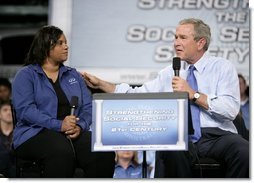 I'm
traveling with some high -- high power out of
Washington
today. Senator Trent Lott, head
of the Budget Committee and a great friend, is with us. Thank
you for being, Senator. (Applause.) And Tricia Lott. That's not Tricia, that's the
granddaughter. And the head of the Appropriations Committee,
Senator Thad Cochran. Thank you both for being here. (Applause.) The Senator and I traveled down on Air Force One together, and I guess the
message I heard was, don't forget
Mississippi
,
Mr. President. (Applause.)
I'm
traveling with some high -- high power out of
Washington
today. Senator Trent Lott, head
of the Budget Committee and a great friend, is with us. Thank
you for being, Senator. (Applause.) And Tricia Lott. That's not Tricia, that's the
granddaughter. And the head of the Appropriations Committee,
Senator Thad Cochran. Thank you both for being here. (Applause.) The Senator and I traveled down on Air Force One together, and I guess the
message I heard was, don't forget
Mississippi
,
Mr. President. (Applause.)
I appreciate Congressman Roger Wicker and Congressman Chip Pickering
joining us today. Thank you guys for coming. (Applause.) You might be aware of the
Pickering
name. I was proud to appoint Chip's
dad, Judge Charles Pickering, to the
Fifth
Court
. What a fine man he was and what a fine
judge he was, and give him our best, please, Chip. (Applause.)
Senator Travis Lee is with us. Senator, appreciate you coming. How about
the Mayor of
Canton
,
Fred Esco? Thank you, Mr. Mayor. Appreciate you. (Applause.)
There are a lot of other folks. If I spent time naming them, you'd never
get back to work. So I'm going to stop trying to name them all. But I do want
to name one other person. I had the honor of meeting Ruth Wilson today, when I
landed there in
Jackson
Airport
. Ruth is a
longtime volunteer. She helped organize a program at her church that has
established a food pantry, an academic tutoring program, a clothes closet and a
transportation service for the elderly. The reason I bring up Ruth is I want to
remind you all that the great strength of
America
lies in the hearts and
souls of our citizens.
Some people say the strength of
America
is our military; we've got
a strong military and I can assure you we're going to keep it that way. (Applause.) Some people say it's because our economy is the biggest
in the world; that's important and we're going to keep the environment such
that we'll continue to expand jobs across
America
. But the true strength of
America
is the
fact we've got people like Ruth, who are willing to take time out of their
lives to feed the hungry, to provide shelter for the homeless, to love a
neighbor just like you would like to be loved yourself.
If you want to serve
America
,
join the army of compassion; volunteer; make a difference in somebody's life.
Help change this great country one heart and one soul at a time -- just like
Ruth Wilson is. Ruth, thank you for coming. (Applause.) I don't know where you are -- there you are.
Welcome. (Applause.)
 I'm
here to talk about the Social Security system. I've spent a lot of time working
on this issue. I believe the job of a President is to confront problems and not
pass them on to future Presidents or future Congresses. I think you expect
people in office, like me, if we see a problem, to deal with it, and not say,
oh, it's too big a political risk to deal with it; or maybe, I don't feel like
dealing with it; or maybe, somebody says I shouldn't deal with it. I believe
you send people to office to say here is a problem and to take it on squarely.
And that's exactly why I'm sitting here today in
Canton
,
Mississippi
,
because I see a problem in Social Security. And I believe I have a duty as your
President to talk about the problem and talk about the solution.
I'm
here to talk about the Social Security system. I've spent a lot of time working
on this issue. I believe the job of a President is to confront problems and not
pass them on to future Presidents or future Congresses. I think you expect
people in office, like me, if we see a problem, to deal with it, and not say,
oh, it's too big a political risk to deal with it; or maybe, I don't feel like
dealing with it; or maybe, somebody says I shouldn't deal with it. I believe
you send people to office to say here is a problem and to take it on squarely.
And that's exactly why I'm sitting here today in
Canton
,
Mississippi
,
because I see a problem in Social Security. And I believe I have a duty as your
President to talk about the problem and talk about the solution.
And here's the problem: First, Franklin Roosevelt did a smart thing when it
came time to setting up Social Security. Social Security checks have meant a
lot to a lot of people. You know what I'm talking about. Your moms and dads or your
grandparents count on that check. We've got some people sitting up here today
who count on that check. I fully understand that when you're talking about
Social Security, you're talking about something really important for a lot of
people. And therefore, the first thing I want to leave you with is that if
you're getting a Social Security check today, you're going to keep getting your
check. I don't care what the propagandists say, I don't care what the
politicians say, nobody is going to take your check
away. And it's important for you to understand that. (Applause.)
Matter of fact, if you were born in 1950 -- before 1950, nothing is going
to change. In other words, the system is solvent for you. The problem is if
you're a younger worker. And see, here's the problem: A bunch of baby boomers,
just like me, are getting ready to retire. I reach retirement age in four years
from now. That's a convenient time for me to retire. (Laughter.) I turn 62. The government says when you're 62, you can
start drawing a check. There are a lot of us. As a matter of fact, there's 40 million retirees today. There's over 70 million
that will be fully retired when the baby boomers retire completely. That's 70
million people, nearly double the amount of people today on Social Security.
And secondly, we're living a lot longer.
I try to stay in shape. I exercise and all that, try to do -- make smart
decisions with my body. I plan on living a long time, and so do a lot of other people my age. We're living longer than the previous generation.
You've got a lot of people getting ready to retire who are living longer than
the previous generation and we've been promised greater benefits. In other
words, you have people running for office saying, vote for me, I'm going to
make sure the baby boomers get greater benefits than the previous generation.
So think about that man for a second, particularly if you're a younger worker.
You got a lot of people like me living longer than ever before, been promised a
lot of benefits, and there's fewer of you paying into the system.
You see, in 1950, there was 15 workers paying into the system for every
beneficiary -- 16 workers for every beneficiary. Today there is 3.3 workers, fewer of you all paying for people like me, who are going to live
longer and have been promised greater benefits.
Now, this is a pay-as-you-go system; you pay in, and we go ahead and pay
out in
Washington
.
You pay into the system -- some people say, well, there's a Social Security
trust, we'll just take your money and hold it for you and give it back to you
when you retire. That's not the way the system works. Part of my responsibility
as your President is to tell you exactly what's going on, to lay it right out
there for you to hear. The way it works in Social Security is your payroll
taxes -- and you pay a lot of payroll taxes -- go into the system, and we're
paying for retirees, like two of the people sitting up here today. And if we
have any money left over, it goes to fund government programs. And all that's
left is an IOU. That's how the system works. And so you're paying in, and it's
going out. Nobody is -- you're not paying in and we're holding the money for
you. You're paying in and it's going out. And in 2017, because baby boomers
like me are getting ready to retire, the system starts to go in the red. In
2027, it's $200 billion a year in the red. In 2030, it's $300 billion; 2041 it
is bankrupt. In other words, it's out.
So think about what I'm telling you. This is the math, folks, this is
exactly what's going to take place unless we do something about it. I'm ready
to -- people like me are retiring; we expect the government to make good on the
promise, of course. But yet, we don't have enough money coming into the system
to do so. So a lot of younger workers out there will be paying into a system
that's bankrupt. And that's not fair.
And that's why I've taken on this issue, and that's why I'm going to
continue traveling the country talking about the need to make sure the safety
net of retirement is not only good for those who have retired, but it's good
for a generation coming up.
Now, I talked about -- the other day I had a press conference, and I've
spoken about this issue at the -- during my State of the Union address. I said,
look, I not only have a responsibility to lay out the problem, I've got a
responsibility to start helping people come up with the solution. It's one
thing to lay out the problem; it's another thing to stand up and say here's
some ideas to move forward, here's some ways we can work together -- first and
foremost, future generations ought to receive benefits equal to or greater than
the previous generation. So I think if you've been working all your life, you
ought to receive a benefit equal to or greater than the promises that I got. I
think that's a fair system. So in other words, that's an important principle
for people to listen to.
Secondly, if you work hard and -- Social Security your entire life, you
will not retire into poverty. The current system today, by the way, doesn't say
that. The current system says you can work all your life and may end up in
poverty. I don't think that's fair. I think people who have worked hard all
their life and paying into the Social Security system ought to have a program
that makes sure they won't retire into poverty.
And so, therefore, I believe benefits for lower-income workers should grow
faster than benefits for higher-income workers, just to make sure that someone
doesn't retire into poverty. You know, you hear all this talk about benefit
cuts; we're talking about making sure benefits grow at the rate of inflation --
that's what we're talking about. You've been promised something; it ought to
grow at the rate of inflation. Today, if you're an upper-income worker, it
grows at the rate of wage growth. What I'm telling people is, is that ought to
be applying for younger -- lower-income workers, but not all workers, so that
the system can take care of those at the lower income scale. That makes sense
to me.
I hope it makes sense to the United States Congress. I think Franklin
Roosevelt would be proud to make sure of this. If you work all your life and
contribute to Social Security you should not retire into poverty. I think
that's a principle that makes sense. I think it's also important for our
elected leaders, both Democrats and Republicans, to come to the table. The
American people now understand we have a problem. And our leaders must choose:
Do nothing and guarantee a massive tax hike, or a 30 percent benefit cut; or
act now to keep the promises of Social Security for the 21st century.
The reason I say do nothing and get a tax hike -- if we don't do anything,
it's estimated that younger workers will have to pay an 18-percent property --
payroll tax to make good on the promises. If you don't like 12, try 18. That's
a lot. Payroll taxes are some of the highest taxes people pay here in America,
and the idea of not having the political will to address Social Security and
sticking younger workers with a high payroll tax doesn't make any sense to me.
Now, I know, sometimes
Washington
locks down. They say, well, we can't do this, it will
help a Republican or help a Democrat. We've got to get rid of that kind of
thinking in
Washington
,
D.C.
We're talking about -- (applause.)
I've got one other idea I want to talk to you about. By the way, the idea I
laid out the other day about growing benefits at the rate of inflation for
lower-income workers -- rate of inflation for upper-income workers, and rate of
wages for lower-income workers, solves most of the problem, long-term problem. There's some other things we can work with Congress on to
make sure that younger workers have got a system available for them.
Nothing changes for our seniors -- I'm talking about those of you born
prior to 1950. I'm really talking about the younger workers, because if we
don't do anything, you're going to have a huge bill to pay, one way or the
other.
Now, I've got another idea that I want Congress to consider, and that is
being able to take some of your own money, your payroll tax that you pay in the
system, and the government allow you to set up a personal savings account.
First of all, it's your money that you send into
Washington
-- not
Washington
's
money, it's your money. We kind of like to spend your money up there; remember,
this is a system you pay in, we take care of the retirees, any money left over
we pay for other programs. Pretty soon the amount of money you send in is going
to be less than the money owed to retirees and it's going to go into the red.
That's why, if we don't do anything, you're going to end up paying more taxes,
or we have to cut benefits. But it's your money.
Secondly, I think it's really important to recognize that if you grow your
money at 4 percent or 5 percent, it's going to amount to a lot more money than
if you keep it in the government and the government can grow it at 1.8 percent. It's how interest continues to grow. Some of you may
have 401(k)s, and you're watching that money begin to
grow. And you hold it in there and it grows over time, and it starts to -- the
growth starts to accumulate. It's called the compounding interest. And that's
an important concept which is not a part of the system today.
For example, if you have a person who has worked all of her or his life at
-- earned $35,000, and the government allows you to take a third of your
payroll taxes and set it up in a savings account, and that account earns a
reasonable rate of return, that, by the time you retire -- this is $35,000 over
your lifetime, by the way -- and you can take out some of the money, a third of
the money that you're paying into the government and set up an account that's
your own, you'll end up with $250,000 by the time it comes to retire --
$250,000 plus that which the government can afford to pay you through Social
Security. That's called a personal savings account. That's your asset. The
government can't use it. It's yours. Government can't spend it on other
programs. It's a hard asset.
Today, the program has got -- leaves behind IOUs, paper IOUs in a filing
cabinet. I think when it comes time to make sure the safety net is available
for younger Americans, we ought to make sure there's hard assets. You put money
in the system; you ought to have an asset you call your own as part of your
retirement plan.
Now, people ask me all the time, well, if I have -- if I have a personal
savings account, what are the rules? Well, first of all, you can't take the
money and put it in the lottery. In other words, this isn't a -- you can't
shoot dice with it. This is part of a retirement plan, and so you'll be given
the options to choose a conservative mix of bonds and stocks. If you don't want
to take any risks, you can put it in government-backed Treasury bills. But a
government-backed Treasury bill gets a greater rate of return than the money
that we've got in the federal government. In other words, this is a chance to
earn more -- watch your money grow in a better way through a conservative mix
of bonds and stocks.
This isn't a new idea, by the way. Guess who gets to do this right now. Federal employees, members of the Senate and the House of
Representatives. They've decided this is a pretty good idea for themselves. Seems like to me, if it's good enough for them
it ought to be good enough for Nissan plant workers. (Applause.)
The good news is, these four members of the Congress agree with me -- if
it's good enough for them, it's good enough for you; that you ought to be given
a chance, if you want -- and that's the other aspect, this is a voluntary
personal savings account. This isn't the government saying you've got to do
this. This is saying, if you want to do this, this
option ought to be available. Some people may not want to do it -- I fully
understand that. You stay in the Social Security system, and when Congress gets
it reformed and I sign the bill, there will be a Social Security system. But I
think you ought to be given the choice. As a matter of fact, I think the more
government trusts people -- with their own money, in this case -- the better
off the country is. (Applause.)
Thirdly, I like the idea of people owning something. I don't believe that
ownership ought to be available just for a privileged few. I don't believe
that. I believe the more people are able to build assets they call their own,
the better off the country is. I want more people saying, this is my asset,
this is my money, and I'm going to leave it to whomever I choose. If I have a
son or a daughter, I want to be able to pass that on to the next generation. (Applause.)
In our country's history, the truth is a lot of people hadn't accumulated
assets. And now is the time to change that. I want people to say, this is mine;
I worked hard for this, I've watched this asset base grow, and now I'm going to
decide -- I'm either going to use it for my retirement, if I want to, or I may
decide to leave it to my son or daughter. Your choice. After all, it is your money.
I want to -- I want it so that people can say, I own something. The more
people own something in
America
,
the more people are going to say, I really care about the future of this
country. The more people own their home, the better off we are. The more people
own their own retirement system and watch it grow, the better off we are.
This plan is good for low-income people, particularly low-income women.
Take a 20-year-old mom earning $8 an hour over her career; under my idea of
things, when she retires at age 63, she'd have a $100,000 asset base, plus the
Social Security plan. And that makes sense -- to spread the idea of ownership
beyond just -- (applause) -- the so-called "investor class." I think
it does.
I'm particularly concerned about a system that hurts widows or spouses. If you -- think about the system today. You work all your
life; say, you die before you're 62 years old; you worked 30 years, or 40 years,
and you leave a widow. If she's working, like most families are now two working
households, if she's working she'll -- when she turns time to retire, she'll
get to choose her plan, her benefits, or the husband's benefits, which are ever
higher, but not both. So the spouse has been working all its life -- his life
-- putting a lot of money in the system, dies early, and the government says
you can have one or the other but not both, even though they've been working
hard to pay in the system, paying those payroll taxes.
If you allow somebody, if they so choose, to have a personal savings
account, you've got yourself an asset that you can pass on to your spouse. It's
your money. You can watch it grow and you can decide where that money goes. To
me, this is a lot fairer system. It makes a lot of sense to trust the people
with their money. (Applause.)
So don't trust my judgment on this alone. Trust somebody else -- named Sam
Beard. He's joined us. He's an expert. He's a fellow who has studied this issue
a long time. He happens to be a Democrat. I first got to know Sam when I put
together a panel headed by a former Senator from
New York
who was a Democrat, Senator Daniel
Patrick Moynihan. I got into office in 2001, I said -- and campaigned on it, by
the way -- I said, give me -- I want to do something about Social Security if I
win. And so I decided to put together a panel of Democrats and Republicans to
see what they came up with. First of all, they had the right spirit about all
this business. They didn't say, I'm serving on this to
enhance one political party or another. They said, we're people who want to
take an objective look: is there a problem, and if so, can we do something
about it.
So, Sam, thanks for joining. Welcome. You might
share some of your experiences on the commission. Were people trying to slug
each other whole time there, or they actually have a good conversation?
MR. BEARD: Well, first, Mr. President, I want to tell you I'm honored to be
here and thank you for inviting me. The next thing I want is just to underline
the staggering leadership of the President. If you think about it,
historically, Franklin Roosevelt with the New Deal effected policy and politics for three generations. This President, by
talking about creating a stakeholder and shareowner society, if we allow all
Americans to set aside $1,000 a year into an account which they own, it will be
a watershed issue, it will be historic. And your leadership is
tremendous.
THE PRESIDENT: Thank you, Sam. Thank you. (Applause.)
MR. BEARD: So I guess I've had the privilege of doing this for 12 years,
Mr. President; you're sort of a newcomer.
THE PRESIDENT: That's right, yes. Otherwise my hair wouldn't have gone
white.
MR. BEARD: I've had the privilege of making 5,000 presentations all across
the country, and I want to underline what the President is saying. This is
essential for the economic health and future of
America
, and to save Social
Security, and it needs to be done as a nonpartisan issue. (Applause.)
* * * * *
THE PRESIDENT: Thanks, Sam. Good job. (Applause.) I appreciate it. Well-spoken. Deanie Smith.
MRS. SMITH: My name is Deanie Smith. I'm 84 years
old.
THE PRESIDENT: You don't look a day over 82.
MRS. SMITH: Thank you, Mr. President. Twenty years ago I retired after
about 30 years of federal service. And I draw my retirement. And then my
husband, who was a veteran in World War II -- he's deceased now -- I draw his
Social Security. I'm not worried about that. But it's my two baby boomers and
their sons that I'm worried about.
THE PRESIDENT: Well, let me ask you something. You count on that Social
Security check?
MRS. SMITH: I do.
THE PRESIDENT: Yes. A lot of people -- a lot of people count on that check.
You know what I'm talking about. You've got folks that are counting on the
check. You've got a grandmother or a grandfather that go to that mailbox, count
on the check.
MRS. SMITH: Go to the bank.
THE PRESIDENT: Yes. And I understand when you talk about Social Security,
somebody is going to pop up and try to frighten Deanie Smith, or friends. That's how you stop things in American politics, you just try to scare people. And I appreciate you saying that you --
MRS. SMITH: I appreciate your saying it's going to be safe, too.
THE PRESIDENT: Well, that's it, and I'm going to keep saying it, because
it's the truth. And everybody who's involved with this issue knows it's the
truth. (Applause.) That's important. It's important
for younger workers to hear we've got a problem and it's important for people
like Deanie to understand she's going to get her
check. Keep going. You're on a roll. (Laughter.)
MRS. SMITH: Well, what I'm concerned about is my son and my daughter and
their two sons. Will there be anything left -- my son will be eligible to
retire -- well, he's already retired, but he can't draw Social Security for
nine years. And my daughter is already --
THE PRESIDENT: This is a man who retired early.
MRS. SMITH: My daughter is 55 and she's going to need some help, too, and
so are the two grandsons.
THE PRESIDENT: I'd be really worried about your grandsons. If you're a
younger worker sitting out there, or a kid in high school or junior high,
you've got a serious problem facing you. You heard the man: either going to pay
18 percent payroll tax, or there's going to be significant benefit cuts. And
they're not going to be cutting benefits significantly on baby boomers. There's
just too many of us. Therefore, you're going to have to* pay for it. That would
be my guess about the political dynamics.
This is a generational issue, folks. Once we assure the grandmoms they're going to get their check -- and you are going to get your check -- then
you begin to hear what Deanie starts saying, what
about my grandkids? That's what people in Congress are going to start hearing.
They're going to hear, we've got a problem, and then we're going to hear
grandparents say, I'm worried about my grandkids, member of Congress. I don't
care what your party is, I don't care what your
political affiliation is; how about coming together to solve this so we don't
saddle a young generation with a huge tax bill. That's how I think about it.
And I appreciate you understanding that you're going to get your check. You
hold the rest of us to account to make sure we take care of your grandkids.
MRS. SMITH: And I'm going to insist my grandsons do the right thing.
THE PRESIDENT: There you go. Welcome. (Applause.) Coley Bailey, right out of
Coffeeville
,
Mississippi
.
MR. BAILEY: Yes, sir.
THE PRESIDENT: What do you do for a living?
MR. BAILEY: I'm a cotton farmer.
THE PRESIDENT: Cotton farmer.
MR. BAILEY: Yes, sir.
THE PRESIDENT: You're probably going to tell me the cotton prices aren't
high enough and the weather is not any good.
MR. BAILEY: That's exactly what I was going to say. (Laughter.)
THE PRESIDENT: Good. You got any kids?
MR. BAILEY: Yes, sir. I've got -- my wife is here in the audience. Her name
is Jody. We've got two children: a daughter, MacKenzie,
is four years old; and then my son, Cole, is four months old.
THE PRESIDENT: Good. Well, so why is a farmer sitting up here talking about
Social Security?
MR. BAILEY: Well, my concern with it is there won't be any Social Security
for my wife and I when we reach retirement age.
THE PRESIDENT: You're 33?
MR. BAILEY: I'm 32.
THE PRESIDENT: Thirty-two -- I was trying to get you moving here a little
faster. (Laughter.) You realize if you're a
self-employed farmer you put the whole 12.4 percent into the system.
MR. BAILEY: Yes, sir.
THE PRESIDENT: You're putting 6.2 percent when you're working, but if
you're self-employed, small business owners -- a lot of small business owners
here in
Mississippi
, a lot of farmers in
Mississippi
, a lot of people working on their own account
in
Mississippi
-- they put the entire 12.4 percent in.
MR. BAILEY: Yes, sir.
THE PRESIDENT: So you're doubly concerned.
MR. BAILEY: And also what's concerning also, without the personal
retirement accounts that you're proposing, we're so close on the farming
community with the finances, it would really trouble a lot of them to go from
the 12 percent to the 18 percent, plus pay that half of 18 percent that we will
be required to pay.
THE PRESIDENT: Yes. See, what he's saying is there's a cloudy future. Do
you know how many young people are saying, I'm not so sure I'm going to see
anything from Social Security. It's beginning to sink in. People say, well, I'm
more likely to see a UFO than I am a Social Security check if I'm 35 and under.
It's beginning to -- people are beginning to understand the nature of the
issue.
And I mean, people can say, well, he's making up the numbers. These numbers
are real, folks, that we're just talking about. You heard Sam. He's studied
this issue for a long time. My job is to lay it out to tell you the truth. You
can figure out whether or not somebody has got the right solution or not. But
I'm telling you right now, if you're 35 years old, you don't think you're going
to see a dime. A lot of people don't feel that way, and particularly if you got kids. So he's looking at putting 12.4 percent
payroll tax into the system, not thinking he's going to see something coming
out of it. No wonder he's sitting up here talking to the President. He's not
out there ploughing his fields.
MR. BAILEY: Yes, sir. We -- one thing that my wife and I have done, when we
got married almost nine years ago, we were worried about -- when we were
talking about retirement, we didn't even consider Social Security at that --
nine years ago.
THE PRESIDENT: Any other youngsters think that way? Talk to a lot -- there
you go. (Applause.) Sad, isn't it? We're going to
change it. That's why we're sitting here. That's why we're talking about the
issue, is to make sure that when I say, are you worried about seeing your
Social Security, those hands won't go up, because we have done our duty -- both
Republicans and Democrats have done our duty to fix the system.
Go ahead.
MR. BAILEY: What we have done to supplement or to aid in our retirement is
-- since the Roth IRA has become available -- I think Senator Roth from
Delaware
introduced it
in '97, and it was available in 1998. So we --
THE PRESIDENT: There you go -- he's the kind of farmer who understands
history. Go ahead.
MR. BAILEY: But we have fully funded the maximum amount every year, the
eight years we've been available --
THE PRESIDENT: Roth IRA, he's watching his money grow. He and his wife said, I'm going to put a little money aside and watch it grow,
right?
MR. BAILEY: The one interesting thing is that, of course, we can go online,
or I can call Legg Mason here in Jackson who controls it for me, and I can see
what it's doing and how it's doing. And just the way
that the interest is compounded, and it's grown over the time that we've done
it, it's a good -- I would definitely be in support of the personal retirement
account.
THE PRESIDENT: See, he's used to investing. You know what's amazing about
America
? When I
was your age, I don't think we spent a lot of time on 401(k)s -- we're about to talk to a 401(k) owner here in a minute -- or IRAs. I just
don't remember. I probably didn't since they didn't exist. And we got a whole
group of youngsters coming up in America today -- 32-year-old cotton farmer, I
suspect a lot of Nissan workers, who understand what it means to watch your own
assets grow and to make investment decisions.
In other words, there's a cultural change in
America
. Congress is lagging behind
the cultural change. But there's a lot of folks who are comfortable about
watching their own money grow, a whole lot of folks.
And it seems like to me to make sense that if Nissan thinks it's all right, if
this cotton farmer takes advantage of a program, that when it comes time to
making sure the Social Security system is modern, that we ought to give workers
all across the country the same opportunities. (Applause.) Ready to go? Cynthia Roberts.
MRS. ROBERTS: Again, thank you, Mr. President.
THE PRESIDENT: What do you do, Cynthia?
MRS. ROBERTS: I'm a human resource representative here at the
Canton
facility for
Nissan.
THE PRESIDENT: Right here?
MRS. ROBERTS: Right here.
THE PRESIDENT: Is it okay for these people to take a little extra time off? (Applause.)
MRS. ROBERTS: I've worked here for about three years now and loved every
minute of it. My thoughts are similar to Coley's, as far as Social Security. I
don't really think those benefits will be here, not only for myself, but also
for my two children who are 17 years old.
THE PRESIDENT: See, again, I know I'm getting repetitive, but I hear this
story a lot, a younger mom saying, Mr. President, I don't think the benefits
are going to be there for me. I'm worried about it. She's beginning to
understand the math. You a 401(k) owner?
MRS. ROBERTS: I am a 401(k) owner.
THE PRESIDENT: How cool is that? Owns her own assets. (Applause.) How does it work here at Nissan? How does
it work at Nissan?
MRS. ROBERTS: Currently, what happens is the 401(k), the company will match 60 percent for up to 5 percent.
THE PRESIDENT: Yes. And so -- are you watching -- you're watching the
account pretty carefully?
MRS. ROBERTS: I do watch. I get a quarterly statement, and I do watch those
monies very closely. I do not like to lose money. (Laughter.)
THE PRESIDENT: No, I don't blame you. Don't shoot any dice then. (Laughter.)
MRS. ROBERTS: But 401(k) has proved to work out great for me and my family.
THE PRESIDENT: See, it's interesting, isn't it -- I can't tell you how good
it is for the country to be sitting next to Cynthia Roberts, working right here
at Nissan, and she's talking to me about watching her assets grow. She gets a
quarterly statement. It's a statement that says, here's what you own and here's
how it's growing. It's hers. Nobody can take it away from her. The government
can't decide, well, we need this for another program. It's your money.
I think it makes sense in a modern Social Security system for people
opening up a quarterly statement that the government can't spend, the
government can't take away, that you can decide what
to do with it. And that's what Cynthia is talking about. (Applause.) Isn't that right?
MRS. ROBERTS: That's right.
THE PRESIDENT: Is it growing?
MRS. ROBERTS: Yes, it has grown substantially.
THE PRESIDENT: Yes, has grown substantially. (Laughter.) I can promise you this; your money -- your money in the government -- if the
government takes your money through your payroll tax, it's not growing
substantially. It's growing a little bitty. And at her age, that money begins
-- when it grows substantially early on and she keeps reinvesting and it -- it
grows substantially a lot quicker over time. And that's important for people to
figure out. Was it hard to invest your own money? Was it hard to get used to?
MRS. ROBERTS: No, it wasn't hard. There are different options. I currently
use someone with our 401(k) company to help me watch my monies and to monitor
the investments that I made.
THE PRESIDENT: So is there -- it's a mix of bonds and stocks?
MRS. ROBERTS: It is mostly all bonds and minimal stocks, but some stocks. I
do take some risk.
THE PRESIDENT: Sure. But she gets -- well, you're young, you ought to. She
can design a portfolio. You hear what she's saying? She's saying, they give her
a chance to manage her own money and she talks to an expert and gets to design
the portfolio that meets her needs. Doesn't that make sense? It's her money to
begin with. The government ought to do the same thing through the Social
Security system. (Applause.) And then Cynthia gets to
decide who to leave it to -- isn't that right?
MRS. ROBERTS: That is correct.
THE PRESIDENT: Unless you decide to spend it when you retire.
MRS. ROBERTS: No, I'm not going to spend it. (Laughter.)
THE PRESIDENT: So you view this as a way to not only make sure that there's
something for you when you retire -- we'll get the Social Security system fixed
so that you can't sit up here with the next President you visit with and say, I
don't think I'm ever going to see a dime. I think if we keep talking about this
the Congress is going to say, oops, people like Cynthia know we got a problem
and they expect us to get something done. So we're going to keep working on it.
But in the meantime, you're building up an asset base -- I presume, with your
children in mind.
MRS. ROBERTS: That is correct, they are always in mind.
THE PRESIDENT: Yes, always on your mind.
MRS. ROBERTS: Always on my mind.
THE PRESIDENT: I'm afraid I'm always on my mother's mind, too, you know? (Laughter.) Anyway, thanks for coming and thanks for
representing the work force here. (Applause.) You did
good, really good.
I'm just curious -- anybody else got a 401(k)? (Applause.) I rest my case. I rest my case. Are you watching your own money grow? Starting
to make sense to have that money you're contributing to the -- through the
payroll tax to be able to -- a part of that to be able to do the same thing? Seems like it makes sense to me. Finally, we're going to end
with DeLois Killen. Welcome.
MRS. KILLEN: Thank you, Mr. President. It's an honor.
THE PRESIDENT: Where are you from, DeLois?
MRS. KILLEN: I am from
Union
,
Mississippi
.
THE PRESIDENT:
Union
,
Mississippi
. (Applause.) And what do you do?
MRS. KILLEN: I live in
Union
. I'm 71 years
old.
THE PRESIDENT: And you're working.
MRS. KILLEN: I am semi-retired. I work for the city of
Union
at the Police Department as the
dispatcher.
THE PRESIDENT: There you go. Whatever you do, don't let her call your car
plates. (Laughter.) Good, thanks for working.
MRS. KILLEN: I need to work.
THE PRESIDENT: You've been working all your life.
MRS. KILLEN: I have been working all my life. And if it wasn't for my
Social Security check, I really couldn't make ends meet.
THE PRESIDENT: Right. But your Social Security check is not providing
enough so that you can retire.
MRS. KILLEN: It is not. If I had known what these younger people know now,
and had the opportunities that they have, I would have had something besides
Social Security.
THE PRESIDENT: Yes, but that's it for you.
MRS. KILLEN: It is.
THE PRESIDENT: Yes. That's really important for people to understand, is
that DeLois counts on the Social Security check she
is --
MRS. KILLEN: Very definitely.
THE PRESIDENT: Yes, you're over retirement age -- barely. (Laughter.) She has to keep working. The system didn't
provide enough for her to retire on.
MRS. KILLEN: I'm just another desperate housewife. (Laughter
and applause.)
THE PRESIDENT: This has been my week to be around funny women, you know? (Laughter.) Good one. (Laughter.) Once again I'm speechless. (Laughter.) Keep going.
Now, you're on a roll.
MRS. KILLEN: Well, I depend on my Social Security for half of my income at
least.
THE PRESIDENT: Yes.
MRS. KILLEN: And I'm so grateful that you think we are not going to lose
it, because I intend to be here a long time yet.
THE PRESIDENT: That's right.
MRS. KILLEN: And I want to be self-sufficient. I want to take care of
myself.
THE PRESIDENT: There you go.
MRS. KILLEN: And with Social Security benefits coming in regularly, I can
plan for the future.
THE PRESIDENT: That's good. It's really important for our seniors when they
hear this debate to have peace of mind, that we're really talking about the
youngsters, the young workers, and not -- and not you, DeLois.
The debate is aimed at making sure the safety net is good for a younger
generation of Americans. You're fine. And people born prior to 1950 are fine.
But if you're young and working, think about this -- the system goes broke in
2041. It's not all that long from now, really, when you think about it. And you
work all your life putting your money into a system that's going broke -- a
little discouraging.
We have an obligation and a duty to fix this. I'm going to continue
traveling the country, DeLois, talking about the
problem. People in
America
are beginning to understand we've got a problem. People are beginning to figure
it out. A lot of younger Americans are now beginning to pay attention to this
issue. If I were you, I'd be paying attention to it, too. You got a payroll
tax, put your payroll tax in the system that's going broke, I'd be out there
wondering what the heck is going to happen in Washington, D.C. to make sure the
money I'm putting in is worthwhile.
I'm going to continue assuring our seniors that they're going to receive
their checks. You tell your grandma and grandads and
your mother and dads, this government of yours will keep its promise. And I'm
going to continue talking to the younger people of
America
and say that we're going to
be wise about how we fix the system. We're going to fix the safety net, and as
we do, we're going to make it a better deal for you. As we do, we're going to
let you take some of your own money and watch it grow so you can build your own
asset base, so you can pass it on to whomever you chose.
We've got a great opportunity here to show the American people that
Washington
isn't all politics, that
Washington
has got the capacity to rise
above partisan bickering and solve and important problem once and for all. And
when we do, when we do, and when we get it done, we'll all be able to say we
have done our duty.
I want to thank you all for giving me a chance to come by. God bless you
all, and God bless our families. God bless
America
. (Applause.)
END 1:11 P.M. CDT
President Discusses Social Security at Latino Coalition Conference May 4, 2005
J.W. Marriott Hotel
Washington, D.C.
10:31 A.M. EDT
THE PRESIDENT: Thank you all. Thanks for coming. Please be seated.
Siéntese. Thank you, Hector. Thank you for the job you're doing with the Small
Business Administration. Thank you all for coming today to hear this
conversation about how to make sure a very important part of our society
functions well for a young generation of Latinos and people from all walks of
life.
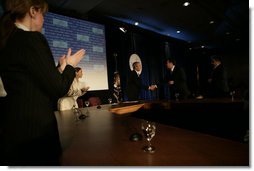 So today
we're here to discuss Social Security and the importance of Social Security.
And I want to thank our panelists for joining us. I want to thank the Latino
Coalition for hosting this reception. As I look out in the crowd I see a lot of
familiar faces and a lot of friends. It's great to see you all again. Thank you
for coming.
So today
we're here to discuss Social Security and the importance of Social Security.
And I want to thank our panelists for joining us. I want to thank the Latino
Coalition for hosting this reception. As I look out in the crowd I see a lot of
familiar faces and a lot of friends. It's great to see you all again. Thank you
for coming.
I want to thank Roberto Deposada, the chairman and president of Latino
Coalition. Thank you for hosting this event. I am honored to be joined today by
-- or we are honored to be joined by the Chairman of the Ways and Means
Committee from Bakersfield, California. It's relevant he is here -- after all,
it's his committee that is going to write the reforms necessary to make sure
the Social Security system works for a younger generation of Americans. I have
worked closely with Chairman Thomas on a lot of crucial issues. When he says he
can get the job done, he means he can get the job done and has proven over the
past five years that he can get the job done. Mr. Chairman, thank you for
joining us. (Applause.)
As well, Congressman Chris Cannon, from Utah, is with us. Thank you for
coming, Congressman; honored you're here.
Before I talk about Social Security, though, I want to remind you the war
on terror goes on. And today's report on the capture of a top al Qaeda
operative, Abu Faraj Al-Libbi, represents a critical victory in the war on
terror. (Applause.)
Al-Libbi was a top general for bin Laden. He was a major facilitator and a
chief planner for the al Qaeda network. His arrest removes a dangerous enemy
who was a direct threat to America and for those who love freedom.
I applaud the Pakistani government for their strong cooperation in the war
on terror. I applaud the Pakistani government and President Musharraf for
acting on solid intelligence to bring this man to justice. The fight continues.
We'll stay on the offensive until al Qaeda is defeated. (Applause.)
Franklin Roosevelt did a wise thing when he set up the Social Security
system. A lot of people throughout the last decades have counted on a Social
Security check to help them in retirement. As a matter of fact, I'm sure you
know people in your communities that rely upon their Social Security check completely
to make sure they have dignity in their retirement. It was a wise idea to set
up the system, and I am mindful that when anybody in Washington talks about
Social Security, a wave of fear ripples through the senior community because
they think somebody is about to take their check away.
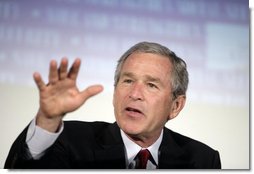 So I
want to open my comments to you all to assure you that your loved ones who
count on Social Security will get their check. Nothing will change for today's
seniors who are getting a Social Security check. If you -- as a matter of fact,
if you were born prior to 1950, nothing will change. The system is solvent
enough to keep its promises. And that's very important for people to hear. So
when you hear all these ads and propaganda saying, well, you know, talk about
making sure the Social Security system is modern and seniors are not going to
get your check, just know it's not true and please assure seniors it's not true,
because it's not.
So I
want to open my comments to you all to assure you that your loved ones who
count on Social Security will get their check. Nothing will change for today's
seniors who are getting a Social Security check. If you -- as a matter of fact,
if you were born prior to 1950, nothing will change. The system is solvent
enough to keep its promises. And that's very important for people to hear. So
when you hear all these ads and propaganda saying, well, you know, talk about
making sure the Social Security system is modern and seniors are not going to
get your check, just know it's not true and please assure seniors it's not true,
because it's not.
The safety net will work for them, but there is a hole in the safety net
for a younger generation of Americans coming up. And here's why -- first, let
me just describe the nature of the system, and that is it's a pay-as-you-go
system. You pay in payroll taxes and the government takes care of retirees, and
with money left over, spends it on other programs. And all that is left is a
file cabinet with IOUs. See, some in our country believe that the system works
this way: you pay in the system, we hold your money for you, and when you
retire, we give it back to you. That's not the way it works. It's a
pay-as-you-go system.
Now, the reason there's a hole in the safety net for people who are going
to be paying into the pay-as-you-go system is because there are a lot of people
getting ready to retire. We are called "baby boomers." I happen to be
one. I'm retiring in four years. At least I'm eligible for my retirement.
(Laughter.) I turn 62 in four years. There are about 75 million baby boomers who
will be retired when it's all said and done. There are 40 million baby boomers
-- I mean, retirees today. So think about that. We have 40 million retirees
today, and in relatively quick order, there's going to be over 70 million
retirees. We've got a lot more people that younger workers are going to have to
pay for.
Secondly, we are living longer. I plan to live a long time. (Laughter.)
It's why I'm exercising a lot. (Laughter.) It's why I'm making right choices
about what I put in my body, and I suggest all Americans exercise more and be
wise about what you eat and what you drink. It'll help you live longer, they
tell me.
But a lot of us are going to live longer. And we've been promised greater
benefits than the previous generation. So if you're a younger worker out there,
you're now looking at more people retiring, who will be living longer -- in
other words, you have to keep paying more monthly benefits over time, who've
been promised greater monthly benefits. And there's going to be fewer of you paying
into the system. In 1950, there were 16 workers for every beneficiary. Today,
there is 3.3 workers for every beneficiary. In short order there will be two
workers for every beneficiary. So young workers are going to be paying for more
people, living longer, getting greater benefits. And the pay-as-you-go system
goes negative in 2017. In other words, there's more money going out than coming
in. And in -- and every year it gets worse. That's just the way it's going to
work.
And so in 2027, you're going to be $200 billion in the hole, for example,
it will be $300 billion in the 2030s, and the system is going to be broke in
2041. So you've got people who are starting to pay into the system now, who are
paying into a system that's not going to be around. And I don't want to make
younger workers a lot of -- nervous in America. The people who ought not to be
nervous are the older Americans. You're going to get your check. It's the
people paying for baby boomers like me who are going to retire who ought to be paying
attention to this issue, because the system is insolvent.
So I have an obligation to encourage Congress to act. And Chairman Thomas
knows what I'm about to say: the longer we wait, the more expensive it's going
to be. If Congress chooses to do nothing on this problem, you're either going
to have to raise your payroll tax to, some estimate, 18 percent, or cut
benefits dramatically by 30 percent. So now is the time to get after it, in my
judgment.
Obviously felt that way because in the State of the Union I spent a lot of
time talking about it, and subsequently have spent a lot of time talking about
it. I'm going to continue traveling our country making it clear to people we've
got a problem, because, see, once they figure out we've got a problem, the next
course of action is going to be to say to Congress, how come you're not doing
anything about it? How come you're allowing partisan politics to prevent good
people from coming together to solve the problem?
I have an obligation to put some things on the table, and I've been doing
that. First, I believe that future generations must receive benefits equal to
or greater than the benefits of today's seniors. Secondly, I believe this
country needs to set a goal that says if you've worked all your life and if you
paid into the retirement system to Social Security, you should not retire in
poverty. To me, that's a noble goal. Frankly, it's the kind of goal that
Franklin Delano Roosevelt would strongly support.
And so in my press conference the other night, I proposed a way of
calculating future benefits for future retirees that says, if you're a
low-income worker, your benefits ought to raise -- rise with wage increases,
and if you're an upper-income worker, your benefits ought to rise with
inflation. Seems fair to me. Seems like a noble calling for the United States
of America, to recognize a lot of people work really hard and don't make a lot
of money, but when it comes time to retire, there ought to be dignity in
retirement. I also believe that younger workers -- and by the way, what -- that
plan alone, that part of a plan, solves the majority of the solvency issue for
a generation of Americans coming up.
In other words, what I'm talking about, making sure that we permanently
solve the Social Security problem can be done. And I have an obligation to
advance the process by putting out some ideas that I think are important. And I
want to thank Chairman Thomas for his willingness to work with us on this
issue, and I'll work with him on this issue.
Now I want to talk about something else that I think the country ought to
consider, and this pertains to younger workers. I think younger workers --
first of all, younger workers have been promised benefits the government --
promises that have been promised, benefits that we can't keep. That's just the
way it is. And I believe I have the duty as the President to be willing to
confront that fact, to tell people the truth. The younger people in America got
to understand that. We've given you promises we just can't keep.
But one way to make a permanent solution to Social Security system a better
deal is to allow younger workers to take some of your own money and set it
aside in a personal savings account that you can call your own. And the reason
why that's important is because if you watch your money grow at a reasonable
rate of interest, you know it compounds over time. There's a compound rate of
interest, which means money grows and grows, bigger and bigger and bigger. For
example, if you're making a $35,000 all your life, and you're allowed to take a
third of your payroll taxes and set it aside in a conservative mix of bonds and
stocks that have a reasonable rate of return, then when you get ready to
retire, you'll have $250,000 as part of a retirement plan. You'll get your
Social Security check, whatever the government can afford, plus money off of
your nest egg.
Money grows. And the current system doesn't encourage, doesn't take
advantage of compound interest. And so step one is, letting a younger person
own their own -- manage their own money in a conservative mix of bonds and
stocks will mean you get a better deal on your own money. This payroll tax is
your money. And the government ought to say you get a better deal on your
money, and you can watch it grow.
Secondly, I like people owning something. The more people own assets, the
better off America is. I reject this notion that the investor class is limited
to only a certain kind of person. The more moms and dads accumulate assets, the
better off it is for American families. I want more people being able to say,
this is mine, the government can't take it away, the government can't spend it,
it's not a part of a pay-as-you-go system. And when you pass away, you can
leave it to whomever you choose. That's a part of America. And more people that
have that -- (applause.)
This idea, I think, is fair. It means you get a better deal on your own
money. It's fair; it encourages ownership. Listen, the system today is a lousy
deal for widows. The way it works today is if you and your spouse are working
and one of you dies early, then the spouse upon retiring gets to choose the
survivor benefits that your spouse has paid into the system, or you own
benefits, which is ever higher, but not both. So think about that. Somebody may
have died at age 52, started working at age 22, worked 30 years and put all
that money in the system, and his or her spouse ends up having to choose, to
decide what retirement account he or she wants -- the one she contributed to or
the one he contributed to, but not both. In other words, the money goes away.
In a personal savings account, as you watch your money grow, a worker sets
aside money in an asset base. That asset can go to help the widow or the
surviving spouse. The system isn't fair today. And we need to make it fair. And
we can make it more fair for people at the lower end of the income scale.
Now, I want to -- and during this conversation some things will come out
that I think probably -- hopefully some questions will come out that are on
your mind.
I want to address a couple of things. One, I understand there is a need for
more financial literacy in America, and so I've instructed the FDIC and the SBA
and the Treasury Department to work with the Latino Coalition and the Hispanic
Chamber and other groups to help make sure that financial literacy is more
widespread in all neighborhoods and all communities. (Applause.) FDIC has got
the money smart financial workshop program. They're going to work with the
Latino Coalition. SBA has got a negocios.gov program on the web page. Treasury
has got all kinds of financial learning materials that we can spread out, and
we need your help.
Secondly, what I'm talking about, though, is happening in America already.
In other words, I'm not inventing something new to say to somebody, you can
invest your own money. When I was coming up, there wasn't a lot of talk about
401(k)s or IRAs. There wasn't any. And today -- yesterday I had an interesting
experience. I went down to the Nissan plant in Canton, Mississippi, and it was
a very diverse audience, a lot of assembly-line workers. And I said, how many
of you all have got your own 401(k)? I mean, the number of hands that went up
was astounding. You've got people from all walks of life managing their money
already. People are getting used to it.
Matter of fact, this was such a good idea that the United States Congress a
while ago decided in the Thrift Savings Plan, the Federal Thrift Savings Plan,
to allow federal workers -- members of the United States Congress and members
of the United States Senate -- to manage their own personal account. See, and
the reason why is, I'm confident they took a look at the rate of return a
government can get versus the rate of return that you can get in a conservative
mix of bonds and stocks, and decided they want their money to grow -- they want
to watch their money grow faster, than that available to the government, and so
they said, they just decided we'll get to do this, too.
If it is good enough for a member of the United States Congress to set
aside some of his or her own money in a personal savings account so they get a
better rate of return, they can pass it on to whomever they want, it ought to
be good enough for workers all across the United States of America. (Applause.)
I am honored to be joined by Fidel Vargas today. Fidel is an interesting
man. He's already been a -- he's 36 and he's already been a mayor of a
California city. Did a fine job there.
You know, when I first got elected, I recognized that the Social Security
issue is going to be an issue that was going to require some -- some sound
thought and reasoning. People needed to be coming together to help think about
this issue. And so I set up a commission. Daniel Patrick Moynihan, the former
Senator from New York, Democrat Senator, was the chairman of it, and I asked
Fidel to join.
And welcome, Fidel. Thanks for coming. He is a -- well, you'll see. He
knows what he's talking about.
* * * * *
MR. VARGAS: And I'm a little embarrassed to say, but I think I'll share
with the President that the first time he ran, I didn't vote for the President.
So excuse me for that, sir. But I'm sure -- (laughter.)
THE PRESIDENT: I understand a lot of other people didn't, either. (Laughter
and applause.)
* * * * *
THE PRESIDENT: Great job, thanks for coming. (Applause.) The fact that you
went to Harvard bothers me more than the fact that you didn't vote for me.
(Laughter.)
MR. VARGAS: We both went to HBS.
THE PRESIDENT: That's right. I forgot that part. (Laughter.) Good job.
Thanks for coming.
The message here is really important, that it doesn't matter whether you're
a Republican or a Democrat on this issue, what matters is, do you care about
the future of the country, and are you willing to set aside partisanship and
work in a constructive way to get something done?
If you're a senior, you're going to get your check. You know what's
happening now? A lot of grandmothers and grandfathers, when they finally absorb
that message, are beginning to say, what about my grandkids; Mr. President, it
seems like a big problem coming for them, what are you going to do about? And
now is the time to do something about.
Fidel, I appreciate your tone, I appreciate your constructive work on this
issue. Thanks for coming.
Our next guest is Russell Ybarra. He's United Nations Tejano.
MR. YBARRA: A true Tejano.
THE PRESIDENT: A true Tejano. Those are the best kind. (Laughter and
applause.)
A businessman -- tell everybody what you do, Russell.
MR. YBARRA: Well, first of all, yes, I was born and raised in the Lone Star
state, so we're neighbors.
THE PRESIDENT: Very good.
MR. YBARRA: Again, my name is Russell Ybarra, and I tell people the first
three words I learned in Spanish was lechuga, tomate you cebolla, because that
was the order we put them on the tacos at my family's restaurant when I was
growing up. (Laughter.) So, anyway, I'm the President and CEO of Gringo's
Mexican Kitchen. We operate six stores in the Houston area and one in San
Antonio.
THE PRESIDENT: Good. How are you doing? Making a little --
MR. YBARRA: We're paying our taxes -- on time. (Laughter.)
THE PRESIDENT: How about your ownership? You paying any of that?
MR. YBARRA: A little bit.
THE PRESIDENT: A little bit, that's good. Well, in other words, you're in
business.
MR. YBARRA: Exactly.
THE PRESIDENT: That's good.
MR. YBARRA: We have a duty.
* * * * *
MR. YBARRA: Again, the 401(k) program in the food service industry is an
exception, not the rule. And I thought, okay, we have a 401(k) program
implemented, in place, and so we should just have everybody lining up to join
the plan. Well, it didn't work out that way. We have very low participation --
and for good reason: many of those that work for us are what you would consider
low-wage earners.
THE PRESIDENT: Can't afford the contribution.
MR. YBARRA: Right. Exactly.
THE PRESIDENT: -- payroll tax.
MR. YBARRA: Well, and that's just it. They're already paying 12.4 percent,
basically, and have little or no disposable income to set aside for future
retirement. So this really impacts them dramatically.
* * * * *
THE PRESIDENT: The best thing is to let them take their payroll taxes
they're paying the system and have a plan that allows their money to grow just
like a 401(k) can. That's the best thing to do for low-income workers. That's
why the Social Security reform is a vital reform for people at the lower end of
the wage scale. It's really important.
Anyway, go ahead. Sorry to interrupt.
* * * * *
THE PRESIDENT: Right. Remember, and this is important for people to hear,
this is not the government saying, you have to do this. This is government
saying, if you so choose to set aside some of your own money, you ought to be
allowed to do so. It's optional. It basically says that government is not going
to dictate, government just says, here's an option to trust people with their
own money.
And a couple of points I want to make on Russell. One, the entrepreneurial
spirit is strong in America; we need to keep it that way. Congratulations on
starting your own business.
MR. YBARRA: Thank you.
THE PRESIDENT: This is a chance -- you volunteered to come up here, so
anybody listening on C-SPAN in the Houston area, looking for a good restaurant,
Russell -- (laughter and applause.)
MR. YBARRA: I'm currently, also, the Greater Houston Restaurant Association
President.
THE PRESIDENT: Oh, good, yes.
MR. YBARRA: And I don't know if you know this or not, but the National
Restaurant Association endorses your plan.
THE PRESIDENT: Well, thanks. I appreciate it.
If you're making $8 an hour over your life, and you start having a personal
account when you're 21 years old, and at the age 63 you'll end up with a
$100,000 nest egg. That's if you stay at $8 all your life. In other words,
that's how money grows. Wouldn't it be fantastic if a lot of folks who work for
Russell's company were able to say, here's my money, here's the nest egg I
built up for my family.
The more ownership there is, the more assets passed on to a community, the
better off the community is going to be. And the idea of owning something ought
to be spread throughout all America. That's the great promise of America.
That's what we're all about. You come here, you work hard, you realize your
dreams, and you have a chance to build something for your family.
How many people -- you said your dad and mom came. I suspect there's a lot
of first-generation of Americans here because their parents came over here
because of dreams and hopes.
By the way, speaking about restaurant employees, we've got to have a
rational policy when it comes to immigrants coming to this country. I believe
if there's -- somebody is willing to employ somebody and they can't find an
American worker, and somebody is willing to do the job, we ought to make that
connection a legal connection. People come here to work. (Applause.)
And this, by the way, will make our borders more secure. As opposed to
people having to get in the back of 18-wheelers and sneaking across, you know,
Texas borders, or trying to walk across the desert to find work, if you've got
a pass that says, I'm a willing worker willing to work for a willing employer,
it means they can just walk across normally and not have to try to sneak
across. We'll be able to defeat a whole industry of document forgers and
smugglers and coyotes, and it means we'll be able to uphold the dignity of
persons around the world. (Applause.)
Anyway, it's called diverting off the topic. Por nada.
MR. YBARRA: One last point, Mr. President, and I think this is a profound
one. The underlying benefit of what you're proposing is a lot like what we did
with our core beliefs, reinvesting in our associates and local community. I
feel by doing this, the American productivity will increase dramatically.
THE PRESIDENT: That's right. Well, basically, what he's just said is, if
you own something, you have a vital stake in the future. I mean, think about
how great it's going to be when Jos and Jessica, as they have an investment
account -- they're young, new married -- we're about to talk to them here --
but on a monthly basis, a quarterly basis, daily basis in some cases, you watch
your assets grow. You open up a statement and say, here is what I own. That
encourages people. If they're seeing something they own grow, that the
government can't take away from them, it encourages. And it will enhance
productivity, and it will enhance the spirit in a lot of communities.
Good job. Thank you, Russell.
MR. YBARRA: Thank you.
THE PRESIDENT: It's great to see you. (Applause.)
Jos . Jos and Jessica, welcome. Thank you all. Newlyweds?
MS. GOMEZ: No, five years.
THE PRESIDENT: See, not newlyweds. (Laughter.) I'm glad you're here. Give
us a sense of who you are, what you're doing.
MR. GOMEZ: It's an honor to be here with you. My name is Jos Gomez. This is
my lovely wife, Jessica. We've been married for almost five years. We have
three beautiful kids. I currently attend DeVry University. I'm a full-time
student.
THE PRESIDENT: Yes? What are you studying?
MR. GOMEZ: I'm studying network system administrator.
THE PRESIDENT: Network systems administrator. Would you like to try to
describe what that means to the technologically illiterate? (Laughter.)
MR. GOMEZ: Basically, I will be taking care of a network in a business, or
something. But I, personally, want to own my own business.
THE PRESIDENT: Want to own your own business? That's great.
MR. GOMEZ: Yes, I want to start my own business later on, in the future.
THE PRESIDENT: Do you have any idea what it's going to be yet, or are you
just getting the skills necessary --
MR. GOMEZ: Still getting the skills --
THE PRESIDENT: -- and the confidence necessary to launch?
MR. GOMEZ: That's correct, that's what I'm currently --
THE PRESIDENT: That's wonderful, though, isn't it? A guy sits up here with
the President: I want to own my own business. (Laughter and applause.) You may
take a few tips from Russell.
MR. GOMEZ: Currently I work in a job part-time, and they don't offer the
401(k). And I work basically on a check-to-check basis.
THE PRESIDENT: Yes.
MR. GOMEZ: What I like about your plan is, it will give me the opportunity
to start saving and looking for the future, for our retirement, and if we
choose to, pass it on to our kids for a nest egg.
THE PRESIDENT: That's an interesting thought. You've got three little kids.
Jessica, you want --
MS. GOMEZ: I have three beautiful children: Joslynn, who is four; Jovanni,
who is two; and Isabella who is one.
THE PRESIDENT: Good, I'm looking forward to meeting them afterwards.
MS. GOMEZ: They're looking forward to it, too. I worry more about their
future, as any other mother does. I worry about that if the system continues
the way it is, as you said before, by the time they work, they're going to be
working twice as hard to take care of us when we retire.
THE PRESIDENT: That's right.
MS. GOMEZ: So that when they -- it's time for them to retire, they're going
to be just be so worn out, they're not going to -- they're going to be broke,
both emotionally and financially.
THE PRESIDENT: Interesting thought, isn't it? Mom is sitting here, saying,
I've watched -- listened to the data. So the system starts to go broke 2017;
2041, as Fidel said, there's nothing left. And she's got little kids. She's
going to be paying into that system, and so are they. It's a troublesome
thought for moms and dads to think about the system as it is, and it's got to
be just as troublesome to think that the government is not -- hasn't done
anything about it. Now is the time to do something about it.
You know, a lot -- I talk to a lot of young folks, like Jos and Jessica.
There was an interesting survey once that somebody pointed out to me, that said
younger people think it's more likely they're going to see a UFO than get a
Social Security check. (Laughter.)
Well, if you feel that way, and you watch that money come out of your check
every month, it's a little discouraging, isn't it? To be paying into something
that you're not sure is going to be around. Yes, so this is a young person
issue. Older people, the grandmas and granddads, they don't have a thing to
worry about. We're going to keep the promise. But it's the youngsters who are
working hard, and the moms and dads who are working hard, and the moms and dads
who are worried about their children when they're coming up, that's what this
issue is about, folks.
And it is amazing to me that we're living in a town where people oftentimes
say, well, we can't cooperate with each other because of party politics. You
heard a good Democrat sit up here and say he believes a reformed system will
help his children and his community. That's the spirit that's needed. And we
here in Washington, we need to think about people like Jessica and Jos , young
kids, working hard, wants to start his business, got young kids, mom sitting up
here saying, I'm worried about it. She's really saying this: You people in
government, how come you can't do nothing about it -- or anything about it?
(Laughter and applause.)
I've learned to correct myself early before it gets on the record.
(Laughter.) Fortunately, the First Lady is not here. (Laughter.) She'd probably
have some joke about it. (Laughter.)
Anyway, thank you all for coming. Is there anything else you want to add?
Well, I appreciate you letting us use you as an example, looking forward to
meeting the kids.
MS. GOMEZ: Thank you for letting us be here.
MR. GOMEZ: Thanks for letting us come on.
THE PRESIDENT: Well, thanks for coming. Our final guest is Elizabeth
Fernandez. Elizabeth, welcome. Tell us what you do.
* * * * *
THE PRESIDENT: Yes, that's an important concept -- sorry to interrupt, but
you're right. To run up the payroll tax rate is going to hurt a lot of small
businesses. One of the things we're always be mindful of in Washington is how
do you make sure the entrepreneurial spirit is strong. And one way to make sure
it's not strong is to overtax the small businesses. And so I appreciate you
bringing the payroll taxes in, it's a significant burden on many small
businesses. And it's really -- really an important point. Thank you.
* * * * *
MS. FERNANDEZ: I don't know -- do you have a financial literacy program, an
education program set up to help --
THE PRESIDENT: Yes, we do. That's the -- FDIC, Treasury Department, SBA are
very much involved with making sure people feel comfortable -- I appreciate you
bringing that up again, Elizabeth -- people feel comfortable about what it
means to invest. I recognize, some people get nervous about it. You heard a
Harvard man said he got -- if he'd gone to Yale, he wouldn't have been so
nervous. (Laughter.) But he said -- no, but it's a new thing -- you know, some
worry about it, but people need to be assured that there are thousands of their
fellow citizens who are comfortable now investing their own money. They hadn't
been doing it in the past.
In other words, there's a new culture in America today. A lot of older
Americans are saying, well, this is too difficult for some, perhaps. But
there's a lot of younger Americans who are getting comfortable with managing
their money through a series of programs, such as 401(k)s or IRAs, to find
contribution plans.
And so -- but you're right. We need to make sure people become more
financially literate. And by the way, in terms of what you can invest in, you
cannot take your money to the lottery. In other words, there's a conservative
mix of bonds and stocks. And there are people to explain what it means. And you
get to decide. If you're a younger worker, you may decide to have a more -- a
greater mix of stocks and bonds. As you get older, you may decide to diversify.
But you're constantly making decisions for your own money.
The government doesn't make those decisions for you. The government makes
options available for you. And then when it comes time to retire, you can go
into a Treasury bond account -- a perfectly safe investment, all of which, by
the way, all those investment vehicles yield a better rate of return than
you're getting on the government's money.
I remember campaigning with John McCain on this issue, and he said that his
thrift savings account -- I think he said something like 7 percent rate of
return on the money, as money grew over time. And that's compared to 1.8
percent in the current Social Security system. And that 5.2 percent difference
in interest makes a huge amount of money, makes a huge difference for you in
the amount of money available over time.
So thanks for bringing it up. Elizabeth, anything else on your mind? You're
awfully articulate. (Laughter.)
MS. HERNANDEZ: No, I just -- thank you for the opportunity to be able to
share concerns, and thank you for your efforts in this area.
THE PRESIDENT: Well, one of the things that Elizabeth said that triggered a
thought here is she said this is a complex issue, there's a lot of
misinformation. And I understand that. There's a lot of moving parts, as they
say -- which says to me, I better keep working on it. And I'm going to. I'm
just getting started. (Applause.) This is an issue that -- I'm going to spend a
lot of time talking about this issue. I will spend as much time as necessary.
Congress has an obligation to act. I appreciate you saying I brought up an
issue that I didn't need to bring up. I needed to bring it up, that's my job.
The President's job is to -- when he sees a problem, is to say, let's deal with
it, not to shirk the duty, not to pass it on.
Fidel mentioned President Clinton -- he started the process. I remember
watching the town hall meeting you all had in Albuquerque in 1996, I think it
was, and it was a fascinating discussion. Michael Boskin, who I think was on
the commission then -- I remember Mike, my buddy, talking about it. And I can't
remember if you presented there, or not.
MR. VARGAS: I was there.
THE PRESIDENT: Did you present?
MR. VARGAS: No.
THE PRESIDENT: Whew! (Laughter.) I thought I might have dissed you there
for a minute. (Laughter.) But my only point is, is that that's what the
President does. The President confronts problems. And now is the time to take
this problem on.
Mr. Chairman, I thank you for being here. Chairman Thomas would not be here
if he didn't realize this was a very vital issue to people from all walks of
life. And he wouldn't be here if he didn't believe that it was important to
work together in a collaborative spirit to get something done. And so thank you
for letting us advance the issue. I appreciate you providing the forum. I'm
honored our panelists came here. Thank you all for being here again.
May God bless you all, and may God continue to bless our country.
(Applause.)
END 11:22 A.M. EDT
President Discusses Social Security with National Association of Realtors May 13, 2005
Marriott Wardman Park Hotel
Washington, D.C.
10:14 P.M. EDT
THE PRESIDENT: Thank you all. (Applause.) Thanks for the warm welcome. Sorry
Laura is not here with me. (Laughter.) As you know, we just got back from an
overseas trip, and even President Putin had heard about Laura's new job as the
"Comedienne-in-Chief." (Laughter and applause.) I'm really proud of
her. She's a great First Lady, and she said -- (applause.) She said, don't go
over there and start looking for a house yet, you've got three-and-a-half more
years. (Laughter.) But I really want to thank you all for inviting me. I'm
looking forward to sharing some thoughts with you.
 Before I
do so I want to thank my Secretary of the Department of Housing and Urban
Development Alphonso Jackson, my fellow Texan. (Applause.) I want to thank Al
Mansell, the President of the National Association of Realtors. (Applause.) And
the Board of Directors and all the members. (Applause.)
Before I
do so I want to thank my Secretary of the Department of Housing and Urban
Development Alphonso Jackson, my fellow Texan. (Applause.) I want to thank Al
Mansell, the President of the National Association of Realtors. (Applause.) And
the Board of Directors and all the members. (Applause.)
We have got an important agenda here in
Washington
. It's an agenda to keep this
country prosperous and safe and free. The war on terror continues. I have an
obligation as your President to remind people about the realities of the world
we live in. There are still people out there who would like to inflict harm on
our people. We will be unrelenting in searching the -- (applause) --
unrelenting in trying to find those who would harm our people and bring them to
justice. And we will be unrelenting in our desire to spread freedom, because
America
understands that free societies are peaceful societies. (Applause.)
It's such an honor to represent the
United
States of America
around the world, and it was such an
honor to represent our country last week in
Europe
.
We must not forget the lessons of
Europe
. When
we see tyranny, we must resist and free people from tyranny. And we must
remember the lessons of Europe, and that is, democracies are able to live
peacefully side by side; a part of the world that -- where there was war after
war, where thousands of American soldiers had died, not only in World War I and
World War II, is now whole, free and peaceful, because of the spread of
democracy. And it's that spread of democracy in the greater
Middle
East
that will yield a more peaceful world for our children and
our grandchildren. (Applause.)
We're also putting policies in place to make this country more free and to
enhance opportunity here at home. And our realtors play a crucial role in
creating opportunity in America. After all, you help people attain an important
part of the American experience and the American Dream, and that is owning a
home. (Applause.) I believe the proper role of government is to encourage
ownership, is to promote an ownership society. An ownership -- when you own a
home, it brings stability to a neighborhood or security to a family. I love it
when somebody -- a first-time homeowner opens up the door to their house and
says, welcome to my piece of property, welcome to my home. (Applause.)
 And
we're making progress. In this country, homeownership set a new record last
year: 69 percent of American families own a home. Think about that. (Applause.)
There are 74 million homeowners in America today. And that's the most ever in
our nation's history. I want to thank you for working hard to help people
realize that dream. (Applause.)
And
we're making progress. In this country, homeownership set a new record last
year: 69 percent of American families own a home. Think about that. (Applause.)
There are 74 million homeowners in America today. And that's the most ever in
our nation's history. I want to thank you for working hard to help people
realize that dream. (Applause.)
In 2002, I was working with Alphonso and we set a goal of increasing the
number of minority homeowners by 5.5 million by the year 2010. Minority
homeownership in America is at an all-time high. We just set a new quarterly
record this year of 51.6 percent of minorities owning their own home --
(applause) -- 2.3 million minorities own a home. We're halfway toward our goal
of over five million by 2010. Housing starts -- we're at the highest level in
over 25 years, reaching nearly two million homes. That's the best annual
performance since 1978. (Applause.)
There's more work to be done. A year-and-a-half ago, I signed the American
Dream Down Payment Act. My 2006 budget requests $200 million for that
initiative. And it's an important initiative. You see, that money will help
thousands of families with their down payment and closing costs, which will
help more people realize the great joy of owning their own home.
To boost housing sales even more, Congress needs to pass my single-family
homeownership tax credit. (Applause.) We estimate this credit would increase
the supply of affordable single-family homes by as many as 50,000 each year.
The idea is to increase the supply of affordable homes by seven million over
the next 10 years.
In other words, there is a proper role for government to provide incentives
for entrepreneurs and small businesses to expand. One thing we've got to make
certain is to understand that the mortgage interest deduction enables more
Americans to be able to own their own home. It is an important part of our tax
code. (Applause.)
We not only want more people owning their home, we want more people owning
their own business. (Applause.) The entrepreneurial spirit in America is
strong, and we need government to put policies in place to keep it that way.
(Applause.)
Here are some ideas to help small businesses flourish and for the
entrepreneurial spirit to be strong: We need to make it less costly for small
businesses to provide health care for their employees. (Applause.) We continue
to expand health savings accounts. We must allow small businesses to pool risk
across jurisdictional boundaries so they can buy insurance at the same
discounts big companies are able to do. (Applause.) And to make sure health
care is available and affordable to people from all walks of life, Congress
needs to pass medical liability reform. (Applause.)
My administration will continue to press for legal reform here in
Washington. Junk lawsuits make it awfully hard for small businesses to expand.
(Applause.) I have submitted a no-nonsense budget to the United States
Congress, and part of that budget is to keep taxes low on our entrepreneurs.
(Applause.)
To make sure this economy continues to grow and the entrepreneurial spirit
is strong, our country needs to have access to affordable, reliable and a
secure supply of energy. Millions of small businesses and families are hurting
because of higher gasoline prices. When gasoline prices go up, it's like taxing
people -- taxing our families, it's taxing small businesses. I understand if
you're trying to meet a payroll, or trying to meet a family budget, small
changes at the pump can have a big impact on your life. And that's why we have
got to address the root causes that are driving up the price of gasoline.
I told a soldier in Fort Hood when I was visiting with him the other day, I
said, how's it going in the military? He said, fine, but how come you don't do
something about gas prices? (Laughter.) And I said, if I could, I would. If I
could just say, lower the price, I'd say that. That's not the way it works. We
need to address the root causes that are causing gasoline prices to go up. The
root cause is that we're consuming energy faster than we're producing it, which
means we're becoming more dependent on oil from overseas.
To reduce that dependence, we've got to take four key steps. First, we must
be better conservers of energy. (Applause.) And we can use technology in a wise
way to encourage conservation. Secondly, we must find innovative and
environmentally sensitive ways to make the most of our existing energy
resources, including oil and natural gas and coal, as well as safe, clean
nuclear power. (Applause.) Third, we must develop promising new sources of
energy, such as hydrogen and ethanol and biodiesel. And fourth, we must help
growing energy consumers overseas like China and India. We must help them apply
new technologies so they can use energy more efficiently and reduce the global
demand for oil.
I applaud the House of Representatives for passing a good energy bill that
meets the four criteria I outlined. And it is now time for the United States
Senate to act. Congress needs to get a bill to my desk before the August
recess. (Applause.)
I want to spend some time today talking about another challenge which faces
this country, and that is the challenge of Social Security. (Applause.) I have
traveled the country a lot to talk to the people about Social Security. And one
thing is for certain; the American people now understand that Social Security
is headed for serious financial trouble. And they expect the folks here in
Washington, D.C. to do something about it. They expect us to put aside partisan
differences and focus on the good of the country. (Applause.)
Franklin Roosevelt did a smart thing when he created Social Security. The
system has meant a lot to a lot of people. Social Security has brought peace of
mind to millions of Americans in their retirement. It's made a huge difference
in people's lives. It is very important for our seniors to understand that when
I talk about strengthening the Social Security system, nothing will change for
you. If you're on Social Security today, you're going to get your check. The
system is solvent enough to take care of anybody who was born prior to 1950.
Now, I understand how this works in politics. I mean, you start talking
about Social Security and the first thing that happens, there's all kinds of
fliers and propaganda that go out that try to frighten today's seniors. I'm
going to continue to remind these people about the truth, and the truth is
twofold. If you're getting a check, if you've retired, nothing changes for you.
But if you're a younger American, our government has made promises to you that
it cannot keep.
Social Security worked fine, but the problem is the math has changed. And
the reason the math has changed is because people like me are getting ready to
retire. (Laughter.) And there's a lot of us. We are called the baby boomers. Do
you realize today there are about 40 million retirees receiving benefits -- 40
million folks counting on the Social Security check. By the time the baby
boomers fully retire, there will be 72 million people receiving a check. So
you're beginning to get to see how the math is changing. More people will be
getting checks.
There's a second difference -- we're living longer. People my age are going
to live longer than the previous generation. The previous generation lived
longer than the previous generation. That's what happens with good technology
and medicine and wise choices. I strongly urge you to exercise on a regular
basis. (Laughter and applause.)
And thirdly, Congress promised greater benefits to my generation than the
previous generation. In other words, people were running for Congress, and
they'd say, vote for me, I'll make sure the baby boomers get better benefits.
So you've got people living longer -- a lot of people living longer -- getting
better benefits, and there's fewer people paying into the system. That's the
other half of the equation.
In 1950, there were 16 workers paying for every beneficiary. In other
words, people were able to share the load, the responsibility of taking care of
a retiree. Today there are 3.3 workers paying for every beneficiary; soon there
will be two workers paying for every beneficiary. And so here's the problem:
You've got fewer workers paying for more retirees who are living longer and
been promised greater benefits.
And so I tell people that this math has created a significant problem for
the solvency of Social Security. In other words, Social Security really is on
the path to bankruptcy -- because of the math, because of what's taking place
in the demographics in America. When baby boomers start to retire three years
from now, the Social Security will start heading into the red. See, we take
your money and we spend it. (Laughter.) That means there will be more people --
the benefits -- the Social Security benefits will be greater than your payroll
taxes, starting in three years. In 2017, the system will pay out more in
benefits than it collects in payroll taxes. In other words, there will be more
going out than coming in. I think I probably said that for the first three
years; it's not -- it starts going in the red. It goes into the red in 2017,
and every year thereafter the situation gets worse.
Let me just give you an example: In 2027, there will be $200 billion in
that year alone going out to pay people who are living longer, like me, greater
benefits than are coming in through payroll taxes -- it's $200 billion. And it
gets worse and worse and worse, until the system is broke in 2041. That's a
problem.
Now, some in Washington say, well, it's not -- 2017, isn't that pretty far
down the road? It's not very far down the road. If you're -- if you got a
six-year-old kid, that means your kid is going to be driving when the system
starts going into the red. If you're a young worker paying into the system,
paying your payroll taxes, and all of a sudden you see the facts, and the
system starts going into the red, that's not a problem down the road.
The Social Security trust -- trustees have made it clear that every year we
wait to fix the problem costs the country at least $600 billion to save the
system. In other words, there's a -- it's time to get something done. If we
wait, if we take the politically easy path, it's conceivable that young workers
will have to pay an 18-percent payroll tax in order to pay for my generation,
or the government is going to have to slash benefits by about 30 percent or
other government programs. We're in a bind. And now is the time to come
together and fix the problem.
The job of the President -- (applause.) My job is to confront problems, not
to pass them on to future Presidents and future generations. (Applause.) So we
have a duty, I think; we have a duty to solve this problem once and for all.
I say "once and for all" -- in 1983, you might remember when
President Reagan and Tip O'Neill got together and they put together what they
said was a 75-year fix. First of all, I love the spirit of people coming
together to fix the problem. They set the right example. The problem was the
75-year fix didn't last 75 years. Here we are, 22 years later, talking about
the problem again. And so we need to fix this permanently. We need to do our
duty. And as we do so, we need to provide extra help to those most in need, and
make it, make the system a better deal for younger workers.
Congress needs to be guided by three goals as they begin work on this legislation.
First, future generations should receive benefits equal to or greater than the
benefits today's seniors get. That's a reasonable goal. Second, a reformed
system should protect those who depend on Social Security the most.
More than one in five Americans rely on Social Security for nearly all
their retirement income. Think about that. So I proposed a Social Security
system in the future where benefits for workers with the lowest incomes will
grow faster than the benefits for people who are better off. Economists call
this idea progressive indexing. It means that in the future all workers will
get Social Security checks bigger than the ones they receive today, but that
the benefits will rise at a rate we can better afford.
This idea was suggested by a fellow named Robert Pozen, an investment
expert and a Democrat who served on the Commission to Strengthen Social
Security. Here's how it works: Today, all workers' benefits grow at the rate
that reflects growth in wages. Under his plan, benefits for the poorest 30
percent of workers would continue to be tied to wages. For the highest-earning
one percent of Americans, benefits would be linked to inflation, which grows at
a slower rate than wages. For all those in between, benefits would grow at a rate
higher than inflation.
By changing the system this way, this country will make this commitment --
and I think it's an important commitment to make -- if you work hard and pay
into Social Security your entire life, you will not retire into poverty. (Applause.)
I met two of our citizens today -- January Igot. She's 26 years old. She
works in Washington, D.C. She earned $33,000 last year. When she retires, her
annual benefit under the reform plan I just outlined would be $21,700 in
today's dollars. That is $3,800 more in real terms than a similar retiree
receives today. I'm just trying to give you a sense of what this would mean to
the average citizen.
Rick Brandt is with us, a 38-year-old guy, a realtor from Newport News,
Virginia. He's got four daughters, and he's married. (Laughter.) He's earned
about $75,000 over the past two years. Under the reformed system, his annual
benefit when he reaches retirement age would be $24,300 in today's dollars,
$3,300 more in real terms than beneficiaries receive today.
A reformed system will introduce greater fairness into Social Security. And
as importantly, for those who are paying into the system in the future, it puts
Social Security on the road to solvency. As a matter of fact, by reducing the
growth in benefits for the wealthiest Americans, we would permanently solve
most of the funding challenges facing Social Security today. In other words,
the reform I just outlined would provide most of the reform necessary to say
that we've permanently solved Social Security.
Now, there are other ways to solve the rest of it, and I look forward to
working with Congress to do so. But one thing we will not do is raise the
payroll tax rate. (Applause.)
I have an obligation as we go through the discussion of Social Security not
to talk -- only talk about the problem, but to talk about common-sense ways to
solve the problem. You just heard a common-sense way to put this system on a
more solvent footing forever. We have a duty to younger workers to do that. If
you're getting your check, you don't have a thing to worry about. Nothing will
change for people who are receiving their Social Security check today. As a
matter of fact, those of us born in 1950, the system will be exactly the way it
is. But younger workers need to listen to this debate, because if Congress will
not do anything, the situation gets worse every year, and you'll be paying into
a system that will be bankrupt in 2041. Those are the facts.
Now, as we fix the system permanently, I think we should give our workers
-- younger workers the opportunity to have a better deal in Social Security, as
well. See, Social Security is a pay-as-you-go system. I alluded to it earlier
-- you pay, we go ahead and spend. (Laughter.) You're paying your payroll
taxes. Some people in this country believe as you pay your payroll taxes, the
government holds it and then when you retire we give it back to you.
(Laughter.) No, the government takes your payroll taxes, we pay out to current
retirees, and with any money left over, we fund the rest of government. And
that which -- and then what ends up happening is, there is a filing cabinet in
West Virginia that's got an IOU in it. (Laughter.) I know firsthand; I saw the
filing cabinet with the IOUs. (Laughter.) That's the solvency of the system. The
solvency of the system is paper.
See, I think we ought to replace the empty promises of government with real
assets. In other words, give younger workers the opportunity, if they so
choose, to put a portion of their payroll taxes in a voluntary personal savings
account. They should be allowed -- (applause.) Notice I said,
"voluntary." In other words, we're giving younger workers the option.
Government is not going to say, you must do this; government is going to say,
you can do this if you so choose. In other words, we're trusting you to make
the right decision. After all, it's your money. (Applause.)
You should be allowed, if you so choose, to invest in a conservative mix of
bonds and stocks, which would give you the benefits of the power of compound interest.
In other words, if you hold your money and keep reinvesting it over a period of
time, it grows and grows and grows. That's what compound interest means. The
accounts would give you an opportunity to earn a better rate of return on your
money than the current Social Security system does.
Today, for example, Social Security provides an annual rate of less than 2
percent for younger workers in the work force -- that's not a very good deal.
You're paying into a system which will be broke in 2041, and not only that, you
don't earn very much on your money. A mixed portfolio of conservative
investments could be expected to pay you 4.6 percent, minimum. In other words,
you put money aside in a conservative mix of bonds and stocks, you should be
able to get 4.6 percent quite easily. Many of you who are managing your own
money know that over time you get a lot better than that.
Here's what a personal account earning 4.6 percent would mean for a
20-year-old mom earning $8 an hour over her career -- in other words, the kind
of person that we want to make sure doesn't retire into poverty. If she so
chooses to invest $600 of her payroll taxes in a voluntary account each year,
by the time she retired, she could expect to have a nest egg worth about
$100,000 in today's dollars. In other words, that $600 contribution would grow
over time, in a conservative mix of bonds and stocks.
Take this as an example, just to give you a sense of how interest will
cause your assets to grow: Say one of your children becomes a nurse and she
marries a policeman, and both enter the work force in 2011, and they work their
entire careers. And they contribute a third of their payroll taxes, and they
put it in a conservative mix that yields a 4.6 percent investment. By the time
they reach 65, they would have accounts worth $669,000 that they could call
their own. That's $669,000 in today's dollars, not the dollars when they're 65
years old.
In other words, money grows. It doesn't grow very much at 2 percent; it
grows a heck of a lot better at 4.6 percent or better. And I think government
ought to give people the chance, the option of taking some of their own money
and watching it grow at a better rate than the government can get for them in
the Social Security system. (Applause.)
The money off of your own asset base, the money off your voluntary personal
savings account would be used to supplement the Social Security check you got.
In other words, government can afford to pay something -- I just laid out a
plan that will cause most of the problem to be permanently solved, and there's
some other things we can do to solve it forever. And so you'll get a check. And
so the personal account, the personal savings account will give you money to
supplement your Social Security check, if that's what you choose to do. That's
just an important concept. In other words, if there is -- it's a combination of
that which the government can afford to pay you, as well as what you earn, what
you -- as you watch your assets grow.
The other thing that's important about this account -- you see, when I said
-- when I said we're going to replace IOUs in a file cabinet with real assets,
that means this is your money, see, this is your account. Government can't take
it away. Government can't spend it on something else. (Applause.)
Voluntary accounts would help with some of the unfairness in today's
system. And the system is unfair for some folks. If your spouse dies before
you're 62 years old, the Social Security system gives you a burial benefit. In
other words, you -- two families working -- two people working in the family
all their life, spouse dies prior to 62, what you get as your benefit is they
bury your spouse for you. That's it. When you reach retirement age, the system
says you can take your check or your spouse's check, which is ever higher, but
not both.
Now, think about that system -- been working all your life, you pay in, you
die early, and the money you put in just goes away. That's not a fair system.
We got people working all their life at hard work, contributing by payroll
taxes into a Social Security system. The good Lord takes one of the members of
the family away, and all the money you put in, into the system, does not accrue
to the benefit of your loved one. You get the benefit -- you get the higher of
the spouse's benefits or your benefits, which is ever higher, but not both.
That's the way the system works.
If you're able to put aside some of your own money in an account you call
your own, and if you die early, you can leave that asset base to your spouse or
your kids to help them along. (Applause.)
I fully understand some citizens are not comfortable with the idea of
managing their money in a voluntary personal savings account. That's natural.
That concept makes some people nervous. That's why the accounts are voluntary.
If you don't like the idea, you can stay in the current system -- the system
that will be reformed. You don't have to worry about it.
The other thing is there will be plenty of options. For example, you can
invest all in T-bills, Treasury bonds. But there will be other options that
will be easy to understand. As a matter of fact, an amazing thing has happened
since I was 20 years old, and that is the advent of 401(k)s came along. And for
those of you who were born about my time, if you look back, I don't remember
sitting around talking about 401(k)s when I was 20, or IRAs -- all different
kinds of options to encourage people to manage their own money.
But that's changed in our society today. There are a lot of people looking
after their own assets now. People are used to investing. Thousands of young
Americans are becoming accustomed to watching their own assets grow through
401(k)s and IRAs. As a matter of fact, this idea has caught on so much that
government is now adopting -- giving people the ability to take some of their
own money and put it aside in a personal savings account as a part of the
retirement system. I mean, the federal government developed what's called the
Thrift Savings Plan. Here we are, debating Social Security, some people are
saying we can't have -- give people the right to manage some of their own
money, yet guess what's happening in Washington. They've decided that they're
going to set aside some of their own money and get a better rate of return on
their money because it grows over time.
It seemed like a pretty good deal to those who write the laws, and so,
therefore, in the Federal Thrift Savings Plan, if you're a member of the United
States Congress and you so choose, you can set aside some of your own money and
put it in a personal savings account. My message to the United States Congress
is, if that idea is good enough for you, it is good enough for workers all
across America. (Applause.)
We have an obligation to confront problems head on here in Washington. Our
children's retirement security is too important for politics as usual. If
you're getting a check, you having nothing to worry about. If you're retired,
the system is just fine for you. But if you're a grandma or granddad, you
better be talking to the members of the United States Congress about what they
intend to do to fix the system for your grandchildren. (Applause.)
We have a shared responsibility here in Washington to work together. We've
got a great opportunity to permanently reform Social Security so that seniors
will be kept out of poverty when they retire. We've got a chance to spread
ownership. I talked about homeownership earlier; I talked about owning your own
business. Another way to encourage ownership in America is to let more people
manage their own money when it comes time for their retirement.
I don't think investments ought to be confined just to the investment
class. I understand the more that people own something, the more they watch
their assets grow, the better off America is. I want people from all walks of
life working hard and developing assets and savings that they can pass on to
their children, if that's what they choose to do. The more ownership we have in
America, the better off America is. (Applause.)
It is time we take on this debate with courage and honesty, and I believe
we'll succeed. And I ask you to contact the members of the House of
Representatives and Senate, members of the Senate from your states, and
encourage them to work in good faith to solve this problem. And when we do,
Republicans and Democrats will be able to stand together and take credit for
doing what is right for our children and our grandchildren.
Thanks for letting me come by today, and may God bless you all.
END 10:53 A.M. EDT
President Discusses Strengthening Social Security for
Younger
Workers
May 19, 2005
Milwaukee
Art
Museum
Milwaukee
,
Wisconsin
11:25 A.M. CDT
THE PRESIDENT: Thank you all very much. Pleased be seated. Thanks for
coming. Thanks for the warm welcome. Dennis, thank you very much. I'm so
honored to see MMAC would host this reception -- or this conversation. Thanks
for coming. And I appreciate Tim Sheehy, as well, the President. I thank the members
who are here for allowing me to come by and have a conversation with some of
your fellow citizens about an incredibly important topic, and that is the
Social Security system.
 But
before I get there, I've got some other things I want to say, if you don't
mind. (Laughter.) First, I'm sorry Laura is not traveling with me today. She is
-- you probably think she's home preparing a few one-liners. (Laughter.) She's
not; she's home packing her bags. She is off to
Jordan
and
Egypt
and
Israel
to
represent our country. I can't think of a better representative than Laura
Bush. (Applause.) She's going to help advance the freedom agenda -- which is
really the peace agenda. The more freedom there is in the world, the more this
world will be a peaceful world. (Applause.)
But
before I get there, I've got some other things I want to say, if you don't
mind. (Laughter.) First, I'm sorry Laura is not traveling with me today. She is
-- you probably think she's home preparing a few one-liners. (Laughter.) She's
not; she's home packing her bags. She is off to
Jordan
and
Egypt
and
Israel
to
represent our country. I can't think of a better representative than Laura
Bush. (Applause.) She's going to help advance the freedom agenda -- which is
really the peace agenda. The more freedom there is in the world, the more this
world will be a peaceful world. (Applause.)
It's been an incredible time. It's been an amazing time, hasn't it, to
watch and to see these people around the world demanding their freedom. And it's
such an honor to be a part of helping people realize the great potential of a
free society. It was an amazing moment to stand in Georgia, Tbilisi, Georgia,
in front of over 150,000 people that were so thrilled to see a representative
of the United States, and of course, thrilled to see us there because we stand
for freedom and human dignity, and the belief that everybody counts, and that
you ought to be able to worship freely. I hope you take great pride in what
America
stands
for, and know that, as we spread not American values, but God-given values,
around the world, this world is a better place. (Applause.)
I want to thank Congressman Paul Ryan. He's one of the bright lights in the
United States Congress, a very sharp guy. (Applause.) He jumped on Air Force
One, easy ride home -- right, Ryan? (Laughter.) Are you going back? Oh, he is
going back. Good. But we spent a lot of time talking about this issue. He's a
smart guy and cares a lot about the Social Security issue. I really appreciate
you taking time out to come and hear this discussion.
I want to thank Andrew Ziegler, the President of the
Milwaukee
Art Museum
,
and David Gordon for letting us come by. What a fantastic building. I mean,
it's really -- (applause.) I know you're incredibly proud of this fantastic
facility, and I know the citizens of
Milwaukee
support it strongly, as you should. So thanks for letting us come by and use
this facility. It's a -- look at it this way -- it's a chance to show it off
for the world, to the extent the world is watching C-SPAN. (Applause.)
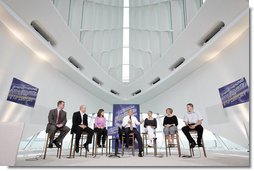 I had an
amazing experience. I stopped by a business here called OnMilwaukee.com.
(Applause.) A little bit of a following, things are catching on. I rode over
here with Jeff Sherman and Andy Tarnoff, two young guys,
Milwaukee
citizens who started this company
-- entrepreneurs who took risk and have put out a product people obviously
want. It's a fast-growing little business. I met our participants over there to
talk about what we're going to do here, but I also love to see entrepreneurs.
You know, part of the role of government is to create an environment in which
people are willing to take risk and -- which means low taxes, reasonable
regulation. We've got to get rid of all these junk lawsuits that are
threatening small businesses, the job creators. But I want to thank Andy and
Jeff and their employees or associates for welcoming me there. And it was --
thanks for putting me on the front page of today's edition. (Laughter.)
I had an
amazing experience. I stopped by a business here called OnMilwaukee.com.
(Applause.) A little bit of a following, things are catching on. I rode over
here with Jeff Sherman and Andy Tarnoff, two young guys,
Milwaukee
citizens who started this company
-- entrepreneurs who took risk and have put out a product people obviously
want. It's a fast-growing little business. I met our participants over there to
talk about what we're going to do here, but I also love to see entrepreneurs.
You know, part of the role of government is to create an environment in which
people are willing to take risk and -- which means low taxes, reasonable
regulation. We've got to get rid of all these junk lawsuits that are
threatening small businesses, the job creators. But I want to thank Andy and
Jeff and their employees or associates for welcoming me there. And it was --
thanks for putting me on the front page of today's edition. (Laughter.)
I also want to welcome Jack Voight, the State Treasurer; and the State
Senate Majority Leader Dale Schultz. (Applause.) Hey, Dale. Tell your wife
hello. We traveled on a bus together.
Let me start off on Social Security by saying this: Franklin Roosevelt did
a smart thing in setting up a safety net for people who, when they retired,
would know they would be able to more likely live in dignity upon retirement.
He did a smart thing. And it worked -- Social Security worked for a long time.
As a matter of fact, I fully understand that right here in the state of
Wisconsin
, a lot of
people are counting on the Social Security check. In other words, Social
Security is really important for a lot of people's lives. In my home state of
Texas
, a lot of people
rely solely on their Social Security check.
And as we discuss Social Security, it's important for the people of
Milwaukee to understand, and Wisconsin to understand, that this discussion
we're having really is not about you, but it's about your children and your
grandchildren -- because I can look in the camera and say with absolute
certainty, if you're on Social Security today, nothing will change, you will
get your check. The system is solvent enough -- (applause.) The system is
solvent for people born before 1950.
The reason I have to say that is because many of you are aware of what
takes place in politics. People say the darndest things to try to change
people's opinions. They might say, if old so-and-so gets elected you're not
going to get your Social Security check. In other words, people have been using
Social Security to scare seniors to vote one way or the other for a long period
of time. And so, therefore, when I'm talking about the reform, I want you to
recognize, one, Social Security is important; and two, if you're a senior, you
have nothing to worry about. You will get your check.
But if you've got a grandchild, you've got plenty to worry about if you
care about your children and your grandchildren. And here's why -- here's why.
There's a lot of us getting ready to retire. We're called baby boomers. I'm
one. As a matter of fact, my retirement age is in 2008. (Laughter.) I turn 62
in 2008 -- it's kind of convenient. (Laughter.) And there's a lot of us. As a matter
of fact, by the time the baby boomers fully retire, there's going to be over 70
million of us. That's compared to 40-some odd million today. So the number of
retirees that the system will have to take care of is increasing dramatically,
and we're living longer.
A lot of baby boomers have been working out and taking care of our bodies,
making good choices, and medicine is better, and we're living longer. It's just
a fact. We're living longer than the previous generation -- and we've been
promised greater benefits. People running for office saying, vote for me, I'm
going to give you more benefits when it comes to Social Security. And sure
enough, they got elected and they kept their promise. And so you've got a lot
of people getting ready to retire who are living longer who are getting greater
benefits, and fewer people paying into the system.
In 1950, there was, like, 15 workers to one beneficiary. In other words,
you had a lot of workers relative to the number of beneficiaries. Today,
there's 3.3 workers per beneficiary. Relatively quickly, it will be two workers
per beneficiary. Fewer people paying greater benefits to a greater number of
people who are living longer.
Now, secondly, Social Security is not a savings account. In my travels
around the country I hear people say, why don't you just give us the money back
we put in. But that's not the way Social Security works. It's a pay-as-you-go
system. You pay; we go ahead and spend. (Laughter.) You pay through payroll
taxes; we spend on paying for the beneficiaries, the retirees for that year.
But if we've got any money left over, we didn't save it for you, we spent it on
government. That's the way it works. It's a pay-as-you-go. And then there's --
all that's left over is a file cabinet full of IOUs. I have seen the file
cabinet in
West Virginia
firsthand, and I saw all the IOUs. But the system is not the kind of system
where we're holding the money for you. That's not the way it works. We're
spending your money and left behind some paper that can only be good if the
government decides to redeem the paper. That's a pay-as-you-go system.
The pay-as-you-go system starts to go in the red because it's going to pay
out more in benefits than it collects in taxes in 2017. That's 12 years from
now. If you've got a six-year-old child, that will be about the time your child
starts to drive, if the driving age is 18 here in
Wisconsin
. In 2027 -- and by the way, the
situation gets worse every year, fewer people paying for more beneficiaries. In
2017, the system will be $200 billion for that year in the red. I don't know
where they're going to get the money. Every year it gets worse. In 2032, it's
like $300 billion in the red. In 2041, it's bust.
Now, if you're a senior you have nothing to worry about because it's got
plenty of money for you. But if you're a young worker, a young entrepreneur, a
young mom paying into the system, you're paying into a bankrupt system unless
the United States Congress decides to act.
Now, I see a problem. I fully recognize that some in
Washington
don't see a problem. They'd
rather kind of sweep this issue under the rug. But that's not the job of the
President. The job of the President is to confront problems and not pass those
problems on to another President, or another Congress, or another generation.
(Applause.) And I realize if we don't act, it's going to cost $600 billion a
year because of inaction. And I realize if we don't act, we're liable to saddle
a younger generation of Americans with an 18-percent payroll tax to make good
for the promises that you've made for me. And that's not fair, and that's not
right.
And so I went in front of the Congress and said, we got a problem. I said
it at the State of the
Union
. I also told the
leadership that I plan on campaigning on this issue -- in other words,
traveling the country doing exactly what we're doing here, making it perfectly
clear to the American people we have a problem. Guess what -- they now know we
got a problem. And that's bad news for people in Washington, D.C. who would rather
do nothing, because once the people figure out we got a problem, the next
question they're going to say to members of the United States Congress is, what
do you intend to do about it.
Now, I have an obligation to do more than just say we got a problem. I've
got an obligation to say, here's some -- here's some ideas that we got to work
on. First, anything we do, we got to make sure that future generations receive
benefits equal to or greater than benefits enjoyed by today's seniors. I think
that's a reasonable principle.
Secondly, I believe that -- I know we can solve a lot of the issue by
embracing what's called progressive indexing of benefits. It's a long word,
fancy words for this. Here's what happens: The promises Congress has made says
that your benefits will raise -- rise based upon wage increases. If you were to
say to the upper-income folks, your benefits will raise -- rise based upon
inflation, you've gone a long way to solving the solvency problem. It sounds
simple, but it basically means that poor people won't have to retire to
poverty, and the wealthier people in America will get benefits that increase
with the rate of inflation -- for people born prior to 1950 -- I mean, after
1950.
That progressive indexing plan does a couple of things. One, I think it is
an important principle to say to somebody who has been working all their life
in a hard job that you're not going to retire into poverty. America can make
that promise. And it's a promise we ought to make for people. It makes sense.
We want our people retiring with dignity. That's one way to make the Social
Security system better.
But it also makes sense to say to somebody who doesn't think they're going
to see any benefits anyway, you're going to get benefits, they're just not
going to grow quite as fast. They'll grow; they're going to be bigger -- equal
to or bigger than their previous generation; they're just not going to be quite
as big as the government promised you -- that politicians promised you. They'll
be bigger, but for the sake of solvency and permanency, if we don't do this,
you're going to be saddled with a $200-billion-a-year bill in 2027. In other
words, there's a reasonable approach that I'm confident that Congress, if it
takes a look at, will see it is reasonable.
Now, we've got to come together and solve other problems to make sure we
permanently solve the issue. I keep saying, permanently, because I remember in
1983 when President Reagan and Speaker O'Neill, in the spirit of
bipartisanship, said, we got a problem with Social Security, and they came
together, and said, we're going to put out a 75-year fix. The problem is, we're
now 22 years later and that 75-year fix didn't stick. In other words, if we're
going to sit down at the table, let's get it done forever. Let's say -- let's
say to a younger generation of Americans, we're going to permanently solve the
Social Security issue so you can grow up with peace of mind. (Applause.)
I'm almost through. I think as we permanently fix the system there's an
opportunity -- I know there's an opportunity to make the system a better deal
for younger workers. And so I've asked Congress to consider this idea: Younger
workers ought to be allowed to take some of their own payroll taxes, if they so
choose, and set up a personal savings account. Some of the taxes will be in a
-- that they pay -- after all, it's their money that they're paying -- they
ought to be allowed to take some of their money and set up a personal savings
accounts.
Here are the benefits for doing that. One, the government does a lousy job
on getting a good rate of return on your money. As a matter of fact, people
calculate that in the Social Security system you earn about 1.8 percent on your
money. That's not a very good deal. You see, if you have a personal savings account,
you could do a lot better than 1.8 percent. A conservative mix of bonds and
stocks, you can get up to 7 percent or 8 percent -- 4 percent. If you're only
in T-bills, you do better than 1.8 percent. And it's that difference in
interest that over time compounds that means a lot.
In other words, if you start setting aside money, with a decent rate of
return, it grows over time, it compounds. And it's that power of compound
interest which younger workers ought to be allowed to take advantage of. But
the system today doesn't let them take advantage of that. (Applause.)
So let me give you an example. If you're a 20-year-old mom earning $8 an
hour over the career, and you're allowed to take a third of your payroll taxes
and put it in a conservative mix of bonds and stocks, by the time that person
retires, she would have a $100,000 nest egg. See, that's the power of compound
interest.
Here's another interesting example for you. Say you've got a child and that
child decides to become a police force, marries a nurse, they're in the
workplace in 2011, and they work their entire careers. They set aside money
based upon the average salary of a policeman and nurse. By the time they
retired at 65, they would have a $669,000 nest egg. (Applause.)
That's what money does when it grows. That's what happens. And people ought
to be allowed to take advantage of that, if they choose. The government is not
saying you have to set up a personal retirement. I fully understand some people
might not feel comfortable about putting their money in bonds and stocks. I
know that. That's why this is a personal savings account -- a voluntary
personal account. Government is not saying, you must do this. They're saying,
if you so choose, you should be allowed to make that decision.
And a lot of people are going to make that decision. You know why? The
world has changed when it comes to investors. We're about to talk to some young
investors. I can assure you, when I was their age, I wasn't spending much time
thinking about 401(k)s. They didn't exist. There wasn't a lot of talk about
people running -- how's your IRA doing? They didn't exist. The whole notion of
people being -- entrusting people with their money and watching it grow is
changing. The culture is changing. The investor class is no longer confined to
just a few people. The investor class is varied, and we ought to have policies
in place that encourage every American to become an owner and investor and
watch their assets grow. (Applause.)
Laura said, don't get too long-winded, but it's not working. (Laughter.) A
couple of other points I want to make. The system is inherently unfair to some.
If you're -- if you and your spouse are working and both of you contributing in
the Social Security system, and one of you die early, when you turn 62, you get
a choice to make. You can either take the benefits accrued in the Social
Security system to you, or to your husband, but not both. Think about that.
Somebody has worked all their life, contributed to the system, dies early, and
the money just disappears. That doesn't seem fair to me. That doesn't seem fair
to me that fellow Americans working all his or her life, contributing in the
system, and then dies early, and the surviving spouse gets a burial benefit
and, at 62, gets the greater of the benefit structure, but not both. It's not
fair. If you allow a younger worker to set aside money and watch that asset
base grow, you're really saying, if something bad happens to you, you can pass
tha
Before we get to our panel, a couple of other points. One, you can't take
your money and put it in the lottery. In other words, this isn't one of these
deals where it's a -- you can take it and put it in high flyers. This is a
retirement fund. This is a safety net. Therefore, there's going to be a
conservative mix of bonds and stocks available for you to choose from. You can
mix it up between bonds and stocks and T-bills any way you want, but you cannot
take your money to the track. In other words, it's a safety net. There will be
guidelines.
Secondly, there will be fee structures that are reasonable. Wall Street
can't rip you off in this deal. I'm sure you've heard people say, oh, Bush's
plan, it's going to give Wall Street a windfall. Wait a minute, there are all
kinds of public retirement funds that exist around the country where the fee
structures are reasonable managed. You'll be treated fairly.
Speaking about that, all kinds of retirement systems around, I don't know
if you know this or not, but the United States Congress took a look at this
idea in what's called the Thrift Savings Plan. That's the federal savings plan.
And they thought about maybe giving somebody the option of putting their money
in a conservative mix of bonds and stocks because they -- the people who vote
on that must have recognized the power of compound interest. And guess what
happened. They adopted a plan that says, members of the United States Congress,
if they so choose, can take some of their own money and set it aside in a
conservative portfolio of bonds and stocks. Here's my attitude about that --
and it should be the attitude of the American people. If setting aside money so
it can grow better in a conservative mix of bonds and stocks is okay for United
States senators, it ought to be okay for workers all across America. (Applause.)
Ready to go? I think we're going to get something done. I really do. I
think the American people understand we've got a problem. I think seniors are
now beginning to understand all the scare tactics, all the propaganda is just
that. And they're going to get their checks. And finally, the final part of
this equation is, there's a lot of young Americans who are beginning to pay
attention to this issue and say, wait a minute, I'm not contributing
hard-earned money into a system that's going broke, and I don't like what I
hear, and I expect members of both political parties to set aside their parties
and focus on the good of the United States of America. (Applause.)
I want to thank you all for coming. First, we're going to start off with
Jeff Brown. Jeff is what we call an expert -- right?
DR. BROWN: I'll take that description.
THE PRESIDENT: That's right. Tell us what you do. This isn't the first time
we've been together, by the way. He's a fine lad.
DR. BROWN: Thank you, Mr. President. I'm a professor -- I don't know if I
should admit it here, but I'm at the University of Illinois. And -- (laughter.)
THE PRESIDENT: Be sensitive. (Laughter.)
* * * * *
THE PRESIDENT: Are students paying attention to the issue?
DR. BROWN: They certainly are after they get done with my classes.
(Laughter.)
THE PRESIDENT: Thanks, Jeff. Thanks for coming. (Applause.)
I like to remind people, he's a Ph.D. and I was a C student. (Laughter.) I
want you to take note of who's the President and who's the advisor. (Laughter
and applause.)
Right, Bobby? Bobby Kraft. Welcome, Bobby. What do you do?
MR. KRAFT: I'm President and CEO of a printing and a mailing services
company here in Milwaukee, First Edge Solutions.
THE PRESIDENT: Started it?
MR. KRAFT: Yes, two years ago.
THE PRESIDENT: Congratulations. Entrepreneurial spirit is strong.
MR. KRAFT: Thank you. I learned that from my chairman over there, my dad.
He -- his company opened first, there are 450 employees.
THE PRESIDENT: Great, fantastic. You and your dad have got the same
hairstyle I notice. (Laughter.)
MR. KRAFT: Absolutely.
THE PRESIDENT: Yes. Sorry, Bobby.
MR. KRAFT: It's been tough. It's been real tough.
THE PRESIDENT: Yes, yes. (Laughter.) Anyway, how many employees you got?
MR. KRAFT: We have 20 full-time employees.
THE PRESIDENT: Good. Add any last year?
MR. KRAFT: Yes, we did.
THE PRESIDENT: Do you realize -- it's a little off the subject, but 70
percent of new jobs in America are created by small business entrepreneurs. And
I want to thank you, Bobby, for being a small business entrepreneur.
(Applause.)
MR. KRAFT: Thank you, Mr. President.
THE PRESIDENT: I asked the same question to -- OnMilwaukee.com. They added
some employees last year, too. It's a good sign. Young entrepreneurs taking
risks, building businesses and employing people.
Now, Bobby, tell me -- you're here on Social Security.
MR. KRAFT: Correct.
THE PRESIDENT: Why? Besides the fact you got invited and you wanted to see
the art museum. (Laughter.)
MR. KRAFT: Before I got into printing I did have a short stint as an
investment advisor. And the first thing I learned getting into the industry and
studying all the financial books is that don't count on Social Security to be
there. We take that same level of education and we teach our employees that
they need to take advantage of the 401(k) we put in place for them because of
the fact, the way the Social Security system is set up, we cannot count on that
to be here.
THE PRESIDENT: Yes, let me stop you. Young guy sitting here in Milwaukee, Wisconsin,
in front of the President -- don't count on Social Security to be there. A lot
of people feeling that way here in America. What I'm telling you is, if we can
get the United States Congress to listen to you, we can put a plan in place to
make sure Social Security is there. (Applause.)
Keep going, Bobby.
MR. KRAFT: Keep going?
THE PRESIDENT: It's got to be a little depressing to be paying small
business rates, small business payroll taxes into a system where you say, it's
not going to be there. That's not good government -- ask people to work hard,
pay a payroll tax, and have people think -- a lot of people think it's not
going to be around. That's the problem. That's the issue. If you're a senior,
you're going to get your check. Bobby is a little worried about his.
Keep going.
* * * * *
THE PRESIDENT: So Bobby just said he's setting up a plan that says to his
workers, you can watch your money grow. In other words, we want you to have a
retirement system called a 401(k). Appreciate you setting it up.
But part of what we're talking about is an educational process. I
understand that. You know, Bobby said some people going around the water cooler
aren't so sure they want to take risks with the money. It's managed risk. It's
certainly not overwhelming risk. And my attitude about that is, if you're
nervous about it, stay in the system. Stay in the system as is. If not, you'll
get some Social Security benefits, but you're also going to get the benefit of
owning your own money and watching it grow. And then when you retire, you'll
have a nest egg. By the way, a nest egg that doesn't end up in a file cabinet
in West Virginia, a nest egg you call your own that the United States
government cannot take away from you. (Applause.)
Keep going, Bobby.
MR. KRAFT: Okay, thank you. You know, really the disheartening thing for us
as employers is talking to our employees who are working paycheck to paycheck
at a time, and telling them that the percentage of tax that's being yanked from
their check every time is going really to nowhere, and they're not able to grow
it at all. And that's not fun to tell one of your employees that, that you
can't count on that. Because we prefer to work on an optimistic basis, growing
a company, being entrepreneurial -- you take risks and you understand how to
mitigate them, but at the same time, you know that part of your employees'
checks are going to be just going really to something that you can't count on.
There's not a lot of confidence out there.
THE PRESIDENT: I appreciate you. That's the problem. That's the issue. It's
the issue confronting people in the Democrat Party, issue people confronting in
the Republican Party. And the fundamental question in Washington, D.C. is, is
there the political will to do what's right; to answer the question Bobby just
brought up, and that is, how can you look a worker in the eye and say, you're
working hard, you're contributing in a system that's going bankrupt. Now is the
time to get after it and solve this problem once and for all.
Bobby, thanks for coming. Very articulate. Good luck in your business. Glad
you're here.
MR. KRAFT: Thank you, Mr. President. (Applause.)
THE PRESIDENT: Christy Paavola.
MS. PAAVOLA: Yes.
THE PRESIDENT: College senior.
MS. PAAVOLA: Yes, I am, at Concordia University, Wisconsin.
THE PRESIDENT: Yes, actually, I've been there.
MS. PAAVOLA: Yes?
THE PRESIDENT: Yes. It's a great place.
MS. PAAVOLA: We think so. (Applause.)
THE PRESIDENT: Beautiful campus. So when will you graduate?
MS. PAAVOLA: May, 2006.
THE PRESIDENT: Got another year to go.
MS. PAAVOLA: Yes.
THE PRESIDENT: Are you out of school now?
MS. PAAVOLA: What?
THE PRESIDENT: I mean, summer -- summer break.
MS. PAAVOLA: Yes. Yes, we just finished Friday.
THE PRESIDENT: Good. Well, congratulations. All A's?
MS. PAAVOLA: Hopeful.
THE PRESIDENT: Yes. (Laughter.) None of your business, Mr. President.
(Laughter.) What would you like to do upon graduation?
MS. PAAVOLA: I would like to teach in the Lutheran schools for the Lutheran
Church -- Missouri Synod.
THE PRESIDENT: Awesome. Yes, good. Wants to be a teacher.
MS. PAAVOLA: Yes.
THE PRESIDENT: Thanks for teaching. By the way, anybody who's looking for a
way to contribute to society -- teach. (Applause.) And you don't have to be a
classroom -- you want to be a classroom teacher.
MS. PAAVOLA: Correct.
THE PRESIDENT: Yes. You can mentor a child, by the way. That's teaching.
You can help save a child's life by teaching him or her how to read. So I hope
you do. Thanks for setting a good example. (Applause.)
MS. PAAVOLA: Thank you, Mr. President.
THE PRESIDENT: So here you are, senior in college, sitting right next to
the President of the United States. (Laughter.)
MS. PAAVOLA: Yes. (Laughter.)
THE PRESIDENT: You got any thoughts about Social Security?
MS. PAAVOLA: Yes, I don't think it's going to be there when I retire, which
is really scary.
THE PRESIDENT: Interesting, isn't it? They took a survey amongst
youngsters. Somebody explained to me, I didn't actually watch -- see the
survey, but I heard what the person said. He said, more people are -- that are
Christy's age think they're more likely to see a UFO than get a Social Security
check. (Laughter.) Pretty funny when you think about the fact that a lot of
young people are going to be putting a lot of money into a system that may not
be around. So we're sitting here with a senior in college saying, I don't think
the system is going to be around.
Got anything else you want to say?
MS. PAAVOLA: I really like the idea of personal savings accounts. I like
the fact that I have control over my money and I have the assurance of knowing
that that money will be there when I retire.
THE PRESIDENT: Yes, thanks. That's a pretty sophisticated point of view for
a college senior. I appreciate it. I hope people your age are paying attention
to the issue.
MS. PAAVOLA: Hopefully. It's an important issue.
THE PRESIDENT: It's a huge issue. It's a huge issue when you think about
working hard and putting payroll tax into a system that's going broke. Imagine
that. Just say we just started anew, and I say, all of you who want to
contribute hard-earned money to a system that will be broke within 20 years,
please raise your hand. Not a lot of contributors. You don't have the choice.
But we've got a choice in Washington to do something about it. That's what the
choice is, and I intend -- (applause.)
Now is your chance. All kinds of cameras. (Laughter.)
* * * * *
THE PRESIDENT: There you go. Well, I appreciate you coming.
MS. PAAVOLA: Thank you, very much.
THE PRESIDENT: You did a heck of a job. You deserve an "A."
(Applause.) You'll have to carry it over for next year, though.
MS. PAAVOLA: Okay.
THE PRESIDENT: Good job. Thanks for coming.
MS. PAAVOLA: Thank you.
THE PRESIDENT: Andrea Marton, welcome.
MS. MARTON: Thank you. It's an honor to be here, Mr. President.
THE PRESIDENT: Andrea, just a little bit about yourself.
MS. MARTON: Well, first of all, I'm Assistant Director at a preschool in
Germantown, Rainbows End.
THE PRESIDENT: Good. Got a child?
MS. MARTON: Yes, I do. He's three, and it's one of the hardest jobs I've
ever had to do.
THE PRESIDENT: Yes. Listen, Andrea is a single mom. Being a single mom is
the hardest job in America. And I want to thank you for being a good mom.
(Applause.) So you go to work. How is it?
MS. MARTON: I love it. I love being with kids, I love improving the future,
and they have a future.
THE PRESIDENT: You bet.
MS. MARTON: I come from a long line of teachers.
THE PRESIDENT: Do you really?
MS. MARTON: Yes. Both my parents are teachers, and my grandfather was a
teacher.
THE PRESIDENT: Are they here?
MS. MARTON: Yes, they are -- my parents. Yes, there.
THE PRESIDENT: Right here in the audience?
MS. MARTON: Yes, over there.
MR. MARTON: You're doing great, Andrea! (Applause.)
THE PRESIDENT: What did he say?
MS. MARTON: I'm doing great.
THE PRESIDENT: I'm not going to comment about your hair. (Laughter.) Thanks
for coming.
So, tell me, the Social Security issue interests you?
MS. MARTON: Yes. Well, being a single mother and part of the working corps,
it's very important for me to have something to rely on. And with the current
system in place, we look down the road and it's not going to be there. And if
it is there, it's going to be real slim.
THE PRESIDENT: You paying payroll taxes?
MS. MARTON: Oh, you better believe it. (Laughter.)
THE PRESIDENT: Do you feel it?
MS. MARTON: I -- I don't see it.
THE PRESIDENT: But you feel it.
MS. MARTON: Oh, yes.
THE PRESIDENT: Well, you see why -- you see what would have been and what
wasn't when you get your check stub, right?
MS. MARTON: Right, right, right. So, for me, to have the option and the
choice to put my money into something that I will see in the future. It's just
great.
THE PRESIDENT: Yes, see, it's an interesting thought, isn't it? A single
mom sitting here saying she wants to be -- have the opportunity to take some of
her payroll taxes -- you called yourself, the working poor?
MS. MARTON: Yes, I did.
THE PRESIDENT: Well, I hope that doesn't stay that way. Keep working.
MS. MARTON: I hope not, either.
THE PRESIDENT: Yes. But the point is, is that this issue affects people
from all walks of life, all income levels. But how about -- I gave the example
of a single mom working an $8 job all her life and is able to put aside a-third
of her payroll taxes and watch it grow in a reasonable rate of return. That
person will end up with $100,000, coupled with a Social Security system that
will have her benefits grow with wages.
And see -- and then all of a sudden, Andrea is sitting there with $100,000
as part of her retirement plan that she can do with whatever she wants. In
other words, you can use it for your retirement or drop it on the little one.
MS. MARTON: Exactly, and that's --
THE PRESIDENT: The little guy.
MS. MARTON: Yes, Angelo is a big part of my life, and I want to make sure
that not only my future is secure, but his, as well. And with this plan, I
believe that it is a great option to put my money into a fund that will earn
interest and will be there, and for the next 40 to 50 years that I work, I'm
going to see it, because I deserve it.
THE PRESIDENT: There you go. (Applause.) I couldn't have said it better
myself. Thanks for coming.
Okay, finally, we've got Joel and Tonya Bruins.
MRS. BRUINS: Hello.
THE PRESIDENT: Where do you all live?
MR. BRUINS: Are you going to do the talking or do you want me to?
(Laughter.)
THE PRESIDENT: It's like one of these couple talk show things, you know.
(Laughter.) What's your favorite color? Anyway -- (laughter.)
MR. BRUINS: We live in Brandon, Wisconsin. I'm a dairy farmer. I'm a
partner with both my brother, John, and my dad, Bill, which you met last year.
THE PRESIDENT: Yes.
MR. BRUINS: And my Uncle Cal. And the name of the farm is Homeland Dairy.
We milk about 500 cows. And --
THE PRESIDENT: What's your job?
MR. BRUINS: I take care of the cows. I'm the herdsman.
THE PRESIDENT: Herdsman, good.
MR. BRUINS: So any breeding and reproduction and calves and anything
dealing with the cattle is what I take care of.
THE PRESIDENT: Good, good.
MR. BRUINS: And personnel, I guess, I get into sometimes, too. To all the
15 employees, they keep you on your toes.
THE PRESIDENT: That's good. It's a good-size operation.
MR. BRUINS: Yes, very -- it's a very good size operation.
THE PRESIDENT: Great. Tonya, you work?
MRS. BRUINS: Yes, I work at the National Bank of Waupan. I'm in the
bookkeeping department there and I also take care of all the ACH processing for
the bank.
THE PRESIDENT: Good. So you're familiar with finances?
MRS. BRUINS: Right.
THE PRESIDENT: Give me your thoughts on Social Security. Dairy farmer
sitting there -- I can presume dairy farmers think about Social Security.
* * * * *
THE PRESIDENT: We've got a farmer right here, with his wife, Tonya, set up
an IRA. It's pretty interesting, isn't it? In other words, this notion about
investing -- people watching their money is pretty well filtering through most
of society. Roth is kind of a fancy word for dealing with tax going in and
coming out, right?
MR. BRUINS: Right.
THE PRESIDENT: Anyway, so, you all watch your investments grow?
MR. BRUINS: We watch them, yes, we do.
THE PRESIDENT: Make a decision?
MR. BRUINS: Yes, we have made decisions on it.
THE PRESIDENT: Tonya, do you want to say something?
MRS. BRUINS: I'm also -- my profit sharing plan at the bank allows me to
control where I -- what funds I want to put my --
THE PRESIDENT: So you've got choices? How does it work?
MRS. BRUINS: Right, yes. We've got 15 different funds we can choose to
invest in. You know, if we want to keep it high risk or low risk, it's our
decision.
THE PRESIDENT: Yes, see. It's an interesting idea, isn't it? The bank she
works for, a little country bank, says, wait a minute, we're going to trust our
employees to be able to make a decision with their own money about what to put
the money in, 15 different options. Was it hard to learn about how to do that?
MRS. BRUINS: They keep us very well-informed. They have people that come in
every year and advisors we can talk to and learn from them.
THE PRESIDENT: Yes, we do -- there are some pockets of financial illiteracy
in our country, but there's nothing like solving financial illiteracy when
you're watching -- when you're making decisions for your own money. You start
asking questions; there's advisors, there's people around to help you make a
rational decision what to do with your own money. And a good way to learn is
when you're watching your own money grow.
And so you get, what, quarterly statements, monthly statements?
MRS. BRUINS: Quarterly.
THE PRESIDENT: Quarterly statements?
MRS. BRUINS: Yes.
THE PRESIDENT: Open it right up, sit down at the kitchen table and say,
look at the -- look what's happening here.
MRS. BRUINS: Yes. We also have the option to change funds whenever we want
to. We can check them online at any time, as well.
THE PRESIDENT: Sure. Think about that, though. It sounds pretty simple, but
isn't it -- doesn't it make sense to have people from all walks of life opening
up a quarterly statement to watch their assets? It certainly makes you pay
attention to the decision government makes. It is, to me, a healthy
America
when
more people are able to say, I'm watching my own assets. I like it when more
Americans are owning their own home, owning their own business, and managing
their own retirement plans. It's good for this country to have that kind of --
(applause.)
* * * * *
THE PRESIDENT: Yes, I appreciate that. By the way, one way to make sure
families stay on the farm is to insist that the United States Congress get rid
of the death tax forever. (Applause.)
Listen, I hope you've enjoyed this as much as I. I want to thank you all
for coming. Good job. (Applause.) I'm just beginning this debate. I'm going to
spend whatever time it takes to continue traveling this country and make it
absolutely clear to the people, we've got a problem. (Applause.) I will
continue to reassure seniors who are counting on their Social Security check,
you have nothing to worry about. You're going to get your check. I don't care what
the mailers say, what the advertisements say, you will get your check. That's
the pledge this government has made, and it's a pledge we'll keep. And I'm
going to continue reminding youngsters that they need to get involved in this
issue because if the United States Congress does not act, we have saddled a
young generation with an incredible burden. And I don't think that's right. I
think now is the time for people in Washington, D.C. to set aside partisanship
and come together and solve this issue one time and for all, for the good of
the Unit
Thank you all for coming, and God bless. (Applause.)
END 12:10 P.M. CDT
President Participates in Social Security Conversation in New York - May 24, 2005
Greece Athena Middle and High School
Athena Performing Arts Center
Greece, New York
10:48 A.M. EDT
THE PRESIDENT: Thank you all. Go ahead and be seated. Be seated, thank you.
We've got to get to work. Thank you all for coming. Please be seated.
(Applause.) Thanks for coming. Thanks for the warm welcome, and thanks for
caring about the future of our country, because that's what we're here to
discuss. Before I get to the Social Security issue, I do want to thank some
people.
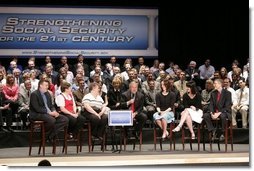 First I
want to thank the Greece Athena Middle and High Schools for letting us use this
fantastic facility. It really is beautiful, yes. (Applause.) A fantastic place,
isn't it? Yes. I want to thank Helen Wahl and Dick Snyder -- Helen is the
principal of the high school; Dick Snyder is the principal of the middle school.
I want to thank all the teachers. I want to thank the superintendent. I want to
thank all the folks who care a lot about making sure the kids get educated here
in this part of the world. (Applause.)
First I
want to thank the Greece Athena Middle and High Schools for letting us use this
fantastic facility. It really is beautiful, yes. (Applause.) A fantastic place,
isn't it? Yes. I want to thank Helen Wahl and Dick Snyder -- Helen is the
principal of the high school; Dick Snyder is the principal of the middle school.
I want to thank all the teachers. I want to thank the superintendent. I want to
thank all the folks who care a lot about making sure the kids get educated here
in this part of the world. (Applause.)
I'm sorry Laura is not here. Yes, you'd probably rather have her here than
me, wouldn't you? Anyway -- (laughter.)
Q We didn't say that.
THE PRESIDENT: Well, no, but you thought it. You didn't say it, but I could
tell you thought it. You're not the only person here who feels that way, I want
you to know. She's doing great. She is on a trip promoting the freedom agenda.
She's made it very clear to people in the Middle East, you can't have a
complete society unless women participate fully in the society in the Middle
East. (Applause.) I'm really proud of her. I'm a fortunate man that she said
yes when I asked her to marry me back in Midland, Texas. She's a great First
Lady. I'm looking forward to having her come home tonight, back to the White
House. (Applause.)
I thank Congressman Tom Reynolds. He's an effective United States
Congressman who cares a lot about this district. (Applause.) I'm proud to call
him friend. I'm proud to call Congressman Sherry Boehlert friend, as well.
Sherry is from the district next door; I've known him for a long time. He's a good,
thoughtful man. He's a fine United States congressman. (Applause.) Congressman
Jim Walsh is with us today. He, too, is a fine United States congressman.
(Applause.) And I was proud to be traveling with Congressman Randy Kuhl -- he's
a freshman member of the House of Representatives, doing a great job. Thank you
all for coming. (Applause.)
They want to ride on Air Force One. (Laughter.) Proud to make room for
them. They want to ride back on Air Force One. (Laughter.) And they probably
want a meal on Air Force One. Save up your appetite, fellows, you got a good
meal coming.
I want to thank all the state and local officials who have joined us today.
I'm proud you're here. There's two athletes in the audience I want to pay
recognition to. First of all, a person you all know well, really a fine member
of the community, member of the NFL Hall of Fame -- Jim Kelly. Thank you for
coming. Good to see you again, Jim. (Applause.) And at the other age of the --
at the other end of the age spectrum is a fine athlete from this part of the
world. I just met her. As you know I'm a baseball person. I love baseball. The
fact that somebody would pitch a perfect game at any level of baseball is
amazing. The fact that a person would pitch a perfect game and strike out every
batter is even more amazing. So welcome a fantastic pitcher in the --
representing the Dodgers baseball team, from Little League Baseball, Katie
Brownwell. (Applause.) Thanks for coming.
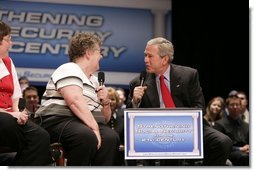 And
finally, one other person, before I get to the topic at hand, I'd like to
introduce, is a woman named George-Ann Schauffele. George-Ann is a volunteer.
And the reason I bring up people who volunteer is I want to remind you that the
true strength of this country lies in the hearts and souls of our citizens;
that if you want to be a participant in America, and in the future America,
volunteer to make somebody's life better. Feed the hungry, help find shelter
for the homeless. George-Ann is involved with the Literacy Volunteers of
Rochester Program, helping somebody learn to read. I can't think of a better
way to pass on a gift from one generation to the next than to mentor somebody,
particularly somebody who needs to learn to read.
And
finally, one other person, before I get to the topic at hand, I'd like to
introduce, is a woman named George-Ann Schauffele. George-Ann is a volunteer.
And the reason I bring up people who volunteer is I want to remind you that the
true strength of this country lies in the hearts and souls of our citizens;
that if you want to be a participant in America, and in the future America,
volunteer to make somebody's life better. Feed the hungry, help find shelter
for the homeless. George-Ann is involved with the Literacy Volunteers of
Rochester Program, helping somebody learn to read. I can't think of a better
way to pass on a gift from one generation to the next than to mentor somebody,
particularly somebody who needs to learn to read.
My point is this: Serve your community and serve your country by taking
time out of your busy lives to volunteer to make somebody's life better; to
answer that universal call to love a neighbor just like you'd like to be loved
yourself. (Applause.) I don't know where George-Ann is. Where are you,
George-Ann. Thanks for coming. Thanks for being a great role model. (Applause.)
We got a lot to do in Washington, D.C. One of the big issues, of course, is
Social Security -- although yesterday there was some progress made. I'm pleased
that the Senate is moving forward on my judicial nominees who were previously
being blocked. These nominees have been waiting years for an up or down vote on
the Senate floor, and now they'll get one. It's about time we're making some
progress. (Applause.)
It's important for this nation to address issues. I believe the job of the
President is to confront problems, not to pass them on to future Presidents or
future generations. I believe my job in representing everyone who lives in this
country is that when I see a problem, is to say to the United States Congress,
let's work together to solve the problem. And, folks, we've got a problem when
it comes to Social Security.
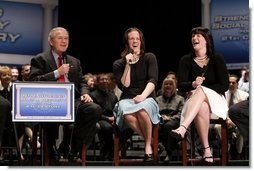 First,
let me start by saying that Franklin Roosevelt did a good thing when he created
the Social Security system. Social Security has been an important part of a lot
of people's lives in America. The Social Security system created by Franklin
Roosevelt provided a safety net for people in their retirement. And it worked.
There are a lot of people still in this country counting on their Social
Security check. And, therefore, I want to start by saying to people who are
getting their check, people who were born prior to 1950, the system will not
change when it comes to you. The system has got plenty of money in it to make
sure you get your check.
First,
let me start by saying that Franklin Roosevelt did a good thing when he created
the Social Security system. Social Security has been an important part of a lot
of people's lives in America. The Social Security system created by Franklin
Roosevelt provided a safety net for people in their retirement. And it worked.
There are a lot of people still in this country counting on their Social
Security check. And, therefore, I want to start by saying to people who are
getting their check, people who were born prior to 1950, the system will not
change when it comes to you. The system has got plenty of money in it to make
sure you get your check.
The reason I have to say that is because I understand how the Social
Security issues has worked in the past -- somebody like me talks about it, and
then somebody comes in behind by telling seniors, "really what he's saying
is he's going to take away your check." That's old-style, scare politics,
but it is a part of the American system. And so people have got to understand
when we start talking about Social Security, to strengthen the Social Security
system for generations to come, to deal with the problem I'm about to describe
to you, that if you're a senior in Greece, New York, you're going to get your
check. It's the folks coming up that you need to worry about. See, if you're a
grandmother, you're going to get your check. You need to worry about your
grandson.
We're about to talk to a generation of folks from this part of the world
about Social Security. Now, here's the reason I even have to bring it up, that
the pay-as-you-go system in Social Security is confronting some serious
demographic difficulties.
Now, the system is pay-as-you-go -- that means when you pay in, we go ahead
and pay out. Your payroll tax goes into a -- not into a trust that we hold for
your account; your payroll tax goes into an account and we pay out the money
for the retirees and with any money left over, we spend it on general government.
It's important for people to understand that aspect of Social Security. In
other words, it's not a trust. In other words, we're not taking your money and
holding it for you and then giving it back to you when you retire. We're taking
your money, we're spending it on current retirees, and in that more money is
coming in that needs to go out for the retirees, we're spending on other
programs. And all that's left behind in Social Security is a group of file
cabinets with IOUs in it. That's the way the system works. It's called
pay-as-you-go.
Now, what's going to change from today in terms of the pay-as-you-go system
is that there's a lot of people getting ready to retire. I happen to be one of
them. (Laughter.) At least I reach retirement age in 2008 -- I like to remind
people, that's a convenient date for me. (Laughter.) Particularly the end of
2008. (Applause.) And there are a lot of people like me. We're called the baby
boomers. I'm looking at some baby boomers out there. As a matter of fact, by
the time the baby boomers fully retire there's going to be over 70 million of
us getting paid by younger workers who are paying through payroll -- paying our
retirement through payroll taxes. Today there's about 40 million retirees. So,
you see, a lot more people are going to be -- having to be taken care of in the
retirement system through the pay-as-you-go system.
And not only that; we're going to live longer than the previous generation.
And not only that; our benefits are going to rise faster -- at least the promised
benefits will rise faster than a previous generation. So you've got a lot of
people who will be living longer, getting paid greater benefits, with fewer
people paying into the system.
In 1950, there were some 16-to-one workers paying into the system for each
beneficiary. Today there's 3.3 workers for every beneficiary. Soon there's
going to be 2 workers for every beneficiary. So I think you're beginning to get
a sense of the math. A lot of us are going to get greater benefits, we're going
to live longer with fewer of the young people paying in the system to take care
of us.
Now, what ends up happening under that type of system is that, in 2017, the
system starts to go into the red -- more money going out than coming in on
Social Security benefits, for Social Security benefits relative to the payroll
taxes. And it gets worse every year. In 2027, it's projected to be -- it will
be $200 billion in the hole, $200 billion more benefits going out than payroll
taxes coming in; every year worse after that, until 2041, all those -- the
paper in the file cabinets in West Virginia are just eaten up, bankrupt. The
system is bust.
What we're asking youngsters to do is to contribute money through payroll
taxes into a system that will be broke in 2041 -- unless we do something about
it. And so that's the problem. And it's a real problem. My friend, Tim Penny,
former congressman from Minnesota, is going to describe the problem to you in
further detail.
Now, I have a duty not only to describe the problem, I believe I have a
duty to come forth and say, let's do something about it and here's some ideas
to the United States Congress. I did it. I stood up in front of the Congress at
my State of the Union, I said, here's a problem; by the way, here's some ideas;
all ideas are on the table -- except running up the payroll tax rate, which I
think would hurt the economy -- all ideas are on the table, bring them forward.
And then I further refined that by talking about some of these ideas. And the
reason I'm doing it is because I understand if we wait, it costs $600 billion a
year more every we wait. See, if we don't do anything, if we don't come up with
a solution to permanently solve this problem, it is conceivable a younger
generation of Americans will have to pay an 18-percent payroll tax, or benefits
will have to be cut by 30 percent, or the rest of government will have to cut
substantially in order to make sure that the promises that have been made are
pr
And so here are some ideas Congress needs to consider. First of all, that a
future generation should receive benefits equal to or greater than the benefits
enjoyed by today's seniors. That seems like a reasonable principle as we go
forward. Secondly, that the Social Security system should be designed such --
the future Social Security -- by the way, if you were born prior to 1950,
nothing changes. What I'm talking about here doesn't pertain to you. You're
going to get your check. The system is going to be exactly the way it is.
There's plenty of money in it to take care of you. It's the younger folks that
need to be paying attention to what I'm talking about.
And so I think a second principle ought to be this: if you've worked all
your life, that you should not retire in poverty. That's a principle that makes
sense. We can design a system that supports that concept. And here's the way
you do it: It's called progressive indexing. That's a Washington kind of thing,
you know. (Laughter.) It says that if you're in the -- for example, a guy named
Pozen, who Tim knows well, came up with this concept. It said that if you're a
-- poorest 30 percent of the workers, nothing will change in terms of how your
benefits increase.
Right now the benefits, by the way, increases are tied to wages. If you're
the top 1 percent of workers in terms of income, your benefits would increase
by the rate of inflation, not by the rate of wage. Your benefits increase, but
not as fast as the folks at the bottom end of the spectrum. And if you're in
between, depending upon your income, your benefits will increase somewhere
between the rate of wage and the rate of price.
Now, incredibly enough, structuring the system this way when it comes to
benefit increases will get about -- a significant portion of the problem
permanently solved. I think it makes sense for Congress to consider this idea.
It says you'll get a benefit equal to or greater than the previous generation;
that, at the very minimum, your benefit will grow at the rate of inflation --
if you're poor, your benefit will grow at the rate of wage increases, and that
you won't retire into poverty.
And there are other things we can do to permanently solve the problem
completely. I say, permanently solve it, because you might remember 1983. Were
you in the Congress then, Tim? Yes, first term in the Congress. Tim came
together with others -- Ronald Reagan was the President, Tip O'Neill was the
Speaker. We had a problem in Social Security. They came together and put
together what they called a 75-year fix. Here we are 22 years later. The
75-year fix didn't stick for 75 years. It's time to fix this deal once and for
all.
And there are some good ideas I put on the table. Let me tell you one other
good idea that I want people to think about before we get to our panelists
here, folks we're going to be discussing this issue with, and that is that I
think that as we permanently solve the system, that we ought to make it a
better deal for younger workers by allowing younger workers to take some of
their own payroll taxes and set it aside in what is called a voluntary personal
savings account. (Applause.)
Notice I said "voluntary." In other words, the government should
say to a younger worker, if you want to, you can put some of your own money
aside. You don't have to. If you're uncomfortable with watching your money grow
with a conservative mix of bonds and stocks, you don't have to do that. You can
keep it the way -- into the system. And you'll get your check. If you're in the
bottom 30 percent, your benefits over time will grow at wages. If you're in the
top 1 percent, they'll grow with inflation. And if you're somewhere in between,
they'll grow depending upon your income, but greater than the rate of
inflation. Secondly, it's called a personal account. That means you own it.
It's an account the government cannot take away. (Applause.)
So why would we do this? Why would we think of this idea? Well, first of
all, with your money in your payroll taxes -- after all it's your money -- is
earning about a 1.8 percent rate of return over time in the Social Security
system. You can do better than that. You can do better than that with T-bills,
which have very little risk to them, if any at all. You can do a lot better
than that in a conservative mix of bonds and stocks. They say that over time
you should be able to average at least 4.6 percent.
Now, over a lifetime that is a significant amount of money relative to the
1.8 percent, because money compounds, money grows. For example, if you're
making $8 an hour and you put your money -- and you're allowed to set aside a
third of your payroll taxes -- $8 an hour over your life, and you're allowed to
set a third of your payroll taxes aside in a personal savings account, and you
earn the 4.5 percent rate of return, which is definitely achievable,
particularly when you look at the history of a conservative mix of investments,
by the time it comes -- you reach retirement age, you'll have earned $100,000
in your nest egg. That will be a part of your Social Security retirement
system. See, you'll get benefits out of the current system, out of the system
that's reformed, plus you get $100,000 that you call your own.
If you're -- say, you're a police officer and a nurse, and enter the work
force in 2011; you set aside money, you make the average salary those folks
make over time, and you set aside a third of your payroll taxes -- both of you
do
-- by the time both retire, they have about $669,000 in a personal savings
account. Money grows over time. The higher the rate of return, the more -- the
faster your money grows, and the more you end up with.
A lot of people are able to understand that. You know why? Because we're
into a 401(k) culture. When Penny and I were growing up, we didn't have
401(k)s. The other day I was in an automobile manufacturing plant in
Mississippi, I'm sitting with a lot of line workers. I said, how many of you
have got 401(k)s? A lot of hands went up. A lot of people from different walks
of life, different backgrounds, now understand what it means to watch your
money grow. This isn't a new concept that's in American society, this is
something that's taking place throughout all of society. And I think it makes
sense to understand the investor class doesn't belong to a privileged few, but
the investor class ought to be extended to everybody who lives in America if that's
what you want, if that's what you choose. (Applause.)
I like the idea of somebody saying, here's your asset and you can leave it
to whomever you want. And the more people are able to do that in our society,
the better off society is. See, I think government ought to promote an
ownership society. We ought to encourage more people to own their own home,
encourage entrepreneurs to be able to take risk and own their own business --
and in this case, encourage Americans from all walks of life, if they so choose,
to manage their own retirement account. And I say, manage it -- you know it's
your money; you're going to have some choices to make when it comes to a
personal savings account. You can't take it to the lottery, by the way. You
notice I've been stressing conservative mix of bonds and stocks, because we
want this account to grow and be a part of a modern safety net for you in your
retirement. And so there will be some guidelines.
And I can predict to you that it works because a lot of other people have
watched their money grow in the same kind of accounts, including people who
work for the federal government. See, we have got in Washington what's called a
Thrift Savings Plan. And members of the United States Senate, for example, can
choose, if they so desire, to set aside some of their own money in a personal
savings account, a voluntary personal savings account. And a lot of people like
it.
I think -- I was doing one of these events with Senator McCain, who told me
that his rate of return on his money was, like, 7 percent over the last 20
years. That's a lot better than the 1.8 percent we now get for you in the
Social Security system. And so my attitude about this issue on thrift savings
plans when I speak to members of the Congress is pretty simple -- if the idea
of taking some of your own money and setting it aside in a conservative mix of
bonds and stocks is good enough for you, Mr. Senator, it is good enough for
workers all across the United States of America. (Applause.) You'll be happy to
hear Senator McCain agrees with me, because he's seen his money grow.
Now, a personal savings account would be a part of a Social Security
retirement system. It would be a part of what you would have to retire when you
reach retirement age. As you -- as I mentioned to you earlier, we're going to
redesign the current system. If you've retired, you don't have anything to
worry about -- third time I've said that. (Laughter.) I'll probably say it
three more times. See, in my line of work you got to keep repeating things over
and over and over again for the truth to sink in, to kind of catapult the
propaganda. (Applause.)
But if you choose to have one of these accounts -- notice I keep saying
"if you choose" -- the government is not going to tell you, you have
to do this. I think the government ought to give you the opportunity to set up
one of these accounts. And the account becomes a part of your retirement plan.
It's your own asset. It's something you leave to somebody -- whomever you
choose. And it makes the system eminently more fair.
Now, with those thoughts in mind, we got a problem, and here's some ideas
on how to solve it. I've asked Congressman Tim Penny, right out of the state of
Minnesota, a person who's followed this issue a lot -- he happens to be of a
different political party than I am, but, nevertheless, we both share the
common goal of doing our duty as involved citizens to permanently solve the
problem of Social Security today.
Welcome, Congressman. Thanks for coming.
* * * * *
THE PRESIDENT: Well, thank you, Tim, good job. (Applause.) Articulate guy,
isn't he? One thing you don't have to worry about is me staying with this
effort. This is a vital issue. The American people expect those of us who are
fortunate enough to serve in Washington to solve problems. And I've just begun.
I like getting out of Washington to begin with -- (laughter) -- I like
explaining the situation. But we're just beginning. If this were easy, it would
have been done a while ago. And I fully recognize some in Washington don't particularly
want to address this issue, it may be too difficult. And I recognize some of
them say, well, this is a partisan thing, we don't want to make one party look
good as opposed -- at the expense of another.
But let me tell you what I think is going to happen. I think -- and Tim is
right -- I think more and more people recognize there's a problem, and people
are beginning to say, go do something about it. And those who obstruct reform,
no matter what party they're in, will pay a political price, in my judgment.
People expect us to go to Washington, D.C. to work together. That's what they
want to see, particularly when it comes to an issue like Social Security.
(Applause.)
We've got three members of a fine family here. We've got grandmother, mom,
and down there anchoring at the end is grandson or son, isn't that right?
MRS. CEGLINSKI: That's right.
THE PRESIDENT: You are Audrey Ceglinski.
MRS. CEGLINSKI: That's right. I'm a 70-year-old widow.
THE PRESIDENT: Don't ever say your age. (Laughter.)
MRS. CEGLINSKI: Oh, that's -- I have no problem. Don't ask me my weight,
though.
THE PRESIDENT: Okay. (Laughter and applause.) Reminds me of my mother.
(Laughter.)
MRS. CEGLINSKI: That's good. I was a teacher's aide for Williamsville South
High School for 25 years, and I retired from there -- a very enjoyable job. I
also wanted to mention I'm a volunteer for Meals on Wheels.
THE PRESIDENT: Oh, fantastic.
MRS. CEGLINSKI: Which I'm missing today. (Laughter.)
THE PRESIDENT: I hope somebody filled in --
MRS. CEGLINSKI: Oh, yes. We've got some great people there. It's a good
group.
THE PRESIDENT: Thanks for doing that.
MRS. CEGLINSKI: I like it a lot. My husband and I retired eight years ago.
Unfortunately, he passed on after only two years, so the money he had invested
in Social Security in a sense was gone. Had we had a personal account, I would
have had some money for Deborah, Jeremy, his brothers, to pass on.
THE PRESIDENT: Let me stop you there, if you don't mind.
MRS. CEGLINSKI: That's fine. (Laughter.) You have my permission.
THE PRESIDENT: Here's the way the system works. Two folks work, they both
contribute to the Social Security system; if one dies early, the spouse, the
remaining spouse gets to choose her benefits or his benefits, which are ever
greater, but not both. Think about that system. Dad went and contributed a lot
into the system. He passed away. But the money he put in -- most of the money
he put in is gone. That's not fair. What kind of system is that? It's not a
fair system. It's not fair to the family. It's not fair to the person who has
worked all his life, in this case. Had he been able to put money aside in a
personal account, that account would have gone to Audrey.
Isn't that right? Keep going. You're on a roll.
MRS. CEGLINSKI: Okay. (Laughter.) I have five children, seven
grandchildren, and that's my concern. I think you, making the young people
aware that there's a problem, is going to make them aware and encourage them to
save. And I think that's what we need to do.
THE PRESIDENT: Well, I appreciate that. Younger people need to pay
attention to this issue. See, if nothing gets done in Congress, as Congressman
Penny pointed out, you're going to get to pay higher payroll taxes -- and
higher and higher and higher payroll taxes. And so you need to pay attention.
Actually, I believe younger people are beginning to pay closer attention to
this issue. We're beginning to get their attention.
First thing is, is there any doubt in your mind that you're going to get
your check?
MRS. CEGLINSKI: I'm getting my check, and it's wonderful.
THE PRESIDENT: They're still coming.
MRS. CEGLINSKI: It's still coming. And I'm planning on it for a while yet.
(Laughter.)
THE PRESIDENT: Well, you need to, yes. Heading toward 80.
MRS. CEGLINSKI: That's right.
THE PRESIDENT: Right around the corner. You look great.
MRS. CEGLINSKI: Thank you very much.
THE PRESIDENT: You look like 100 to me. That's where you're going to be.
Thirty more years?
MRS. CEGLINSKI: I'll remind you of that. (Laughter.)
THE PRESIDENT: All right, good. And she's going to want her check. On her
99th birthday, she's going to want her check. And you're going to get your
check. Okay, and so who did you bring with you?
MRS. CEGLINSKI: I brought my daughter, Deborah, the oldest of my five.
THE PRESIDENT: Debbie or Deborah?
MRS. CEGLINSKI: Debbie. We like to call her Debbie.
THE PRESIDENT: You called her Deborah.
MRS. CEGLINSKI: Yes.
THE PRESIDENT: Okay. (Laughter.)
MRS. CEGLINSKI: Only when she's in trouble. And Jeremy, her youngest son.
THE PRESIDENT: Fantastic. Debbie, welcome.
MRS. BROWN: Thank you.
THE PRESIDENT: Thanks for coming. Mom did a good job, didn't she?
MRS. BROWN: Yes, she did.
THE PRESIDENT: So what was it like growing up? Was Mom pretty tough, a
disciplinarian?
MRS. BROWN: Yes, she was. (Laughter.)
THE PRESIDENT: Well, then you and I share the same thing. (Laughter.)
MRS. BROWN: Yes, we do.
THE PRESIDENT: Tell me what's on your mind.
MRS. BROWN: Well, I appreciate the opportunity to be here. I was an at-home
mom. I was privileged that my husband, who is here today, was willing to let me
stay home and raise the kids, work part-time. But when you do that, you don't
get to pay into a retirement system anywhere. So I went, got my masters degree.
I have a job I'm very happy with now. But I will never be able to build a good
retirement in the amount of time I have until I retire. So it's very appealing,
the plans that you're talking about, because I'll be quite dependent on Social
Security.
THE PRESIDENT: Yes, set aside a little money, watch it grow at a better
rate than the current Social Security system.
MRS. BROWN: Exactly, so that -- certainly, for Jeremy and for my other
three sons, as you said, it would make me happy to know that they're taken care
of, too, and that they would have options.
THE PRESIDENT: Right. And how is old Jeremy doing?
MR. BROWN: I'm doing good. (Laughter.)
THE PRESIDENT: Tell them where you were born.
MR. BROWN: Tomball, Texas. (Laughter and applause.)
THE PRESIDENT: Tomball, Texas, right outside of Houston.
MR. BROWN: Yes.
THE PRESIDENT: So you've got grandmom here, you've got mom here.
MR. BROWN: I've got the brother out in the audience
-- one of the three is out in the audience, the other grandparents.
THE PRESIDENT: Good. First of all, what are you doing with yourself these
days?
MR. BROWN: Well, I'm 18; I'm a sophomore at Canisius College, in Buffalo.
(Applause.)
THE PRESIDENT: What's your major?
MR. BROWN: I'm dual-majoring in business marketing and business management.
THE PRESIDENT: Great. All A's?
MR. BROWN: Hopefully. (Laughter.)
THE PRESIDENT: Well, don't worry about it. That won't disqualify you from
being President. (Applause.)
All right, Jeremy, get going, will you?
MR. BROWN: Well, being the younger generation, I'm just starting to pay
into the system. I like the idea of having these personal accounts, getting a
better rate of return in the end, and compound interest and everything so I
build up something for myself that I could leave for my future kids and
everything. And I like the fact that I'll have something to show for it,
because people go and pay decades and decades into Social Security and when it
comes time for me to retire, if we don't change, I'll have nothing to show for
it.
THE PRESIDENT: You know what's interesting -- I say this a lot when I
travel around the country -- is that a lot of young people think it's more
likely they'll see a UFO than a Social Security check. (Laughter.) What do you
think, Jeremy?
MR. BROWN: I don't know. I'd rather see Social Security change. (Laughter.)
THE PRESIDENT: I didn't ask your preference. (Laughter.) But there's a lot
of young people who, when they listen to the debate and understand the
demographic shift that's going on, don't think they're going to see anything.
What kind of system is that where you got a young guy getting ready to graduate
from college paying into a -- paying a payroll tax, a hefty payroll tax into a
system where he doesn't think he's going to see any benefits from it. It's a
system that sounds like to me is screaming for reform, so that somebody who
contributes into the system not only knows they're taking care of a baby boomer
generation, or doing their part for their retirement, but also will have
something left over for his family in this case.
What do you want to do when you get out of college?
MR. BROWN: Go into real estate.
THE PRESIDENT: Real estate, yes, good. Sounds like to me you can understand
finances pretty well, too, that money can grow over time.
MR. BROWN: Yes.
THE PRESIDENT: Anybody -- any other 18-year-olders that you know worried
about this issue, thinking about the issue?
MR. BROWN: They are now. I got them informed.
THE PRESIDENT: Yes, you do? That's good. (Laughter.) Good job. It's
important for people Jeremy's age to start listening to this discussion. As Tim
said, the longer we wait, the more difficult it's going to be for an up and
coming generation.
This is a generational issue, folks. See, the grandmoms and grandads around
America now understand they're going to get their check, and so once that
comfort level has been provided, the next logical question from many of the
grandmothers I've talked to is, what you going to do about my grandson? You've
said there's a problem, Mr. President, I expect you and the United States
Congress to make sure that my grandson has got a viable retirement system.
That's what a lot of people are beginning to say around America.
And that's why I can predict that once we get through on this issue, once I
finish traveling the country -- and I got a lot more to do -- people are going
to start demanding from their representatives and their senators a solution.
They don't want any Washington double-talk. What they want is a solution, so a
grandmother can then look at her son, her grandson, Jeremy, and say,
thankfully, people in Washington did their duty, and I can rest easy knowing
I'm going to get my check and Jeremy is going to get his, as well. That's the
issue. (Applause.)
Good job. You were great.
You two look alike. These are the Weitzel girls -- McKenna and Riley, isn't
that right? Okay. Which one is Riley? That makes you McKenna.
MS. McKENNA WEITZEL: That's true. (Laughter.)
THE PRESIDENT: They're twins. I'm the father of twins. I am a white-haired
father of twins. (Laughter.)
MS. RILEY WEITZEL: They can do that to you.
THE PRESIDENT: Did you do the same thing?
MS. RILEY WEITZEL: Yes.
THE PRESIDENT: Tell me what you all do.
MS. RILEY WEITZEL: Well, I'm a history teacher at Bread of Life Christian
Academy here in Rochester.
THE PRESIDENT: Fabulous. Thanks for teaching.
MS. RILEY WEITZEL: I teach history to the fourth through seventh grades
there. Hi, guys, I love you and I miss you. Be good.
THE PRESIDENT: Taking advantage of C-SPAN. (Laughter and applause.)
MS. RILEY WEITZEL: And I am getting married in the summer, in August. And
my fianc and I are just starting to think about retirement and about future
generations and, hopefully, if God blesses us with kids, our kids, and
something we can pass on down to them. We're really excited about your plan,
and that we can set up personal accounts and then watch compound interest grow,
and hopefully get a nest egg and be able to hand that down to our kids.
THE PRESIDENT: Fantastic. I don't remember thinking about compound interest
growing when I was 23. There wasn't a lot of discussion about that type of
issue. There's a change, there's a cultural change in America when it comes to
investment. Because a lot of people are now getting used to the concept of
watching their own money grow, isn't that right.
So is fianc here?
MS. RILEY WEITZEL: Yes, he's right over there -- Ben.
THE PRESIDENT: Ben. Look at him, fine-looking lad.
MS. RILEY WEITZEL: Thanks. I think so, too. (Applause.)
THE PRESIDENT: August is the wedding?
MS. RILEY WEITZEL: August 6th. You're invited. (Laughter and applause.)
THE PRESIDENT: That's a smart move. (Laughter.) She knows I won't come, but
I will send a gift. (Laughter and applause.) McKenna going to be in the
wedding?
MS. RILEY WEITZEL: McKenna is my maid of honor, of course.
THE PRESIDENT: Cool. McKenna, what do you do?
MS. McKENNA WEITZEL: I'm a hairdresser at the Scott Miller Salon in
Pittsford, New York.
THE PRESIDENT: Great, good.
MS. McKENNA WEITZEL: It's a wonderful place to work.
THE PRESIDENT: A lot of talk about Social Security?
MS. McKENNA WEITZEL: Not a whole lot there, but, honestly, I've been
thinking about it.
THE PRESIDENT: Have you? Good.
MS. McKENNA WEITZEL: Yes, definitely. I feel like there's definitely a
problem in the system right now and things need to change. And I want to say
that it's completely commendable of you to stand up and tackle this issue.
THE PRESIDENT: Oh, thanks. Thank you. That's my job. (Laughter.) I
appreciate you saying that. There's a lot of others in Washington feel the same
way I feel, that there's -- they say, are you taking a risk? How can you be
taking a risk when you're doing what the people expect, solving problems. I
think the people who take the risk are those who won't come to the table to
discuss the issue in a way that will help solve the problem. (Applause.)
So are you in agreement with Riley on personal accounts?
MS. McKENNA WEITZEL: I certainly do. I feel like being able to take more
ownership over your future and over your investments is very wise.
THE PRESIDENT: Yes. Don't you like the idea -- some of you have got 401(k)s
and you open up your statement on a quarterly basis -- it seems like to me that
would be a healthy thing for our country if more and more people are opening a statement
that says, this is what your worth, this is how your worth has grown. It's a --
to me, it's a notion of getting people to understand that they've got to pay
attention to the future of the country, when you, on a monthly basis, in some
cases on a daily basis, if you want to get on the Internet and look at your --
look at your asset base. Now, you're contributing in to the -- both of you --
payroll tax, aren't you?
MS. McKENNA WEITZEL: Yes, we both currently are.
THE PRESIDENT: Pretty good-size chunk.
MS. RILEY WEITZEL: No, not really.
THE PRESIDENT: No, a pretty good-size chunk of your payroll tax.
MS. RILEY WEITZEL: Oh, of course.
MS. McKENNA WEITZEL: Yes, yes.
THE PRESIDENT: I think the interesting thing is that when you first talk to
people entering into the workplace their reaction when they first get their
checks, what -- their reaction to what it's like to not have quite as much
money as you expected. That happen to you?
MS. McKENNA WEITZEL: Yes, that was a shocker. (Laughter.)
THE PRESIDENT: Yes, in other words, government tends to take out a pretty
good chunk. And it seems like to me that a significant chunk that is being
taken out ought to at least be able to say to young kids, there's a reason why,
it's worthwhile for the money to go out, because it will help me in my
retirement age. That's kind of what we're talking about, isn't it?
Okay, now that you've got your kids watching, anything else you want to
say?
MS. RILEY WEITZEL: Just, be good today.
THE PRESIDENT: How about you -- how about you, McKenna? McKenna, you got
anything else you need to say?
MS. McKENNA WEITZEL: Well, I just also want to state that I feel like it's
just encouraging to know that we could collect money in the end, that we aren't
hoping that there will be money there, that it truly will be -- and also just
the responsibility of knowing that you're setting aside money, and that you
will be getting it.
THE PRESIDENT: See, it's a little lack of trust right now it sounds like to
me -- don't quite trust the government to have a Social Security system
available for my -- for the money I put in. This is a matter of trust. This is
a big issue.
I want to thank our panelists for coming to discuss this issue. (Applause.)
Very good job.
Washington has a duty to earn the trust of the people by making wise
decisions about how the people's money will be used. We have a chance -- both
Republicans and Democrats have a chance to come together and to solve the
Social Security issue forever. And when we do -- and I believe we will, because
the people's voices are going to resonate on this issue -- and when we do, all
of us who are fortunate enough to serve this country can look back and say, we
did our duty for generations to come.
Listen, thank you all for coming. May God bless you all, and may God
continue to bless our country. (Applause.)
END 11:40 A.M. EDT
President Discusses Strengthening Social Security for Rural America - June 2, 2005
Hopkinsville Christian County Conference and Convention Center
Hopkinsville, Kentucky
2:30 P.M. CDT
THE PRESIDENT: Thanks for the warm welcome. Please be seated. Thanks for
the warm welcome. Glad I brought a little rain with me. (Laughter.) I'm honored
to be here. I've got some friends -- just met them, but some folks from the
community here who want to discuss Social Security with me and with you. It's a
vital subject. But before I get there, I do want to say a couple of things.
 First,
it's such an honor to land at Fort Campbell, Kentucky. (Applause.) I say
"honor," because that base houses some of the finest men and women
our country have ever known. (Applause.) Men and women, and their families, who
are making incredible sacrifices on behalf of the American people. They're doing
some hard work to protect the country, and as they do that hard work, they're
helping free people. We are laying the foundations for peace because more
people are free in the world. And I want to thank those of you who support the
base. (Applause.)
First,
it's such an honor to land at Fort Campbell, Kentucky. (Applause.) I say
"honor," because that base houses some of the finest men and women
our country have ever known. (Applause.) Men and women, and their families, who
are making incredible sacrifices on behalf of the American people. They're doing
some hard work to protect the country, and as they do that hard work, they're
helping free people. We are laying the foundations for peace because more
people are free in the world. And I want to thank those of you who support the
base. (Applause.)
Freedom is on the march. I was proud to see that Laura has a great trip
overseas. She was advancing the freedom agenda, making it clear that free
societies are societies that honor women and welcome women into the daily lives
of government and business. (Applause.) She sends her best. She's become quite
the comedian over the last couple of weeks. (Laughter.) I love her dearly.
She's a great First Lady and a wonderful wife. (Applause.)
I appreciate knowing your Governor. I want to thank Governor Fletcher for
doing a fine job for the people of Kentucky. (Applause.) I know Congressman Ed
Whitfield is traveling, but I think he sent his mom and dad here. Mr. and Mrs.
Whitfield, thank you all for coming. There you are. Great to see you all.
(Applause.) Tell Ed I was asking about him. (Laughter.)
I want to thank all the state and local officials who have joined us today.
I'm honored that you're here. I want to thank Mayor Liebe for being here. I
want to thank those of you who serve in the city councils and county commissions,
if that's what you call them here in Kentucky. Thanks for serving.
I want to tell you somebody else I met who's serving in an incredibly
important way, and that is a fellow named Dr. John Cotthoff. (Applause.) A
couple of people have heard of him. (Laughter.) He came out to the -- to meet
me at Air Force One. Every time I stop at a place, I ask somebody who has
volunteered in the community to come out so I can herald volunteerism, so I can
thank this one person in this one case for his kindness. He's a doc. He
established a clinic in 1991, the St. Luke Free Clinic. He volunteers his time.
He helps 4,000 working uninsured people get health care. He's an -- he's a
soldier in the army of compassion. He's one of the millions of citizens in this
country who have heard the universal call to love a neighbor just like you'd
like to be loved yourself and are helping this country, one person at a time.
 If
you're a member of the army of compassion, I want to thank you for joining
John. If you want to serve our country, feed the hungry, find shelter for the
homeless, love somebody, teach somebody to read, and you'll be making a huge
contribution to America just like Dr. John Cutthoff is. John, thank you for
being here. I appreciate you coming. (Applause.) Thank you, sir.
If
you're a member of the army of compassion, I want to thank you for joining
John. If you want to serve our country, feed the hungry, find shelter for the
homeless, love somebody, teach somebody to read, and you'll be making a huge
contribution to America just like Dr. John Cutthoff is. John, thank you for
being here. I appreciate you coming. (Applause.) Thank you, sir.
We got a lot to do in Washington, D.C., and there's too much politics up
there. (Laughter.) Pure and simple. I'm calling on Congress to do a couple of
important things. One of them is to make sure we're wise about how we spend
your money. If the program doesn't wok we ought not to be spending money on it.
(Applause.)
I submitted a tough budget. Congress passed a tough budget and now it's time
for them to make sure they don't overspend when it comes time to appropriating
your money. (Applause.) We've got a plan to cut our deficit in half in five
years, and if they're wise stewards with your money, we will do that.
Secondly, four years ago I submitted a strategy to the United States
Congress to make us less dependent on foreign sources of energy. And we've had
four years of debate. This is the year where they've got to stop debating an
energy bill and pass an energy bill that will encourage conservation --
(applause) -- a bill that will encourage conservation, a bill that will
modernize the electricity grid, a bill that will spend money on clean coal
technology -- we've got a lot of coal in America; we could use technology to
make sure we burn it cleanly. We've got to explore for oil and gas in
environmentally friendly ways. We've got to spend money to use ethanol -- so we
can use ethanol and biodiesel. (Applause.) We've got a plan that will make us
less dependent on foreign sources of energy.
Listen, I understand people are paying higher prices at the gas pump. I
know that you're paying that tax -- it's like a tax that goes -- that money,
and it's up because we're dependent. And the more dependent you are on somebody
else's energy, the more likely it is you'll pay a higher price for it. And so I
put a plan up there to get us to diversify away from the old habits and the old
ways. The bill passed the House, it passed the Senate committee. It's now on
the floor of the United States Senate. For the sake of economic security and
national security, the Senate has got to get that bill passed; the House and
Senate have got to reconcile their differences and get me a bill I can sign by
August of this year. (Applause.)
 I want
to talk about Social Security. Franklin Roosevelt did a smart thing when he set
up the Social Security system. There's a lot of people who depend upon their
Social Security check. I suspect there's a lot of people in this part of the
world that depend on that check. I want to start off by telling those of you in
Kentucky who get a check now from Social Security, nothing is going to change
for you. You're going to keep getting your check. I don't care what the
politicians say. I don't care what the advertisers say, I don't care what the
pamphleteers say, nothing changes for you.
I want
to talk about Social Security. Franklin Roosevelt did a smart thing when he set
up the Social Security system. There's a lot of people who depend upon their
Social Security check. I suspect there's a lot of people in this part of the
world that depend on that check. I want to start off by telling those of you in
Kentucky who get a check now from Social Security, nothing is going to change
for you. You're going to keep getting your check. I don't care what the
politicians say. I don't care what the advertisers say, I don't care what the
pamphleteers say, nothing changes for you.
When you hear us talking about the Social Security system being in trouble,
people who are getting their check have got to understand you're in good shape.
It's the youngsters coming up who have a problem with Social Security. And I'll
tell you why -- (applause) -- let me tell you why. A lot of us are getting
ready to retire. We're called baby boomers. See, my retirement age happens to
be in 2008. I reached retirement age in 2008, which is a convenient year for me
to retire. (Laughter.) And there's a lot of baby boomers, and we're living
longer than the previous generation. So you're beginning to get a sense of the
new math. Baby boomers -- I think when we fully retire, it's going to be about
73 million of us that the younger people are going to have to pay for. Right
now there's over -- a little over 40 million retirees. So there's a whole lot
of new retirees getting ready to retire soon who are living longer, which means
younger folks are going to keep paying into -- paying for us longer and longer.
And we've been promised greater benefits.
To complicate the problem for the younger generation of Americans, there
are fewer people paying into the system for every retiree. In 1950, there were
about 16 workers for every retiree. Think about that. So if the government made
a promise, there was 16 of you that were able to divide up the promise. Today,
there are 3.3 workers per retiree. Pretty soon there will be two workers per
retiree. You got a lot of people getting ready to retire who will be living
longer, drawing greater benefits, with fewer people paying in the system.
And we're paying into what's called a pay-as-you-go system. Now, that means
you pay through payroll taxes, and we go ahead and spend. (Laughter.) We, of
course, spend on retirement benefits. But that's not all that Congress has been
spending your payroll tax on. See, a lot of people think they're sending their
payroll taxes in and the government holds the money for them, and when it comes
to retire, you get your money back. That's now how it works.
People are paying their payroll taxes; the beneficiaries are receiving
their benefits, and there's been money left over. And that money has gone to
government programs. And so all that's left in the Social Security trust is a
file cabinet full of IOUs. And when those IOUs come due, somebody has to pay
for them either through reduced benefits or greater taxes.
The pay-as-you-go system is -- really isn't fair, if you think about it.
The government has said you're going to pay payroll taxes for your retirement,
but they've gone ahead and spent your money on other government programs. And
as a result of the pay-as-you-go system, with more people retiring, in 2017,
the system goes into the red. In other words, more benefits will be going out
than payroll taxes coming in. That makes sense. If you got fewer people paying
in and more people retired, pretty soon it's going to catch up with you. And it
does in 2017.
That's not very far down the road. If you've got a six-year-old child,
that's -- the system goes in the red when you're child starts to drive. That is
if you -- you have driver's licenses at 18 here, Ernie? Yes, 18. It was
harrowing experience when our daughters -- 16, well, that's interesting, yes.
(Laughter.) Let me know when they're on the road. (Laughter.)
And every year thereafter the system gets worse, because more people are
getting benefits and they're living longer. In 2027, the amount of money coming
in will be $200 billion less than the amount of money going out. Every year it
gets worse from 2017 on. In 2032, I think it is, $300 billion a year. In other
words, we're piling up an unsustainable system for younger workers. You got
younger workers paying into a system that is going to go bankrupt in 2041,
unless we do something about it.
So I saw a problem. If you take an objective look at the math, you can't
help but see a problem. It's no problem for people who are getting their check
today. If you're getting your Social Security here in Kentucky, you don't have
a problem. But if you've got a grandchild, you do a problem -- or at least that
grandchild does. And so I decided to put the issue up for discussion in
Washington. I'll tell you why I did. The job of the President is to confront
problems, is to deal with problems, not pass them on to future Presidents or
future congresses. That's the job of the President of the United States. (Applause.)
I suspect some in Washington wish I hadn't have brought it up, because some
in Washington really don't want to deal with it. But every year we wait, we're
saddling a younger generation with about $600 billion in costs. I mean, it's
conceivable if we don't do anything that the payroll tax will have to go to 18
percent in order to make -- fulfill the promises for the baby boomers. And I
don't think that's fair to a younger generation of Americans, to not have
political courage and deal with the problem and pass on the problem to them. I
just don't think it's right.
And so I've been traveling the country, spending a lot of time trying to
impress the folks with two things right off the bat. One, we have got a serious
problem, and if we don't do anything about it, we're saddling a young
generation with a huge problem. And, two, if you get your check, nothing is
going to change. I keep saying that because I understand the politics of Social
Security -- if you don't want to get anything done, all you've got to do is go
around the country trying to scare seniors. And then the seniors will say to
the members of the Congress, please don't do anything. And so I'm going to
spend a lot of time convincing seniors nothing changes -- and convincing folks
there's a problem, because once the people realize there's a problem, then the
next question they ask to their elected representative is, we've got a problem
and I've sent you up to Washington to solve problems, and so what are you going
to do about it? See, instead of just sitting up there, why don't you work with
the Preside
I also have a duty to lay out some ideas, and so I have done so. I have --
I have suggested the following principles: one, that future generations should
receive benefits equal to or greater than the benefits enjoyed by today's
seniors. That makes sense to say to somebody who's paying in the payroll tax.
If you're a youngster, you're paying in, the system ought to at least yield
benefits equal to or greater than the baby boomers, for example.
Secondly, I believe the system -- I know the system can be designed so that
someone who works all their life does not retire into poverty. That seems to
make sense. You got a lot of people working hard in America and they're
contributing to the Social Security system, and when they retire, they retire
into poverty. To me, that's a system that is a flawed system. And so,
therefore, I supported an idea, what's called progressive indexing. That's long
Washington words for this: Right now benefits rise at the rate of wage
increases. And so I proposed that the poor Americans, those at the lower end of
the income scale, have their benefits continue to rise with wages; and that the
upper-income folks have their benefits rise with inflation. In other words, all
benefits go up, one set of benefits faster than others.
And if we're able to implement that plan, that solves a significant portion
of the solvency issue for Social Security. Just think about that. By slowing
down the rate of benefit growth -- benefits still grow, but at a slower rate, a
rate in which government can now afford, a younger generation can afford to pay
in, at a slower rate -- we solve a lot of the Social Security problem.
And so I put that on the table for people to consider. To me, it makes
sense. To me, it's fair. Benefits go up; certain people's benefits will go up
faster than others, depending upon their income level.
And so, then there's other options on the table that Congress needs to come
and talk about. In good faith, they need to come -- set aside their political
party and say, for the good of the country, why don't we come together and
solve a significant problem.
I want to talk about one other idea that we're going to spend some time
talking about today. In order to make Social Security a better deal for younger
Americans -- in other words, what I've just laid out is a way to permanently
solve the issue. But I think we ought to make it -- without raising taxes, by
the way, without raising payroll taxes, which is important. (Applause.) I think
we ought to let younger workers, if they decide -- if they say, this is
something I'd like to do -- is to take some of their own money that they're
paying into the system through the payroll tax and set that money aside in a
voluntary personal savings account.
Let me tell you why it will be a better deal -- and we're going to spend
some time talking about this -- money grows over time. You hold money and you
get a decent rate of return on that money, it tends to compound, it grows, the
growth accelerates. That's just how it works. It's called the compounding rate
of interest. Right now, when we collect your money, if you're a youngster out
there working hard and paying into the system, you'll be displeased to know you
get about a 1.8 percent return on your money, which is pitiful, rate of return.
Heck, you can put your money in T-bills and do better than that.
I think we ought to allow younger workers to take some of their own payroll
taxes -- remember, it's your money, and not the government's -- and set it
aside, and be able to invest in a conservative mix of bonds and stocks, if
that's what you choose to do. I recognize some people, that makes them nervous
in America. You don't have to do it. It's a voluntary idea. In other works, you
say, here's your option, if this is what you think makes sense. A conservative
mix of bonds and stocks, for example, can yield over a period of time 4.5
percent rate of return. And that difference between the 4.5 percent somebody
gets or the 1.8 percent you're now getting over a 30-year period is a lot of
money. It's a lot of money.
And so, when I say better deal, it's a better deal for somebody to earn
better interest on their own money. That makes sense. I mean, we tried it
before, by the way. As a matter of fact, we're trying it now. This may interest
you. This was such a good idea that members of the United States Senate and the
United States Congress decided that in the federal retirement system, called
the Thrift Savings Plan, that people, if they so choose, ought to be allowed to
set aside some of their own money to get a better rate of return on their
money. So here's my attitude and my message to the people in Washington, D.C.
If you let yourself do it, if you think it's such a good idea for you, who's
been elected to the Congress, then you ought to let workers have that same
option. (Applause.)
The personal savings account, the voluntary personal savings account would
be a supplement to your Social Security check. It would be a part of a Social
Security system, it's not "the" Social Security system. The
government is going to say you can't put all your payroll tax, you can put a
portion of your payroll taxes, and so you'll end up with something in the
Social Security system, as well as your own nest egg that the government cannot
take away. It's your own nest egg that the government can't spend on other
government programs. It's your money. (Applause.)
If you're a 20-year-old making $8 an hour over your career -- 20 years old
today, $8 an hour over your career, and if the government lets you put a third
of your payroll taxes in a voluntary personal savings account, you'll end up
with a nest egg of $100,000 when you're 63. If you're a police officer and a
nurse, who started working in 2011 and you work your entire careers, when you
retire both of you will have a combined nest egg of $669,000 as part of your
retirement package. That's how money grows.
I think it makes sense to let people, if they so choose, have an asset they
call their own. It's beneficial for society. One of the things I've tried to do
as the President is promote an ownership society. We want more people owning
their own assets. We want more people owning their own home. We want to
encourage entrepreneurship, so people can own their own small business. I think
it makes sense to have people from all walks of life owning and managing their
own assets, if that's what they choose to do. I reject the idea, soundly reject
the idea that the investor class, the so-called investor class should be the
only owners in America. I think ownership ought to be spread to every corner of
America, for people of all walks of life, no matter what their demographic
background may be, or no matter what their income level is. I like the idea of
moms and dads being able to pass on assets to whomever they choose. (Applause.)
A couple of other things -- I'm getting a little windy, aren't I?
(Laughter.) Thank you. She said I'm on a roll. (Laughter and applause.)
Just a couple of other points I want to make; then we'll go to some of our
guests here -- not "some of our guests," all of our guests. First of
all, there are rules. In other words, people say to me, well, you know, what
happens if somebody makes a risky investment? The idea of having a voluntary
personal savings account does not allow for -- you can't take your money to the
lottery, or the track. (Laughter.) There's a conservative mix of bonds and
stocks.
By the way, this happens all the time in our society where people are given
some options in a rather conservative mix. It doesn't take much to get a better
rate of return than government gets for you now. I was with John McCain at one
of these events one time; he said he thought -- as he remembered, he got about
a 7 percent rate of return on the conservative mix of bonds and stocks that he
has held for about 20-some years. You put 7 percent onto a pretty good size of
money, that grows rather quickly. And it's your money.
And so there will be rules. People say to me, well, Wall Street will
benefit. No, we're not going to let Wall Street gouge people on this. I mean,
that's just not going to happen. There will be a -- there will be reasonable
fees. And, of course, the government will have an oversight role in all this
business. It will be an opportunity for people if they so choose.
Let me tell you one other thing to -- that I think you'll find patently
unfair about this system. You got a husband and a wife, and they've worked all
their life, both contributing into the Social Security, and the husband passes
away. And the wife will then be in a position to either have her own benefits,
or her husband's benefits, but not both. In other words, somebody has been
working -- the spouse has been working and one dies early, and both of them had
been working all their life -- think about this system -- when it comes time to
retire, the surviving spouse -- man or woman -- gets to choose his or her
benefits, or the deceased spouse's benefits, which is ever higher, but not
both. That means somebody has worked all their life and put money into the
system that at some point in time just goes away.
And these are hard working people we're talking about in America -- people
who have worked hard and paid that payroll tax. And if you're a youngster who
just entered the work force, you know what it means to give some payroll tax.
That's that first shock you get when you see that payroll tax coming out of
your check. Imagine a system where you've worked all your life and it's not
there. And so one of the reasons -- another reason I like somebody to be able
to have assets that they can pass on to whomever they choose, here's an
instance -- the example I just gave you says that a husband or a wife will have
an asset base upon death to be able to pass on to the surviving spouse to help
them out during this incredibly difficult period.
And so Congress needs to consider this idea. And I repeat, if it's good
enough for you in the Congress, it ought to be good enough for working people
here in America. (Applause.)
Rick Paxton. Welcome, Rick, thank you. Where do you live?
MR. PAXTON: Yes, sir, I live right here in Hopkinsville , Kentucky here.
THE PRESIDENT: Good place to live, isn't it?
MR. PAXTON: It's a wonderful place to live. (Applause.)
THE PRESIDENT: Thanks for coming. Tell everybody what you do.
MR. PAXTON: I'm a financial consultant with Hilliard-Lyons, have been for
the last 15 years.
THE PRESIDENT: Good. I ask -- on these panels I always ask somebody who --
to come who knows what he or she is talking about, an expert.
MR. PAXTON: Uh-oh. (Laughter.)
THE PRESIDENT: Usually it's a PhD. I know you're not one. And I --
(laughter) -- and I like to tell people, he's a PhD. I'm a C student -- was a C
student -- and look who the advisor is. (Laughter.) So all you C students out
there, work hard, but there's hope for you. (Laughter and applause.)
All right, Rick. Rick studies markets and investments. Let her rip.
MR. PAXTON: Yes, sir. Well, first, I have with me today my wife, Anne, and
my two wonderful children, Chris and Elizabeth.
THE PRESIDENT: Well, good. Welcome.
MR. PAXTON: And on behalf of my children, I just want to thank you for
being brave enough to take this on. I know it's politically been a thing that's
been talked about. I can remember 30 years ago in a college economics class, the
professor talking about the coming problem because of our generation, the baby
boomers.
THE PRESIDENT: Yes.
MR. PAXTON: And I just want to commend you for taking this on.
THE PRESIDENT: Well, thanks Rick. You're kind to say that, thank you.
(Applause.) That's what you're paying me to do. Go ahead.
* * * * *
THE PRESIDENT: That's interesting. I hope everybody understands what he's
saying. If you keep your money and it grows, it tends to -- it accelerates, it
snowballs, I guess. It's not a very sophisticated terminology, I recognize --
Q That's very good.
THE PRESIDENT: Thank you. Well, I did pay attention to some courses.
(Laughter.) Anyway, but it grows.
You told me an interesting story about some of the seminars you conduct.
Q Yes, sir. One of the jobs that I have is to go into companies and work on
the retirement plans with them. And we address rooms of people who are planning
for their retirement and enrolling in the retirement plan. For 15 years I've
been doing this, and the first question I ask them, and have for 15 years,
"Is there anybody in this room who thinks that they'll be able to depend
on their Social Security when they get there? Do you think it will be there for
you in retirement?" And in 15 years, I've never had a hand go up.
THE PRESIDENT: Interesting, isn't it? Think about a government that has
this program where we're taking a lot of money out of your pocket. And he goes
in a room and says, anybody think they're going to see a check -- these are
younger workers he's talking to -- or think the system will be there for them?
And they don't raise their hand.
What are the -- government must build trust. And one way you build trust is
you say that when you put money into something you're going to get something
out of it. Now, if you're an older American, you're in good shape. But the
dynamics have shifted. And what the amazing thing is, a lot of youngsters
understand what he's talking about; they're beginning to see the realities of a
Social Security system that is not solvent for them. It's solvent for their
dads and granddads and grandmoms; it's not solvent for them.
You know, they tell me -- somebody told me about a survey one time where
the youngsters said they're more likely to see a UFO than a Social Security
check. (Laughter.) It's got to be a little disheartening if you're a person who
believes you're more likely to see a UFO than get a Social Security check and
you're paying into the system, hoping that the system is available for you. And
that's why I keep trying to explain to people -- or do explain to people, this
is a generational issue. Grandmoms and granddads ought to be worried about
their grandchildren coming up and putting money in a system that's not going to
be available for them. (Applause.)
What else you got? I've got a question for you. I've got an interesting --
you know what's interesting about our society -- and there is some concern, I
readily understand that people are nervous about maybe investing their money,
particularly older Americans that aren't used to it. But think about what's
taking place in society today -- 401(k)s. You look like kind of an older fellow
-- were you aware of a 401(k) when you were 20 years old?
MR. PAXTON: I wish they were around then.
THE PRESIDENT: Yes, 401(k)s are investment vehicles for workers to watch
their own money grow. It's part of retirement. A lot of people have them. I was
in an automobile factory in Mississippi, talking to line workers. I said, how
many of you all invest your -- watch your own money grow and make investment
decisions for your money through a 401(k) plan in this plant? I'm telling you,
hands went up -- a lot of hands, people from all walks of life. The culture is
changing -- we've got investors now all across America, people from all walks
of life learning to invest. IRAs -- I'm sure you're spending a lot of time on
that.
MR. PAXTON: Sure.
THE PRESIDENT: So when you hear people say, well, I'm not so sure if
America is ready for this, two things come to my mind. One, a lot of Americans
already are watching their own money grow. And, two, you can learn pretty quick
when you're watching your own money. You know what I'm saying? You ask a lot of
questions when it's your money, and you learn really fast.
And so, Rick, thank you for coming, I appreciate it.
MR. PAXTON: You're welcome, sir. Thank you for inviting me.
THE PRESIDENT: We've got Clay Walton. Speaking about younger -- I don't
know about UFOs and Social Security checks; I do know you're a farmer. Isn't
that right?
MR. WALTON: That's right.
THE PRESIDENT: Well, say something, then. (Laughter.)
MR. WALTON: That's correct.
THE PRESIDENT: Okay. What do you farm?
MR. WALTON: I'm from here in Hopkinsville.
THE PRESIDENT: Like what crops?
MR. WALTON: I grow alfalfa hay.
THE PRESIDENT: Very good. Is the market all right? I shouldn't have asked
that -- it's never all right if you're a farmer, is it?
MR. WALTON: You can buy some, if you want. (Laughter.)
THE PRESIDENT: Take it back to Crawford. (Laughter.)
So tell me, has this family farm been around for a while?
MR. WALTON: Yes, sir, it sure has.
THE PRESIDENT: Good.
MR. WALTON: My father and my grandfather and even my great-grandfather.
THE PRESIDENT: Really? Which brings up another subject. We've got to get
rid of the death tax forever. (Applause.) We want to keep this asset in this
man's family. Talk about passing assets from one generation to the next,
farmers are pretty good about that. It doesn't make sense to tax a person's
assets twice -- when you're living and then when you die.
Anyway, sorry to interrupt, just a thought that popped into my head.
(Laughter.) Happens occasionally. (Laughter and applause.) What's your concerns
on Social Security?
MR. WALTON: Well, my concern is, being a farmer, Social Security is really
the only thing I have. Nobody offered me a 401(k), or anything when I started
farming. And I'm paying into it all these years and I'm really counting on it,
and I would kind of like it to be there when I retire.
THE PRESIDENT: Interesting, isn't it -- here's a sole proprietor, kind of a
man out there on his own and he's paying into the system and sounds like to me
-- I don't want to put words in your mouth, but it sounds like you might be a
little nervous about whether it's going to be there.
MR. WALTON: Oh, absolutely.
THE PRESIDENT: Congress has got to understand you've got a 29-year-old
farmer working hard, putting money in the system -- He's sitting right up here
in front of all these cameras saying, I'm not so sure the system is going to be
there for me. That's the problem. And that's the problem that I'm going to
spend whatever time is necessary talking about to get the folks up there to get
something done on behalf of this good man. (Applause.) He works hard enough to
have to [sic] worry about whether or not Congress can do the right thing with
his money.
What else you got?
MR. WALTON: I have a new wife.
THE PRESIDENT: Well, that's a good move. (Laughter.) That's the smartest
thing you did. (Laughter.) Good, I'm looking forward to meeting her.
MR. WALTON: All right.
THE PRESIDENT: Have you ever thought about the personal accounts, at all?
Has that thought ever --
MR. WALTON: Oh, I think that's a very good idea. I mean, you know, anybody
that's just giving their money away, they -- you know, having choices and options
for a little bit of our money seems reasonable to me.
THE PRESIDENT: Yes, seems like it to me. I mean, what's wrong with
government saying, if you so choose? I recognize that's maybe a little
different philosophy than some have in Washington. But it says, we trust you.
After all, who should government trust? Government ought to trust the people.
That's how this government is formed. That's the strength of our country, is
trusting people. And, after all, we're trusting you with your own money. You
said you're working hard, you're paying in the system. I just want you to
recognize -- I recognize whose money it is. It's not the government's, it's
yours.
You're doing fine. (Applause.) Is it raining enough for you?
MR. WALTON: Growing a little bit more now.
THE PRESIDENT: That's good. All right, Erica. Good job. When were you
married, by the way?
MR. WALTON: A little over six months ago.
THE PRESIDENT: Should have invited me. (Laughter.) Never too late, get a
couple of matchbooks or something. (Laughter.)
Erica Campbell -- thank you, good job. Erica, welcome.
MS. CAMPBELL: Hello.
THE PRESIDENT: What do you do?
MS. CAMPBELL: I'm a full-time nursing student and part-time medical
assistant at OB/GYN Associates.
THE PRESIDENT: Awesome. Need a little medical liability reform in
Washington, D.C., by the way, to keep these OB/GYNs in practice. (Applause.)
MS. CAMPBELL: Yes, we do.
THE PRESIDENT: You've also got a -- your most important job, however, is --
MS. CAMPBELL: I'm a mother.
THE PRESIDENT: There you go.
MS. CAMPBELL: I have a four-year-old daughter named Kyler.
THE PRESIDENT: Fantastic. Is she here?
MS. CAMPBELL: She's right over there. Hi, Kyler.
THE PRESIDENT: Sound asleep.
MS. CAMPBELL: Asleep? Okay.
THE PRESIDENT: Laura told me not to talk too much -- I put her asleep,
didn't I? (Laughter.) This is -- I love this story by the way. Here's a single
mom, working hard, working a job -- two jobs -- mom, first; a -- what did you
say you were, a OB/GYN?
MS. CAMPBELL: A medical assistant.
THE PRESIDENT: Medical assistant.
MS. CAMPBELL: And a full-time nursing student.
THE PRESIDENT: Now going -- a student, becoming a student. That's great. I
appreciate you doing that. It's -- you're doing your duty. Now, here you are
talking about Social Security. Tell -- give me some thoughts.
* * * * *
THE PRESIDENT: Let me stop you right there real quick. Isn't it interesting
-- a mom sitting here talking about a 401(k) or an IRA. These are investment
vehicles that encourage people to save their own money.
Now, tell me what it's like on a 401(k). I mean, do you get a monthly
statement, quarterly statement?
MS. CAMPBELL: We get -- it seems like every day we piece of paper from it.
(Laughter.) But it's like every two weeks --
THE PRESIDENT: Oh, that's good.
MS. CAMPBELL: -- I think we get a statement from it. It's taken out of my
paycheck before I ever see it, so I don't miss it, and it's right there and I
can keep up with it.
THE PRESIDENT: And you get to look at it.
MS. CAMPBELL: It's actually through Hilliard-Lyon.
THE PRESIDENT: That's good. Doesn't it make sense to have a society in
which people are constantly reminded about growth of their assets? It seems
like to me it would cause people to pay pretty close attention to what the
government's decision-making process is like. I mean, here's a young woman who
opens up on a bimonthly basis her statement, reminding her that she owns that.
That's part of an ownership society.
Keep going. (Laughter.)
* * * * *
THE PRESIDENT: This is what we're talking about. We're talking about giving
a worker, a fellow American, the opportunity -- if she so chooses -- to take
some of her own money, watch it grow just like she's doing in a 401(k),
building up a nest egg, an asset base which will give her peace of mind. In
other words, an asset that she can pass on to her young daughter.
Now, this asset will grow over time as we talked about, the interest
compounds at a reasonable enough rate, it grows. And I just -- I cannot believe
that people in Washington, D.C. are -- don't understand the power of this idea
for a person like Erica, and wouldn't be willing to give Erica the opportunity,
if she chooses -- her choice -- to set aside some of her own money, just like
she just said she wants to do.
And -- is it hard to invest? I mean, do people -- I hear people say, well,
it may be too difficult.
MS. CAMPBELL: I did it. I didn't think it was too hard. I'm not a rocket
scientist, but whenever you sign up for your job they just set it down and
explain it to you right then and you sign up for it, and you don't have to do
anything else if you don't want to.
THE PRESIDENT: See, there's plenty of help. And you've got advisors, people
who are going to -- and these 401(k) plans, for example -- and I'm -- there
will be a whole group of people that will be available to give people
reasonable advice about what to do with their own money. And it's really
important for our fellow citizens to understand it doesn't take much to get a
better rate of return than the government is getting for you now. And that
differential makes a huge difference for future savings for our fellow
citizens.
Erica, thank you. Looking forward to meeting Kyler.
MS. CAMPBELL: Thank you.
THE PRESIDENT: We better not wake her up yet, though, right?
MS. CAMPBELL: We're waking her up for the picture. (Laughter.)
THE PRESIDENT: Yes, okay, good. (Applause.) Thanks for coming.
Lindsay Freeman. Lindsay, right here from Hopkinsville?
MR. FREEMAN: Right here in Hopkinsville, 68 years.
THE PRESIDENT: Really, and that's how old you are?
MR. FREEMAN: Yes, sir. (Laughter.)
THE PRESIDENT: So, therefore, you were born here.
MR. FREEMAN: Yes, sir.
THE PRESIDENT: And you were a major general?
MR. FREEMAN: I retired from the Army Reserve as a major general, yes.
THE PRESIDENT: Thanks for serving. Good job. (Applause.) You get -- you're
eligible for Social Security?
MR. FREEMAN: Yes, sir.
THE PRESIDENT: Are you getting it?
MR. FREEMAN: That's a big part of my income today, is my Social Security.
THE PRESIDENT: A lot of people like Lindsay in America -- "a big part
of my income," how I live my life depends upon the Social Security check.
And there's thousands and thousands of people like Lindsay. They're saying, I
need my check, Mr. President. Don't take it away from me. Don't mess with it.
And he doesn't have to worry about it. I hope -- I hope that message has sunk
in.
MR. FREEMAN: Well, I'm not worried about it for me, but I'm worried about
it for my daughter who is out here, Elizabeth. And she works for the drug court.
And we're worried about it for my son who is an equine veterinarian out in
Utah.
THE PRESIDENT: Really. That's good. That's what I'm hearing a lot more of,
by the way. Once we've convinced seniors there's nothing to worry about, then
they're starting to say, well, Mr. President, I'm not worried about me, but
what are you -- what do you all intend to do in Washington about my children or
my grandchildren?
This is -- folks, this is a generational issue we're talking about. This is
an issue that really does relate to a younger generation of Americans who are
just starting in the work force and coming up.
What else you got on your mind?
MR. FREEMAN: Well, I need to introduce my wife, Nancy, who is a former
schoolteacher, is here. And she's the one in the wheelchair over there with the
broken leg. And then my daughter's friend, Kenneth Stoll (phonetic) is a
firefighter --
THE PRESIDENT: Fantastic.
MR. FREEMAN: And then my sister-in-law, TC Freeman, works for Senator
Bunning. So we have --
THE PRESIDENT: Yes, well -- fortunately, you don't have a large family;
otherwise we'd still be -- (laughter and applause.)
Let me say something about your wife. First of all, thanks for being a
schoolteacher. One great way to serve our nation is to teach school. And it's a
wonderful profession. (Applause.)
MR. FREEMAN: Well, I worked in a family business for almost 50 years, and
of course, I paid self-employment tax for all those years. And I just wish that
I'd have had an opportunity to invest some of my own money 50 years ago. And I
would have invested it in a real safe mutual fund. And based on Rick's
statistics, I'd have been a millionaire.
THE PRESIDENT: That's right. Well, he's not kidding, though. You put enough
money aside and you hold it long enough, and you get a decent rate of return,
money grows. That's what people have got to understand. We're missing that
opportunity in America. One way to make this system work better, a better deal
for people who are putting hard-earned money is just give them a chance to
watch their money grow in a conservative mix. And that's what you're talking
about.
I appreciate you reminding people of that. I'm also beginning to hear more
people saying, I wish I'd have put a little something aside, or had the
opportunity if I so choose to put money aside. And that's all we're saying.
We're saying, if you want to, you can put it aside. The government is not
saying, you have to. We're saying, you ought to be able to -- which seems
reasonable. After all, they get to.
What else you got, General?
MR. FREEMAN: Well, I still work part-time for BMAR Associates, which is
located here in Hopkinsville, and Terry Hanby is the President, and he has
about 1,400 employees. And he really pushes your Social Security program, I'll
tell you.
THE PRESIDENT: Well, I appreciate that. Tell him, thanks. (Applause.)
You know, one of the interesting things that Lindsay said, there are a lot
of businesspeople who contribute 12.4 percent into the Social Security -- a lot
of sole proprietors. They pay the whole deal. You know workers pay 6.2 percent,
but if you're self-employed, you're liable to pay 12.4 percent, which doubles
the pain if you're a young self-employed person, when you think nothing is
going to be there.
And so we're really dealing with an issue that not only relates to a person
being able to retire -- in other words, listen, Social Security has been a
safety net -- let's put it that way -- and there's a big hole in the safety net
for a younger group of Americans, and we're trying to bind that hole up.
But we're also giving people a chance to pass on assets from one generation
to the next. That's what a free society is all about, isn't it? People work
hard, they benefit from the freedom of America, and then they're able to pass
something on to the next generation, if that's what they choose to do. To me,
that brings stability to our society. It's an incentive; it gives people peace
of mind. It gives a young mom peace of mind.
We've got an interesting person with us here. That would be you. (Laughter.)
Cecil Ferrell.
MRS. FERRELL: Right.
THE PRESIDENT: Microphone -- I'm a little hesitant to tell her anything
after that -- she reminds me of my mother a little bit. (Laughter.)
MRS. FERRELL: I thought I was just supposed to hold it, I didn't know I was
supposed to talk in it. (Laughter.)
THE PRESIDENT: Well, we're trying to get some wisdom from you. I'm really
hungry. (Laughter.)
MRS. FERRELL: You are?
THE PRESIDENT: Can you help me out?
MRS. FERRELL: Well, I tell you, the only thing is to bring you a hamburger.
(Laughter.)
THE PRESIDENT: That's it. Cecil Ferrell was one of the founders and owners
of Ferrell Hamburgers. When did you all start the deal -- start your business?
(Applause.)
MRS. FERRELL: We started in Owensboro in 1929. We had two places there. My
husband and his four brothers were all in together. And so when they built the
one in Hopkinsville, David and I moved down here and took over. So we've been
here for 69 years.
THE PRESIDENT: Whew, that's a lot of burgers. (Applause.)
MRS. FERRELL: That's right. A lot of water under the bridge. A lot of water
under the bridge. (Laughter.)
THE PRESIDENT: That's right, a lot of water under the bridge.
MRS. FERRELL: I have -- my husband died in 2001, and my daughter died in
2002 --
THE PRESIDENT: You've had a tough go.
MRS. FERRELL: My son is here. He --
THE PRESIDENT: Where is he?
MRS. FERRELL: He's over here, Phillip.
THE PRESIDENT: Are you still telling him what to do? (Laughter.)
MRS. FERRELL: No, you don't tell him anything. (Laughter and applause.)
THE PRESIDENT: You're doing good.
MRS. FERRELL: His wife is with him, Carolyn; and one of my grandsons,
David, lives in Bowling Green. He drove down.
THE PRESIDENT: That's good. You have a family reunion.
MRS. FERRELL: Just to see you.
THE PRESIDENT: Just to see you! (Laughter.) I take it you're eligible for
Social Security?
MRS. FERRELL: Well, I'm getting that way. (Laughter.) I'm 86 years old. I
go to work every morning at 4:00 a.m. (Applause.) How about that?
THE PRESIDENT: You're doing good.
MRS. FERRELL: I stay there usually around 12 hours a day. On Monday, I go
in at 3:00 a.m. and I stay for about 12 hours. So that's a pretty full life.
THE PRESIDENT: I'd say so. See if we can kind of tack back toward Social
Security here. (Laughter.)
MRS. FERRELL: Okay. Well, I draw --
THE PRESIDENT: Are you getting a check?
MRS. FERRELL: I draw my husband's Social Security.
THE PRESIDENT: Right, you draw the --
MRS. FERRELL: Mine, I wasn't getting anything, so -- (laughter.)
THE PRESIDENT: Remember what I told you? She had a choice, the higher of
the two. So the payroll tax you put in there just, poof, just went away.
MRS. FERRELL: Yes, it just went the way of the balloon.
THE PRESIDENT: Yes, it went in to pay for some of those government programs
in the pay-as-you-go system.
MRS. FERRELL: Right.
THE PRESIDENT: And you're getting a check. Any doubt you'll get a check?
MRS. FERRELL: No, I don't have any doubt. And I think that --
THE PRESIDENT: That's good to hear.
MRS. FERRELL: -- I think the system that you're working up is going to work
if people will just get with it and hang in there with you.
THE PRESIDENT: I think it will. I appreciate you saying that. (Applause.)
MRS. FERRELL: Is my face red?
THE PRESIDENT: No, not at all. You're doing good. (Laughter.) You know what
the problem is in Washington?
MRS. FERRELL: What?
THE PRESIDENT: There is kind of a zero-sum attitude. See, if we do this,
so-and-so might look good; or such-and-such party might benefit; and,
therefore, let's do nothing. It's not the right attitude, you know that?
MRS. FERRELL: No.
THE PRESIDENT: This country expects better out of the elected officials.
(Applause.) Don't you?
MRS. FERRELL: People have to learn how to work together.
THE PRESIDENT: Well, that's right. And my attitude is this -- the
President's job is to lay the problem out. I've done so here today; I will
continue doing so around the country. I'm heading down to Crawford, but after
that I'm going to head back out again, and I'm going to spend time talking
about Social Security every week until something gets done -- because that's my
job. And my job also is to remind people of both political parties that there's
a time to set all that business aside and focus on what's good for the American
people. (Applause.)
And what's good for the American people is to hear the truth. The truth is
we've got a problem. The truth is people who have retired are going to get
their checks, they have nothing to worry about. And the truth is they've got a
younger generation of Americans coming up that are going to be paying into the
payroll -- paying through payroll tax into the Social Security system, into a
system that's going to be bankrupt in 2041.
And now is the time. Now is the time for people to come together. And when
they do there will be plenty of credit to go around -- plenty of credit for
whoever is willing to come to that table and do what's right for the American
people.
I want to thank you all for joining us. I want to thank you all for coming out
today on a rainy day to say hello. I appreciate you giving me a chance to come
and explain one of the really vital issues for the United States, an issue that
will affect generations of Americans to come. We're going to get something
done, folks. You know why? Because when it's all said and done, the American
people are going to rise up and say, solve this problem, then you can go on to
the next. (Applause.)
Thanks for coming. God bless. (Applause.)
END 3:22 P.M. CDT
President Discusses Strengthening Social Security in Washington, D.C. June 8, 2005
Capitol Hilton Hotel
Washington
,
D.C.
1:19 P.M. EDT
THE PRESIDENT: Thank you all. Please be seated. Thanks for coming. Thanks
for the warm welcome. Thanks for the kind introduction,
Gary
,
it's good to keep it in the old
Texas
family. (Laughter.) All you other Texans who are here, make sure you behave
yourself. (Laughter.)
But I'm really honored to be here. I appreciate ABC, I appreciate your
leadership, I appreciate the entrepreneurial spirit, I appreciate the fact that
you're hiring people and making your communities better in which you live.
 I want
to thank Carole Bionda and Kirk Pickerel and the board of directors for having
me here. You made a mistake, you should have invited Laura -- (laughter) -- to
be your speaker, if you were looking for the A-team in our family. She's become
quite the comedienne. (Laughter.) I'm pleased to report, though, that she's
doing great. I'm a lucky man when she said "yes" when I asked her to
marry me. And I think the country is lucky to have her as the First Lady.
(Applause.)
I want
to thank Carole Bionda and Kirk Pickerel and the board of directors for having
me here. You made a mistake, you should have invited Laura -- (laughter) -- to
be your speaker, if you were looking for the A-team in our family. She's become
quite the comedienne. (Laughter.) I'm pleased to report, though, that she's
doing great. I'm a lucky man when she said "yes" when I asked her to
marry me. And I think the country is lucky to have her as the First Lady.
(Applause.)
You know, I came to
Washington
to get some things done. This isn't my permanent home. I'm going to give it my
all, put my energy into the job, and pour my soul into my work, and when time
is up, I'm going to head back home. But I want it to be said that my
administration came to
Washington
,
D.C.
to solve problems. And when
we had a problem that we square -- that we dealt with it squarely. And we did
it based upon principle. And we've been presented with some problems in this
administration. One of them was a recession, because of an enemy attack and the
down-cycle in the economy. We had to deal with the recession.
And at the heart of my decision making was my understanding that most new
jobs in America are created by small businesses -- (applause) -- and therefore
any relief, any decisions as to how to deal with the recession had to be good
policy for small businesses. And the tax relief we passed made a difference for
our small businesses here in
America
.
(Applause.)
And the economic policy is working. I mean, after all, more people work in
America
today
than ever before in our nation's history. The unemployment rate is down to 5.1
percent. Small businesses are flourishing, the entrepreneurial spirit is
strong. But there's more work to be done, there's more work to be done.
One of the main jobs we have here in
Washington
is to protect our country. You see, not only did the attacks help accelerate a
recession, the attacks reminded us that we are at war. It's a different kind of
war. It's a war that has taken the country a while to adjust to, because we're
not facing nation states, we're facing terrorist organizations that know no
border, terrorist organizations that know no conduct the way civilized nations
know it when it comes to fighting war. They'll kill innocent people like that
in order to justify a hateful ideology.
 Which
means that we've got to do a couple of things here out of
Washington
. One, we've got to do everything
we can to protect the homeland. And we are. We're doing a better job of
collecting and analyzing intelligence and sharing intelligence. Tomorrow I'm
going to go to Columbus, Ohio, to talk about the renewal of the Patriot Act,
which is an important piece of legislation that on the one hand guarantees the
civil liberties of the American people, but on the other hand, gives our terror
fighters the same tools that we use to deal with drug lords or white collar
criminals. (Applause.) We're making progress about making sure federal agencies
do a better job of communicating.
Which
means that we've got to do a couple of things here out of
Washington
. One, we've got to do everything
we can to protect the homeland. And we are. We're doing a better job of
collecting and analyzing intelligence and sharing intelligence. Tomorrow I'm
going to go to Columbus, Ohio, to talk about the renewal of the Patriot Act,
which is an important piece of legislation that on the one hand guarantees the
civil liberties of the American people, but on the other hand, gives our terror
fighters the same tools that we use to deal with drug lords or white collar
criminals. (Applause.) We're making progress about making sure federal agencies
do a better job of communicating.
The best way to defend the homeland, though, is to stay on the offense, is
to find these people, is to defeat them abroad so we don't have to face them at
home. And that's exactly what the
United States of America
is doing.
(Applause.) And for those of you who have got a loved one in the United States
military, I want to say two things to you: one, we'll make sure your loved one
has whatever is necessary to protect America; and, secondly, thank you for
their sacrifice. (Applause.)
And the second way to defeat the terrorists is to spread freedom. You see,
the best way to defeat a society that is -- doesn't have hope, a society where
people become so angry they're willing to become suiciders, is to spread
freedom, is to spread democracy. You know, during the course of the last
campaign, I used to tell people about the power of liberty to transform
societies. And what I meant by that was that one of my close associates in
world politics is Prime Minister Koizumi of Japan. He's a buddy. He's a friend.
He's the kind of guy you can sit down at the table and say, what are we going
to do together to help keep the peace, how best to deal with the -- with Kim
Jong-il in North Korea, for example. We strategize. All aimed at making the
world a more peaceful place.
But it wasn't all that long ago that an 18-year-old Navy pilot named George
H.W. Bush -- and I'm confident some of your relatives -- were at war with
Japan. When you really think about it, 60 years isn't all that long ago, is it?
And yet today, the enemy has become a friend. And the reason why that enemy is
a friend is because of freedom and democracy. Democracy has got the capacity to
change the world. (Applause.)
I believe everybody wants to be free. I believe mothers all across the
world, regardless of their religion or where they live, want to bring up their
children in a free society. I believe that is a universal drive and a universal
desire. And it has been proven that democracies are peaceful. The best way to
defeat terrorism in the long run and the best way to leave behind a foundation
for peace for a generation of Americans coming up is to spread freedom and
democracy around the world. And freedom is on the march.
For the youngsters here today, I want you to pay attention to what's in the
news. You're living in a remarkable period. Just think about what has happened
in a quick period of time. Millions voted in Afghanistan. Millions defied the
suiciders in Iraq to vote. People turned out in the town squares across Lebanon
demanding freedom. In the Ukraine there was a freedom revolution. People in the
world want to be free, and the United States of America will promote democracy
and promote freedom movements for the sake of peace and stability. (Applause.)
So while we'll continue to work to do our duty to secure you, we got to
work here at home to keep this economy growing. And here's some practical ways
to do that. First, I understand that health care is an issue for small businesses.
See, if most new jobs are created by small businesses, it makes sense to have
good economic policies that help small businesses. And so, therefore, one of
the things we've got to do is to be wise about how we help small businesses
deal with insurance, health insurance.
One thing is for certain, to deal with health insurance is we need to pass
medical liability reform. One reason your premiums are high is because of the
junk and frivolous lawsuits that are running good doctors out of practice and
running up the cost of medicine. (Applause.) When I first came to Washington I
wasn't so sure this was a federal issue. You know, being the former governor of
a state, I kind of felt like the states could take care of medical liability
issues. But you see, all these lawsuits cause docs to practice what they call
defensive medicine. They practice more medicine than necessary just in case
they get sued. And all these lawsuits are running up the cost of medicine
because premiums go up that they pass on to the bill payer. Well, it just so
happened the federal government pays a lot of medical bills. So you were paying
Medicare and Medicaid and veterans benefits. It is estimated that these junk
lawsuits are costing taxpayers about $27 billion a year.
And so I decided, well, maybe this wasn't a state issue; maybe this was a
federal issue since it's affecting our federal budget so much, and it's a
federal issue that requires a federal response. And so I put a good bill out,
the House passed it, it's stuck in the United States Senate. For the sake of
affordable health care, the Senate needs to get a good medical liability bill
out of that -- (applause.)
A couple of other practical ideas that small businesses need to look at and
that Congress needs to act upon, one of them is health savings accounts. I urge
you to take a good look at HSAs as a good way to help deal with the rising cost
of health care, and at the same time, make sure your employees have got
coverage. Take a look at it.
A second plan that makes sense is to allow small businesses to pool risk
across jurisdictional boundaries, what's called association health care plans.
It means that if you're a small business in Texas and you're a small business
in New Jersey, that you can be in the same risk pool if you share the same type
of industry -- restauranteur, for example, in Maine, and a restauranteur in
Florida can be in the same risk pool. Obviously, the more people in the pool,
the more you spread risk, the lower the cost.
The way I like to put it is this: Congress ought to allow small businesses
to join together so they can buy insurance at the same discount that big
businesses get to do, for the sake of health care for small businesses and
their employees. (Applause.)
One way to make sure this economy continues to grow is to show the markets
and the people that we're wise about how we spend your money. I sent some
budgets up to Congress that are lean, that said, well, let's -- why don't we
set priorities and also ask the question of, you know, some of these programs
we're funding, are they working. And if they're not working, let's stop funding
them -- kind of a results-oriented system. I'm pleased to report both the House
and the Senate passed my budget -- which, by the way, will mean that we can cut
the deficit in half in a five-year period of time without raising your taxes.
(Applause.)
Speaking about taxes, if we want this economy continuing to grow, we got to
keep them low. The Congress ought to make the tax relief we passed permanent.
(Applause.) Part of that tax relief was a provision I know you might be
interested in. You see, I believe a person ought to be allowed to pass their
assets on to whomever they want without the government taxing them twice, once
while you're alive and right after you die. (Applause.) We put the death tax on
the way to extinction, except unfortunately the law says that in 2011, it's
going to come back to life again. That's not fair. And it's not right. The
Congress needs to make sure that death tax is gone forever, for the sake of
small businesses. (Applause.)
I'm going to make two other points about how to make sure this economy
grows. One of them is going to be -- I'm going to talk about Social Security. I
think that's an economic issue. It's a funding issue. It's an issue that says
we got a lot of debt that we owe people, and the fundamental question is how
are we going to pay for it.
The other issue, before I get there, is energy. You know, when I first came
to Washington, I recognized that we were -- our dependency upon foreign sources
of oil was going to be a problem for us. You see, if you're depending upon
somebody else to provide energy, at some point in time it becomes an issue --
either an economic issue or a national security issue, or both. And so I put a
strategy up to the United States Congress, said, look, why don't we do
something smart. Why don't we put an energy strategy into law that will
accomplish some important goals. They've been debating this energy strategy for
four years. And so I'm here to describe to you our strategy, and at the same
time, remind the United States Congress that for the sake of economic security
and national security, they need to get an energy bill to my desk by August of
this year. (Applause.)
American families and small businesses are paying higher gasoline bills,
which is like a tax. And I understand that this has -- that this tax has a drag
on our economy. It's money that's going out of your coffers that could be
otherwise used to pay a laborer, or pay for health care. And the reason why
your gasoline bills are going up is because we are dependent on foreign sources
of energy. We import over 60 percent of the crude oil, which is the major stock
for gasoline, from overseas -- or about 60 percent. That's a lot. And,
therefore, when global demand is such and price goes up, we pay for it at the
pump.
And so I said to Congress, we need to diversify away from a hydrocarbon
society. And that's going to take awhile, but we need to lay the groundwork to
do so. And what does that mean? It means we've got to be better conservers of
energy; we've got to have an incentive for people to conserve more. We can do a
better job of being wise about how we use our resources.
Secondly, we need to spend money on research and development to figure out
how to use soybeans, for example, to develop fuel. Now, I went to a plant the
other day in Virginia, a small soybean refinery, where they're making soy
diesel -- diesel fuel out of soybeans, called biodiesel. The more diesel
engines there are that can use soybean fuel, the less dependent we are on
foreign sources of energy. It makes sense to explore ways to make sure that we
can use corn or soybeans to diversify away from oil that come from a foreign
country. We're spending money on clean coal technology. Do you realize we've
got 250 million [sic] years of coal? But coal has got environmental hazards to
it, but there's -- I'm convinced, and I know, that we -- technology can be
developed so we can have zero-emissions coal-fired electricity plants.
We ought to be using nuclear power. It's a renewable source of energy. I
know that technology has changed where I could say to the American people,
nuclear power is a lot safer than it ever has been in the past. These are all
parts of this energy bill that Congress needs to pass to encourage renewable
sources of energy, different sources of energy, clean sources of energy that
will enable us to be less dependent on foreign sources of energy.
We need to be, by the way, exploring for oil and gas in our own hemisphere
in environmentally friendly ways. You know, a hot issue here is ANWR, the big
track of land in Alaska. It's millions and millions and millions of acres. And,
yet, because of the advance of technology, we can find oil and gas on those
millions of acres in a track of land about 2,000 acres in size. It's an amazing
technological advance. But we ought to be using this technology to make us less
dependent on foreign sources of energy.
There's a lot of things we need to be doing and are doing. I don't know if
you remember, but I put out a new initiative for exploring the possibility of
using hydrogen to power automobiles. See, I believe in 10 years' time, with the
wise use of taxpayer's money, a new generation of Americans will be driving
automobiles driven by hydrogen, not by oil and gas.
Congress needs to stop debating this issue and stop playing politics and
get this bill at my desk so I can say to the American people, this country has
got a strategy which may not pay off yesterday, but will pay off tomorrow for the
American people. (Applause.)
There's one other issue I want to talk about, that's Social Security.
First, Social Security worked great for a lot of folks for a long period of
time. My predecessor, Franklin D. Roosevelt, did a smart thing in setting up the
Social Security system. Social Security provided a safety net for a lot of
seniors, and it was an important safety net. So you know, I'm traveling -- or
you may not know, I'll tell you now, you will know -- (laughter) -- I'm
traveling a lot talking about Social Security. I'm meeting people that say, I'm
dependent upon my Social Security check. I'm confident you know folks that say,
I need my check; it's a part of my life.
And so the system has worked fine for a lot of folks. As a matter of fact,
it's going to work fine for everybody born prior to 1950. So if you're a senior
getting your Social Security check out there, you have nothing to worry about,
the system is solvent for you. You're in good shape -- I don't care what the
politicians say, I don't care what the ads say, the pamphlets say. Don't let
them scare you; you're going to get your check. And that's important for people
to understand.
But if you're a younger citizen, you'd better be paying attention to this
issue. And here's the reason why -- here's the reason why: There's a lot of
people like me -- we're called the baby boomers -- who are getting ready to
retire. See, my retirement date is 2008. (Laughter.) I'm turning 62 years old
on 2008. (Laughter and applause.) It's a convenient time. (Laughter.) And I'm
just the beginning of the baby boomers. See, I was born in 1946, we're called
the leading edge of the baby boomers. And there's a lot of others behind me.
Do you realize that there's about 40 million Americans retired today; by
the time the baby boomer generation fully retires, there will be 72 million
Americans, more or less. There is a lot of us. We're living longer than the
previous generation. You know, we're living longer, I hope, than any other
generation. I'm pulling for that part of my generation. (Laughter.) And a lot
of politicians have run prior -- in prior years, and said, vote for me, I'll
increase the benefits for a generation coming up. And you know what? They did.
And so, therefore, my generation, our generation, which will be living longer
--and more of us -- have been promised greater benefits, which is okay until
you realize this aspect of the problem: fewer people are now paying into the
system.
In 1950, there was about 15 workers per every retiree. In other words, the
load was pretty well spread across a group of people paying payroll taxes.
Today, there's 3.3 workers per retiree. Soon there's going to be two workers
per retiree, trying to take care of a generation which is going to be living
longer with greater benefits and a lot of us. So that's the problem. That's the
math. That's the beginning of your understanding -- or the country's
understanding of why we have a problem.
Let me put it in terms of dollars for you. In 2017, the system goes into
the red. In other words, more benefits going out than payroll taxes coming in.
In about 2027, it's about $200 billion short. In other words, every year from
2017, the red -- the red -- the deficit gets larger and larger and larger. In
2027, it's $200 billion. In the 2030's, it's about $300 billion. In 2041, the
system is bust.
Now, think about that for a minute. We're fine, by the way, those of us
born before 1950. All seniors are getting their check. You're in good shape.
But you need to start asking people who have been elected to office what we
intend to do about this problem for your children and grandchildren, because
we're asking young Americans to come up in a system and pay a pretty sizeable
payroll tax into a system where those of us in Washington who look at the facts
understand it's going broke. That doesn't seem to make sense to me. That
doesn't seem like good stewardship of the people's money, nor does it seem like
good leadership. See, my job as the President of the United States is confront
a problem if I see one, and not pass it on to future Presidents and future
Congresses. (Applause.)
I see a problem. I've just defined it to you. And it's clear. This is a --
these are solid numbers that I'm talking about. You can't -- people in
Washington can't say baby boomers aren't getting ready to retire and there's a
lot of us who have been promised more benefits and we're living longer. That's
a fact. And it's a fact that fewer people are paying into the system. And it's
a fact this system is going bankrupt. I'm -- and so I'm going to keep talking
about it.
My strategy is pretty simple: Explain the problem to the American people,
and keep explaining it and explaining it, and assuring seniors that you're
going to get your check. And then at some point, the people of this country are
going to say to Republicans and Democrats alike, why aren't you doing something
about the problem. I'm beginning to understand the problem as a citizen, now
how come you, as an elected official, aren't doing something about it. And
we're making progress. People understand there's a problem.
I remember early on after I got elected, I told members of Congress, I
said, I'm going to take this issue on. Frankly, there wasn't all that much
applause when I said it. (Laughter.) Some folks up here would rather take the
easy path and do nothing. See, it's the easy path to say, well, we'll just let
somebody else take care of it, vote for me. But that's not -- to me, that's not
how you define leadership. That's not what the people expect. The people expect
us regardless of our political party to come up here and solve problems. And
we've got some Republicans talking about the issue, which is good. And we've
got some Democrats talking about it. And my attitude toward them is bring your
ideas forward. I'm interested in building a consensus so that we can say we
have done our duty for a younger generation of Americans coming up.
Here are some principles by which I am conducting discussions. One, the
reform system must say to future generations you'll get benefits equal to or
greater than the current generation. I think that's a wise principle to be able
to say to somebody putting money into the system -- remember, you've got these
youngsters now putting money into the system to pay for us, and they're
wondering where the system is going to be for them. And the answer is a reform
system for people coming up ought to be -- you ought to get benefits equal or
greater than the current benefit structure.
Secondly, I think this principle is very important. And that is if you've
worked all your life, you've worked hard at a job, and you've contributed into
Social Security, you shouldn't retire into poverty. I mean, the safety net is
more than just providing a check. The safety net is to provide, you know, peace
of mind in retirement. So I like the idea of sending this principle to
Congress. You can work hard, but you're not going to retire into poverty.
And there's a way to make the system do that, and here it is -- it's called
progressive indexing, an idea that I embraced in a press conference the other
day, in the East Room of the White House. And it said this -- it says -- by the
way, right now, benefits increase -- they're all increasing, but for everybody
they increase at the rate of wage increases, not price increases. Wages go up
faster than price. And so the benefits are going up faster than the cost of
living.
And so what I think Congress ought to consider doing is saying that for the
poorest of Americans, your benefits, future benefits will go up based upon wage
increases, and for the wealthier of Americans, your benefits go up based upon
price increases. You know, it's everybody's benefits -- calculated benefits for
the future. Again, we're talking about a younger generation of Americans
coming. Those of us born in 1950 -- prior to 1950, nothing changes. It's really
important for Americans to understand that. It's for the new generation coming
up, as we calculate a reformed plan that permanently fixes Social Security.
One idea is to say, for the poor Americans, your benefits -- calculated
benefits over time go up with the rate of wage increases. For wealthy
Americans, it goes up at the rate of inflation, cost of living. And in between,
there's a scale. Now, that's a system where we can say, poor Americans won't retire
into poverty. But interestingly enough, if that were to be passed by Congress,
that alone would permanently fix a majority, a significant portion of the
Social Security problem. Isn't that interesting? Just that alone, just that
change alone would go a long way, a significant way for doing our duty to
permanently fix the Social Security problem for a younger generation of
Americans.
And I've got one other idea that Congress needs to understand. And by the
way, under this system, 99 percent of Americans would -- 1 percent of Americans
would have the same purchasing power they have today, 99 percent would have
greater purchasing power under this kind of system.
Today the average American worker gets $14,800 a year in benefits from
Social Security. Under the plan I just described, that would grow in real terms
to $17,750 by 2055. And yet the system would be -- most of the system would be
permanently solved, most of the problem would be permanently solved.
You know, a lot of folks, youngsters tell me that -- I have been told about
a survey of youngsters who have said they're more likely to see a UFO than get
a Social Security check. (Laughter.) If this idea that says, if you're
wealthier -- top 1 percent of the country -- your benefits -- future benefits grow
by cost of living, if you're poor, they grow by wage and in between, is scaled
up. And if you don't think you're going to see anything, it seems like to me
this makes sense for you if you're a younger worker getting ready to put
something in the system.
Now, there's a way to make the whole system permanent. There's other ideas,
and I'll work with anybody who has got a good idea. But my job is not to shirk
the problem. It's to deal with the problem head on and to bring solutions to
the table. And here's a good idea I call progressive indexing.
I want to talk about another idea that Congress needs to seriously
consider. As we permanently fix the system, we ought to make the system a
better deal for younger workers, as well. You see, here's the issue with --
another issue with Social Security, it's called a pay-as-you-go system. You pay
your payroll tax and we go ahead and spend it. (Laughter.) You see, some people
think that the Social Security system is a system where you pay in your Social
Security tax and we hold it for you, and then when you retire, we give it back
to you. That's not the way it works.
The way it works is this: you pay your payroll tax, we pay out to current
retirees, and then we spend your money on other government programs. That's the
way it works. And that's been going on for quite awhile. I happen to believe
there's a better way to do this than to say there's a Social Security system
where we're guarding your money and not spending it on other programs.
And here it is: I think the best way to make sure that people have got real
assets in the Social Security system, not just IOUs in a file cabinet, is to
let younger workers take some of their own money, if they so choose, a
voluntary program, and set up a personal savings account. (Applause.) In other
words, the proposal I made to Congress says you can take a third of your
payroll tax and set it aside as part of your Social Security retirement system.
And here's why I believe that it makes a lot of sense. First, I like the
idea of people owning their own assets in America; I like the idea of people
having ownership in something. And I also understand the power of compound
interest. In other words, when you set aside money, it grows, it compounds over
time. That's how money works. Right now, in the Social Security system, we get
about 1.8 percent on your money for you, which is really low. (Laughter.) A
conservative mix of bonds and stocks is expected to pay about 4.6 percent
annually over time. It's been the historical average. Some of you do a heck of
a lot better than that. I was campaigning with -- on this issue with Senator
McCain, and he thought out loud that he had made about 7 percent on his own
personal savings account, conservative mix.
In other words, you can do pretty well with a conservative mix of bonds and
stocks. Heck, you can put your money in T-bills alone and do better than the
1.8 percent we get you. And over time, that money grows. The difference between
what we can get on your money and what you can get in your own personal savings
account, if you decide to set one up, is pretty darn significant.
Let me give you an example. Say you've got children that are coming up and
they get married and enter the work force in 2011 -- one is a nurse, say, and
one is a police officer. Given the salary scales today and given what a 4.6
percent growth rate would mean on money set aside in a personal account, by the
time that those folks retire at age 65, they would have a nest egg of $669,000,
plus whatever is left for them in the Social Security system. See, it's their
money. That's how money grows. That's what interest does. When you start
setting aside money at age 20 years old, and it's earning nearly 5 percent, it
grows. It tends to accelerate growth the older you get, by the way. A lot of
you know what I'm talking about.
It seems like to me that that makes sense to let younger workers take
advantage of the compound rate of interest. It makes sense to give people a
better rate of return on their own money. After all, when we're talking about
payroll taxes, we're not talking about the government's money. That's your
money. It's the money that you put into the Treasury. (Applause.)
The money in the personal accounts, if you -- the government says you can
do it and if you decide to do it -- remember, this is voluntary. This isn't to
say -- the government is saying, you must do this. See, some people won't be
comfortable about putting money aside in a voluntary personal account, and you
won't have to. There will be a Social Security -- reformed Social Security
system available for you. This just says you can put some of it, if you so
choose to do so.
If you decide to do so -- let me just give you a comparison between the
couple I just mentioned to you of today's system, and the future system. The
couple would receive $42,000 a year in Social Security benefits. In a reformed
system, the total amount of income from both the personal accounts and the
Social Security check would grow to nearly $54,000 in today's dollars. See,
that's what -- when you get your money to grow and an asset base you call your
own, it means you have more money to retire with. And that's what we're trying
to make sure is available for all folks.
Let me tell you something else wrong with the current Social Security
system. If you both work, in your family, husband and wife work, and one of you
dies before 62 years old, the Social Security system will pay for your burial
benefits. And then, upon retirement, the surviving spouse gets a choice between
the deceased's benefit structure or the survivor's benefit structure from
Social Security, but not both.
See, in other words, the system today says, you get to work all your life,
and if you die early, the money you put in the system just goes away. I don't
think that's fair. I don't think it's fair to say to a citizen in this country
who has been working hard to make a living that the money you've earned through
the payroll taxes isn't around anymore, if you go on. Your spouse gets the
greater of your benefits or her benefits, but not both.
So think about what a personal account would mean: A voluntary personal
savings account would mean that there would be an asset base from both the
husband and wife. And if one of them unfortunately died early, that asset base,
that group of assets that had grown over time, could be passed on to the
husband or wife, whoever the spouse is, the surviving spouse. That's fair, that
makes sense. It means the money that you have worked for just won't go away. It
will be available to help in times of need.
Now, people say to me, well, you know, this is going to be hard to figure
out how to invest. I said, it may be, except I want you to all to remember,
particularly you older folks here, like me, they've got 401(k)s in society
today. I don't remember talking about 401(k)s when I was growing up, or IRAs,
but there's a whole investor society.
One of the most amazing events came when I was in Mississippi at an
automobile manufacturing plant. And I said, how many of you all have got
401(k)s? This was quite a diverse audience, people from all walks of life,
mainly line workers. I'll bet you 95 percent of the hands went up. You know,
this isn't what you call the typical investor class. These are people working
hard to put food on the table. And you know what? They're managing their own
money. They're watching their own asset base grow with time. That's healthy for
our country, saying to somebody, you can grow assets, and you can pass your
assets on to whomever you want is good for America. The more people who own
something in this country, the better off our country is. The more people from
all walks of life have got an asset to pass on to their loved one, the better
off America is.
I like the idea of saying you can take some of your own money if you so
choose and set up a personal savings account as a part of your retirement plan.
You know who else liked it? Members of the United States Congress. (Laughter.)
They've got what they call the Thrift Savings Plan here in America. It's a plan
that says it's okay if you're a member of the United States Senate to take some
of your own money and set it aside and watch your money grow at a better rate
of return than government would get for you. It's called a Thrift Savings Plan.
And here's my attitude: If a Thrift Savings Plan, if a personal savings
account is good enough for a member of the United States Senate, it is good
enough for working people all across America. (Applause.)
Now is the time for Congress to come to the table and get something done.
It's important, because we've got unfunded liabilities out there that can serve
as a drag on our economy, and we've got a young generation of Americans coming
up that are going to be contributing to a system that's broke. And that's not
fair. I believe those of us who've been elected have got a solemn obligation to
tackle tough problems. I know that's what the American people expect.
I'm confident we can get something done. I really am. I don't care what all
the naysayers say, or the people that are so political they can't -- they can't
get out of their current mind set here in Washington. See, I believe when it's
all said and done, the American people are going to start speaking. And louder
and louder, they're going to say, we got the problem with Social Security folks
-- now we expect you in Washington to do something about it. And I'm ready to
take the lead on it, and continue to take the lead on it. There's no doubt in
my mind I'm doing the right thing addressing this issue, and there's no doubt
in my mind when Republicans and Democrats come together to solve this problem,
a lot of good people are going to be saying, you know what, I've done my duty
for the American people.
Thanks for letting me come by to say hello. God bless. (Applause.)
END 2:06 P.M. EDT
President Discusses Strengthening Social Security with FFA June 14, 2005
The Pennsylvania State University
University Park, Pennsylvania
1:54 P.M. EDT
THE PRESIDENT: Mr. President, thanks for the great introduction, and thanks
for having me. It's an honor to be here at Penn State University, one of the
great universities in our country. (Applause.) I want to thank the President of
this fine university, President Spanier, for having us. Thank you for letting
me come here on this beautiful campus.
 Guess
what happened. There was a pretty famous person at the airport today.
(Laughter.) And so I said, why don't you ride over to the college campus with
me here, the university campus -- I need a briefing on what's going on. And Joe
Paterno kindly agreed to travel with me. (Applause.) I said, let's talk
football. He said, why don't you tell me what's going on in Washington?
(Laughter.) I tell you one thing about Joe Paterno; there's no more decent
fellow on the face of the Earth. What a man who sets -- a man who sets high
standards, he loves his family, he loves this university, he loves his country,
and my mother and dad love him. Coach, thanks for coming. Proud you're here.
(Applause.)
Guess
what happened. There was a pretty famous person at the airport today.
(Laughter.) And so I said, why don't you ride over to the college campus with
me here, the university campus -- I need a briefing on what's going on. And Joe
Paterno kindly agreed to travel with me. (Applause.) I said, let's talk
football. He said, why don't you tell me what's going on in Washington?
(Laughter.) I tell you one thing about Joe Paterno; there's no more decent
fellow on the face of the Earth. What a man who sets -- a man who sets high
standards, he loves his family, he loves this university, he loves his country,
and my mother and dad love him. Coach, thanks for coming. Proud you're here.
(Applause.)
I appreciate the FFA a lot. I appreciate the fact that the Pennsylvania FFA
has made a table for the Crawford, Texas FFA. I'm looking forward to telling
the folks there at Crawford how decent the good folks here are in Pennsylvania.
I really want to thank you for that gesture. I bet they like that table. I'm a
little disappointed you didn't make the table for me. (Laughter.)
But thanks for what you -- thanks for the example you have set. Thanks for
understanding the importance of values. I mean, one thing that's really
important about our farming communities all across the country is that in our
farming communities you find the values of hard work, faith, love of family,
and love of our country. And I want to thank you all for carrying on that
tradition of carrying those values.
I'm sorry my wife isn't here. Yes, I know, most people are sorry --
(laughter) -- she's not here instead of -- she's here -- she's not here instead
of me. But she is doing great. I'm a lucky man when Laura said, I do. She is a
fabulous First Lady, a great mom and a great wife. (Applause.) And she sends
her very best.
I want to thank the Governor of the great state of Pennsylvania for joining
us today, Governor Rendell. I'm proud you're here. Thank you for serving.
(Applause.) I am traveling with members of the mighty Pennsylvania
congressional delegation. First, Senator Arlen Specter -- I appreciate you
being here, Mr. Chairman. Senator Specter is battling cancer with incredible
courage, and I appreciate your allegiance. (Applause.)
I'm proud to be with Senator Rick Santorum, a graduate of Penn State
University. (Applause.) Congressman John Peterson from this area -- John, thank
you for joining us. (Applause.) Dennis Wolff, the Secretary of Agriculture from
Pennsylvania, I appreciate you being here, Dennis. (Applause.) I want to thank
Chris Herr, the President of the Pennsylvania FAA Foundation. I want to thank
Mike Brammer, the Executive Manager. Most of all, I want to thank you all for letting
me come by.
 You
know, when I landed, I met another person, named Mickey Peters. The reason I
bring up Mickey is she is a volunteer with the Centre County Cooperative
Extension 4-H program. She has been a volunteer for more than 40 years and
helping instill values and reminding all of us that we have a commitment to
serve our respective communities. The reason I bring up Mickey is because, if
you're interested in serving your country, your state or your community,
volunteer. See, the great strength of this country lies in the hearts and souls
of our citizens. If you want to truly be a patriot in America, feed the hungry,
find shelter for the homeless, love a neighbor just like you'd like to be loved
yourself. Mickey, thank you for coming, and thank you for the example you have
set. (Applause.)
You
know, when I landed, I met another person, named Mickey Peters. The reason I
bring up Mickey is she is a volunteer with the Centre County Cooperative
Extension 4-H program. She has been a volunteer for more than 40 years and
helping instill values and reminding all of us that we have a commitment to
serve our respective communities. The reason I bring up Mickey is because, if
you're interested in serving your country, your state or your community,
volunteer. See, the great strength of this country lies in the hearts and souls
of our citizens. If you want to truly be a patriot in America, feed the hungry,
find shelter for the homeless, love a neighbor just like you'd like to be loved
yourself. Mickey, thank you for coming, and thank you for the example you have
set. (Applause.)
I am particularly grateful to come to speak to younger Americans -- and a
few older ones here I see scattered around. (Laughter.) We're living in
historic times. These are amazing times. And I hope you're as excited about
them as I am. I wish I could tell you this wasn't the truth -- the case, but
the case is, we're still fighting the war against terrorists. It's a different
kind of war. But it's a necessary war, because our most solemn duty is to
protect the homeland. (Applause.)
Our strategy is clear: We will stay on the offensive against the enemy. We
will find them where they hide. We will bring them to justice. We will defeat
them in foreign lands so we do not have to face them here at home. (Applause.)
And for those of you with a relative in the United States military, I want you
to do me a favor and thank them on behalf of the Commander-in-Chief, but more importantly,
thank them on behalf of a grateful nation for their sacrifice and service.
(Applause.)
The second part of our strategy to defeat terror, to spread the peace, is
to spread liberty, is to help those courageous souls who demand the God-given
right to live in a free society. Freedom is on the march around the world now.
We're living in amazing times when millions of people in Afghanistan, when
given a chance, went to the polls to say, we want to live in a free society.
Freedom is on the march in places like Lebanon and Ukraine. Freedom has taken
hold in Georgia. Freedom has taken hold in Lebanon. Freedom has taken hold in
Iraq, where 8.5 million citizens defied suiciders and killers to say with a
loud voice to the world, we want to be free. And a free society is a necessary
part of spreading the peace. (Applause.)
So as you watch the dramatic changes taking place in the world, keep in
mind we're laying the foundation for a peaceful world, a world in which boys
and girls from all cultures and all countries can realize their dreams, can
live in a free society. There's no doubt in my mind this world will be better
off as freedom spreads. And I'm proud that the United States of America is
taking the lead in spreading democracy and freedom around the world.
There are dramatic times here at home. As you know, there are dramatic
changes in agriculture taking place. Now, farming is still the first industry
in America. It is a luxury that we live in a country that can feed ourselves,
and we need to keep it that way. (Applause.) The American agriculture is
diverse and it's a complex industry, where family farmers are CEOs, where the
occupations in agriculture run from engineering and food science to business
management to biotechnology -- which says to me, you better take advantage of
the educations you got; which says, you got to learn, you got to set high
standards and work hard, read more than you watch TV, take your teachers
seriously -- because you're going to need a good education in order to be able
to compete in this world. (Applause.)
We started our -- we made good progress for the agricultural committee --
agriculture community by this farm bill I was honored to sign three years ago.
This is a farm bill that provided a strong safety net for our farmers. It
allows farmers and ranchers to plan and to operate based upon market realities,
not government dictates. You see, we tried to reduce government interference in
the agricultural market, and at the same time, create incentives for sound
conservation practices. The bill I signed, and the Congress passed, has helped
strengthen the farm economy, and promoted independence by our farmers, and
helped preserve the farming way of life. And now we've got to build on the
successes.
I've got a good man as the Secretary of Agriculture in Mike Johanns. He
actually grew up on a farm. Some of you will be pleased to hear he grew up on a
dairy farm. (Applause.) He's going to be speaking to an FFA group in Illinois.
He's going to be listening to farmers and ranchers all across our country as we
prepare for a new farm bill. But one thing is for certain -- he doesn't need to
travel the country for me to understand this -- in order for the agricultural
sector of America to be strong, we got to keep your taxes low. (Applause.)
The tax relief we passed has helped our economy overcome a lot of
challenges. The small business sector is strong today because small businesses
are paying fewer federal taxes. The entrepreneurial spirit is strong today
because of the tax relief. More people are working today in America than ever
before in our nation's history. The national unemployment rate is 5.1 percent.
We're making good progress. But in order to make sure this progress continues,
Congress needs to make the tax relief we passed permanent. (Applause.)
And speaking about tax relief, in order to make sure our farms stay within
our farming families, we need to get rid of the death tax once and for all. It
makes no sense -- (applause) -- it makes no sense to tax a person's assets
twice, once while they're living and again after they die. For the sake of
family farmers, Congress needs to get rid of the death tax forever. (Applause.)
To keep agriculture strong, to make sure these good folks have a chance to
make a good living in the agricultural sector, we need to continue to open up
new markets abroad. I always told the American people, if you're good at
something, let's promote it. We're really good at growing things, so why don't
we grow things and sell them abroad? I mean, we've got enough food to feed
ourselves, so it seems like to me to be a good strategy to open up markets so
others can buy our crops, our soybeans and our corn, our products we grow right
here at home.
My administration supports trade initiatives that level the playing field,
and one such initiative is the Central American Dominican Republican Free Trade
Agreement, which is coming before the United States Senate and the House of
Representatives. Let me tell you why I think this is a good deal for all
Americans, as well as our farmers and ranchers. Right now the United States is
open to more than 80 percent of the goods being sold out of Central America
into our own markets, and yet 80 percent of our goods don't have equal access
to their markets -- markets of about 44 million people. Catch this -- the
United States is already open to more than 99 percent of Central America's
agricultural products. In other words, we've opened up our market, but our farm
exports to Central America are losing ground every day to third countries that
have got trade deals with these nations.
As your President, it seems like to make sense to me to say, if we treat
you this way, you treat us -- that's what fair trade is all about. By opening
up Central American markets, it will help our farmers. The American Farm Bureau
Federation estimates that CAFTA could boost our agricultural exports by $1.5
billion when fully implemented. For the sake of fairness, and for the sake of
the agricultural economy, the United States Congress needs to pass the CAFTA
trade agreement now. (Applause.)
To keep American agriculture strong, we need to assure -- ensure that all
Americans have access to affordable, reliable and secure supplies of energy.
You know, when I first came to Washington, D.C., nearly four years ago -- a
little over four years ago -- I knew we had a problem with energy. See, we're
too dependent on foreign sources of energy. So we developed a strategy that
would make us less dependent on foreign sources of energy. And by the way, one
reason why you're seeing your gasoline prices go up, why farmers are paying
higher fertilizer prices, why it costs more to fill your tractor, is because
we're dependent on foreign sources of energy.
And so I said to the United States Congress, why don't we get wise about our
energy policy? Why don't we do things differently? Why don't we encourage
conservation? Why don't we make sure we spend money so we can have clean coal
technology, so we can use the coal resources of a state like Pennsylvania in
our electricity plants that has zero emissions? Why don't we continue research
and development, so we can use soybeans or corn to develop new sources of
energy?
I was at a plant the other day in Virginia. It was a soy diesel refinery.
They're taking crops grown right here in America, putting them in the refinery,
and out comes a fuel that we can use in diesel engines.
We need to be using clean, safe nuclear power. We need to make sure that
the United States of America diversifies away from a hydrocarbon society, so
we're no longer dependent on foreign sources of energy. The House has passed a
bill, the Senate will have the bill on the floor. This Congress needs to stop
debating energy policy and get a bill to my desk before the August resource --
recess break. (Applause.)
Now, I want to talk about one other subject that the young here need to pay
attention to, and that's the Social Security issue. First, you know, some
people have said to me in Washington, why did you bring it up? Why did you talk
about such a politically difficult subject? Well, here's why. I think there's a
problem. I'm about to explain why there is a problem. But I also know what the
nature of the job of the presidency is. The job of the President is to confront
problems, and not pass those problems on to future Presidents and future
Congresses. (Applause.) The easy path is to do nothing. That's the easy
political path. The tough path is to come together and get something done. But
let me tell you something -- by doing nothing, you're about to hear that we will
have done a disservice to a younger group of Americans coming up.
Franklin Roosevelt did a wise thing when he created the Social Security
system. Social Security has been an important safety net for a lot of seniors.
And for seniors receiving a check today, I want to assure you you're going to
continue to get your check. The system is solvent for our seniors. You have
nothing to worry about. I know all the political ads and the propaganda. I'm
sure, Governor, you've had to put up with that occasionally. But the truth is
-- the truth is, if you're born prior to 1950, you're going to get your check.
I don't care what the politicians say. (Applause.)
Here's the problem. The problem exists for a young generation of Americans.
And the reason why is there are a bunch of people getting ready to retire.
We're called baby boomers. I'm one. I was born in 1946. I reach retirement age
in 2008 -- it's a convenient year for me to reach retirement age. (Laughter and
applause.) The problem is there's a lot of people like me getting ready to
retire. Do you realize today there are about 40 million retirees receiving
benefits? By the time the baby boomers retire, there's going to be about 72
million of us receiving benefits and a whole lot of people getting ready to
retire. And we're living longer. My generation will live longer than the
previous generation.
Coach Paterno said, are you exercising a lot, Mr. President? I said, all
the time, Coach, I'm trying to live longer than the previous generation. And
not only that, but when people were running for Congress in previous years,
they'd say, vote for me, I'll make sure your benefits go up faster than the
rate of inflation. And that's what happened. That's one of those political
promises that was kept. So you've got a lot of baby boomers like me, a whole
lot of us, going to be living longer, getting greater benefits than the
previous generation, which is all fine and good until you realize the other
half of the equation.
Now, in 1950, early '50s, there was about 16 workers for every beneficiary,
which meant the load wasn't all that heavy when you're paying your payroll tax
to take care of a beneficiary. Today, there's 3.3 workers per beneficiary. When
a lot of these kids get older, there's going to be 2 workers per beneficiary. You've
got fewer workers, fewer people taking care of people like me who will be
living longer and receiving greater benefits. And that's the problem. In 2017,
there will be more money going out than coming in. And every year thereafter,
it gets worse. In 2027, there will be about a $200-billion-a-year shortfall.
And it gets worse, until finally, 2041 the system would be bankrupt.
So we're looking at a bankrupt system for younger workers. We're asking
younger workers to pay payroll tax, to pay hard-earned money into a system
that's going broke. That doesn't seem right to me. That doesn't seem fair, to
know the facts and not do something about it. And so that's why I went in front
of the United States Congress, and I said, we've got a problem. The problem --
the facts are irrefutable, and now we need to do something about it. I said,
why don't we get rid of all the partisan bickering in Washington, D.C., and
come together for the good of a generation of people coming up. (Applause.)
I believe I have more -- a responsibility more than just bringing the
problem out there. And so I have talked about solutions, and I'd like to share
some of my thoughts with you. First, a reformed system -- now, remember, if
you're getting your check, I'm not talking to you. Nothing changes for people
receiving their checks. I met a lot of grandmothers and grandfathers who kind
of went, thank goodness, I'm going to get my check. And then, you know what the
next question is? They say, what are you going to do about my grandkids, Mr.
President? What do you and the Congress intend to do about a group of
youngsters getting ready to go into the workplace? So I said, the first we got
to do in a reformed system is to say to future generations, you'll receive
benefits equal to or greater than the benefits today's seniors get. Seems to
make sense to me.
Secondly, I said a reformed system must reassure future generations that
those who depend most on Social Security will have the most protection in their
retirement. In other words, I don't believe anybody ought to retire into
poverty. I don't believe we ought to have a system where somebody is working
all their life, and then they get a check and it keeps them in poverty. That
doesn't make sense to me, And so I've adopted the idea put out by a Democrat
named Robert Pozen. I think Mr. Pozen has got a good idea, and here's what it
says.
It says that the Social Security checks for the highest 1 President of
Americans will remain the same in today's dollars as the checks received by
beneficiaries today. It means no cut in benefits to the upper 1 percent. The
other 99 percent of American workers will get bigger checks in today's dollars
than the current retirees, which means an increase in benefits. The top 1
percent earners would have their benefits go up at the cost of living; the
lower income Americans would have their benefits go up with wages, and it would
be scaled in between. And that's important, because, you see, if Congress were
just to adapt that part of the proposal, it would solve, by far, the biggest
problem we face in funding Social Security for the out years.
Now, it takes other measures, and I want to work with Republicans and
Democrats to look at other ways to make the system -- permanently fixed.
We got some folks here that are dairy farmers. Jeff Grove, and his son,
Caleb, are with us. Jeff is a third-generation dairy farmer. Caleb will start
his first year with FFA this fall in Shippensburg, Pennsylvania. Jeff and his
brother, Jay, run the family farm. By the way, their mom, Anna, is here. Boys,
listen to your mother. (Applause.)
Caleb wants to join the family business when he's finished school. If he
chooses to, Jeff could retire at 65 and start drawing benefits in 2021. Under a
system with progressive indexing, he could expect a benefit of over $12,000 a
year in today's dollars -- today's dollars -- compared to about $11,000 in
today's dollars for a similar worker. In other words, the program would be
beneficial to Jeff. That means after adjusting for inflation, his benefits would
be 10 percent higher.
What I'm trying to do is to tell you the system that Mr. Pozen has proposed
goes a long way toward fixing the system, but it's a good deal for people
paying into the system today.
If Caleb turns out to be a farmer just like his dad, he can expect an
annual benefit of more than $15,700 in today's dollars. In other words, the
system helps us achieve what we want -- permanent solvency, and to say you're
not going to retire into poverty. That makes sense. Under the reform proposed by
Mr. Pozen, 99 percent of Americans will see their benefits grow and no one's
benefits
will be cut.
It's important for Congress, if they've got a better idea, to bring it up.
If you think you can do better in solving this problem, I don't care whether
you're a Republican, or a Democrat, put your ideas on the table. That's why
they sent you to Washington, D.C. in the first place. (Applause.)
So, I've got some ideas to permanently solve the Social Security deficit
and the problem, so we can say to youngsters, when you work and pay something
into the payroll system, there will be something for you when you retire. And
I've got another idea that I want Congress to consider, and that I want people
in this country to listen to carefully. And it's to make sure the system is a
better deal for younger workers.
Now, first, let me describe how Social Security actually works. It's called
a pay-as-you-go system; you work hard and you pay through payroll taxes, and we
go ahead and spend. We spend on the benefits for retirees, and then, with the
money left over, we spend on programs. See, some people think where the Social
Security system is one where we take your money and we hold it for you, and
then when you retire we give it back. That's not the way it works. You pay, we
pay out the money for the retirees, and the money left over -- see, there's
money left over until 2017 -- it goes ahead and funds all the different
programs of government. And do you know what's left behind? Paper. IOUs in a
file cabinet in West Virginia. (Laughter.) Those are the assets of the Social
Security system.
In order to make sure there's real assets in Social Security, I think we
ought to allow younger workers, if they so choose, to take some of their own
payroll taxes and set up a voluntary personal savings account. (Applause.) I
think it makes sense to encourage people to build a nest egg they call their
own -- by the way, a nest egg the government cannot take away; a nest egg the
government can't take and spend on programs that they like.
I'll tell you why it makes sense to allow younger workers to take some of
their own money as a part of a Social Security system, if that's what they so
choose -- is because people can get a pretty good rate of return on a
conservative mix of stocks and bonds, or a portfolio of bonds only. A
conservative mix of stocks and bonds can yield you 4.6 percent. By the way, you
get about 1.8 percent on your money in the government. It's a lousy rate of
return compared to what a conservative mix of bonds and stocks will get you.
And the important thing about earning 4.6 percent is that over time your
money compounds, it grows. And that's important. If you're a youngster and you
start saving some of your own payroll taxes -- and I say, by "some of your
own payroll taxes," sometimes if you listen to the rhetoric in Washington,
it sounds like the people there believe the payroll tax is the government's
money. It's not the government's money, it's the people's money. The people are
working hard for that money. (Applause.)
Let me just give you an example. Suppose one of your brothers or sisters
becomes a farmer and marries a food scientist and they earn typical wages from
both those professions; and you enter the work force in 2011, and you work your
entire career; and you're allowed to put a third of your payroll taxes aside,
and it grows at 4.6 percent and compounds over time -- by the time you retire,
you'll have a nest egg of $570,000 -- your money. It's a part of a Social
Security system. It would supplement your Social Security checks, but it's your
money. No one can take it away from you. It's your money. It's money you can
pass on to whomever you choose. And that's an important part of an ownership
society in America. (Applause.)
It's important -- let me tell you -- let me give you an example of the
Social Security system today that I think is patently unfair. You've got two
folks working in their family, one of them dies before age 62, you know what
the government pays? Burial benefits, period. And then when the other spouse
reaches a retirement age, he or she gets to choose the benefits from her work
or his work or the spouse's work, which is ever higher, but not both. In other
words, the way the system works today, you've worked all your life, and you
predecease your spouse, and the spouse's benefits are greater than yours would
have been, the money you earned just goes away.
That doesn't seem fair to me, that you've got Americans all across the
country working hard to put bread on the table, and they get a bad break and
they die early, and the money they've contributed to the Social Security system
just isn't around for the surviving spouse.
It seems like to me it makes sense to let workers, if they so choose, to
take some of their own money and put it aside in a personal savings account.
And if something bad happens, like early death, there would be some assets for
the surviving spouse, assets he or she could live on to help the family; assets
to help with the grief; and assets to make their life better in retirement.
No, the idea of giving younger workers the ability to take some of their
own money and set it aside so they can watch their money grow is an idea that's
already taken hold here in America. Some of us older guys, like Specter and
Rendell and others here, when we were coming up, we weren't sure what a 401(k)
was. There weren't any. We didn't know what IRAs were in those days. There's a
whole investor class of people growing up in America, people who are used to
watching their money grow. And it seems to make sense to me to make sure a
modernized, reformed Social Security system for a young generation of Americans
ought to incorporate this idea, if that's what they choose to do, as a part of
a modern retirement system.
This isn't a new idea, by the way, in Washington, D.C. I think you'll find
this interesting, at least I certainly did when I started looking in on the
issue -- is that the United States Congress has set up what is called a Thrift
Savings Plan. It's a plan that lets United States senators and members of the
House of Representatives set aside some of their own money in a conservative
mix of bonds and stocks. You know what I think? I think if that plan is good
enough for members of the United States Congress, it's good enough for workers
all across America. (Applause.)
I've come today to tell you that there are some of us in Washington, D.C.
who do not want to leave you saddled with a retirement system that's going
broke, that we realize we have an obligation to address this problem. I'm
enjoying traveling the country talking about the Social Security issue. It
gives me a chance to get out of Washington, gives me a chance to remind the
skeptics and critics that there are people in Washington, D.C. who care about
the common good, that care about addressing problems. There are people in that
Nation's Capital that have gone there for the right reason, to focus on the
people's business and to come up with solutions, so that when it's all said and
done, no matter what your party might be, we can say, job well done. We came to
Washington, we didn't spend a lifetime there, we worked hard and we did the
people's business.
I'm going to continue working this issue, state after state after state.
I'm going to continue to call upon the United States Congress, members of both
political parties, to stand up, to do what's right for a young generation of
Americans coming up, to fix this Social Security system once and for all so a
young generation of Americans will have that same sense of security that
previous generations had when it came time for them to retire.
There's no doubt in my mind we're going to get this job done. And if you're
interested in the subject, pay attention; call your elected representatives.
The voice of the people can determine what takes place in Washington, D.C.
I want to thank you all for giving me a chance to come by and visit with
you. I want to thank you for being -- (applause) -- I want to thank the members
of the FFA for being leaders, for making right choices, for setting high standards,
for setting the example, and for serving the communities in which you live. May
God bless you all, and may God continue to bless our country. (Applause.)
END 2:29 P.M. EDT
President Participates in Social Security Conversation in Maryland June 23, 2005
Montgomery Blair High School
Silver Spring, Maryland
10:03 A.M. EDT
THE PRESIDENT: Thanks for the warm reception. Ben, you always draw a good
crowd. (Laughter.) He claims he went to this high school.
MR. STEIN: I did -- class of '62.
THE PRESIDENT: Yes, pretty soon you'll be receiving a Social Security
check.
MR. STEIN: I hope so. I hope my son and my grandchildren will, too.
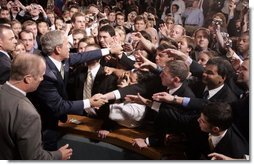 THE
PRESIDENT: Listen, thank you all for giving us a chance to come and visit with
you about Social Security. Before I begin, I do want to thank Laurie Checco,
who is the Business Manager at Montgomery Blair High School. Thanks for letting
us come by; I appreciate you opening this beautiful facility. (Applause.)
THE
PRESIDENT: Listen, thank you all for giving us a chance to come and visit with
you about Social Security. Before I begin, I do want to thank Laurie Checco,
who is the Business Manager at Montgomery Blair High School. Thanks for letting
us come by; I appreciate you opening this beautiful facility. (Applause.)
I want to thank Mark Mackey and Linda Hollands, who are part of the
National Retirement Planning Coalition for sponsoring this event. It's
important that there be an open dialogue about Social Security, the problems
inherent with Social Security and the opportunities to fix Social Security. And
that's why I've come today. So thank you all for sponsoring this.
You know, some in Washington wish I hadn't brought it up. (Laughter.) They
said, why would you bring up Social Security? I mean, after all, we might have
to run for election. (Laughter.) Why would you bring up such a difficult topic?
And the answer is because I see a problem and I believe my job is to address
problems and not pass those problems on to future Presidents, future Congresses
or future generations. And here's why I see a problem.
Before I describe the problem, I do want to congratulate one of my
predecessors, Franklin Roosevelt, for doing something really smart and really
wise, and that is setting up a safety net for retirees. Social Security has
worked. (Applause.) It's been a very important part of a lot of people's lives.
And the first thing I want to say to those who receive a Social Security check
today: nothing changes for you; you're in good shape. The system is solvent for
people receiving a check. The reason I say that is because I understand how
politics works. You see, the surest way to stop something from going forward or
stop a dialogue or stop reform if reform is needed, is to scare people. And in
the past, people have used the Social Security issue to scare seniors. They
say, old George W. gets elected, you're not going to get your check -- or, if
this goes through, you're not going to get your check. You know, that's kind of
shameless politics.
And so I'm spending a lot of time not only describing the problem, but
assuring seniors that no matter what the rhetoric is coming out of Washington,
you are going to get your check. So you need to tell your grandparents they're
going to get their checks. All of us, whether you're Republican or Democrat,
know how important this program is to a lot of seniors around the country. The question
is not whether the seniors will get their checks. The question is whether
younger Americans will be able to have a safety net, a retirement system just
like today's generation gets.
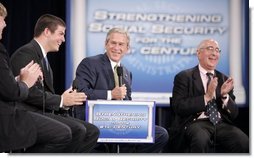 And
here's why we have a problem. There's a lot of people, like me, getting ready
to retire. (Laughter.) In my case, I reach retirement age in 2008 -- which
turns out to be a fairly convenient date. (Laughter.) Get it? (Laughter and
applause.)
And
here's why we have a problem. There's a lot of people, like me, getting ready
to retire. (Laughter.) In my case, I reach retirement age in 2008 -- which
turns out to be a fairly convenient date. (Laughter.) Get it? (Laughter and
applause.)
About 70 million-plus of us are getting ready to retire. You're so old, you
don't even qualify as a baby boomer. (Laughter.)
MR. STEIN: Thank you, Mr. President.
THE PRESIDENT: No, don't worry about it. (Laughter.)
There's now about 40 million retirees. So you get a sense of the problem.
In other words, a whole bunch of people are getting ready to retire, and we're
living longer than the previous generation, and we've been promised greater
benefits than the previous generation.
And so you've got a lot of people getting ready to retire who have been
promised greater benefits. The problem we have is that there are fewer people
paying into the system. In 1950, there were about 16 workers for every
beneficiary. Today, there's 3.3 beneficiary -- workers for every beneficiary.
Soon there will be two workers for every beneficiary. You've got a lot of
people living longer, getting greater benefits with fewer people paying for us.
And the system, as a result, starts going into the red when the baby boomer
generation begins to retire.
As a matter of fact, it starts going into the red in 2017. I know that
sounds like a long time for people in Washington. It's not very long if you're
entering the work place. In other words, you're paying into a system that
starts going broke in 2017, into the red. And every year thereafter, after
2017, the problem gets worse. In 2027, it's $200 billion in the hole; in 2030,
it's $300 billion in the hole.
See, Social Security is not a trust. It's a pay-as-you-go system: you pay,
and we go ahead and spend. You pay payroll taxes. You work hard, you put
payroll taxes into the system, and the federal government spends your payroll
taxes on retirees, and with money left over, it goes for government programs. And
all that's left is a file cabinet of IOU's. In other words, some think that
we're taking your money and we're holding it for you and then we're going to
give it back to you when you retire -- that's not the way it works. It's a
pay-as-you-go system, and the pay-as-you-go system starts going into the red.
And it gets worse and worse and worse.
As a matter of fact, every year we wait it's going to cost us $600 billion
to fix it -- $600 billion a year to fix it. In other words, the longer we wait,
the harder it is for me to be able to look at younger Americans and say, the
money you're putting in the system is going to be there for you.
Now, if you're older, you're going to get your check. If you're born prior
to 1950, you're fine. If you're a younger American, you need to pay attention
to this issue. I think this is a generational issue. Grandmothers and granddads
have nothing to worry about; their grandchildren have got a lot to worry about.
My strategy has been to travel the country saying we've got a problem. I
think pretty well most Americans now understand we do have a problem. And the
reason I knew that was the first step that needed to be taken is because I have
confidence that once people realize there's a problem, then they'll ask their
elected representatives to do something about it. And I was pleased to see some
members, Republican members of the House and the Senate have started laying out
ideas. I've been laying out ideas.
I think it's time for the leadership in the Democrat Party to start laying
out ideas. See, the American people expect those of us who've come to
Washington, D.C. to negotiate in good faith on behalf of the people if there's
a problem. People ought to say, here's what I'm for, not what they're against.
People ought to be willing to step up and lead, as opposed to playing partisan
politics. That's what the people want. (Applause.)
I believe future generations ought to receive benefits equal to or greater
than the previous generation. I like the idea that has been put on the table by
a Democrat economist named Pozen. It's called progressive indexing -- it says
if you're the poorest of Americans or lower-income Americans, you get your
benefits calculated by wage increase. If you're the richest Americans, top 1
percent, you get your benefits calculated by inflation, increase of inflation.
In other words, everybody's benefits go up. The wealthier people's benefits
will go up slower than the poorer benefits. And in between, there's a scale.
That's called progressive indexing. It basically says we can make a commitment
to poor Americans that if you worked all your life, you're not going to retire
into poverty. I like that idea. I think that makes a lot of sense. (Applause.)
This progressive indexing solves -- permanently solves most of the problems
in Social Security. It doesn't solve it all, but it takes -- it permanently
solves most of the problem. And there are other ideas on the table. I asked
people to bring them forth -- you've got a good idea, step up with it, I'm more
than willing to listen.
What I'm not going to listen to is this partisan bickering in Washington,
D.C. People really expect us to do different. 2 They expect us to think
differently and act differently when you see a problem, and we have a problem.
(Applause.)
I've got another idea that we're going to discuss today. It's an idea that
some feel uncomfortable about -- I understand that -- but I think it's
certainly worth the dialogue. And that is, on the one hand, we ought to
permanently solve the solvency issue for Social Security so I can -- we can --
all of us involved in politics can look at younger workers and say, you're
fixing to pay into a system that will not only take care of baby boomers like
me, but there will be a retirement system for you.
I also think we ought to make the system a better deal for younger workers,
and that means giving younger workers the option, the ability, if they so
choose, to take some of their money -- after all, it's your money in the
payroll taxes -- and set it aside in what we call a voluntary personal savings
account. It's an opportunity -- (applause.) I like the idea of giving somebody
a chance to build a nest egg that the government can't spend. In other words,
remember the -- (applause.) What you have left in the Social Security system
today is a file cabinet with IOUs. In West Virginia, I actually went and saw
the file cabinet, and I'm proud to report the paper is there. (Laughter.)
I like the idea of encouraging people to own assets that they get to
manage. It makes economic sense, if you're a younger worker, and you realize
that we're taking your money and we're putting it in a system that may not be
around for you, you ought to demand change. But let me tell you what else we're
doing. We're taking your money and putting it into a system that's yielding
about a 1.8 percent return. That's a lousy deal.
So I think you ought to be allowed to take some of your money, set it aside
in a voluntary personal savings account so you can invest in bonds or stocks --
bonds and stocks, whatever you so choose. You can't put it in the lottery, by
the way. There will be go-bys. In other words, the government is going to say,
we're not going to let you take it to the track; we're not going to let you --
we're not going to let you take wild risks. People do this all the time, by the
way, and they get a better rate of return than 1.8 percent. And if you can get
a better rate of return than 1.8 percent, that compounds over time. And it's
that compounding of interest that helps create wealth and security in
retirement. The voluntary personal accounts will complement that which is
available to you through the Social Security system. But you're going to get a
better deal on your own money than in the current system.
I like the idea of people having assets that they can pass on from one
generation to the next. I reject this notion that the investor class is
confined to only a certain group of people. I think investors ought to be
around -- (applause.)
And, finally, I believe this idea ought to be debated because the system is
not fair, in this sense. If you're a -- if you're a spouse, and your other
spouse -- and your -- if you're a husband and your wife works, or you're a wife
and your husband works, and you're both contributing in the Social Security
system, if one of you dies early -- if you die before 62 -- what you get is you
get a burial benefit from the government. In other words, you've been working
all your life, you're putting money in the Social Security system -- both of
you have been -- one of you dies early, and the government says, here, fine,
here's a burial benefit. And then when you get to retirement age, you get to
choose. You get to choose the benefits of your spouse or your own benefits,
whichever might be higher, but you don't get both.
Think about that. So you've got two folks contributing into the system, one
dies early, and by the time the survivor reaches retirement age, he or she gets
to say, I either get my spouse's benefits, or my benefits, but not both. In
other words, one of -- the deceased spouse has contributed to a system and the
money has just gone away. That's not fair. It's not fair to say to working
people, work all your life, and the money you've contributed is not around if
you happen to die early. It's not fair to the spouse, it's not fair to the
family. If we allow younger workers -- if they so choose -- to take some of
their own money. Now, remember, I keep saying, "if they so choose" to
take some of their own money and set it up in an asset that grows over time. If
that were to happen, if somebody were to die early, at least there's an asset
to pass on to help the spouse.
See, the system is not fair today. It's not fair for younger workers to
know it's going broke and you have to contribute into it. It's not fair for
people living today, who worked in their system all their -- paid into the
system and there's not an asset upon death, early death. It's not right. And I
think now is the time to get something done.
By the way, the idea of voluntary personal savings accounts is not new.
You're going to hear from some young investors. Investing is not new. It's new
for older people -- you know, when we grew up, there wasn't 401(k)s or IRAs.
These are relatively new concepts. I bet there was no 401(k)s when you grew up.
You look like a baby boomer. (Laughter.) Yes, okay, you.
But the idea of, you know, saying if you work for the government you can
take some of your own money and put it aside in a voluntary personal savings
account isn't new in Washington. I don't know if you know this or not, but the
Federal Thrift Savings Plan -- that's the plan that the Congress set up for
themselves and people who work in the federal government -- it says if you want
to, you can set aside some of your own money in a mix of bonds and stocks.
And so my attitude is to folks around the country is, if it's a good idea
for congressmen and senators, in other words, if they think it's a good enough
idea for themselves, it ought to be a good enough idea for workers all across
the country. (Applause.)
Anyway, I see a problem, I'm willing to talk about solutions. I'm looking
forward to working with both Republicans and Democrats to get the job done. And
I want to thank our panelists for joining us to help make some very important
points. See, this is an education process we're going through. People have got
to be educated. There's a lot of messages getting out there on the TV screens.
You know, people saying this and people saying that. Once people understand
there's a problem, once the grandmothers and granddads understand they're going
to get their check, they can relax, then they're going to start asking people
who have been elected to office, what are you going to do about my grandkids?
You don't have a grandkid yet, do you?
MR. STEIN: Thank God, our son is only 17. (Laughter.)
THE PRESIDENT: Well, that's good. You went to high school here?
MR. STEIN: I went to Montgomery Blair High School, class of '62. The best
class ever.
THE PRESIDENT: Really? That's good. (Laughter.)
MR. STEIN: I'm concerned about it. I'm extremely concerned about it.
THE PRESIDENT: You've been talking about it for a while.
MR. STEIN: I talk about it -- I represent two groups. I represent the
National Retirement Planning Coalition, which helps people plan for retirement.
And I'm also representing for the gangstas all across the world -- (laughter)
-- hidden corners in the low-lows, girl. (Laughter.) That's rap music, Mr.
President. (Laughter.)
THE PRESIDENT: Yes. (Laughter.)
* * * * *
THE PRESIDENT: I'll tell you an interesting story. I was at an automobile
plant in Mississippi, and I -- there you go. (Laughter.)
MR. STEIN: He's from Mississippi.
THE PRESIDENT: Yes, okay, two of you. (Laughter.) And I was with the line
workers. And I said, how many of you all have 401(k)s? In other words, how many
of you are managing your own money? And I bet 90 -- I didn't count, but a lot,
90 percent of the hands went up. These are people from all walks of life, all
income groups. It's amazing how quick you become financially literate when
you're watching your own money, in other words.
But let's talk about financial literacy, and let's talk about this notion
of risk. Let's talk about whether or not a person who is nervous about stocks
and bonds has the capacity to absorb all these fancy words you're talking
about.
MR. STEIN: But they're not -- they turn out not to be fancy words.
THE PRESIDENT: They sound fancy.
MR. STEIN: Well, it isn't fancy. (Laughter.) A stock is a share in
ownership of a corporation, a broad index of stocks is a share in hundreds,
thousands of corporations. And the values of those investments will fluctuate
from year to year. But over long periods of time, they will do incredibly well.
I mean, here's a statistic -- I know you don't like statistics.
THE PRESIDENT: No, I like them, yes. Particularly when they help make the
point. (Laughter.)
MR. STEIN: But over any 20-year period in the last hundred years, a person
who bought the broad index of the Standard & Poor's 500, the largest 500
corporations in America, would not have lost money, and his average return
would have been 10 times his money. That is so much more than Social Security,
it's insane. Over a 25-year period the average return is more than 20 times his
money. And there's been no 20-year period in the last hundred years when a
stock market investor would have lost money. So there will be fluctuations from
year to year, but over long periods of time, investors in stocks through mutual
funds, exchange traded funds, variable annuities will come out way, way, way
ahead of the game, wildly ahead of the game.
THE PRESIDENT: A lot of people -- I hear, you know, I hear these people
saying, well, all they want to do is let Wall Street get rich.
MR. STEIN: They're already rich. (Laughter.)
THE PRESIDENT: All right, richer. In other words, I think one of the things
people have got to understand, and perhaps you can help on this one, is that
there will be negotiated fees on behalf of the people. In other words, you're
not going to get gouged. I think that's a convenient red herring.
MR. STEIN: Yes, the usual fees on these things, especially if you're a
careful shopper, and especially under your plan, are going to be extremely
minimal. I mean, fees for many of these things are close to zero. And Wall Street
is not going to get rich off this, they're already rich, they don't need the
money. The person who needs the money is the person Ben or Brian's age who is
going to get in at the age of 20 or 21 or 22 or 25 and is going to let compound
interest do all the heavy lifting for him. If you get in, in your 20s, by the
time you're in your 40s, you're set.
THE PRESIDENT: Compound interest? Some people many not know what that is.
MR. STEIN: Well, compound interest means you earn interest, and then you
earn interest on the interest. And if you let that work for you in the stock
market for 20, 30, 40 years, even if you're just putting a small amount away
each month, you're going to have a much more comfortable retirement than you
ever dreamed of having. If you start when you're in your 40s or 50s, the
problem doesn't get solved. If you start when you're 20, it does get solved.
And that's sort of exactly what we're talking about with your Social Security
plan. If we start now, it's going to be easy to solve the problem. If we wait
until the system is already broke, it's going to be incredibly difficult and
expensive to solve the problem. Why not do it now, when it's easy?
THE PRESIDENT: See, the idea is to say to younger workers, instead of
putting money into a bankrupt system, or a system that will be bankrupt, we're
going to, one, permanently solve the problem and, two, give you a better deal,
by letting you watch your own money grow, investing in a safe mix of bonds and
stocks that will compound over time. (Applause.)
Wendy Merrill is with us. Should we turn to Wendy?
MR. STEIN: Yes, absolutely.
THE PRESIDENT: Wendy, where are you from?
MS. MERRILL: Good morning. Thanks for having me.
THE PRESIDENT: Where are you from?
MS. MERRILL: I'm from Reisterstown, Maryland --
THE PRESIDENT: Reisterstown, very good.
MS. MERRILL: -- which is near Baltimore.
THE PRESIDENT: Great, thanks for coming over.
MS. MERRILL: Thank you, my pleasure. I'm 32 years old, and I --
THE PRESIDENT: You don't look a day over 21.
MS. MERRILL: Oh, aren't you sweet, thank you.
THE PRESIDENT: Oh, you know how we politicians are. (Laughter.)
MS. MERRILL: I have two family members with me today. I wanted to say
"hi" to, my husband Stephen and my father Neil are in the audience
with us today.
THE PRESIDENT: Thanks for coming, yes. Say hello to them after the event?
MS. MERRILL: Yes.
THE PRESIDENT: Good, thank you.
MS. MERRILL: And I have been in the financial services business for 10
years. I'm an insurance broker. I work with my family's insurance agency. And
I'm a big fan of these personal accounts.
THE PRESIDENT: Right.
MS. MERRILL: I think it's a great solution to the problem. I am a member of
-- I'm a little older than these guys over here, but I'm definitely a member of
the generation that was taught that I couldn't count on Social Security for my
retirement. For that reason, ever since I joined the workforce I've been saving
in 401(k)s and IRAs and really taking charge of my own future, which is what I
advise my clients to do as well, when we discuss retirement planning. I just
tell them, you know, don't count on Social Security -- unless it gets fixed, of
course.
THE PRESIDENT: That's kind of sad, isn't it? Excuse me for interrupting.
You've got younger Americans saying, don't count on Social Security. I guess
the word is getting out -- slowly, but surely -- we've got a problem with
Social Security, to the point where you've got some people saying, don't count
on it. As a matter of fact, I saw a survey where it said younger workers feel
like they're more likely to see a UFO than get a Social Security check.
(Laughter.) Excuse me for interrupting.
MS. MERRILL: No problem, I agree. I mean, I --
THE PRESIDENT: It is amazing that we sit here in Washington not getting
anything done knowing that you've got younger Americans not thinking they're
going to see a check on Social Security. That's the wrong kind of politics.
(Applause.)
Sorry, go ahead.
* * * * *
THE PRESIDENT: Well, that's exactly the concept that I'm asking Congress to
think about. One of things that people have got to understand is like in the
Federal Thrift Savings Plan, there is -- the options are relatively limited. In
other words, you can't go out and create your own notion about what you want to
invest in. The government says, here, if you want to take some of your own
money, here's a variety of options and, you know, mainly bonds, mainly stocks,
a mix of bonds and stocks. And the truth of the matter is, when you're younger
you may want to take a little risk. I presume you say to younger people, take a
little risk. When you're older, kind of --
MS. MERRILL: Absolutely. I mean --
THE PRESIDENT: -- crank down on the risk.
MS. MERRILL: -- it's always on an individual basis, obviously. But younger
people can definitely afford to take more risk, and compound interest works for
you. And you're better off putting a dollar in yesterday as opposed to two
dollars tomorrow, because of that.
THE PRESIDENT: Yes. Good. Well, thanks for coming.
MS. MERRILL: My pleasure.
THE PRESIDENT: Appreciate you being here. (Applause.)
Brian Smart.
MR. SMART: Yes, sir. How are you?
THE PRESIDENT: Feeling pretty good, yes. (Laughter.) How about you?
MR. SMART: Good, good.
THE PRESIDENT: Good, thanks for coming. I understand you just got a job?
MR. SMART: Yes, which my parents -- mom and dad and sister --
THE PRESIDENT: They must be thrilled, yes. (Laughter.)
MR. SMART: They were very happy about -- very happy.
THE PRESIDENT: Well, congratulations. And you paying payroll taxes yet?
MR. SMART: Yes.
THE PRESIDENT: Yes, you are.
MR. SMART: Yes, a lot of them.
THE PRESIDENT: More than you realized, right?
MR. SMART: It's a scary thing. I mean, I graduated from Radford University.
I graduated this December, so relatively new, and got a job. And I'm out there
making money, and this is kind of something that's come up to my attention that
it's not going to be there. And it's something that really bothers me.
THE PRESIDENT: Like that bite of the check, first time that happened, got
your attention?
MR. SMART: Well, I mean, it's got my attention previously. But it's
something that I'm realizing now that -- and I'm not doing anything. I'm paying
into something that I can't even use, and there's nothing I'm going to be able
to do with it when I retire.
THE PRESIDENT: Yes, see, it's kind of a sad thought, isn't it? The
government now -- has got a system now that has evolved away from something
that worked really well. Franklin Roosevelt created something that worked well
-- working well when there's 15 workers for every beneficiary. And slowly but
surely over time, as a result of demographic change, promises we made we cannot
keep. You got a 23-year-old guy, got his first job, saying he's nervous about
the system.
Government ought to -- government at the very minimum ought to earn the
trust of the people. He trusts -- (applause.) Keep going.
MR. SMART: Well, I mean --
THE PRESIDENT: So have you been paying attention to this issue when you
were at college?
MR. SMART: A little bit.
THE PRESIDENT: Tell me the truth.
MR. SMART: No -- to be honest, no, I haven't. (Laughter.) But, I mean, it's
something that to me I've seen firsthand with my grandmother. She's retired,
living the life I'd love to live. You know, she -- her and my grandfather
invested wisely when they were young in stocks. And right now she's basically
living off her dividends. She doesn't count on Social Security.
THE PRESIDENT: Yes.
MR. SMART: Which is something that scares me because she's already at
retirement.
THE PRESIDENT: Right.
MR. SMART: Something I have 40, 50 years before it even -- I even start
drawing Social Security.
THE PRESIDENT: Well, your grandma made some -- and grandfather made some
wise choices. There's some people in this country that's all they depend upon is
their Social Security check. And it's really important that those folks know
that they're going to continue to get their check. There are a lot of people
that the only check they live on is the Social Security check. Which as you can
imagine, when they start hearing people talking about reforming the system,
they're really thinking, well, maybe my check is going to go away. And people
have got to know it's not. It's just not going to go away. Government will
never do that to people. But I'm not so sure you're going to have a check.
MR. SMART: And that's something as a 23-year-old person who's paying into
Social Security now really scares me.
THE PRESIDENT: I hope so.
MR. SMART: Because I don't -- I mean, I don't know enough. I don't really
know enough right now to try to make a decision. And I'm hoping you can guide
me in the right direction.
THE PRESIDENT: That's it.
MR. SMART: And tell me this is what you need to do.
THE PRESIDENT: Well, all right, I'll tell you, I'll give you a hint -- in
2041, the system goes bankrupt. That's not very long.
MR. SMART: I know.
THE PRESIDENT: It's long for me and old Ben. That seems like ages, doesn't
it?
MR. STEIN: That's a long time.
THE PRESIDENT: Yes, but not for him.
MR. STEIN: No, not at all.
THE PRESIDENT: Do you remember when you were 23?
MR. STEIN: Extremely vividly. I remember when I was here at Blair High
School at 17 and 16. But you know, his grandparents hitched their wagon to a
star, which was the star of investing in stocks and bonds and it worked
incredibly well. The idea of allowing all Americans -- not just well-to-do or
even upper middle class ones -- to hitch their wagons to that star makes total
sense. Why should we say to the ordinary citizen, look, because you're not
rich, you can't get in on the same kind of investment opportunities that rich
people can get in on. Let's let everybody get in on it, let's let everybody get
a chance to make some real money.
The Standard & Poor's Index compounded at a rate -- I know you don't
like statistics -- but 14 percent a year from 1926 to 2004. If you could have
your Social Security, or even a quarter of it, or a fifth of it compound at
that rate instead of at 1.8 percent a year, the difference would be
astronomical -- astronomical.
THE PRESIDENT: Yes, I do like statistics. (Laughter.)
MR. STEIN: Okay, sorry. (Laughter.)
THE PRESIDENT: Just not too many of them.
MR. STEIN: Okay. (Laughter.)
THE PRESIDENT: What I like more -- even more than statistics is the notion
of an ownership society. We want more people owning something. (Applause.)
You know, Brian said something interesting -- he basically turned -- he
said, I hope you old guys fix it. And we have an obligation to fix it. I think
there's a lot of younger folks sitting around saying, well, I'm -- one, I
either don't care, I'm not paying attention to it, when they start paying
attention to it, realize there's a problem, and they're going to say, well, you
know, surely the people we sent to Washington will do something to permanently
fix it. Surely, there's enough goodwill in the nation's capital that people
will set aside their political parties and come together and permanently solve
this problem. Surely, they're not going to let us pay money into a bankrupt
system.
I hate to tell you, unfortunately, some are playing politics in Washington.
But we're going to keep working it and keep working it and keep calling upon
the people. (Applause.)
Go ahead.
* * * * *
THE PRESIDENT: Like when you were sitting in the library, reading all --
reading all those books, did you ever think about sitting on the stage with the
President? (Laughter.)
MR. SMART: No, not at all.
THE PRESIDENT: How about the library part? Was that fiction? (Laughter.)
MR. SMART: Fiction. (Laughter.)
THE PRESIDENT: I know what you mean. (Laughter and applause.)
Ben Ferguson.
MR. FERGUSON: Howdy. I'm not one of those two Mississippi guys.
THE PRESIDENT: You are from Mississippi? Where?
MR. FERGUSON: Well, Memphis, but I go to school at Ole Miss.
THE PRESIDENT: Ole Miss. Very good, yes. (Applause.)
MR. FERGUSON: There we go. I'm glad there's one.
THE PRESIDENT: So why are you here? Come all the way from Ole Miss.
MR. FERGUSON: I got together with some students who started an organization
called Students for Saving Social Security --
THE PRESIDENT: Really?
MR. FERGUSON: -- because we realized that basically our second chance at
Social Security, the only chance we ever have to have this, is if it gets fixed
and we get our personal accounts. That's the only way we're going to get it. We
know it's not fair, we know we're paying someone money that we're not going to
see, and so we need our second chance. And that's the only way we're going to
get it. I mean, besides if we win Ben Stein's money, but he told me there's not
enough. (Laughter.)
THE PRESIDENT: Pretty good line.
MR. FERGUSON: Yes.
THE PRESIDENT: So how did you get involved in the Social Security issue?
It's a -- it's pretty interesting that you would pick up on the issue and
decide to do something about it.
* * * * *
THE PRESIDENT: You're on a role. Keep going. (Laughter.) See, I've got a
little -- one of the dynamics of this issue is the people that are -- the
people that benefit from Social Security today have nothing to worry about. You
notice I keep saying that. In my line of work, you've got to say the same thing
over and over and over again, finally get it to sink in.
But one of the dynamics on the issue is that there's a lot of folks out
there who need to pay attention to it who might not be paying attention to the
issue. And, therefore, members of the Senate and the House aren't hearing from
younger Americans.
And so part of the goal is to remind people that if you're getting your
check, you're going to get your check, but if you've got a child coming up, you
better start asking the politicians what they're going to do about your child
or your grandchild.
* * * * *
THE PRESIDENT: Yes, that's why I want to repeat what I said earlier. I
believe in ownership. I want people from all walks of life, every background,
saying, this is mine, I own this; I'm going to work my life, I'm going to own
this asset, I'm going to pass it on to whomever I want to pass it on to.
(Applause.) The more ownership there is in America, the better our future is.
The more people can say, this is my stake, this is my home, my business, my
retirement fund, my health care account -- the more people say, I own this, the
more solid the future of America will be.
Have you got something else, because I've just -- that was my peroration.
MR. STEIN: No, I was just going to say, it is a basic fact of both
political and economic life, that societies that have a -- in which the
ordinary citizen feels he has a stake in the society and isn't just a ward of
the state, isn't just a straw in the wind blowing about by the state, are
societies that last a long time. And we want this society to last forever, and
it will if we have an ownership society. (Applause.)
THE PRESIDENT: Absolutely. Go ahead, yes.
MR. FERGUSON: And, too, one thing is I want to let you know, and there's
been a lot of people that have said in the media that young people just don't
care. We started our organization two months ago. We have over a hundred
college campuses, chapters that have said, we want to be involved in this debate.
(Applause.)
THE PRESIDENT: That's good, thank you.
MR. FERGUSON: Young people care, and I want to say, thank you to you, for
actually listening to us, instead of talking about us.
THE PRESIDENT: Well, I appreciate you. If you're interested, I'm sure you've
got a web page where people interested in the issue can --
MR. FERGUSON: Yes, you want me to plug it?
THE PRESIDENT: Well, yes, you've got the grammar -- (laughter) --
MR. FERGUSON: It's secureourfuture.org. There you go.
THE PRESIDENT: It's like Marketing I, right?
MR. FERGUSON: That's right. I'll give you some money later.
THE PRESIDENT: Try it again -- secureourfuture --
MR. FERGUSON: Dot org. Right, there you go.
THE PRESIDENT: So people can get on the web page, figure out how to help.
MR. FERGUSON: Start a campus chapter.
THE PRESIDENT: Get involved in the issue.
MR. FERGUSON: Get involved and be heard.
THE PRESIDENT: My final point is, where does a guy get a pair of shoes like
that?
MR. STEIN: You can get them at a place called FrontRunners, in Brentwood,
California.
THE PRESIDENT: Never mind. Listen, thank you all for coming. God bless.
(Applause.)
END 10:42 A.M. EDT
President Participates in Conversation on Senior Security - July 22, 2005
Boisfeuillet Jones
Atlanta
Civic Center
Atlanta
,
Georgia
11:58 A.M. EDT
THE PRESIDENT: Thank you all. (Applause.) Thank you all very much. Please
be seated. (Applause.) Thank you -- I'm proud, thank you. (Applause.) Thank you
all. We got work to do here. Thanks for the warm welcome. I know you're really
cheering for Mother. (Applause.)
I'm really thrilled to be back in Atlanta. We're going to talk about
Medicare and Social Security. Thanks for letting me come by to discuss these
two really important programs with you. I think you're going to find it
interesting.
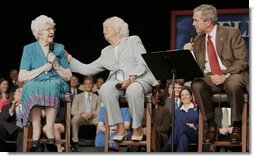 I want
to thank the Atlanta Chamber for sponsoring this event. I think it's a good use
for the Chamber's time to let us come -- I say "us" because there's
going to be more than one speaker, you'll be happy to hear -- to talk about
things that are important for our senior citizens. This is an educational
experience for people. And I can't thank you enough for sponsoring this, so to
all the Chamber folks -- Tom Bell and Sam Williams and the members of the
Chamber, thanks a lot for letting us come by. (Applause.)
I want
to thank the Atlanta Chamber for sponsoring this event. I think it's a good use
for the Chamber's time to let us come -- I say "us" because there's
going to be more than one speaker, you'll be happy to hear -- to talk about
things that are important for our senior citizens. This is an educational
experience for people. And I can't thank you enough for sponsoring this, so to
all the Chamber folks -- Tom Bell and Sam Williams and the members of the
Chamber, thanks a lot for letting us come by. (Applause.)
I want to thank my friend, Sonny Perdue. You know, I saw Sonny at the
airport -- he and Mary kindly came by -- and I said, Sonny, how is your budget?
He said, we got a surplus. I said, congratulations. (Applause.) That's a sign
of leadership. And I want to thank you, Sonny, for serving your state.
I want to thank very much Jim Wagner, the President at Emory. We have just
come from a Medicare education seminar at -- on the campus of that fantastic
university. It is a special place. Thanks for letting us come by. I appreciate
you very much for letting us -- for coming today, as well. (Applause.)
It turns out when you fly from Washington on Air Force One, people
sometimes like to get a ride. (Laughter.) So I was honored to have coffee today
on Air Force One with some really great members of the Georgia congressional
delegation, starting with the United States Senator Saxby Chambliss.
(Applause.)
And Johnny Isakson is with us, too. I appreciate you, Johnny. (Applause.)
And we flew down with Congressman Jack Kingston, Congressman John Linder, and
Congressman Lynn Westmoreland -- three members of the House. (Applause.)
I want to thank the members of the Statehouse who are here -- Eric Johnson,
Bill Stevens, Jerry Keen -- I appreciate you all serving in the Senate and the
House of Representatives here in the state of Georgia. I want to thank my
friend, Julie Gerberding. She is the Director of the Centers for Disease
Control and Prevention. Where are you, Julie? Somewhere. Thanks for coming.
(Applause.) Oh, there you are. (Applause.) It's a really important agency and
she's doing a really fine job. I'm proud of your service to the country, and
it's great to see you again.
Today Mom and I met Bill and Nina Hartman. They came out to the airport.
They are volunteers with the Clayton County Retired and Senior Volunteer
Program. The reason I bring them up is they are like thousands of other people
around our country who have heard the call to volunteer. They've heard the call
to serve our country by becoming a volunteer. These good folks help senior
citizens stay healthy and active by working in a fitness center. In other
words, they're taking time out of their life to help somebody else. And the
reason I bring volunteering up is that if you want to serve America, a great
way to do so is to feed the hungry, find shelter for the homeless, help those
who need help.
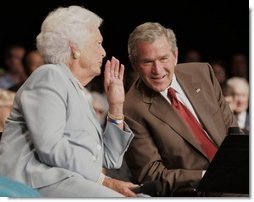 Yesterday
in the Oval Office I had an extraordinary experience. A young man from Ghana,
who was born lame, was basically adopted by a faith-based program here in
America, and he got a prosthesis. He's now a bicycler and a triathlete. He set
an example for others in his country that just because you're lame doesn't mean
you're a second-class citizen.
Yesterday
in the Oval Office I had an extraordinary experience. A young man from Ghana,
who was born lame, was basically adopted by a faith-based program here in
America, and he got a prosthesis. He's now a bicycler and a triathlete. He set
an example for others in his country that just because you're lame doesn't mean
you're a second-class citizen.
As well, a fellow came to the Oval Office who had as a dream of providing
wheelchairs for those who are disabled all around the world. He wants to lift
their spirits by giving them a chance to be mobile, other than -- so that
they're not stuck on the street corners of their cities. He realized
wheelchairs were too expensive. So he designed one that will be available at a
reasonable price all throughout the -- I said, why are you doing it? He said, I
heard a call. See, thousands of people make up the great strength of the
country. And the strength of this country is the hearts and souls of our
citizens. If you want to serve, volunteer. Make somebody's life better.
Surround somebody who hurts with love, and you'll be doing your country a great
service. I want to thank Bill and Nina for the example they've set. (Applause.)
How am I doing?
MRS. BARBARA BUSH: Okay. (Laughter.)
THE PRESIDENT: I want to make a couple of points before we get to
retirement security for our seniors. First thing is, is the people of Great
Britain must understand how strongly America stands with them during these
trying times. Like the citizens -- (applause.) I'm confident, like our country,
the citizens of that country will not be intimidated by thugs and assassins.
They understand what we know -- (applause.) They understand what the citizens
of this country understand, is that we will hold true to our principles of
human rights and human dignity and the freedom to worship. We're not going to
let anybody frighten us from our great love of freedom.
For those of you who have got a loved one who has joined the war on terror,
I want to -- I want to ask you a favor: Send them an email and tell them the
Commander-in-Chief is incredibly proud, and the United States of America stands
squarely with them. (Applause.)
We're engaged in a global war on terror, and we're facing an enemy that has
got an ideology based upon hate. If you're trying to figure out their ideology,
just think the opposite of America. We believe in religious tolerance. We
believe in equal rights for women. We believe in human rights and human dignity
and minority rights. We believe people ought to be able to live in a free
society and express themselves the way they see fit.
These folks believe in a dark vision of the world where there's no such
thing as dissent or religious liberty. All you got to do is think about the
Taliban in Afghanistan, where if you spoke your mind, you were whipped in the
public square, and young girls weren't given an education. That's what they
think. And they have designs, they have goals. They want to topple governments.
They want us to retreat from the world so they can spread their ideology of
hate.
The only way to protect America is a dual strategy: One, stay on the
offense, bring these people to justice before they hurt us; and at the same
time, spread an ideology that competes with their ideology, and that's an
ideology of democracy and freedom. (Applause.)
Thank you. We are laying -- I just want you to know, for those of you who
have got children and grandchildren, I firmly believe that the actions we're
taking today to defend ourselves, by taking those actions, we're laying the
foundation of peace for generations to come. (Applause.)
I want to talk about one other decision I've made recently, and then we'll
get on to Medicare and Social Security. One of my most solemn duties is to find
good, honorable, decent people to serve on our courts, and I did -- (applause.)
And I had the opportunity, as you know, upon the retirement of Justice Sandra
Day O'Connor, to find such a person. And I looked hard and I consulted with the
Senate and interviewed quite a few people, and came to the conclusion that
Judge John Roberts will make a great Supreme Court justice. (Applause.)
I came to that conclusion after analyzing his record and having a good,
extensive chat with him. He's a man who loves our country; he's a man who loves
his family. He's a person who understands what it means to be a strict
constructionist, somebody who looks at the words of the Constitution for what
they are, somebody who will not legislate from the bench. (Applause.)
I want to thank your United States senators for setting the right tone. I
urge senators from both political parties to rise above needless partisanship
and give this good man a fair hearing and a vote as quickly as possible, so he
can be seated on the bench prior to the reconvening of the Supreme Court.
(Applause.)
It is really important that your government constantly make -- analyzes
programs to make sure they work. And one of the programs that I was concerned
about was Medicare, and a program I am concerned about is Social Security. I
say "was" concerned about Medicare because, working with Republicans
and Democrats, we have modernized the Medicare program. And today, I want to
spend a little time talking to you about our strategy to make sure seniors get
the word that there's a modernized Medicare program now available for them.
I say modernized because, if you really think about it -- let me put it to
you this way -- Medicare would pay for heart surgery, but not for the drugs
that could prevent the heart surgery from being needed in the first place. That
didn't make any sense. You know, you pay $100,000 for a surgery, but not
$1,000, or whatever it cost, to prevent the surgery from being needed. In other
words, the system was old. It worked well for a lot of seniors, but it was
bureaucratic in nature. And it wasn't working well for a current generation of
seniors. And so I called upon the Congress to change this. Let's do something
smart on behalf of our seniors. And today, I want to talk about the bill.
First thing that Medicare has done is it says that if you're -- when you
join Medicare, you get preventative screenings. Put in Texas terms -- in order
to solve something, you got to diagnose it. And it makes sense to diagnose
something early before it gets too late. That's what we're now saying to
today's seniors. That seems to make sense. If you're a taxpayer you want to
make sure the Medicare system diagnoses problems so we can solve them quicker.
Secondly, we've now got people covered for screenings that can catch illnesses
from diabetes to heart disease. We're beginning to change the system. We've
provided drug discount cards for our seniors, and it has made a big difference
for a lot of seniors. About 6 million seniors have used those cards, and it has
been great savings for them.
Now, what's going to change -- and this is a voluntary program, by the way.
This a program that says if you're happy with the way things are in Medicare,
don't change. But there's going to be some new options available for you, some
new choices. I happen to believe the more choices consumers get, the better off
the consumers are. And so what we've done with Medicare is we've said that
we've now got a prescription drug benefit available for you. Starting on
October the 1st, beneficiaries will start receiving information about the
available plans that you can choose from. On November 15th, the enrollment
opens; January 1st, prescription coverage -- prescription drug coverage begins.
So that's the timetable.
I got my man, Mark McClellan, here. His job is to make sure that seniors
get the information necessary to meet the timetable. Part of making sure
seniors have got the information necessary to meet the timetable is Mother and
I have come. This is educational. We're trying to get on the TV screens so
people understand there's something new coming in Medicare. And we're
stimulating a grassroots effort. We're going to hear from two good folks who
are involved with spreading the word to our seniors.
I say this is a good deal, and I really truly believe it is, because, first
of all, on average, beneficiaries receive over $1,300 of federal assistance to
pay for prescription drugs. Medicare will cover 95 percent of prescription
costs after a senior has spent $3,600. So, in other words, you got a
catastrophic plan now part of Medicare. Think how important that is for a
senior. You sign up -- you decide to look at this option, there's an option now
available so that you can rest assured that you're not going to go broke
because of major medical costs because of pharmaceuticals. In other words, the
federal government is saying we're going to help you and we're going to also
make sure that there's a catastrophic plan. And we want to help you have a
surety and comfort as you get older, knowing that you can't get wiped out
because of prescription drug bills. I think this is a very important added
benefit that will be available for our seniors.
Low-income seniors -- about a third of our seniors will be eligible for a
drug benefit that includes little or no premium, low deductibles and no gaps in
coverage. On the average, Medicare will pay over 95 percent of the prescription
drug cost for these low-income beneficiaries. It's a good deal. This isn't --
we're not here to promote a political party. We're here to promote a good deal
for our seniors. And I urge you, if you're a son or a daughter, find out what
I'm talking about and talk to your mom or dad, or talk to your grandparents. If
you want to be involved through your church or through a community
organization, find out about what we're talking about. And it's not hard. We've
got all kinds of -- 1-800-Medicare. That's not that hard to figure out how to
call that -- 1-800-Medicare, or Medicare.gov on the Internet. But find out what
we're talking about. Verify. And then go out and help a senior make a right
decision, the decision best for them.
To receive assistance, low-income beneficiaries need to fill out a simple
application. I know you hear government say, simple application -- there's no
such thing. (Laughter.) Actually, this is simple. McClellan will tell you how
simple it is in a minute. I'm just telling you it's four pages. (Laughter.) But
the print is big. (Laughter and applause.)
And so we'll talk a little bit about Medicare today. It's changing for the
good. Seniors will have more options from which to choose from. And that's
always good. Anytime consumers get better options, it means there's going to be
a better response to your needs. And again, I repeat, if you're happy the way
you are, listen, I understand a lot of seniors simply don't want to change;
they're pretty well happy the way things are. They shouldn't be forced to
change, and they're not going to be. I'm just saying there's something else
available, if you're interested. And our job is to make sure there's enough information
out there to show you that it's worthwhile taking a look. So we'll discuss
that.
I also want to talk about Social Security. The first thing I want to say on
Social Security is, Franklin Roosevelt did a good thing when it came to Social
Security. Social Security has been a really important program, and, therefore,
people who are receiving Social Security today must hear this loud and clear:
Nothing is going to change for you.
I understand the politics of Social Security all too well. When I ran for
President, they said, if George W. gets in there, they're going to take away
your check. Well, I got in, and you're still getting your checks. (Applause.)
And what I'm here to tell you, you're still going to get your checks. I don't
care what the rhetoric is, seniors have nothing to worry about when it comes to
Social Security. What you better worry about is whether or not your
grandchildren are going to get any checks. (Applause.)
Here's the problem: First of all, Social Security is a pay-as-you-go system.
In other words, there's not a trust. Some people think, well, Social Security
is the kind of deal where the government takes your money and holds it for you
and then gives it back to you when you retire. No, the government takes your
money and spends it. (Laughter.) It's called pay-as-you-go. You pay, and we go
ahead and spend. (Laughter.) And what's left is a file cabinet full of IOUs to
future generations. I know firsthand about the file cabinets. I went to West
Virginia and looked at them. (Laughter.) You'll be happy they're there.
(Laughter.) But there's not real assets in them -- it's paper.
And so you got a system based upon that, and the strains on the system is
this: Baby boomers like me -- (laughter) -- are getting ready to retire.
There's about 40-odd-million people who are receiving benefits today. By the
time my generation retires, there's going to be over 70 million people. A lot
of us are getting ready to retire, and we're living longer. And, interestingly
enough, we've been promised greater benefits than the previous generation. So
think about that. You got a lot of people who will living longer getting
greater benefits. And to compound the problem, for the people sitting here
today, particularly the young workers, there's fewer of you paying into the
system.
In 1950, there was about 16 workers for every beneficiary. Today, there's
3.3 workers for every beneficiary. Soon there's going to be two workers for
every beneficiary. That means the pay-as-you-go system is fixing to go into the
red, when you think about it -- fewer people paying for a lot of people like
me. And it starts in 2017, the system starts paying out more benefits than it
collects.
People receiving benefits today have no problem -- you got plenty of time
and plenty of money that you're going to get what you -- what you've been
promised. But I'm here to talk to -- who I'm here to talk to are the younger
folks. I want you to know I cannot in good conscience, as your President, know
that the system is going broke and knowing a lot of people are working hard to
put payroll taxes into a broke system. And so I called upon -- (applause.)
And I think -- I'm thinking about you. Now is the time to act on this. And
I understand some in Washington don't want to deal with the issue. It's too
politically sensitive. Well, that's fine for someone to think that way, but, in
my judgment, when it costs $600 billion a year every year you wait in order to
fix the system -- ultimately fix it, there's nothing too sensitive. I mean,
we're talking about a very important program for a lot of folks.
And so I've made some suggestions. It's one thing to say we got a problem,
but it's another thing to say we got a problem and here's some suggestions. In
other words, I'm saying to the Congress, here's some ideas. The first idea is
to make sure that future generations will receive benefits equal or greater
than the previous generation. We can do that, and make the system whole.
Secondly, I believe that the system, at the very minimum, ought to say to
somebody who has worked all your life, you're not going to retire into poverty.
I think it's an important principle. (Applause.) And, therefore, I subscribe to
the idea put forward, interestingly enough, by a Democrat, a fellow named
Pozen, who believes that the poorest of our citizens ought to have their
benefits increased by wage, at the rate wages increase. That's the way all
people get their benefits today. That's one of the reasons why the system is
going to go broke: the benefits are growing too fast, relative to what we can
afford. So I believe people at the bottom end of the ladder ought to be able to
get their benefits based upon wages.
I think the richest one percent ought to have their benefits indexed on
price. And I think it ought to be scaled up in between. And by the way, that
suggestion right there will solve, by far, the vast majority of the solvency
issue of Social Security. In other words, by changing what has been promised,
but making sure everybody's benefits increase, you're going to solve the
problem for younger generations of people coming up. It's a big step toward
solving it. And with some other modifications, we can say that we have done our
duty.
So here's some ideas for the Congress to talk about. Now, I think the
Congress needs to -- both Republicans and Democrats, if they've got a better
idea, bring them forward. And we're getting some action. There's some good
people acting in good faith, bringing some ideas forward to help make sure we
solve Social Security for a generation of people coming up. But I'll be frank
with you, some people are playing politics with the issue there. They just
don't, simply, want to do anything. And in my judgment, I think the people, the
American people, when they really figure out the problem we got in Social
Security, they're going to say to the people who are obstructing any progress,
that's not what we're interested in. We're interested in setting aside politics
and doing something for a generation of Americans coming up.
I'll tell you what else we need to do. We need to not only make sure the
system is solvent for a younger generation of Americans -- and by the way, if
you're getting your check, you don't have to worry about it. You'll notice it's
the third time I've said it. Sometimes in this business of ours you've got to
keep repeating yourself in order for it to sink in. But I think -- (applause.)
But I tell you what else we need to do, we need to -- as we fix the system
permanently, we need to make it a better deal for younger workers. I think younger
workers, at their option, ought to be allowed to take some of their own money
and set it aside in a personal savings account. (Applause.) Thank you.
I'll tell you why I think that. I believe that people can do a better job
than the 1.2 percent return they get on their money in the current Social
Security system. First of all, it's your money, and I believe that if you're
given the option, the opportunity to take some of that money and set it aside
in a conservative mix of bonds and stocks, that you can do a lot better than
1.2 percent that we get for you. And that growth of that money, over time,
compounds and grows. And that's important. So step one, the reason you ought to
be allowed to do this, is you get a better deal on your own money, and you can watch
it grow.
Secondly, I believe -- I believe, and I know, that this is a better deal
than the current Social Security system for widows. You realize that if you're
a two-working family -- spouses, both spouses work in the family, and one dies
early, that eventually the sole surviving spouse can choose the benefits from
his plan or her plan, which is ever higher, but not both. The bottom line on
what I just told you is that somebody worked a long time and that money just
goes away. That doesn't make any sense to me, I don't think it's fair. I think
if the government lets you set aside some of your own money in an account -- I
know if the government lets you do that, you'll have an asset that you can pass
on to your spouse. (Applause.)
Thirdly, I think it's important in this society -- it's important in this
society to encourage ownership. Somehow there's this notion that ownership
ought to be confined to a few, the investor class is only suitable for certain
folks. That's not what I think. I know that the more people own an asset that
they call their own, the better off society is. I want people from all walks of
life, all neighborhoods -- if they so choose -- to open up a statement on a
monthly basis, watching their assets grow, assets that the government cannot
take away, assets government can't use for other programs through the
pay-as-you-go system, assets that they can pass on to their loved ones, assets
that they call their own. That's going to be good for America when that
happens. (Applause.)
Now, there's a big debate about this idea in Washington -- there's a big
debate about this idea in Washington. Let me just conclude by giving you this
fact, and the people of Georgia and the people of America can make their own
conclusion about the wisdom of letting people set aside their own money, if
that's what they choose to do. I'm going to tell you about the Thrift Savings
Plan. It is a federal government savings account, passed by the United States
Congress. And guess what the members of the Congress said. They said, we'd like
to set aside some of our own money as a part of the Thrift Savings account in a
personal savings account. We want our money to grow better; we want our assets
to be there; we want to be able to pass our assets on to whomever we choose.
Here's my view. If the Thrift Savings Plan, that includes a voluntary personal
savings account, is good enough for members of the United States Congress, it
is a good enough option of workers all across America. (Applause.)
Ready to go? Thank you all. I just read Mother's mind. She said, don't you
think you've been talking a little too long?
MRS. BARBARA BUSH: That's not what I was thinking.
THE PRESIDENT: Well, don't tell them what you were thinking, then, if that
wasn't it. (Laughter.)
MRS. BARBARA BUSH: I was thinking how great you look in the new brown look.
(Applause.)
THE PRESIDENT: About time somebody noticed. (Laughter.)
MRS. BARBARA BUSH: Cozy.
THE PRESIDENT: Well, thanks for coming. Why in the heck are you here?
(Laughter.)
MRS. BARBARA BUSH: I'm here because I'm worried about our 17 grandchildren,
and so is my husband. They will get no Social Security. I'm also here because
-- I've been dying to say this. You did say freedom of speech, I heard you.
THE PRESIDENT: Oops. (Laughter.)
MRS. BUSH: You better watch out. (Laughter.) I really think that George W.
could have just said, to heck with Social Security, it won't bother me, I'll
get mine, I don't need it, and forgotten the rest of the young people. I'm very
proud of him. It's a political nightmare to talk about Social Security, and
he's got the guts to do it. So I'm for it. (Applause.)
THE PRESIDENT: Is that all you got to say?
MRS. BARBARA BUSH: I've had it on my mind. The brown suit just came up, but
-- (laughter.) I'm very proud of him.
THE PRESIDENT: You turned 80 and all of a sudden you ran out of things to
say, it's amazing. (Laughter.) Wait a minute, she looks great at 80.
(Applause.)
MRS. BARBARA BUSH: I just don't like having an almost-60-year-old
white-haired son. (Laughter.)
THE PRESIDENT: Yeah, well -- you can see where I got my white hair from.
(Laughter.) Thanks for coming, Mom.
Mom is concerned about, like a lot of other grandmoms are concerned about,
whether or not this government has got the will to solve a Social Security
problem. You see, once grandmothers and granddads understand that they're going
to get their check, the next question is, well, if it's so bad, Mr. President,
how come the Congress can't come together with you and save it for my
grandchildren? And that's what's happening. It's going to take a while to get
people to understand the importance of this issue. A lot of people would rather
-- in Congress -- say, well, let's just don't touch it; we've got a campaign
coming up, or something like that. Well, I just don't think it's right. And I
want to thank you, Mom, for saying what you said.
Something is going to happen. One thing that's not going to happen is me
dropping the subject. I believe my job -- (applause.) And this is what the
people want in the President
-- I think, I'm pretty confident -- they want a President to confront
problems, not pass them on to other Presidents or other Congresses. (Applause.)
Mark McClellan. Mark McClellan is with us. He is Dr. Mark McClellan, by the
way; Texan; father of twins -- twin daughters, -- is that right?
DR. McCLELLAN: That's right.
THE PRESIDENT: Yes. His brother, Scott McClellan, is the face of the
administration. His job is to handle the press corps. I think he does a fine --
do you not -- yes, he does a fine job. (Applause.) Thank you. I'm trying to get
a little buy in from our brothers and sisters in the press corps. So I've got
two McClellan boys with me. And Mark's job is to handle the Medicare rollout.
What is your job description? (Laughter.)
DR. McCLELLAN: Well, it covers Medicare and Medicaid, and this is a very
important time for Medicare, as you said, Mr. President. Medicare is about to
turn 40, and it's, for a long time, provided help with doctor bills and
hospital bills when you get sick. But as you said, medicine is now about
helping you stay well. So we want to make Medicare into a new kind of program
that's a partnership with seniors, or people with disability, people who care
about our beneficiaries, so that they can stay well and take advantage of what
modern medicine has to offer. And that's what the prescription drug benefit and
all the other new benefits in Medicare, the voluntary new benefits, are all
about.
THE PRESIDENT: Yes. And so here's the question we're faced with: Congress
has already made the decision, as did I. They passed the law, I signed it. In
other words, this is law. We're not talking about something that might happen,
this is something that has already happened. And Congress, in its wisdom, gave
us, I think, two years, if I'm not mistaken, to prepare our country, the 42
million seniors, for new options. And so I told Mark, your job is to make sure
that 42 million seniors get the word.
So what are you doing?
DR. McCLELLAN: We are on schedule to bring those benefits to seniors on
January 1, 2006, as you said. And the big challenge right now is to make sure
everybody with Medicare and everybody and their families and friends who care
about them gets the facts so that they can make an informed decision. This is a
voluntary new benefit, as you said, so people need to make a decision about it
to sign up.
THE PRESIDENT: Right, and there's the timetable I talked about, there's the
phone number I talked about -- 1-800-Medicare; Medicare.gov.
Now, here's what we're -- here's part of our strategy. First, we're
appealing to the sons and daughters of -- to talk to their mom or dad about
this program. And it's very important -- if you want to be a good son or
daughter, be responsible. Learn what we're talking about here, study it, and
sit down with your mom and dad and talk about whether or not they want to
choose one of the plans.
DR. McCLELLAN: And we can give you some information right now. No matter
how you get your Medicare today -- a lot of people have retiree coverage, the
new Medicare benefit can help them strengthen that coverage. A lot of people
are getting coverage here in Georgia through a Medicare advantage plan, the
Medicare health plan; you can get extra drug benefits through those plans. And
a lot of people are struggling, Mr. President, with no help at all paying for
their prescription drugs, especially people with limited means who are having
to choose between medicine and other basic necessities like food and rent.
THE PRESIDENT: Talk about the program -- I've said it -- come back behind
here, on the low-income seniors.
DR. McCLELLAN: That's right. You said it's a simple application. I'll tell
you one thing, it's really simple. It's four pages. It's 16 questions.
THE PRESIDENT: And that four -- first of all, the four-page thing didn't
sound --
DR. McCLELLAN: Big type.
THE PRESIDENT: -- simple to some people. All right.
DR. McCLELLAN: That's right. There are a total of 16 questions. And a lot
of times --
THE PRESIDENT: Four questions a page. (Laughter.)
DR. McCLELLAN: That's right. And let me do a little bit more math.
THE PRESIDENT: Okay, yes. (Laughter.)
DR. McCLELLAN: The drug benefit for lower-income people, for people with
limited means -- about a third of all our beneficiaries are eligible -- it's
worth close to $4,000. It's very comprehensive. It's just a few dollars for
each prescription. So if you do that math, that works out to about $1,000 a
page. (Laughter.)
THE PRESIDENT: A page, very good.
This is a good deal. You know, as I told a group a while ago, they said --
they hear a politician say it's a good deal, they're thinking, yes, check is in
the mail. (Laughter.) I really want -- I really want you to take this
seriously. And I expect, again, sons and daughters and grassroots activists and
people involved with seniors to take a look at this. If you don't, you're doing
a disservice to seniors. At the very minimum, you ought to make a -- take a
look at what we're talking about. If you're a low-income senior, you need to
get the form and fill it out. It will help you a lot. It will help you a lot.
It's a -- this is a compassionate piece of legislation.
Now, part of our strategy is to rely upon folks other than government
employees, and we've got two folks involved with making sure people understand
what we're talking about. And one of them, we're going to start with Hugh
Chancy.
Hugh, where do you live?
MR. CHANCY: Mr. President, it's a pleasure and honor to be here. I'm Hugh
Chancy. I'm from Hahira, Georgia.
THE PRESIDENT: Hahira. (Applause.) How many people in Hahira?
MR. CHANCY: We have a population of about 1,800.
THE PRESIDENT: That's good, yes. Three times bigger than Crawford.
(Laughter.) And your business?
MR. CHANCY: I have a family business. My father was a pharmacist and
started a pharmacy in 1966, and my brother and I inherited it. And I went off
to the University of Georgia and married my sweetheart, Tina Chancy.
(Applause.) Tina and my son, Patrick and Austin, are here with me today, the
better part of my family.
THE PRESIDENT: Let's don't segue to SEC football, if you don't mind.
(Laughter.) Keep it on the subject. So you got yourself a pharmacy --
MR. CHANCY: Right, two pharmacies.
THE PRESIDENT: Two pharmacies.
MR. CHANCY: I have another pharmacy in a small town above Hahira -- Adel,
Georgia.
THE PRESIDENT: You bet, right around the corner. (Laughter.) The reason why
we've asked you to come is because pharmacists all across the state of Georgia
understand they have a fantastic opportunity now to provide a good service to
their customers.
* * * * *
THE PRESIDENT: Isn't that fantastic? I thank you for doing that.
(Applause.) If you're a Georgia pharmacist, call your president -- this
president. (Laughter.) You can call me, I don't know if you'll get the phone
call returned or not. But become involved. I mean, this is -- it's in your
interest, by the way, that people understand the new drug benefit.
And I want to thank you for -- and your organization for providing a kindly
service to help people. You said something interesting. There's -- a lot of
seniors are concerned about change -- in other words, they hear change, and
they're not sure if it's good or bad. Again, if it's voluntary, it ought to,
first of all, help ease people's concerns. In other words, if you're happy with
where you are, don't worry, nothing changes. But at least be wise enough to
take a look and see what's available.
And so what we're -- I think you're going to get the drift here, that we're
going to rally the grassroots all across the country to make sure people are
aware of what is available.
Speaking about rally -- good job, by the way. You handled it well. Looking
forward to seeing the sweetheart. (Applause.)
Dorothy. Dorothy Leone-Glasser.
MS. LEONE-GLASSER: Yes, sir.
THE PRESIDENT: Is that accurate?
MS. LEONE-GLASSER: Close enough.
THE PRESIDENT: You're employed. Close enough, well -- George Z. Bush.
(Laughter.) Close enough, but it's not my name. (Laughter.) Anyway --
MS. LEONE-GLASSER: No, it's Glasser.
THE PRESIDENT: Glasser -- just what I was saying, Glasser. (Laughter.)
Where do you work?
MS. LEONE-GLASSER: I own a Wisdom of Wellness Project company, but I'm a
nurse practitioner and a wellness counselor.
THE PRESIDENT: Fabulous. Right here in Atlanta?
MS. LEONE-GLASSER: Yes, for 25 years.
THE PRESIDENT: Good. And how are you going to be involved in the Medicare
program rollout?
MS. LEONE-GLASSER: I have been involved for at least the last three years.
I was involved initially in signing up people for their prescription drug card
--
THE PRESIDENT: Really, good.
MS. LEONE-GLASSER: -- and helping enroll them in that. And I want people to
know how important it is with the new Part D of Medicare that's going to be
coming January 1st in 2006, that they realize that it's not just a prescription
drug card, but there are some other wonderful benefits that are coming for
Medicare recipients. And remember, this is also sometimes children and people
who are seriously ill on disability, and they're going to be getting a physical
exam, like you said, to be able to not only screen for other diseases, but it's
part of what everyone will receive on Medicare. And also, they're going to get
other screenings that are going to be so important to them.
THE PRESIDENT: What she's saying is, we've modernized the program. Can you
imagine a program that didn't provide preventive care? It wasn't a very modern
program. And so we've modernized it. This is also a program that now provides a
very good prescription drug benefit. You know why? Because medicine had
changed, and it seemed to make sense to bring Medicare into the modern world.
If you're going to have a program that says we're going to give health care to
our seniors, shouldn't it be modern? Shouldn't it provide modern medicine? And
that's precisely what we're doing for our seniors. right? (Applause.)
* * * * *
THE PRESIDENT: Well, thanks for saying that. Dorothy is a part of a
grassroots movement. Mark, she said we've got to make sure that docs
understand. What are you doing to make sure docs understand?
DR. McCLELLAN: That's right. Well, health professionals are where people
turn first for advice about anything related to their health. The new Medicare
benefits are part of that. The pharmacists, nurses, physicians are going to be
very much involved in seniors getting assistance with understanding the new
prescription drug benefit.
So we've got targeted kinds of materials. We've worked with medical
professional groups, pharmacist groups, nursing groups, physician groups, to
have material that doctors and pharmacists and nurses can use in their
practice. They don't want any extra burden. They're very busy taking care of
patients now. They want help for their patients, as you just heard, so that
their patients can get the up-to-date care, and the materials that we're giving
out can help them do that.
THE PRESIDENT: Part of making sure our seniors are feeling good about
themselves and life is to make sure the retirement system works. You heard me
talking about Social Security earlier. I want to talk to two Social Security
beneficiaries -- you've got to speak in the mike.
MRS. HEVERLY: I forget. I've never done it.
THE PRESIDENT: Yes, well, it's an interesting experience, isn't it?
MRS. HEVERLY: Can you hear me?
THE PRESIDENT: I can hear you loud and clear.
MRS. BARBARA BUSH: She's 91.
THE PRESIDENT: I know she's 91, Mom. (Laughter.) She doesn't look a day
over 90. (Laughter.)
* * * * *
THE PRESIDENT: I want to make sure people like Frances hear the message
that they're getting a Social Security check and nothing's going to change. Are
you getting a Social Security check?
MRS. HEVERLY: I sure am, and I appreciate it. (Laughter.)
THE PRESIDENT: So you're saying it's an important program.
MRS. HEVERLY: It sure is.
THE PRESIDENT: There's a lot of people around Georgia and around this
country who feel just like Frances does, and they understand how important --
they say the program is important. And you got to know I understand how
important it is for people. There's a lot of people who rely only on their
Social Security check. And, therefore, you can imagine my concern when I hear
people say, well -- to people like Frances -- you better worry, because when
they start talking about modernizing Social Security, they're really talking
about taking away your check, and that's not fair.
Are your friends worried about their checks?
MRS. HEVERLY: Not really.
THE PRESIDENT: Good.
MRS. HEVERLY: Not where I live. Everybody is pretty happy there.
THE PRESIDENT: That's good. That's good. (Laughter.) Now, let me ask you something.
Have you begun to hear the message that the Social Security system is in
trouble not for you, but for a generation of people coming? Is that beginning
to get out there?
MRS. HEVERLY: Yes, yes.
THE PRESIDENT: And do you expect somebody to do something about it?
MRS. HEVERLY: Well, I expect you to do something about it. (Laughter and
applause.)
THE PRESIDENT: In America, we have three branches of government.
(Laughter.) I am going to try to do something about it.
MRS. HEVERLY: I know you are.
THE PRESIDENT: And you ought to keep expecting people, not just me, but
people from both political parties to do something about it. (Applause.)
MRS. HEVERLY: I agree with you.
THE PRESIDENT: They really ought to. We're not doing our job unless we do
something about it. That's why I was proud to bring it up in the State of the
Union. I don't know, I think this may be the -- I can't remember, I've done a
lot of visits like this around the country on Social Security. I like them, it
gets me out of town. (Laughter.) But I think it's important. Part of my job is
to educate people. As you notice, we're talking about educating people on
Medicare. Some will keep talking about Social Security -- it's important for
people to be educated about the problem that's coming.
If you're a younger worker, you'd better pay attention to this issue. I'm
glad to hear Frances say she's comfortable with understanding she's going to
get her check -- and she is. But if you're a younger person, if you're getting
into the work force right now, I'd pay attention to this issue if I were you,
because, as you know, the first thing that happens to you is -- after you get
your first paycheck -- is recovering from the shock of that payroll tax
deduction. (Laughter.) Well, that's going into a system that's going bankrupt,
and you need to hold people to account that have asked for your vote and that
are serving for you, in order to get this solved.
Carol, Carol Lowing.
MRS. LOWING: Hello, how are you?
THE PRESIDENT: I am great. Having the time of my life, by the way. You know
why?
MRS. LOWING: I'm really thrilled that you're here.
THE PRESIDENT: Thank you. I'm glad you said, gosh, I wish Laura were here
and not you, but -- (laughter) -- it happens all the time.
MRS. LOWING: Oh, I'd never say that.
THE PRESIDENT: No, I'm saying, I'm glad you didn't say that, but I'm not
surprised if you would. (Laughter.)
Good, you're on -- getting Social Security and Medicare.
MRS. LOWING: Yes, definitely. I'm here today with my husband, almost 50
years married, and we still talk. (Applause.)
* * * * *
THE PRESIDENT: Well, thank you. There is misinformation, and the only way
to try to correct the truth -- I mean, look, you're going to get your checks if
you've retired. And I just got to keep saying it over and over and over again,
because the truth of the matter is, you're right, some people aren't interested
in these reforms and one way to stop the reforms is to put out misinformation.
And people are going to get their checks.
Now, it's really interesting what her grandson says -- he said, now, go for
it. In other words, give me a chance to invest some of my own money. What has
changed in America is this 401(k) culture. When I was coming up, my mother and
I never sat around and talked about 401(k)s because they didn't exist. Or IRAs.
But our society -- there's a group of people coming up in our society today
who are used to managing their own money. They've seen a 401(k) and they've
seen an IRA, and they've seen their assets grow, and they are comfortable with
managing a mix of bonds and stocks. And by the way, you can't take your money
under this idea and put in the lottery. In other words, there's a go-by. These
plans are managed plans. They give you a chance to invest in a conservative
mix. We're not interested in setting up a program and having somebody lose it
all at the dice table. That's not how it works.
And this has happened -- people who are in a 401(k) know what I'm talking
about; or in an IRA. And what we're interested in is getting a decent rate of
return on your money, because over time it grows and it compounds. It's called
the compounding rate of interest. And it's important that that money be allowed
to compound and grow. So your grandson is wise in saying I want a chance to
watch my money grow over the next 30 or 40 years, money that will be a part of
a retirement account.
And so my job is to keep talking, assuring seniors that you're going to get
your check. I hope your neighborhood is listening. Because they're going to get
their check. And your grandson, obviously, is listening because he understands
he isn't going to get one -- (laughter) -- unless the federal government stops
playing party politics and focuses on the good of the United States of America.
That's what we're here to talk about. (Applause.)
I want to thank again -- I want to thank the Chamber for giving us a chance
to come by and say hello. I am so grateful that we had a chance to explain to
the good folks of Atlanta and whoever else is listening that there's a really
interesting opportunity for seniors when it comes to good health care through
Medicare, and there's an opportunity for those of us who have entered politics
to solve problems, to do so when it comes to Social Security. These are
important issues for today's seniors, and they're important issues for people
who are going to retire.
In other words, this is a generational issue -- Social Security is a
generational issue. And again, I repeat, I want the youngsters who are paying
attention to this to understand the consequences of inactivity. And if you see
inactivity, I would strongly urge you to get involved in the system and let
people know that you're not happy with what's going on. It's time for us to
address this problem head on.
We're in the process of making changes in Medicare. If you want to be
involved, please do so. Call 1-800-Medicare; find out if the program is right
for your grandmother or grandfather, your mom or dad. If you're running a
community-based program, call 1-800-Medicare and find out how we can get
materials to you. If you're interested in your church or your synagogue or your
mosque or your religious organization, and you want to help the seniors who
attend there, find out what we're talking about. Just take a look at the
brochures -- it won't take long -- and then give somebody some good advice.
Say, here are the options; it's your choice to make. I think you're going to
find this to be a really exciting way to help our seniors get a modernized
health care system.
Thank you all for letting us come by. May God bless you all, and may God
continue to bless our country. (Applause.)
END 12:52 P.M. EDT
|
 www.socialsecurity.gov