This section presents projections of the numbers of persons receiving Federal SSI payments by category and age group.
1 SSI recipients are categorized as (1)
aged or (2)
blind or
disabled. The following paragraphs discuss the age groupings and recipient categories in more detail.
|
•
|
The aged category includes those individuals whose eligibility for SSI benefits is established based on meeting the age-65 2-or-older requirement, and other SSI eligibility requirements including income and resource limits. In December 2007, there were 1.205 million aged recipients of Federally-administered SSI payments.
|
|
•
|
The blind or disabled category includes those individuals whose eligibility is established based on meeting the definition of blindness or disability and the applicable income and resource limits as well as any other SSI eligibility requirements. This category is often subdivided into two subcategories based on age: blind or disabled adults (age 18 or older) and blind or disabled children (under age 18). In December 2007, there were 6.155 million blind or disabled recipients of Federally-administered SSI payments.
|
|
—
|
The blind or disabled adults subcategory includes those individuals age 18 or older who meet the definition of blindness or disability for individuals age 18 or older and SSI income and resource limits. Included in this category are students age 18 to 21 who must meet the adult definition of disability and differ from other adults only in that they qualify for a special student earned income exclusion. After attainment of age 65, these individuals generally continue to be classified as blind or disabled adults (rather than aged). In December 2007, there were 5.034 million blind or disabled recipients of Federally-administered SSI payments age 18 or older, including 7 thousand students who used the special student earned income exclusion and 812 thousand disabled or blind recipients age 65 or older.
|
|
—
|
The blind or disabled children subcategory includes those individuals whose eligibility is established based on meeting the definition of blindness or disability for individuals under age 18. These children are subject to parent-to-child deeming until they reach the age of 18. At age 18 these individuals continue to be eligible for SSI if they meet the definition of blindness or disability for individuals age 18 or older as well as other eligibility criteria and, as a result, are reclassified as blind or disabled adults. In December 2007, there were 1.121 million blind or disabled recipients of Federally-administered SSI payments who were under age 18.
|
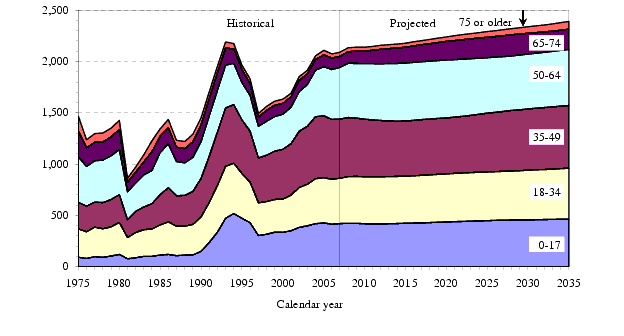
Table IV.B1 presents historical and projected numbers of persons applying for SSI benefits, by calendar year of application. Figure
IV.B1 presents the same information in graphical form. Recent historical data indicate that applications have grown fairly rapidly beginning in calendar year 2002, and that this growth continued through calendar year 2005. The rate of growth in applications, however, slowed significantly in 2005 and 2006, and for the 2007 Annual Report we projected a slight decline in the numbers of applications for calendar year 2007. The actual result for 2007 represented an increase relative to the number that was estimated last year, with the numbers of applications for 2007 coming in 1.9 percent higher than was estimated in the 2007 Annual Report.
Note: Totals do not necessarily equal the sums of rounded components. Historical split among age groups is estimated on a calendar year of age basis.
The fairly rapid growth in applications from 2002 to 2004 was largely attributable to two main factors: (1) the downturn in the economy that began early in 2001 and (2) the signature proxy process
3 introduced by SSA in June 2004. In the short term, our projections are for the numbers of applications to increase by 2 percent in 2008 and then stay roughly level, with the overall level of applications reflecting a permanent upward shift due to the signature proxy process. In the longer term, applications are estimated to grow roughly in line with overall population growth.
The adjudication of these applications involves an evaluation of levels of income and resources available to the applicants, as well as other eligibility factors including marital and citizenship status and living arrangements. In addition, over 90 percent of the applications are for disability benefits which generally require an evaluation of an alleged impairment by the appropriate State Disability Determination Services. An unfavorable disability determination may then be appealed by the applicant through several administrative levels of appeal. If all administrative levels of appeal are exhausted, the applicant may in turn carry his/her appeal to the Federal courts. Data on recent historical experience for this disability decision process are presented in section
V.C.
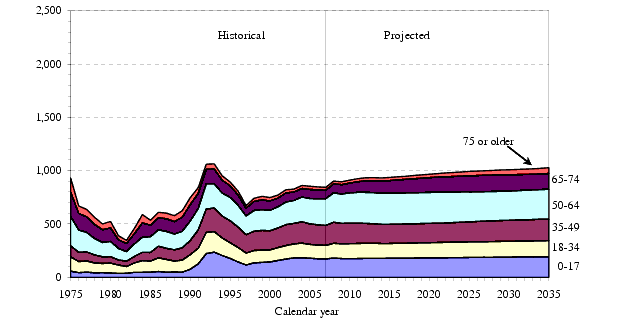
Table IV.B2 and figure
IV.B2 present historical and projected numbers of persons who start receiving SSI payments as a result of this decision process. Individuals are counted as of the first month that they move into SSI payment status. For this reason, we refer to these individuals as “
new recipients” rather than “
awards.”
4 During the 2002 to 2004 period, growth in new recipients did not keep pace with the growth in applications. From 2005 to 2007, the numbers of new
recipients declined even though the level of applications during this period was higher than in the preceding years. There are two important contributing factors to the slower growth for new recipients as compared to applications: (1) since 2001 there has been
Note: Totals do not necessarily equal the sums of rounded components. Historical split among age groups is estimated on a calendar year of age basis.
substantial growth in the number of claims pending adjudication which is consistent with a longer lag time between application and the allowance decision; and (2) since the introduction of the signature proxy process there has been a significant increase in the number of denials for applications where the applicant does not meet the nonmedical criteria, causing a permanent downward shift in the allowance rate. However, the number of new recipients is projected to increase in the next 5 years due primarily to the assumption that there will be some reduction in the level of pending claims. After 2012, new recipients are projected to remain about level for a few years. Over the longer term the numbers of new recipients are estimated to increase gradually in line with the projected growth in applications.
Some of the persons receiving SSI benefits in a year will be removed from current-payment status during the year because of death or the loss of SSI eligibility. The loss of eligibility can occur either as the result of a redetermination of the individual’s nonmedical factors of eligibility, including income and resources, or due to a determination that he/she is no longer disabled as defined under the Social Security Act, as a result of a continuing disability review.
5 For example, disabled children, upon attainment of age 18, lose eligibility if they do not qualify for benefits under the disabled adult eligibility criteria. For purposes of this presentation, we refer to the net reduction in the number of SSI recipients in payment status during a period as the number of SSI terminations for that period.
In the following tables, we have separated the numbers of people moving out of payment status into those leaving due to death (table
IV.B3), and those leaving for all other reasons (table
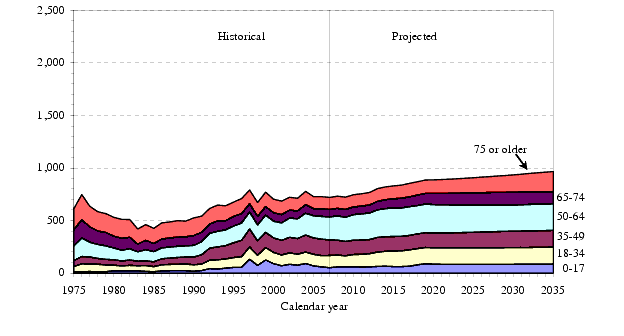
IV.B4). Table
IV.B5 and figure
IV.B3 present historical and projected numbers of total terminations by calendar year.
Note: Totals do not necessarily equal the sums of rounded components. Historical split among age groups is estimated on a calendar year of age basis.
Note: Totals do not necessarily equal the sums of rounded components. Historical split among age groups is estimated on a calendar year of age basis.
Note: Totals do not necessarily equal the sums of rounded components. Historical split among age groups is estimated on a calendar year of age basis.
Actual numbers of terminations declined in 2007 compared to 2006. This decline resulted from declines in the terminations for reasons other than death, which were offset in part by small increases in the terminations due to death. The decline in the terminations for reasons other than death were essentially due to reductions in the numbers of continuing disability reviews (CDRs) and nonmedical redeterminations processed due to constraints on Agency administrative resources. Some continued restraint on terminations over the next 10 years is expected due to continued resource limitations. Thereafter a gradual return to normal processing schedules for these reviews is assumed as resources are made available to SSA to carry out these legislatively mandated workloads.
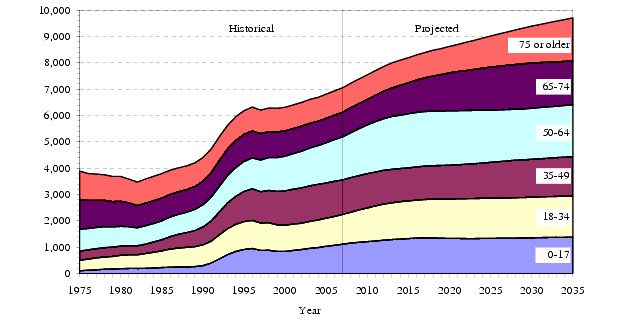
Combining the number of persons coming on the SSI payment rolls during a year with the number of those already receiving benefits at the beginning of the year, and subtracting the number leaving the rolls during the year, yields the number of persons receiving Federally-administered SSI payments at the end of the specified period. Individuals receiving Federal SSI payments, who comprise the great majority of Federally-administered recipients, are presented in table
IV.B6 and in figure
IV.B4. The net effect of actual experience in 2007 was that the number of Federal SSI recipients at the end of 2007 was about 1.8 percent higher than the corresponding number at the end of 2006, but close to 1 percent lower than projected in last year’s report.
Note: Totals do not necessarily equal the sums of rounded components. Historical split among age groups is estimated on a calendar year of age basis.
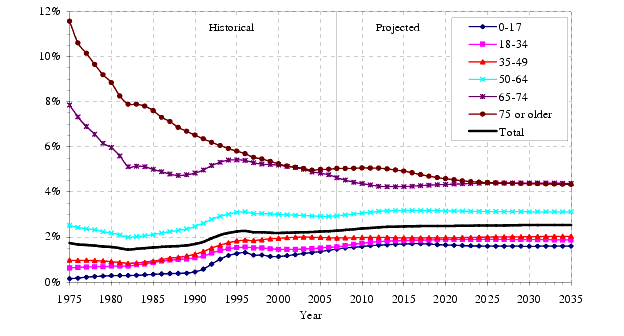
As illustrated in figure IV.B4, the implementation of Public Law 104-121 and Public Law 104-193 resulted in a decline in the Federal recipient population from 1996 to 1997. From the end of 1997 through the end of 2000, the Federal SSI recipient population grew at an annual rate of less than 1 percent. Since 2000, the growth rate for the Federal SSI recipient population has averaged 1.6 percent per year. Our projections indicate that by 2018 we expect to gradually return to a modest growth rate of about 1 percent per year over the remainder of the 25-year projection period. In order to place this projected growth in the context of overall population growth, table
IV.B7 and figure
IV.B5 present Federal SSI recipients as percentages of selected Social Security Area population totals.
For the totals shown in table IV.B7, the percentages are calculated using the population age group totals corresponding to the age groups in the Federal recipient categories. Because the ratios for the separate recipient categories are computed as percentages of differing base populations, the percentage for the total SSI recipient population is not the arithmetic sum of the percentages for the respective recipient categories. As indicated in the table, the percentage of the total Social Security Area population who were receiving Federal SSI payments declined from 1975 through the early 1980s. In 1983, this percentage started increasing and continued to increase through 1996. Due to factors described previously, the percentage of the total population receiving Federal SSI payments declined in 1997, but leveled out over the next few years. It has increased slightly over the past few years and is expected to increase gradually over the projection period, due largely to the changing age distribution of the underlying population.
The various subcategories of Federal SSI recipients, however, follow significantly different growth patterns in relationship to their respective population totals. The aged Federal SSI recipient population declines steadily as a percentage of the 65 or older population throughout the historical period and most of the projection period, with the decline leveling off near the end of the projection period. In contrast, except for decreases in the late 1990s due to the eligibility redeterminations and continuing disability reviews mandated by Public Law 104-193, the number of blind or disabled children receiving Federal SSI payments increased steadily as a percentage of the under age 18 population, with the increase being quite steep in the early 1990s. The total blind or disabled Federal SSI recipient population as a percentage of the total population remained fairly level until the early 1980s when it started increasing and continued to increase through 1996. After the modest decrease in the late 1990s due to the implementation of legislation described in other sections, the number of blind or disabled persons receiving Federal SSI payments began a gradual increase as a percentage of the total population that is estimated to continue through 2015, reaching more than 2.1 percent of the total population. In the later years of the projection period, the percentage is expected to gradually decline under the assumption that SSA will receive the resources necessary to carry out the normal CDR and nonmedical redetermination workloads.
Note: Totals do not necessarily equal the sums of rounded components. Historical split among age groups is estimated on a calendar year of age basis.
In examining the recent history of SSI participation and the projections of such participation in the near future, certain patterns are worth noting. The rapid increase in the total number of SSI participants in the early 1990s is a function of the growth in the numbers of disabled adults and children. The growth in the numbers of children receiving SSI resulted in large part from the Supreme Court decision in the case of
Sullivan v. Zebley, which greatly expanded the criteria used for determining disability for children. The growth in the numbers of disabled adults is a more complicated phenomenon which is not completely understood. However, extensive research conducted under contract to SSA and the Department of Health and Human Services suggested that this growth was the result of a combination of factors including (1) demographic trends, (2) a downturn in the economy in the late 1980s and early 1990s, (3) long-term structural changes in the economy, and (4) changes in other support programs (in particular the reduction or elimination of general assistance programs in certain States). The recent modest changes in program participation reflects the combined effects of recent legislation described in previous sections, along with changes in some of the factors mentioned above.
Note: Totals do not necessarily equal the sums of rounded components. Historical split among age groups is estimated on a calendar year of age basis.