IV. ACTUARIAL ESTIMATES
This chapter presents actuarial estimates of the future financial condition of the Social Security program. These estimates include projected income and cost of the OASI and DI Trust Funds, in dollars over the next 10 years and as a percentage of taxable payroll or in present-value dollars over the full 75‑year period, along with a discussion of a variety of measures of the adequacy of current program financing. In this report we carefully distinguish between (1) the cost (or obligations) of the program, which includes, for the future, all benefits scheduled under current law, and (2) expenditures (disbursements or outgo), which include actual payments for the past and only the portion of the cost of the program that is projected to be payable with the financing provisions in current law.
As described in the Overview section of this report, these estimates depend upon a broad set of
demographic, economic, and programmatic factors. Since assumptions related to these factors are subject to uncertainty, the estimates presented in this section are prepared under three sets of assumptions, to show a range of possible outcomes. The intermediate set of assumptions, designated as
alternative II, reflects the Trustees’ best estimate of future experience; the low-cost
alternative I is more optimistic and the high-cost
alternative III more pessimistic for the trust funds’ future financial outlook. The intermediate estimates are shown first in the tables in this report, followed by the low-cost and high-cost estimates. These sets of assumptions, along with actuarial methods used to produce the estimates, are described in chapter V. In this chapter, the estimates and
measures of trust fund financial adequacy for the short range (2009-18) are presented first, followed by estimates and
measures of actuarial status for the long range (2009‑83) and for the infinite future. As an additional illustration of uncertainty, estimated probability distributions of certain measures are presented in Appendix E.
Financial adequacy, or solvency, of the trust funds reflects the ability to pay scheduled benefits in full on a timely basis and is generally assessed using the “
trust fund ratio,” which is defined as the
assets at the beginning of a year expressed as a percentage of the projected cost for the year. Thus, the trust fund ratio represents the proportion of a year’s cost that can be paid with the funds available at the beginning of the year. A trust fund ratio of 100 percent of annual program cost is generally assumed to provide a reasonable “contingency reserve.” During periods when trust fund income exceeds disbursements, the excess is held in the trust funds. To the extent that trust fund assets exceed 100 percent of annual cost, the excess is dedicated to advance fund a portion of the Social Security program’s future financial obligations. During periods when trust fund disbursements exceed income, as might happen during an economic
recession, trust fund assets are used to meet the shortfall. In the event of recurring shortfalls for an extended period, the trust funds can allow time for the development, enactment, and implementation of legislation to restore financial stability to the program.
The short-range test of financial adequacy is applicable to the OASI and DI Trust Funds individually and on a combined basis. The requirements of this test are as follows: If the estimated trust fund ratio is at least 100 percent at the beginning of the projection period, then it must be projected to remain at or above 100 percent throughout the 10-year projection period. Alternatively, if the ratio is initially less than 100 percent, then it must be projected to reach a level of at least 100 percent within 5 years (and not be depleted at any time during this period) and to remain at or above 100 percent throughout the remainder of the 10-year period. In addition, the fund’s estimated assets at the beginning of each month of the 10-year period must be sufficient to cover that month’s disbursements. This test is applied on the basis of the intermediate estimates. Failure to meet this test by either trust fund is an indication that solvency of the program over the next 10 years is in question and that legislative action is needed to improve the short-range financial adequacy of the program.
This subsection presents estimates of the operations and financial status of the OASI Trust Fund for the period 2009-18, based on the assumptions described in chapter
V. No changes are assumed to occur in the present statutory provisions and regulations under which the OASDI program operates.
1
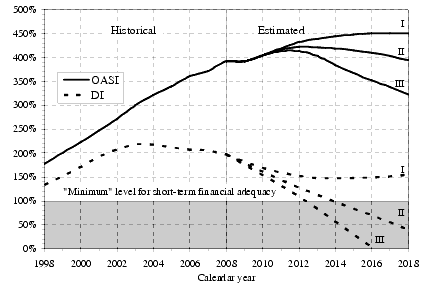
These estimates are shown in table IV.A1 and indicate that the assets of the OASI Trust Fund would continue to increase rapidly throughout the next 10 years under all three sets of assumptions. Also, based on the intermediate assumptions, the assets of the OASI Trust Fund would continue to exceed 100 percent of annual expenditures by a large amount through the end of 2018. Consequently, the OASI Trust Fund satisfies the test of short-range financial adequacy by a wide margin. The estimates in table
IV.A1 also indicate that the short-range test would be satisfied even under the high-cost assumptions (see figure
IV.A1 for graphical illustration of these results).
The increases in estimated income shown in table IV.A1 under each set of assumptions reflect increases in estimated OASDI
taxable earnings and growth in
interest earnings on the invested assets of the trust fund. For each alternative, employment is assumed to decrease in 2009 and, for alternative III only, in 2010. Thereafter, employment is assumed to increase in every year through 2018 for each alternative. The number of persons with taxable earnings would increase on the basis of alternatives I, II, and III from 162 million during calendar year 2008 to about 177 million, 174 million, and 171 million, respectively, in 2018. The total annual amount of taxable earnings is projected to increase in every year through 2018 for each alternative. Total earnings increase from $5,511 billion in 2008 to $8,319 billion, $8,329 billion, and $8,710 billion, in 2018, on the basis of alternatives I, II, and III, respectively.
2 These increases in taxable earnings are due primarily to (1) projected increases in employment levels as the working age
population increases, (2) increases in average earnings in
covered employment (reflecting both real growth and price inflation), and (3) increases in the
contribution and benefit base during the period 2009-18 under the automatic-adjustment provisions.
Growth in interest earnings represents a significant component of the overall increase in trust fund income during this period. Although
interest rates payable on trust fund investments are assumed to temporarily decline from current levels, the continuing rapid increase in OASI assets will result in a corresponding net increase in interest income. By 2018, interest income to the OASI Trust Fund is projected to be about 18 percent of total trust fund income on the basis of the intermediate assumptions, as compared to 15 percent in 2008.
Rising expenditures during 2009-18 reflect automatic benefit increases as well as the upward trend in the number of beneficiaries and in the average monthly earnings underlying benefits payable by the program. The growth in the number of beneficiaries in the past and the expected growth in the future result both from the increase in the aged population and from the increase in the proportion of the population that is eligible for benefits.
The estimates under all three sets of assumptions shown in table IV.A1 indicate that income to the OASI Trust Fund would substantially exceed expenditures in every year of the short-range projection period, and assets are therefore estimated to increase substantially.
The portion of the OASI Trust Fund that is not needed to meet day-to-day expenditures is used to purchase financial securities, generally
special public-debt obligations of the U.S. Government. The cash used to make these purchases flows to the General Fund of the Treasury and is used to meet various Federal outlays or to reduce the amount of publicly-held Federal debt. Interest on these securities is credited to the trust fund and, when the securities mature, they are reinvested in new securities if not immediately needed to pay program costs. When securities are redeemed prior to maturity in order to pay program costs, general fund revenues flow to the trust fund. Thus, the investment operations of the trust fund result in various credits and cash flows between the trust fund and the General Fund of the Treasury.
The estimated operations and financial status of the DI Trust Fund during calendar years 2009-18 under the three sets of assumptions are shown in table
IV.A2, together with values for actual experience during 2004-08. Income is generally projected to increase steadily under each alternative, reflecting most of the same factors described previously in connection with the OASI Trust Fund. DI Trust Fund assets are projected to begin to decrease in 2009 under each alternative. Under the low-cost assumptions, assets would begin to increase again after reaching a low point in 2012. Under the
intermediate assumptions, assets would continue to decline through 2018. Under the high-cost assumptions, DI assets would decline steadily until exhaustion in 2016.
Cost is estimated to increase in part due to increases in average benefit levels resulting from (1) automatic benefit increases and (2) projected increases in the amounts of average monthly earnings on which benefits are based. In addition, under all three sets of assumptions, the number of DI beneficiaries in
current-payment status is projected to continue increasing throughout the short-range projection period. Over the period 2008-18, the projected annual average growth rate in the number of DI worker beneficiaries is roughly 0.9, 2.3, and 3.5 percent under alternatives I, II, and III, respectively. Growth is largely attributable to the gradual progression of the baby-boom generation through ages 50 to
normal retirement age, at which ages higher rates of disability incidence are experienced. The estimates under all three sets of assumptions anticipate additional growth in the numbers of DI worker beneficiaries due to a projected sharp, but temporary, increase in incidence rates to levels comparable to some of the highest ever experienced under the DI program. These increases are projected to result from the current economic recession. The projected higher levels of disability incidence are expected to subside as the economy recovers, and to return to levels comparable to those projected in last year’s report.
3
The proportion of DI beneficiaries whose benefits terminate in a given year has also fluctuated in the past. Over the last 20 years, the rates of benefit termination due to death or conversion to retirement benefits (at attainment of normal retirement age) have declined very gradually. This trend is attributable, in part, to the lower average age of new beneficiaries. Declines in mortality for the general population have also led to improved mortality experience among the DI disabled-worker beneficiaries. In addition, conversions to old-age benefits were at a temporarily reduced level for years 2003 through 2008 due to the gradual increase in the normal retirement age. The termination rate due to recovery has been much more volatile. Currently, the proportion of disabled beneficiaries whose benefits cease because of their recovery from disability is very low in comparison to levels experienced throughout the 1970s and early 1980s. Projected rates of recovery terminations in this year’s report are temporarily elevated in years 2011-14 due to increased funding for the purpose of reducing the backlog of continuing disability reviews (CDRs) conducted by SSA. Following this temporary increase in CDRs, recovery termination rates are projected to return to levels consistent with (1) projected levels of work terminations and (2) the assumption that terminations for medical improvement will be consistent with continued timely completion of CDRs after 2014. The overall proportion of disabled workers leaving the DI rolls (reflecting all causes) is projected to return to higher levels in 2009 when the gradual increase in the normal retirement age temporarily ceases.
At the beginning of calendar year 2008, the assets of the DI Trust Fund represented 197 percent of annual expenditures. During 2008, DI expenditures continued to exceed noninterest income. Although total DI income exceeded DI expenditures by $0.9 billion, the trust fund ratio for the beginning of 2009 still decreased, to about 179 percent. Under the intermediate set of assumptions, expenditures are estimated to exceed total income from 2009 through 2018. The projected expenditures in excess of income result in a decline in the projected trust fund ratio to 40 percent by the beginning of 2018.
Under the low-cost assumptions, the trust fund ratio would decrease to a low of 147 percent at the beginning of 2014, before increasing to 155 percent at the beginning of 2018. Under the high-cost assumptions, the assets of the DI Trust Fund would decline steadily, dipping below the level of 1 year’s expenditures during 2012, and becoming completely depleted in 2016.
Assets of the DI Trust Fund were greater than 1 year’s expenditures at the beginning of 2009. By the beginning of 2014, however, the trust fund ratio is projected to decline to 98 percent. Accordingly, the DI Trust Fund does not satisfy the Trustees’ short-range test of financial adequacy under both the intermediate and high-cost assumptions. However, under the low-cost assumptions the DI Trust Fund does meet the short-range test of financial adequacy, because assets remain above 1 year’s expenditures through the end of the short-range period, as described above (see also figure
IV.A1).
The estimated operations and status of the OASI and DI Trust Funds, combined, during calendar years 2009-18 on the basis of the three alternatives, are shown in table
IV.A3, together with figures on actual experience in 2004‑08. Because income and cost for the OASI Trust Fund represent over 80 percent of the corresponding amounts for the combined OASI and DI Trust Funds, the operations of the OASI Trust Fund tend to dominate the combined operations of the two funds. Consequently, based on the strength of the OASI Trust Fund over the next 10 years, the combined OASI and DI Trust Funds meet the requirements of the short-range test of financial adequacy under all three alternative sets of assumptions.
While combining the operations of the OASI and DI Trust Funds permits an assessment of the short-range test for the two programs on a combined basis, in practice assets from one trust fund cannot be shared with another trust fund without legislative changes to the Social Security Act. For example, under the high-cost scenario, table
IV.A2 shows that the DI Trust Fund becomes exhausted in 2016. The value of the combined OASI and DI Trust Funds in that year shown in table
IV.A3 shows that OASI assets could be made available to pay DI benefits through 2018, but only with legislation to permit this action.
The factors underlying the changes in the intermediate estimates for the OASI, DI and the combined funds from last year’s annual report to this report are analyzed in table
IV.A4. In the 2008 Annual Report, the trust fund ratio for OASI was estimated to reach 438 percent at the beginning of 2017—the tenth projection year from that report. If there had been no changes to the projections, the estimated ratio at the beginning of 2018 would be 7 percentage points lower than at the beginning of 2017, or 431 percent. There were changes, however, to reflect the latest actual data, as well as adjustments to the assumptions for future years and the projection methods. The resulting ratio shown in this report for the tenth projection year (2018) is 394 percent. The net effect of changes in demographic assumptions over the short-range period resulted in a reduction in the tenth-year trust fund ratio of 2 percentage points. The cumulative net effects of changes in economic data and assumptions resulted in a reduction in the trust fund ratio of 26 percentage points by the beginning of 2018. The change due to economic assumptions reflects the effects of the economic recession that started in December 2007 on revenue and benefit levels. There were several relatively minor changes in the short-range projection methodology since the 2008 report. The changes included improvements in the methods for estimating the numbers of beneficiaries and average benefit amounts at the end of each quarter, given numbers and average amounts at the end of each calendar year. The combined effect of the various methodological improvements was to increase the ending trust fund ratio by about 2 percentage points. Finally, a decrease in the 2018 trust fund ratio of 12 percentage points resulted from the combined effects of incorporating recent programmatic data including the further correction of the trust fund allocation error described in section
III.A.
Corresponding estimates of the factors underlying the changes in the financial projections for the DI Trust Fund, and for the OASI and DI Trust Funds combined, are also shown in table
IV.A4. The largest effects on the DI trust fund ratio at the beginning of 2018 are due to the revised economic assumptions and updates for programmatic data and assumptions. In particular, temporary increases in disability incidence rates related to the current recession make up about 20 percentage points of the 31 percentage point reduction attributable to programmatic assumptions. The change in the valuation period accounts for the remainder of the total change in the DI trust fund ratio.